Reading Becket via Kit Fine (12)
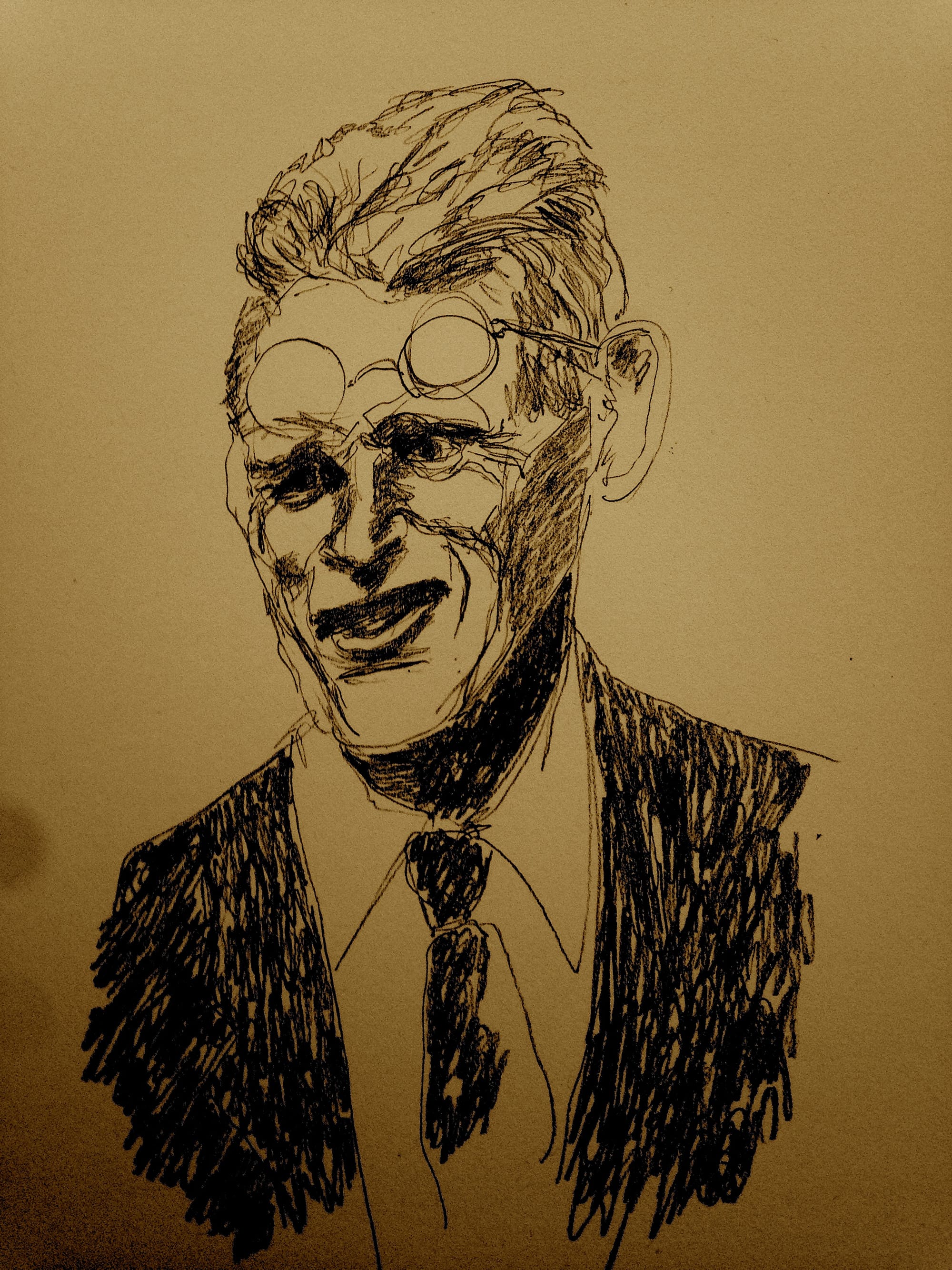
Not I
Consider Not I. The most striking feature is the radical separation of voice from embodied personhood. The mouth speaks at extraordinary speed, while the rest of the body is immobilised or absent. This is a formal move that makes visible what had already been operative in the prose. The voice is a part that refuses to integrate into a whole. It speaks, but it does not cohere into a subject. There is no stable “I” that could serve as the ground of the utterance. What the audience experiences as disorientation is the effect of a broken grounding relation.
Ordinarily, speech is taken to be grounded in a speaker, and the speaker is taken to be a unified subject. Here, that hierarchy collapses. The voice continues without securing its own source. Attempts within the speech to narrate a life, to locate an origin, to attribute experiences to a self, are repeatedly cut short or corrected. The voice itself enforces the constraint. It refuses to allow any narrative configuration to settle.
This is the dramatic equivalent of the looping structure seen in Ill Seen Ill Said. Each attempt at self-description opens a possible configuration, and each is immediately withdrawn as inadmissible. The loop does not return to the same place. It returns to a narrowed space of possibility. With each cycle, fewer claims remain viable. The work progresses not by accumulation but by elimination.
In That Time, the same logic is redistributed across time rather than space. Three recorded voices recount fragments of a life, but none is privileged as definitive. They speak in sequence, not in dialogue, and the body to which they are attached remains largely inert. The audience is invited to recognise the voices as belonging to a single figure, yet the work systematically refuses to allow this recognition to harden into identity. Each voice presents a different temporal perspective, a different attempt at anchoring experience. None succeeds. The past does not ground the present. Memory does not secure continuity. The body, visible but largely passive, does not function as a unifying centre.
What might have been a psychological portrait becomes instead a demonstration of non-compossibility. The goods of memory, continuity, and narrative selfhood cannot be realised together under the constraints the work imposes. What is crucial here is that the voices do not contradict one another in any straightforward way. They are not competing accounts of the same events. Rather, they fail to integrate. Each voice is internally coherent, yet no combination of them yields a whole that could serve as the ground of the self. This is mereology without synthesis. The parts exist, but the whole they seem to promise never arrives.
The theatrical form makes this impossibility palpable. In prose, the reader can sometimes imagine that a fuller account might be forthcoming, that the next sentence might resolve the tension. On stage, the constraints are embodied. Time passes. Voices repeat. Nothing resolves. The structure insists on itself. Across these works, the same theological discipline is at work. The refusal of grounding is not nihilistic. It is principled. A world is being defined in which no utterance can claim final authority, no memory can secure identity, and no body can function as a stable centre of meaning. These refusals are not accidental absences. They are constitutive exclusions.
To introduce psychological fullness or narrative closure would not enrich the work; it would negate it. This is why Beckett’s drama often feels more severe than his prose, even when the material is similar. The stage eliminates certain interpretive escape routes. The reader of prose can linger, reread, or imaginatively supply missing connections. The audience in the theatre is forced to inhabit the loop in real time. The constraint becomes experiential rather than merely conceptual.
Once again, affect follows structure. Unease arises because the audience is asked to remain within a system that denies the usual grounds of reassurance. But this unease is not the point. It is the cost of fidelity to the constraint. The work does not aim to make the audience uncomfortable. It aims to remain consistent with the world it has fixed. Seen in this wider frame, Beckett’s late prose and drama form a continuous project. The difference between page and stage is not a difference of intention but of material realisation. In both cases, the work explores what it is to speak without grounding, to persist without synthesis, to remain within a loop that cannot terminate without falsification.
Previously: Psychiatry, Theology, Chess, Murphy (8), Murphy (6), Murphy (5), Murphy (4) Murphy (3), Murphy (2), Murphy(1), Introduction, Criticism Psychiatry