Reading Beckett via Kit Fine (4)
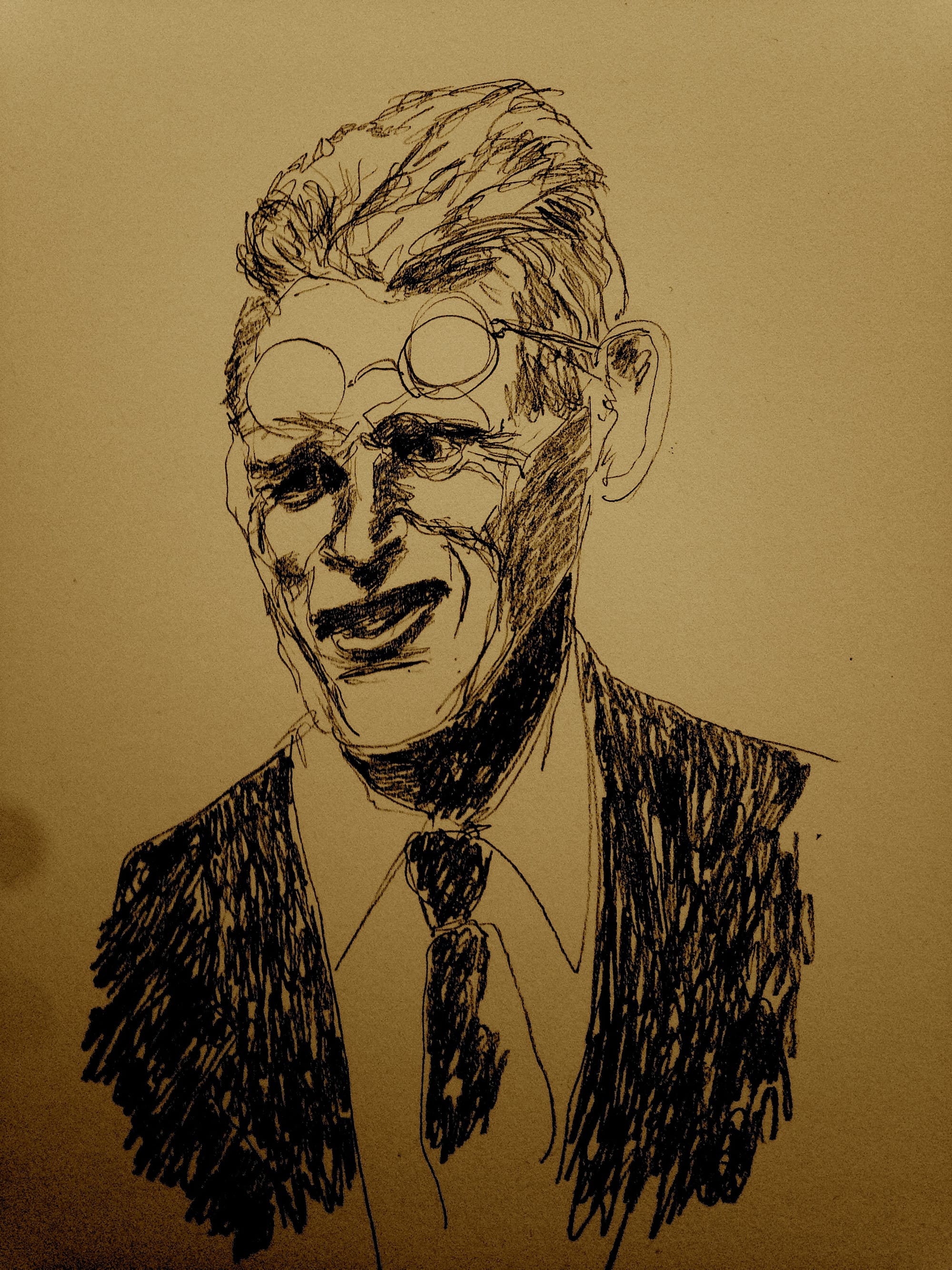
Murphy 2
We now move to the first point in Murphy where Murphy is no longer allowed to remain primarily stationary. He moves through public space, interacts with institutions, and attempts to insert himself into ordinary causal sequences. Beckett uses this to demonstrate something precise and devastating: once essence is unsettled, counterfactual reasoning no longer works, and without counterfactuals, action itself disintegrates.
Counterfactuals are not psychological expectations or narrative conveniences. They are structural commitments of a world. To act is to rely on claims of the form: if I do this, then that will follow. These claims presuppose stable grounding relations. Beckett shows what happens when those relations fail. Murphy’s first attempt at action concerns work and money, domains that rely almost entirely on counterfactual structure. Work only makes sense if effort grounds payment, if payment grounds subsistence, if subsistence grounds continued participation in the world. Beckett makes
Murphy’s entry into this domain deliberately awkward. Murphy does not reject work on principle. He approaches it as though it were simply another activity that might be slotted into his world. Beckett writes: “Murphy was indifferent to money, but he was not indifferent to the lack of it.” Indifference to money would normally ground indifference to earning. But Murphy is not indifferent to lack. The usual counterfactual bridge has collapsed. If I am indifferent to money, then I am indifferent to its absence does not hold. Properties fail to transmit their implications. This is counterfactual failure.
In ordinary worlds, counterfactuals track similarity and law like regularity. In Murphy’s world, similarity breaks down. Being indifferent to money does not make one similar to someone indifferent to poverty. The relevant background conditions refuse to align. Murphy’s attempts to explain himself only deepen this breakdown. When he speaks about his situation, his explanations fail to ground understanding. Beckett notes: “His explanations explained nothing, but they left no room for explanation.” Murphy’s explanations are internally coherent. They do not contradict themselves. But they do not ground anything beyond themselves. They terminate explanation rather than advancing it. This is exactly the structure of a p to p reasoning loop extended into discourse. Explanation returns to itself without producing entitlement to further inference. Murphy’s reasons are weakly valid but non-progressive. They license no new conclusions. They do not entitle anyone, including Murphy, to act differently afterwards.
This is why conversation feels so flat and so disturbing. Speech closes possibilities. Beckett also introduces a crucial shift in how time functions. Events occur sequentially. Murphy moves from one place to another. Yet time does not accumulate narrative force. Beckett writes with deliberate dryness about Murphy’s movements, listing them without allowing them to compound into development. The effect is not monotony but structural paralysis. Time passes, but nothing becomes more possible. Counterfactuals ground temporal direction. In a progressive world, the past constrains the future in a way that allows planning. In Murphy’s world, past events do not ground future expectations. Murphy’s previous failures do not make future success less likely, because likelihood itself has lost traction. The world does not update.
Beckett makes this explicit through Murphy’s relation to intention. Murphy forms intentions, but they do not bind him. What he intended to do and what he did were independent variables. This is a metaphysical claim. In a normal world, intention grounds action, even when it fails. Failure still presupposes the link. Here the link itself is gone. Intention and action coexist without grounding relation. The modal connection between intention and execution has been severed. The result is that Murphy cannot genuinely try. Trying is itself a counterfactual laden act. To try is to accept that if I exert myself, then there is some chance of success. Murphy’s world does not support this.
Beckett’s prose makes this unbearable by refusing drama. Murphy does not struggle heroically. He drifts, not because he is lazy, but because drift is all that remains once counterfactuals collapse. Beckett begins to show that failure itself has become non-informative. In an ordinary world, failure teaches. It updates one’s understanding of what is possible. In Murphy’s world, failure teaches nothing because it does not ground revision. Beckett writes: “He was no worse off than before.” This phrase recurs in spirit throughout the novel, but here it acquires technical force. No matter what Murphy does, he is not worse off, because being worse off would require a metric grounded in consequence.
Without counterfactual structure, there is no “off” to be worse or better relative to. Counterfactuals are not optional embellishments of rational life. They are what allow the world to respond to action. Beckett shows us a world that still permits movement, speech, intention, and explanation, but has withdrawn the normative authority of consequence. Actions occur, but nothing is thereby at stake. This is also where the comedy of the novel sharpens. Beckett’s humour is not absurdist nonsense. It is the absurdist humour of watching someone attempt to act in a world that refuses to acknowledge the grammar of action. Murphy’s failures are funny because they are structurally inevitable. The world is set up so that nothing he does can count as a successful or unsuccessful attempt in the usual sense.
Chapters close without resolution. Resolution would require a counterfactual pivot, a moment where if this happens, then something changes. Beckett denies us this because the world Murphy inhabits cannot supply it. Chapter Three therefore completes a transition. We have moved from stasis, to indeterminate essence, to systematic counterfactual collapse. From here on, the novel will no longer even pretend that action can function normally. Institutions, games, and eventually death itself will be introduced as attempts to re impose structure on a world that no longer supports it.
Next: Murphy (3)
Previously: Murphy(1), Introduction, Criticism