Reading Beckett via Kit Fine (11)
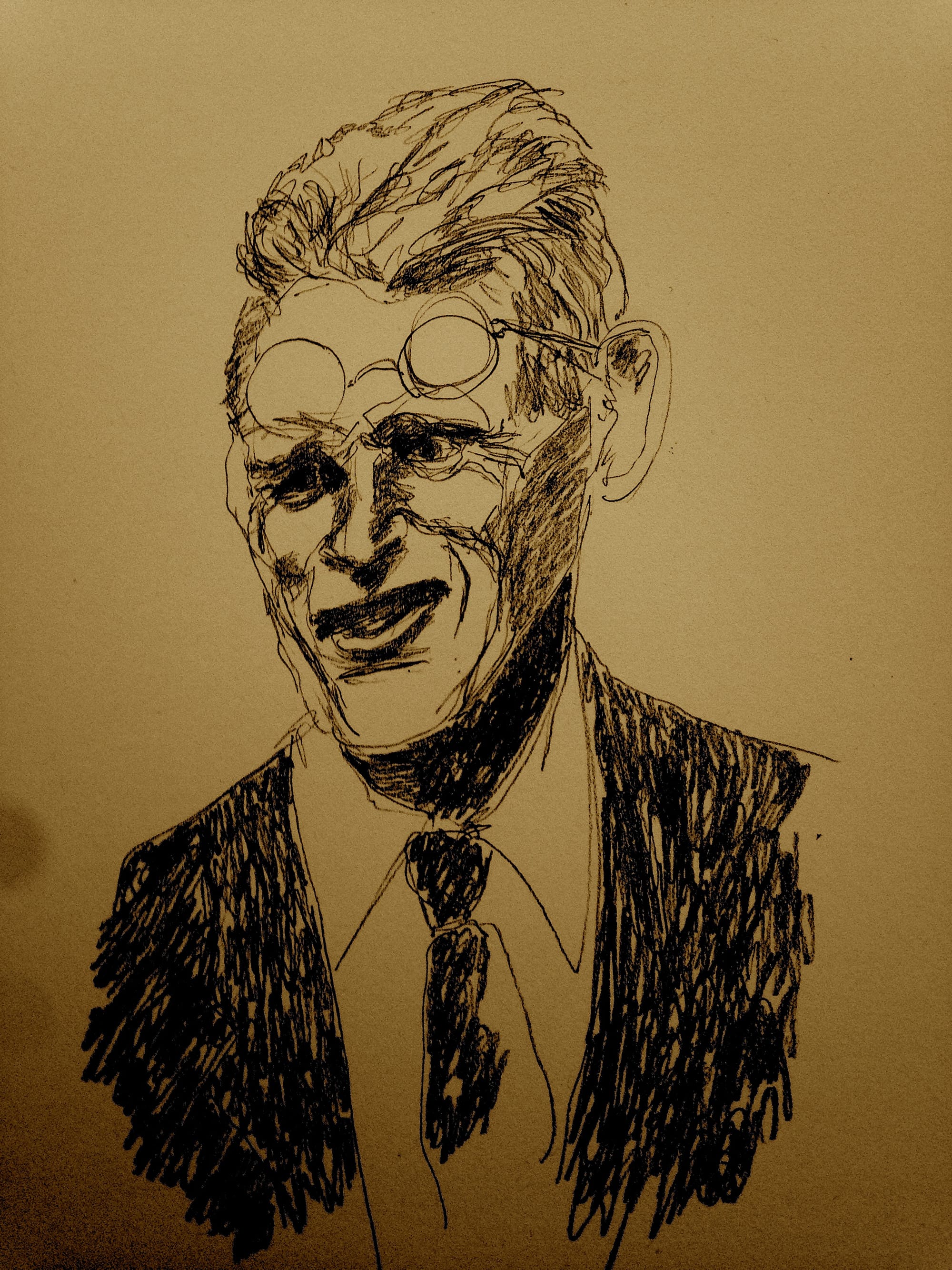
Psychiatry
Beckett’s encounter with psychotherapy exposed him to a structural impasse that his writing would never abandon. The therapy revealed a limit built into the relation between speech, self-knowledge, and experience. This is the limit his work keeps returning to as an organising constraint.
The important point is not that Beckett was analysed, but that analysis itself became, for him, an exemplary site where the promise of articulation encountered its own boundary. What matters structurally is not the biographical detail but the shape of the situation. Psychoanalysis proceeds on the assumption that speech can progressively integrate what is otherwise dispersed or unconscious, that the speaking subject can be made increasingly coincident with what is said. Beckett’s experience unsettles this assumption. Speech does not integrate; it proliferates. Instead of producing coherence, it multiplies corrections, revisions, and hesitations. Instead of grounding the self, it exposes the instability of grounding itself.
This is why Beckett’s later formulation of language as a veil is so exact. A veil is not a wall. It allows something to show through, but only partially, refracted, distorted, never fully present. Crucially, a veil cannot simply be removed without changing the situation altogether. To tear it away would not reveal a hidden truth but would destroy the very conditions under which anything appears at all. Beckett’s insistence that the task is not to lift the veil but to bore holes in it captures the logic of his art. Each hole allows something through, but the veil remains, and indeed becomes more evident the more it is punctured. This already gives us the basic structure. Individual sentences, images, or voices function as partial perforations. They allow glimpses, not disclosures. What is glimpsed is not a hidden content but the fact that disclosure itself is constrained. The work’s identity is grounded in this constraint.
It is not a matter of psychological repression or trauma in the ordinary sense, but of a constitutive limitation on what can be said without falsifying the situation. The unconscious here is a structural condition that explains why retrieval cannot complete itself. This becomes especially clear once Beckett engages with ideas of birth trauma and intrauterine regression. These are often treated symbolically, as if the womb were a metaphor for enclosure, safety, or loss. But my reading treats these images as formal devices that impose strict constraints on what counts as an admissible world.
A womb is a closed system with sharply defined boundaries. Inside it, there is no perspective from which the whole can be surveyed. There is no distance, no overview, no stable orientation. Any account from within such a system must be partial, repetitive, and subject to constant revision. This is exactly the structure of Beckett’s later prose and drama. The voices speak from within a system that does not permit exit, overview, or synthesis. They do not fail to achieve these things by accident. The system itself excludes them. This exclusion is essential, not optional. To introduce a stable narrative arc, a secure psychological interior, or a reliable observer would be to change the identity of the work. It would no longer be the same world.
Certain goods that are often assumed to belong together in literature simply cannot coexist here. Psychological depth and radical epistemic scruple cannot both be realised within the same structure. Narrative coherence and fidelity to the limits of saying pull in different directions. Beckett fixes a constraint and then explores what follows from it with relentless consistency.
This is why readers so often report mixed feelings. They admire the precision, the honesty, the severity, while feeling discomfort, frustration, or even hostility toward the experience of reading. But this mixture is a by-product of moving between levels without keeping them distinct. At the level of parts, one may legitimately register deprivation. At the level of the whole, one must recognise necessity. The feeling of ambivalence arises when these two assessments are collapsed into one. The work succeeds because it refuses certain satisfactions. Those satisfactions are excluded by the structure that defines the work’s identity. The exclusion is not something to be repaired by interpretation. It is what interpretation must learn to respect.
Beckett’s texts do not progress by accumulation. They progress by revision. A scene is proposed, withdrawn, modified, and reintroduced under altered conditions. Each return is not a repetition of the same but a re-entry into a space whose rules have shifted slightly. In this respect the famous critical response to Waiting For Godot that in the play nothing happens - twice - is not quite right.
The reader experiences this as being trapped in a loop, but the loop is not static. Each cycle tightens the constraints on what can responsibly be said next. This looping is a different mode of organisation to explanation as completion. Explanation does not move upward toward a unifying principle. It circulates between part and whole. The parts make the whole legible. The whole explains why the parts must be as they are. There is no terminating point where explanation can stop without falsifying the work. The refusal of closure is not thematic despair; it is structural integrity.
Seen in this light, Beckett’s engagement with psychoanalysis takes on a new shape. Analysis aims, at least in its classical form, at integration and containment. Beckett’s work repeatedly stages the impossibility of both. Containment becomes claustrophobic rather than therapeutic. Integration becomes distortion rather than healing. This does not mean Beckett rejects psychoanalysis as such. It means he discovers a structural truth that psychoanalysis itself sometimes encounters but cannot fully accommodate: that there are forms of subjectivity and experience for which articulation does not function as repair.
This discovery does not lead Beckett to silence. On the contrary, it commits him to speaking under conditions where speech cannot redeem itself. That is why the voice in works like Ill Seen Ill Said persists even when it recognises its own inadequacy. Silence would be an escape, and escape would violate the constraint. The task is not to overcome the limit but to remain faithful to it.
At this point, what I’ve tagged, following Calder’s suggestive provocation, the “theological” dimension comes into view, not as doctrine but as structure. A theology, in the most general sense, specifies the conditions under which a world and its creatures make sense. Milton fixes the reality of free will and explores its consequences. Beckett fixes the unreliability of saying and explores its consequences. In both cases, the work is governed by a commitment that cannot be revoked without destroying the world it sustains.
Happiness, at least in its ordinary forms, presupposes certain compossibilities: between inner life and outer confirmation, between desire and satisfaction, between expression and recognition. Beckett’s structural commitments systematically break these alignments. The result is not misery as a mood, but a world in which the usual routes to settledness are unavailable. This is an ontological statement about what can and cannot be made to cohere.
In Ill Seen Ill Said, the first thing to notice is that its prose continually renegotiates the conditions under which description is permitted. The text constructs a world only insofar as it can withstand correction, withdrawal, and re-entry. This is why the opening gestures feel both tentative and oddly authoritative. Something is placed before us, but the placing itself is immediately subjected to scrutiny. The authority of the voice is not grounded in knowledge of the scene but in vigilance over its own assertions.
A sentence will often do three things at once. It posits an object or configuration, it limits the scope of that positing, and it prepares the ground for its own revision. The effect is the establishment of a rule: no claim is allowed to stand unless it can survive being revisited under altered conditions. This is why the prose feels sparse but dense at the same time. Very little is said, but each utterance carries a heavy load of responsibility. Consider how often the text returns to the figure of the woman, the hut, the stones, the surrounding space. These are not narrative anchors in the usual sense. They do not accumulate history or psychological depth. Instead, they function as fixed points around which the discourse can loop. Their persistence allows the text to test different modes of saying without dissolving into pure abstraction. The woman is not a character whose inner life we are invited to imagine. She is a structural constant, a part whose role is to remain present while the rules governing her description change.
Mereological considerations becomes crucial. The woman is a part of the work, but she is also a part that mirrors the form of the whole. She is isolated, partially visible, subject to observation that never quite settles. In this respect, she is not merely in the world of the text; she exemplifies the world’s governing conditions. The same can be said of the observing voice. It is not external to the scene, nor is it securely inside it. It occupies a position that allows it to comment, correct, and retract, but never to exit the system it monitors. The relation between these parts is not additive. The work does not become clearer as more details are supplied. Instead, each added detail recalibrates what counts as acceptable description. This is why repetition is so important. When a scene is revisited, it is not because the text has run out of material, but because the act of revisiting itself is the only way the work can progress. Progress here does not mean moving toward resolution. It means refining the constraints under which the work operates.
This looping structure explains why the text resists paraphrase. Any attempt to summarise what happens misses the point, because what happens is the ongoing negotiation of what can be said. The work’s identity is grounded in this negotiation. Remove it, and you do not merely simplify the text; you destroy it.
This is why attempts to read Ill Seen Ill Said as allegory or psychological case study fail. They treat the parts as standing for something else, whereas their real function is to enact a rule-governed process. Psychoanalysis offers a model in which speech is meant to ground understanding. The analysand speaks, associations unfold, and the analyst helps integrate what emerges. Beckett’s text takes the opposite route. Speech does not integrate; it fragments. Each attempt to clarify introduces new uncertainties. The role of vigilance replaces the role of interpretation. What matters is not what the speech reveals, but whether it violates the constraints that define the situation. This does not mean that the text is hostile to meaning. It means that meaning is treated as something that must be earned under severe conditions. The work refuses shortcuts. Emotional explanation, symbolic overdetermination, and narrative completion are all temptations the text recognises and then disallows. This disallowance is constitutive. The world of the text is one in which those moves are simply not available. The text continually confronts the reader with goods that are individually intelligible but jointly unrealisable. We understand what it would mean for the woman to have a backstory, for the observer to have stable authority, for the scene to settle into clarity. But if any of these were granted, the structure would collapse. The work would cease to be what it is.
Any frustration some readers feel is evidence that the constraint is being felt. Once this is recognised, the language of affect loses its centrality. Feelings of unease, boredom, or fascination are responses to the pressure exerted by the structure. The task of criticism is not to endorse or reject those feelings, but to explain why the work reliably produces them. That explanation lies in the relation between parts and whole, not in the psychology of the reader.
A theology, in this structural sense, fixes what can count as a meaningful utterance within a world. In Ill Seen Ill Said, the governing principle is that no utterance can claim final authority. Every claim must remain exposed to revision. This is a discipline of saying that refuses to ground itself in anything beyond its own procedural integrity. This discipline explains the austerity of the prose. Ornamental language would introduce elements that could not be properly monitored. Psychological depth would introduce claims that could not be responsibly sustained. Narrative momentum would create expectations the work could not fulfil without betraying its own rules.
The severity of the style is therefore not expressive but regulatory. It enforces the conditions under which the work can exist at all. Seen this way, Beckett’s late prose does not represent a retreat from meaning but a refinement of it. Meaning is no longer located in what is said, but in how the saying is constrained. The work becomes an exploration of what it is to remain faithful to a limit, even when that limit forecloses comfort, resolution, or happiness.
In the late works, Beckett does not abandon the procedures of his prose. He relocates them. What had been distributed across sentences and paragraphs becomes concentrated in the relation between voice and body, sound and silence, appearance and disappearance where saying cannot ground presence, and presence cannot stabilise saying.
Next: Not I
Previously: Theology, Chess, Murphy (8), Murphy (6), Murphy (5), Murphy (4) Murphy (3), Murphy (2), Murphy(1), Introduction, Criticism