Reading Beckett via Kit Fine (6)
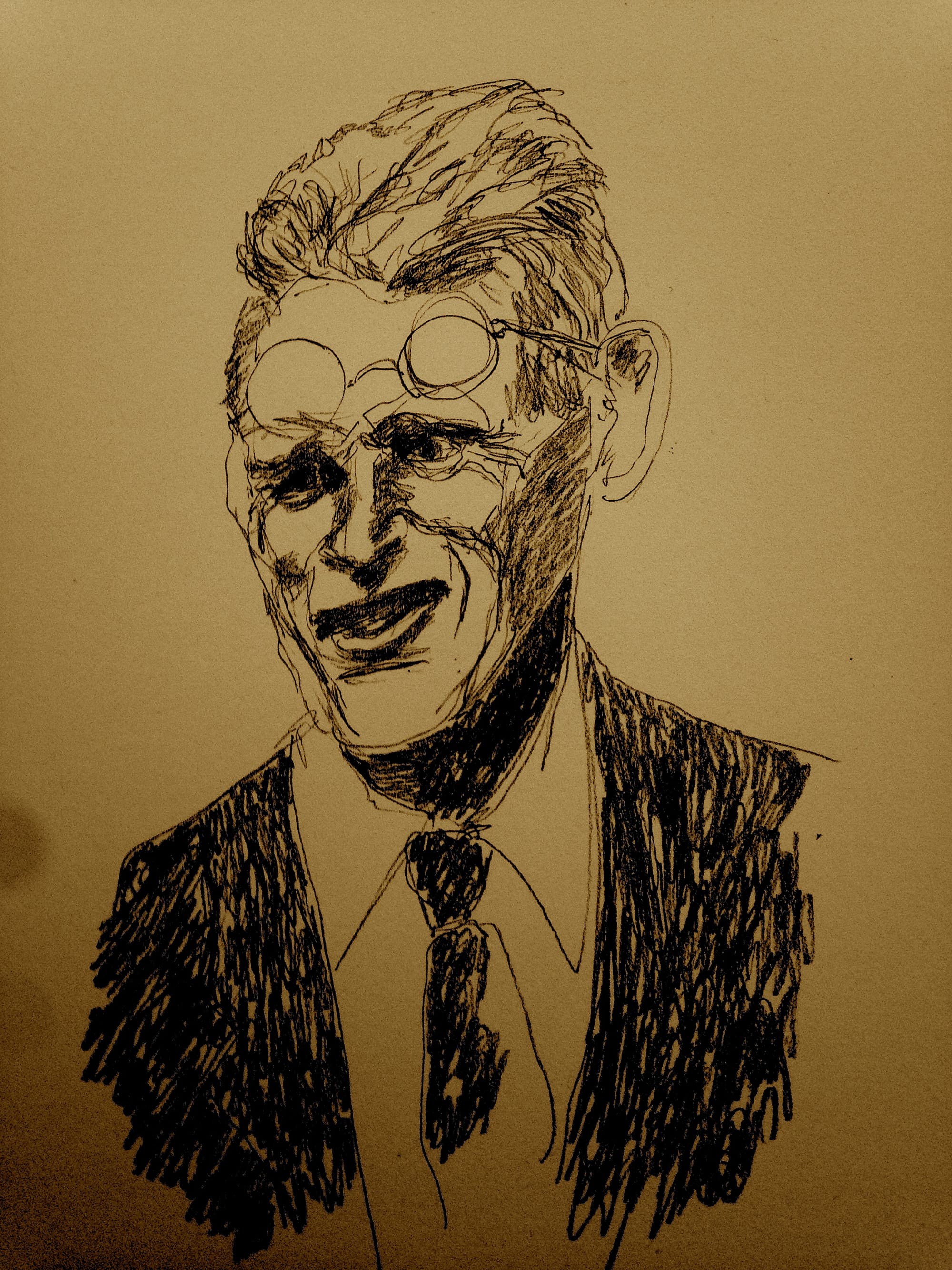
The 3 Zones Of Mind
Now Beckett maps the mind’s internal space into three zones. Murphy’s first zone is the zone of parallel forms, the zone where the mind replays physical events with a corrected direction. “Here the pleasure was reprisal, the pleasure of reversing the physical experience. Here the kick that the physical Murphy received, the mental Murphy gave. It was the same kick, but corrected as to direction.” That is counterfactual reasoning as erotics of control: not “what might have happened” in a vague wistful sense, but a structured reversal operator.
A reversal can be valid without being progressive. If your whole practice is “the same kick, reversed”, you risk living in a system where every conclusion is parasitic on the premise, and the premise is never left behind. That is the p-to-p loop disguised as revenge.
The second zone begins to look like the zone of the impossible, not in the sense of fantasy as comfort, but impossibility as a different kind of rigour. “In the second were the forms without parallel.” Beckett is pointing to mental contents that have no bodily counterpart. They are not just images. They are states whose “ground” cannot be supplied by the physical story. Impossible worlds allow you to model intensional structure, the internal articulation of a situation, without forcing it to be globally consistent.
Murphy’s mind is exactly that kind of modelling space. It tolerates contradictions, or rather it tolerates elements that cannot be made to cohere with the body’s world, and it treats that tolerance as the condition of its freedom. The dread is that this “freedom” is also a severance, a splitting where the mind becomes its own clandestine set, its own clandestine cinema. The erotic material, too, is not an add-on, it is part of the modal engine. Beckett writes Wylie’s kiss as a kind of temporal deformation, an editing trick that slows the world and makes desire into a measurable transformation: “A kiss from Wylie was like a breve tied, in a long slow amorous phrase…” The kiss becomes a formal operation, stretching time, reorganising the sequence of states. And Beckett immediately adds a meta-label where the proof carries its own commentary about what it is doing. “The above passage is carefully calculated to deprave the cultivated reader.” He tags the move. He tells you the rule you have just applied.
In Fine’s progressive setting, a “strong” step is one that makes genuine progress, not merely a step that keeps the derivation going. Beckett is playing with that difference by making some passages carry their own admission of tactics, their own disclosure of the rule by which they operate. If you loop back to the earlier park scene with this in mind, the biscuits and the duck-medium are no longer just grotesques. They are the externalised version of the same problem: how you can be surrounded by premises, by data, by sensations, by money, by bodies, and still be unable to make a noncircular move. Murphy’s irritation after the scene is written as a failure of spark. “Now all was nebulous and dark, a murk of irritation from which no spark could be excogitated.” That is a formal paralysis rendered as atmosphere. It is what it feels like when the system will only yield derivations that you can already see are empty returns, and you cannot find the transformation that counts as progress.
From there he “went to the other extreme”, disconnecting from sensation and “composed himself… for the torpor he had been craving”. This is where the dread deepens. Torpor is the attempt to exit the proof by exiting the world, to step outside the space in which the question of circularity even arises. But exiting the world is not a move in the world. It is a change of system, or the fantasy of a change of system. It is like refusing to accept either transitivity or reversibility by refusing argument altogether. Beckett shows why that temptation is strong, and why it is also haunted.
A closed system does not become less closed because you lie down. It can become more vivid, more elaborately self-sufficient, and then the impossible starts to feel not like liberation but like the only available furniture. Even the minor line about Neary’s predicament quietly echoes this. Neary’s trouble becomes a hunt inside a hostile space of selves, “like looking for a needle in a haystack full of vipers”. Then : “The horse leech’s daughter was a closed system.” A closed system here is not peace. It is a kind of social impossibility, a person as a sealed world with “multitudinous self”, ‘multitudinous’ being a word lifted from Macbeth whose predicament can be seen as exactly paralleling Murphy’s problem of access between worlds, of what transformations are permitted across boundaries. You can circle her, you can accumulate information, you can add details, and still not get the kind of entailment you want, still not reach the conclusion that would count as progress. So for Murphy and so for Macbeth.
So Beckett is building a rigorously uncanny picture: human life as a tangle of arguments whose validity is not the issue, because validity is cheap, and whose horror is the feeling of being trapped in derivations that return you to yourself. The mind becomes a theatre of counterfactual reversals, “the same kick… corrected as to direction”, and of forms “without parallel”, and the body becomes the stubborn site of constraints that the mind can neither fully incorporate nor fully escape.
The dread is that the split is not merely psychological. It is structural. It is the shape of the space of possibilities you inhabit, a space where certain caresses may not exist, where certain moves may always collapse into identity, where the proof keeps going and keeps proving only what it began with, p, therefore p, therefore p, with new props each time and the same conclusion waiting at the end like a room you cannot stop re-entering.
Murphy 4
At this point in the novel, Beckett has already done the heavy ontological lifting. The world has stalled, essence has failed to settle, counterfactuals have collapsed, and circularity has become the lived structure of experience. Now Beckett begins to refine this structure, not by adding new metaphysical ingredients, but by making the existing ones operate at higher resolution. What changes now is not the ontology but the fineness of its articulation.
Understanding this as transitional would be misleading. It is the chapter in which Beckett begins to treat Murphy’s condition not as a personal predicament but as something that can be handled, managed, and eventually formalised. Beckett is no longer showing us that the world fails. He is showing us how one learns to live inside that failure by developing techniques that are neither solutions nor escapes, but local stabilisations. Beckett shows us Murphy in motion again, but the motion has changed character. Earlier movement was either ritualised, like the rocking chair, or inert, like drifting through public space. Here, movement becomes instrumental without becoming purposive. Murphy begins to act in ways that look like adjustments, calibrations, attempts to reduce friction rather than to advance.
This is subtle, and Beckett’s prose reflects it. The language becomes slightly more technical, more procedural, as if Murphy were learning how to operate a system rather than how to live a life. Grounding is asymmetric and explanatory. If A grounds B, then B holds in virtue of A. Correlation, by contrast, is symmetric and inert. Two things occur together, but neither explains the other. Chapter Five is full of correlations that masquerade as grounding. Murphy does something, something else happens, and yet nothing is explained, nothing is settled.
Beckett signals this shift in register through Murphy’s growing preoccupation with conditions rather than outcomes. Murphy begins to think less in terms of what will happen and more in terms of what must be arranged so that nothing too disruptive happens. This is not resignation. It is a kind of negative expertise. Murphy is learning the constraints of his world with increasing precision. In an impossible or non-progressive system, you cannot aim at global resolution, because the system does not support it. What you can aim at is local consistency, small pockets where circularity does not explode into contradiction or pain. Murphy’s behaviour shows him becoming adept at identifying these pockets.
One of the key scenes here involves Murphy’s relation to Neary and the growing constellation of secondary figures. What matters is not their personalities but the way Murphy uses them to externalise loops that were previously internal. Earlier, Murphy’s circularity was primarily mental. Now it becomes social. Conversations repeat, gestures recur, misunderstandings persist without escalation or clarification. Beckett writes exchanges that feel almost schematic, as if demonstrating the same inference pattern under different substitutions. In a circular argument, one can replace a premise with an equivalent premise and preserve validity without gaining anything.
Beckett does this narratively. One interlocutor replaces another. One situation replaces another. The form remains the same. Murphy moves through these substitutions without resistance, because resistance would require the belief that something new could be achieved by refusing. Beckett sharpens this by introducing a faint but unmistakable sense of management. Murphy is no longer simply avoiding action. He is arranging his circumstances so that action will not demand itself. This is a crucial shift. Avoidance is still responsive. Management is anticipatory. Murphy is now acting on the world in order to maintain the world’s non-progressive character. He is no longer trying to break dependence relations. He is trying to reconfigure them so that nothing depends too heavily on him and he depends too heavily on nothing.
This is a world of minimal grounding. Facts depend on other facts just enough to persist, not enough to compel. Beckett’s prose becomes noticeably flatter here, and this flatness is doing philosophical work. Emotional peaks would imply evaluative structure. Dramatic conflict would imply stakes. Beckett drains these away because the ontology he has constructed cannot support them. Instead, we get careful description of routines, negotiations, minor adjustments. Murphy’s life begins to resemble a system running at low power. This is also the point at which the novel begins to gesture toward institutionalisation, though it has not yet arrived.
Murphy’s techniques of self-management resemble, in miniature, the techniques institutions use to stabilise unstable elements. An institution does not need to resolve impossibility. It only needs to contain it. Murphy is intuitively discovering containment strategies. The distinction between strong and weak satisfaction is doing work here. A strong satisfaction would be a state that genuinely resolves a problem. A weak satisfaction merely prevents it from worsening. Murphy’s strategies increasingly aim at weak satisfaction. He is not trying to be fulfilled. He is trying not to be disrupted. Beckett makes this explicit in Murphy’s relation to pleasure. Earlier, pleasure was intense, almost painful, as in the rocking chair. Here, pleasure becomes muted, instrumental. It is something to be modulated rather than sought. This aligns with Fine’s insistence that not all satisfactions are equal in logical role. Some close off inquiry. Others merely suspend it. Murphy is learning how to suspend.
The erotic dimension of the novel also changes here. Desire no longer appears as something that might ground connection or conflict. It becomes another variable to be managed. This is not repression in the psychological sense. It is ontological reclassification. Desire is treated as accidental, contingent, something that can be dampened without altering essence. When desire no longer grounds identity or relation, it becomes a noise to be filtered rather than a signal to be interpreted.
Bekett also deepens the theme of doubling, but now in a subtler register. Murphy begins to observe himself with increasing detachment, almost as if he were another system operating alongside his own. This is not yet the explicit doppelgänger of later chapters, but it is the preparation for it. When grounding relations weaken, identity can persist numerically while fragmenting functionally. Murphy remains Murphy, but different aspects of him begin to operate semi-autonomously. This fragmentation is not chaotic. It is regulated. Beckett’s sentences become more controlled, more evenly paced, as if mirroring Murphy’s own efforts to keep the system from oscillating too wildly.
The dread here is quieter than in earlier sections, but deeper. Earlier the horror came from recognising the loop. Now it comes from recognising that the loop can be lived in, refined, optimised. A world in which impossibility is explosive is terrifying but brief. A world in which impossibility is sustainable is far worse. It allows habits, routines, even a kind of peace. But this peace is purchased at the cost of progress, meaning, and genuine relation. Beckett is careful not to romanticise this. Murphy does not become serene. He becomes competent at minimisation. Murphy’s life is full of small successes that are not successes in any robust sense. Things do not go wrong. That is all that can be said. This is a system that satisfies consistency constraints without satisfying explanatory ones.
As the chapter draws to a close, the reader can feel the novel tightening its focus. The techniques Murphy is developing are not idiosyncratic. They are proto-institutional. They anticipate the asylum not as a place of madness, but as a place where non-progressive systems are formalised and maintained. This section thus functions as a hinge. It shows how a private metaphysical predicament begins to acquire public form. Nothing in this chapter contradicts what has come before. Everything is a refinement. The stalled world of Chapter One is now being navigated with skill. The unsettled essence of Chapter Two is now being protected from forced resolution. The counterfactual collapse of Chapter Three is now being worked around rather than fought. The circularity of Chapter Four is now being inhabited rather than resisted. This is not a decline but an adaptation to a particular logical environment.
Murphy is not failing to live well. He is learning to live in a world where living well, in the ordinary sense, is not an available option. Beckett shows us what it looks like to become fluent in an impossible world. From here, the novel will move toward explicit structures that mirror and amplify what Murphy has been doing privately. Institutions, games, and ultimately death itself will appear not as disruptions but as formal continuations of the same logic. Beckett shows Murphy begin to treat his own life as a set of adjustable parameters.
I want to go through this once more just to be clear what I think Beckett is doing. If you get it then there's no need to go on with this section to be honest. But personally I often lose track of what an author's trying to say and wish they'd say it again just so I can pick up the missing threads. So if I'm being repetitive, well, bite me!
Beckett writes that Murphy “set about arranging his circumstances so that they would make the least possible claim on him.” This marks a shift from reaction to calibration. Earlier, Murphy avoided or withdrew. Here he arranges. The verb presupposes structure. Yet the goal is not improvement, fulfilment, or even survival, but minimisation of claim. Murphy is no longer attempting to alter what grounds what. He is trying to thin grounding relations until they exert almost no force. That phrase “least possible claim” is philosophically precise. A claim is a demand that follows from a fact. If I am here, then I owe attention. If I am hungry, then I must eat. Murphy’s project in now is to remain in the world while ensuring that as few such “if–then” structures fire as possible.
He does not deny that claims exist. He tries to weaken them so they do not bind. This is an attempt to live in a space of minimal dependence, where facts coexist but rarely explain or necessitate one another. Beckett reinforces this by repeatedly describing Murphy’s actions in terms that strip them of outcome. Murphy does things “without enthusiasm” and “without aversion”. These are not psychological descriptors. They are modal ones. Enthusiasm and aversion both presuppose stakes. They assume that outcomes matter. By removing both, Beckett places Murphy in a zone where actions are permitted but unendorsed, allowed to occur without acquiring significance.
Fine would say that such actions satisfy permissibility conditions without satisfying grounding conditions. The interactions with Neary make this structure visible from the outside. Neary remains a character who believes in strong entailments. If one loves, one should pursue. If one suffers, one should react. Murphy listens to Neary’s speeches, but Beckett carefully notes that they “produced no effect”. That phrase is crucial. It does not say Murphy disagreed. It says nothing followed. The inference chain breaks. Neary’s premises never acquire explanatory force within Murphy’s world. This is particularly clear in the scene where Murphy contemplates Neary’s theories and finds them “interesting but unimportant”. Interest without importance is a devastating pairing. Interest marks cognitive uptake. Importance marks grounding. Murphy allows the first and withholds the second.
A distinction between mere acceptance and acceptance as ground helps here. Murphy accepts Neary’s talk as content, but not as reason. It does not license any new conclusions about what Murphy ought to do. Beckett also begins to describe Murphy’s inner life in increasingly procedural terms. Murphy thinks not in images of freedom or escape, but in terms of zones of tolerance. Beckett writes that Murphy’s aim was “to keep himself in that region where the mind could function with the minimum of interference.” This is not a romantic interiority. It is an operational specification. The mind is treated like a system that can be tuned to reduce noise. Interference is not pain or anxiety, but external grounding pressure.
Murphy is not trying to eliminate grounding altogether. He still eats. He still moves. He still speaks. What he seeks is a regime in which grounding relations exist only weakly, where they do not cascade. A fact might ground one further fact, but it should not ground a whole sequence. Beckett’s language mirrors this by presenting actions as isolated nodes rather than links in a chain. The erotic dimension also reflects this shift. Desire appears, but it is immediately bracketed. Beckett notes that Murphy “did not repudiate desire so much as decline to ratify it.” Repudiation would be an action grounded in value. Declining to ratify is a refusal to give desire normative authority. Desire occurs, but it does not count as a reason.
Fine’s framework lets us see this not as repression but as a reclassification of desire from essential to accidental. This reclassification shows up linguistically in Beckett’s flattening of affective language. Where earlier chapters allowed pleasure to verge on pain, here pleasure becomes almost administrative. Beckett writes of Murphy seeking “a certain level of comfort, not more, not less”. Comfort is not happiness. It is a threshold condition. This is a satisficing condition rather than an optimising one. Murphy is no longer aiming at the best state, but at a state that does not trigger further demands.
One of the most revealing moments comes when Beckett describes Murphy’s sense that “events no longer surprised him”. Surprise requires violated expectation. It presupposes a counterfactual picture of how things were supposed to go. The loss of surprise therefore signals not numbness, but the collapse of expectation itself. When counterfactuals lose authority, surprise disappears, because nothing is ever strongly expected to follow. Beckett does not celebrate this condition. He describes it with a faint, clinical unease. Murphy’s world has become predictable precisely because nothing is at stake.
The dread is the dread of a system that has found a way to persist without resolving anything. Murphy has achieved consistency without progress. Beckett remarks that Murphy was “no nearer to anything than before”. Earlier, this phrase functioned as a general description of stasis. Here it acquires a new precision. Murphy is intentionally no nearer. Nearness itself has been demoted as a value. The world no longer has destinations, only regions of tolerability.
This is adjustment to an environment where destinations are not well defined. The chapter closes with Murphy poised between private calibration and public systems. He has learned how to live inside his own loops. What remains is the question of whether those loops can be externalised, formalised, and sustained by something larger than individual effort. A system that tolerates non-progressive states without contradiction will eventually institutionalise them.
Murphy is functional, but only within a narrow band. It is the functionality of a world that has learned how to keep going without ever moving on.
Next: Murphy (5)
Previously: Murphy (3), Murphy (2), Murphy(1), Introduction, Criticism