Reading Beckett via Kit Fine (3)
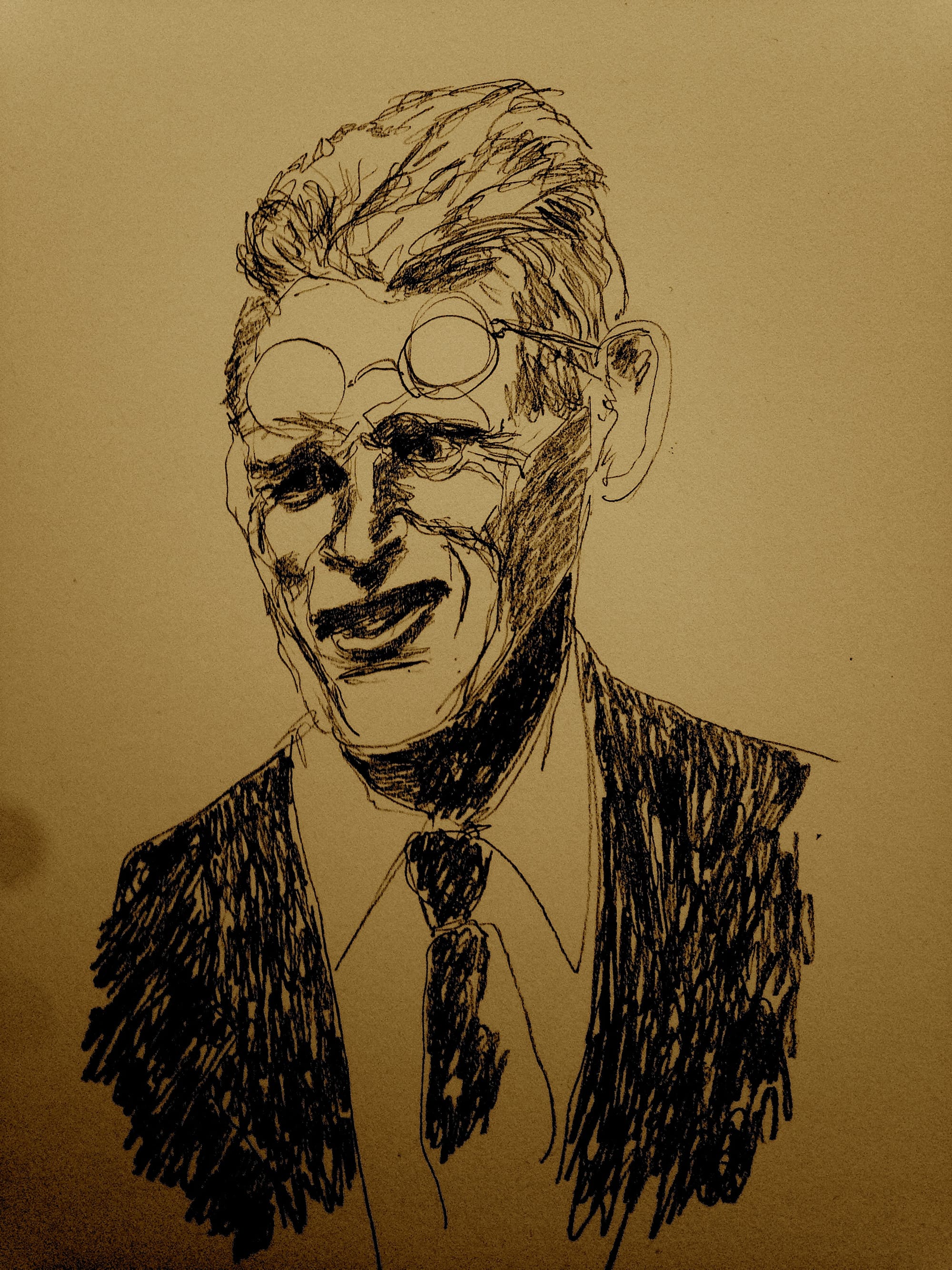
Murphy 1
My aim is not to translate Beckett into philosophy, but to show that Beckett has already built a world whose logic is Finean avant la lettre. The first thing the opening chapter of Murphy does is to refuse the ordinary grounding relation between body, world, and action. The novel opens with a sentence that looks casual and aphoristic, but already performs the central operation of the book. “The sun shone, having no alternative, on the nothing new.”
Sunshine ordinarily grounds expectation. It brings with it warmth, visibility, the promise of activity. Beckett explicitly strips the sun of any such grounding role. It shines because it must, not because it brings anything about. The phrase “having no alternative” removes agency, intention, and contingency at once. The sun does not choose to shine, and its shining does not make a difference. The final phrase, “the nothing new,” cancels any remaining hope that illumination will produce novelty.
From the first line, the world is present but inert. Causes occur, but they do not open possibilities. Beckett is not presenting a bleak mood. He is establishing a rule. The world will allow facts, but it will resist consequences. This is the first indication that we are not in a standard possible world, where facts reliably ground other facts, where if something happens then something else follows. Instead, we are in a world where the background logic of implication has been loosened. Fine’s work on impossible worlds says an impossible world need not violate logic outright. It can respect local coherence while undermining global inferential authority. Beckett’s first sentence already does exactly this.
Murphy is then introduced in a posture that makes this failure of grounding bodily rather than abstract. He is “naked in his rocking-chair of undressed teak, with his eyes closed.” Each element here carries ordinary implications that Beckett carefully neutralises. Nakedness usually implies exposure, vulnerability, erotic possibility, or shame. Here it implies none of these. The body is naked, but nothing follows. The rocking chair implies motion, but not travel. The eyes are closed, but Murphy is not asleep. The chair is made of “undressed teak,” a phrase that echoes Murphy’s nakedness, but again without symbolic payoff. Beckett piles up properties that normally ground responses and then drains them of force.
The rocking itself is crucial. Murphy rocks “from side to side,” rhythmically, deliberately. This is ritualised motion. Yet the motion has no destination. It does not carry Murphy anywhere, not even metaphorically. It is movement stripped of telos. In a standard world, movement grounds change. If someone moves, then something is different afterwards. Beckett constructs a situation in which movement composes only with itself. Rocking leads to more rocking. This is the bodily analogue of a trivial entailment, p to p. Murphy’s rocking is not rest, but neither is it progress. It is an infinite loop that never grounds a new state. The closed eyes intensify this effect. Vision ordinarily grounds orientation. If I open my eyes, I situate myself in a world. If I close them, I withdraw. Beckett removes this binary. Murphy’s closed eyes do not mark sleep or inwardness in any psychological sense. They mark suspension. The world remains present, but Murphy refuses to let perception ground engagement. This refusal is not explained or justified. It is simply the way things are allowed to be here. The novel does not ask us to sympathise with Murphy’s choice. It asks us to inhabit a world in which such a posture is possible.
Beckett then gives us Murphy’s own account of his mind, famously described as a “large hollow sphere, hermetically closed to the universe without.” The temptation is to read this as metaphor, or as early modernist psychology. But doing so misses the structural point. Murphy is not describing his psychology. He is proposing an ontological model. The mind, on this model, is not grounded in the world. It is sealed off, self regulating, internally articulated. Murphy divides it into zones, with the third zone being the one he values most, where mental events occur without reference to external contingencies. The key word here is contingency. Murphy wants a space where facts do not depend on other facts outside the system. Murphy is attempting to treat his mind as essentially independent. If the essence of Murphy is mental, then the world should not constrain him. But Beckett refuses to allow this essence to settle. Murphy’s body remains, naked and rocking, stubbornly present. The mind is treated as essential, the body as accidental, but the world never ratifies this division. As a result, neither the mental nor the bodily fully grounds Murphy’s possibilities. His essence remains indeterminate. This indeterminacy generates the novel’s distinctive stasis.
Murphy wants to inhabit a world where mental events ground everything that matters. But he continues to exist in a world where bodies take up space, where other people appear, where time passes. These two worlds are each coherent on their own. A purely mental world is imaginable. A purely embodied, socially structured world is imaginable. What Beckett shows is that they are not compossible in the way Murphy desires. Fine’s notion of non compossibility identifies this. Murphy is trying to combine two ways of being that cannot be jointly realised without structural breakdown, which is what Fine’s notion of non-compossibility is.
Celia’s presence brings this breakdown into focus. Celia represents a rival grounding regime. For Celia, presence grounds obligation. If Murphy is there, then he should respond. If he is naked, then something is at stake. Her expectations are modal. She assumes that facts about bodies generate reasons, demands, futures. Murphy’s refusal to engage is not a refusal of love so much as a refusal of that entire inferential structure. Beckett stages their interaction with meticulous restraint. There is no dramatic confrontation. Instead, there is a quiet sense that they are speaking across incompatible worlds. Celia’s questions do not land because Murphy’s world does not support the counterfactuals they rely on. If Celia speaks, then Murphy should answer. But that “should” has no force here. The world allows Celia to speak, but it does not require Murphy to respond. This is not because Murphy is cruel or evasive. It is because the grounding relation Celia presupposes does not operate.
In an impossible world, facts can exist without grounding one another in the usual way. The world does not collapse into contradiction. It simply loses its ability to generate consequences. Beckett’s opening chapter is a careful demonstration of this. Sunshine shines, but nothing happens. Murphy rocks, but nothing changes. Celia speaks, but nothing follows. Each event is locally intelligible. The failure occurs at the level of implication. Even Beckett’s narrative voice participates in this structure. The prose is lucid, controlled, often wry. There is no impressionistic blur, no surrealist eruption. This clarity is essential. Beckett wants us to see that nothing is wrong with the descriptions. The problem lies elsewhere. The world is not confused. It is stalled. Each sentence makes sense. The sequence as a whole refuses to go anywhere. The famous phrase “nothing new” returns here with full force. Novelty is not blocked by ignorance or repression. It is blocked by structure. The world does not allow new states to be grounded by old ones. Time may pass, but it does not accumulate significance.
This is why Murphy’s posture feels uncanny rather than merely lazy or eccentric. He is not resting. He is inhabiting a world where rest and action have lost their contrast. The rocking chair becomes, in this sense, a model of the entire novel. It is an object designed to move without progress. It satisfies the minimal conditions of motion while cancelling its usual consequences. Murphy’s attachment to it is metaphysical alignment. The chair and Murphy belong to the same kind of world. Both allow repetition without advancement. Both permit activity without grounding change. What emerges from the opening chapter, then, is not a character study but an ontological experiment. Beckett constructs a world in which essence is unsettled, grounding relations are suspended, and counterfactuals fail to carry authority.
Fine’s philosophy allows us to describe this with precision. Murphy’s world is not absurd, or if it is it, is a species of absurdity that is impossible in a technical sense. It violates not logic, but the background conditions that allow facts to generate futures. Everything that follows in the novel will build on this initial construction. The asylum, the chess game, the repetitions, the final death will not introduce new logics. They will explore the consequences of the one already in place. That is why it is so important to see the opening chapter as the grounding layer of the entire book. Beckett tells us, from the first line, what kind of world this is. Fine gives us the tools to see that he means it literally.
Kit Fine’s Machinery
It is worth pausing to make explicit one Finean idea that is doing a great deal of work here, because without it the analysis can seem merely impressionistic. Fine uses the simple schema p to p to mark the most blatant form of circularity in reasoning. An argument from p to p is valid in a trivial sense, but it makes no progress. Nothing is added, nothing is grounded by something else. In ordinary reasoning, circularity is often hidden inside longer chains, but Fine’s point is that whenever reasoning fails to move beyond what it already presupposes, it has the same structure as a p to p inference. What matters is not that such reasoning is logically inconsistent, but that it is non progressive. It cannot generate new entitlement, explanation, or consequence.
When Fine generalises this idea beyond arguments to structures, we get a powerful way of describing worlds in which events occur but do not ground further events. This is exactly the structure Beckett gives to Murphy’s opening situation. Murphy rocks, and from that rocking follows only more rocking. He withdraws into his mind, and from that withdrawal follows only further withdrawal. The world repeatedly moves from p back to p. Motion does not ground change, perception does not ground engagement, presence does not ground obligation. Everything that happens already presupposes itself. The rocking chair is therefore not just a symbol of stasis but a physical instantiation of Fine’s p to p structure. It allows activity that is formally valid, in the sense that nothing contradicts anything else, while blocking all genuine progress.
If the opening of Murphy establishes a world in which grounding relations stall, the next pressure point is the status of Murphy himself within that world. Beckett does not present Murphy as a character who has a body and has a mind. He presents Murphy as a site where the relation between body and mind has ceased to be ordered. The novel does not say that Murphy is torn between two aspects. It shows us a situation in which it is no longer clear which aspect, if either, is essential. Fine insists that essence is not a matter of what happens to be important to us, nor of what is psychologically dominant. Essence is what something is, independently of our descriptions of it. Modal facts flow from essence, not the other way around. What is possible for Murphy depends on what Murphy is. Beckett’s strategy in the early chapters is to prevent this question from settling. Murphy’s predicament is not that he chooses mind over body or body over mind. It is that the novel never allows either choice to stabilise as definitive.
Murphy’s description of his mind as a sealed sphere should be read as a metaphysical claim. He wants his mind to be essentially independent. The phrase “hermetically closed to the universe without” is not decorative. It names a refusal of grounding. If the mind is hermetically sealed, then facts about the external world cannot ground mental facts. The mind becomes a self sufficient domain whose internal relations answer only to themselves a la Berkeley. At the same time, Beckett refuses to let Murphy’s body become merely accidental. The body is not treated as something Murphy could simply shed or ignore. It intrudes constantly. Murphy must eat. He must move. He must occupy space. Other people encounter him as a body first. The novel does not allow the body to fade into background noise. It remains obstinately present, even when Murphy tries to treat it as ontologically secondary.
Non-compossibility names how two descriptions of a thing can each correspond to a possible way of being, without being jointly realisable. A purely mental being is possible. A purely embodied, socially embedded being is possible. What may not be possible is a being who is essentially mental while retaining all the functional and relational features of embodiment. Beckett stages Murphy as an attempt to occupy precisely this non-compossible conjunction. (David Chalmers, following Leibniz, imagined a philosophical zombie who is a being who retains all the functional and relational features of embodiment without anything mental. Perhaps the same lessons can be drawn from that thought experiment.)
The failure that results is not dramatic collapse but suspension. Murphy does not disintegrate. He does not go mad. He does not resolve the tension. Instead, he exists in a kind of ontological holding pattern. This is why the novel feels so still even as things happen. Murphy’s essence never settles, and so his possibilities never stabilise. He cannot fully act as a body, because his body is not treated as essential. He cannot fully withdraw into the mind, because the world continues to impose bodily demands. What we see is not conflict but indeterminacy.
Beckett reinforces this indeterminacy through Murphy’s nakedness. Nakedness ordinarily heightens bodily essence. It strips away social roles and exposes vulnerability. Here it does the opposite. Murphy’s naked body is strangely neutral. It does not provoke desire, shame, or urgency. The body is present without asserting itself as essential. This is not repression or denial. It is ontological flattening. Properties that usually ground consequences lose their force.
In ordinary life, certain properties matter because they are tied to what we are. If I am essentially embodied, then injury, exposure, and need matter. If Murphy were essentially mental, then bodily exposure would be genuinely accidental. Beckett refuses to decide which framework applies. As a result, bodily properties neither fully matter nor fully disappear. They hover. Celia’s role becomes sharper when seen through this lens. Celia does not simply want Murphy to behave differently. She presupposes a different account of his essence. For Celia, Murphy is essentially a body among bodies. If he is present, then he is available. If he is naked, then something is at stake. Her expectations are not normative demands layered on top of Murphy’s being. They are grounded in an ontology Murphy does not share. This is why their interactions feel uncannily mismatched rather than conflictual. Celia speaks as if Murphy’s bodily presence grounds relational obligations. Murphy listens, but the grounding relation does not take hold. In his world, the obligations that follow do not follow. Murphy’s failure is structural. The inference Celia relies on does not go through.
Murphy and Celia are not merely incompatible personalities. They inhabit incompatible modal frameworks. Celia’s world requires that essence flow through the body into social relations. Murphy’s world suspends that flow. Each world makes sense on its own. Their attempted conjunction produces stasis rather than synthesis. This non-compossibility also explains why Murphy’s interior world, the third zone of his mind, never becomes liberating. If Murphy were purely mental, that zone could ground a genuine alternative mode of existence. But because his essence remains unsettled, the zone functions instead as a looping refuge. Entering it does not generate a new way of being. It simply repeats the withdrawal. Murphy goes inward, but nothing follows from having gone inward. The counterfactual “if Murphy withdraws into the third zone, then he is free” never completes. Without settled essence, modal claims lose traction. What Murphy can do becomes unclear because the world has no stable answer to what kind of thing he is.
Beckett shows this by narrative structure. Murphy’s actions never quite count as actions. His refusals never quite count as decisions. Everything is suspended between categories. The doubling that begins to appear in Murphy’s self descriptions should also be understood ontologically at this stage. Murphy is not split into two selves in a psychological sense. He becomes doubled because the novel allows two incompatible candidates for essence to persist side by side. There is Murphy as body and Murphy as mind. Neither is reducible to the other. Neither can eliminate the other. They resemble one another enough to remain attached, but differ enough to prevent unification. This is the earliest form of the Cartesian doppelgänger structure that will later become explicit in institutional and narrative forms. Identity is grounded in essence. When essence is unsettled, identity relations weaken. Murphy remains numerically one, but ontologically unstable. He is the same person in the trivial sense, but not the same kind of thing from moment to moment. This instability produces immobility. The self cannot move forward because it does not know what it would be moving as. This then is a refinement of the impossible world. The world does not merely fail to ground events. It fails to ground being. Murphy is not a subject who cannot act. He is a being whose essence does not settle sufficiently to make action possible. His stillness is the consequence of living in a world where essence, body, and mind refuse to line up.
Once essence is indeterminate, counterfactuals will collapse more systematically. Doubling will intensify. Institutions will appear as attempts to force grounding from outside. Chess will emerge as a fantasy of pure structure without essence. Death itself will fail to terminate anything cleanly. None of this will require repeating the argument made here. It will unfold from it. Fine’s central claim that essence precedes modality gives us the right pressure point. What Murphy can do, what counts as possible or impossible for him, depends on what he is. Beckett’s strategy is not to give us a strange answer to that question, but to prevent any answer from stabilising at all.
Beckett makes this refusal explicit very early. Murphy is introduced not simply as someone who prefers mental life, but as someone who has reorganised the hierarchy between mind and body. The crucial passage comes in the description of Murphy’s mental “zones”: “He sat in his rocking-chair in this way because it gave him pleasure, such pleasure that pleasure was almost pain. The mental experience he enjoyed was of a kind that could be described as the life of the mind, but he preferred to call it the mind’s own world.” This is already a metaphysical claim. Murphy does not say that the mind represents the world differently. He says it has its own world. This world is not just a collection of thoughts. It is a structured domain with its own internal relations and grounding rules. Murphy is claiming that his mind constitutes such a domain.
Beckett then sharpens the claim: “It was a world complete in itself, hermetically closed to the universe without.” “Hermetically closed” is a statement about grounding isolation. If the mind is hermetically sealed, then facts about the external world do not ground mental facts. The ordinary dependence relation is cut. Murphy is attempting to treat mental facts as ungrounded by bodily or environmental facts, while still allowing bodily facts to exist. If Murphy were essentially mental, then bodily facts would be accidental. They could occur without affecting what is possible for him. But Beckett immediately refuses to let this work. The body remains stubbornly present and active. Murphy is naked, rocking, occupying space. His body is not treated as a mere vehicle. It intrudes constantly, but without becoming authoritative. Beckett reinforces this by refusing to describe the body in terms that would allow it to ground action.
Murphy is naked, but nakedness does not lead to vulnerability or urgency. He rocks, but rocking does not lead to fatigue or decision. The body is present without functioning as an essential determinant. This produces an essential indeterminacy. The text never tells us whether Murphy is essentially embodied or essentially mental, and therefore never tells us which counterfactuals are legitimate. This indeterminacy governs the smallest details of Murphy’s behaviour.
Consider Beckett’s description of Murphy’s preference for the third mental zone: “The third zone was the place of bliss, a limbo where the principle of identity was banished.” The “principle of identity” here is ontological identity. Murphy wants a domain where identity does not ground persistence, obligation, or continuity. He wants a space where essence does not determine identity conditions. But Beckett does not let Murphy remain there. Murphy can enter this zone, but nothing follows from having entered it. The counterfactual “if Murphy enters the third zone, then he is free” never completes. Entry does not ground liberation.
This is a textbook case of non-compossibility. A world in which mental bliss is self-sufficient is possible. A world in which Murphy remains embodied, socially visible, and temporally extended is possible. What Beckett constructs is an attempted fusion of these worlds, and the result is ontological stalling. This intensifies when Murphy begins to move in public space. His encounters with others show that the problem is not internal conflict but incompatible grounding regimes. Celia’s expectations make this explicit. When she speaks to Murphy, she assumes that bodily presence grounds relational obligation. Beckett writes: “Celia knew that Murphy loved her. What she did not know was how little this mattered.” This is modal mismatch. For Celia, love grounds expectations. If Murphy loves her, then something follows. For Murphy, love is not essential. It does not ground action. Love is treated as an accidental property in Murphy’s ontology, while Celia treats it as essential. The clash is therefore not normative but metaphysical. Celia’s inferences are valid within her world. Murphy’s refusal is not a rejection of those inferences, but a failure to recognise their grounding force. The world Murphy inhabits does not licence them. This becomes painfully clear in the repeated structure of their exchanges. Celia asks, waits, expects. Murphy listens, but nothing follows. Each interaction has the same Finean shape: p leads back to p. Speech does not ground response. Presence does not ground engagement. Love does not ground obligation.
Beckett does not dramatise this as cruelty. He presents it as inevitability. Non-compossibility allows us to see why no compromise is possible. Murphy cannot simply “try harder” to be with Celia, because doing so would require accepting a different account of his own essence. He would have to be essentially embodied, essentially relational. Beckett’s Murphy cannot do this without collapsing the mental world he treats as primary. The two ontologies cannot be jointly realised. This also explains why Murphy’s stillness is not resistance. It is not that Murphy refuses to choose. It is that no choice is metaphysically available. Choosing body over mind or mind over body would require a grounding relation the world does not supply. The result is not indecision but suspension.
We can already see the early formation of doubling, though it is not yet explicit. Murphy is simultaneously the one who rocks and the one who withdraws. These are not two characters, but two incompatible candidates for essence. Identity depends on essence. When essence is unsettled, identity becomes thin. Murphy remains numerically one, but ontologically unstable. He is the same person in a trivial sense, but not the same kind of thing across contexts. This instability produces what will later become full doppelgängers and institutional doubles. But here it appears first as self-incompatibility. Murphy is not divided against himself psychologically. He is divided because the world allows two incompatible accounts of what he is to persist without resolution. His essence does not settle, and without settled essence, modality collapses. Possibilities fail not because Murphy is weak or afraid, not because of anything Murphy wills at all, but because the world cannot decide what kind of being he is.
Next: Murphy (2)
Previously: Introduction, Criticism