Reading Beckett via Kit Fine (5)
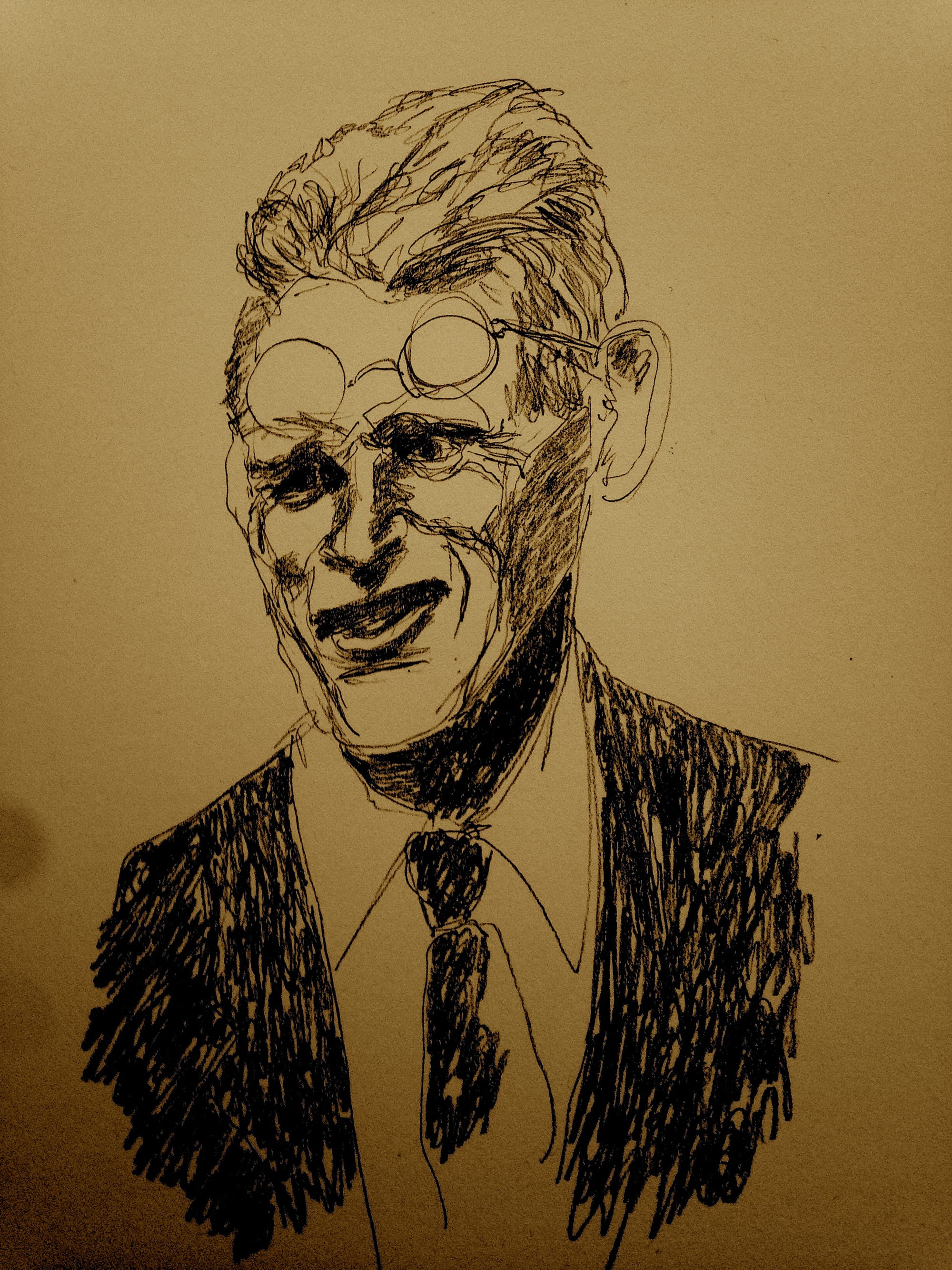
Murphy 3
Beckett keeps presenting little circuits of thought that look like progress, like you are getting somewhere, and then reveal themselves as a return to the same proposition, the same position, the same “yes, but yes”. The whole anxiety about the blatantly circular argument from p to p is that we need a way to distinguish a merely valid return from a genuinely progressive move that earns new ground. Beckett stages that distinction as lived experience, as irritation, as a kind of metaphysical embarrassment, and then as dread.
In the park sequence and the biscuits the surface is mundane, almost a cartoon, a tramp’s taxonomy of cakes, a medium with a duck’s body language, a small dog like a floating idea. Yet the scene is already a model of a proof that keeps trying to advance and keeps falling back into identity. Murphy sets up a method, enumerates possibilities, tries to make choice into a rational path. But the more he refines the details, the more the details feel like they presuppose the conclusion. This is the everyday version of the dilemma about circularity: in a deductively valid setting, the conclusion is always, in one sense, “contained” in the premises, so what could make a piece of reasoning substantively noncircular rather than just formally permitted?
In Beckett’s park, the effort to “get” a grip on things yields a grip that is exactly the same grip, just clenched harder. And when it fails it produces that snap of irritation, that sense that one has been moved without moving. Beckett even makes Murphy imagine alternative temperaments as if they were alternative proof systems. “Wylie in Murphy’s place might have consoled himself with the thought that the Park was a closed system in which there could be no loss of appetite; Neary with the unction of an Ipse dixit: Ticklepenny with reprisal.”
Those are three ways of handling the dilemma. Wylie’s “closed system” is the dream of a complete, self-contained calculus where nothing genuinely leaks out, so nothing genuinely matters, so circularity is never a problem because nothing is ever a problem. Neary’s “Ipse dixit” is the authoritarian shortcut, not progress but decree, as if “p therefore p” could be made respectable by tone of voice. Ticklepenny’s “reprisal” is the flip, the reversible arrow, the move where you take what happened and run it backward, so your conclusion is your revenge. Murphy cannot do any of these cleanly.
“But Murphy was inconsolable, the snuff of the dip stinking that the biscuits had lit in his mind, for Nelly to extinguish.” The biscuits are funny, and then Beckett says they have lit something and it stinks. That is a Lynchean kind of hinge, the banal object that becomes an ignition point. The stink is the affective register of a certain logical position, the sensation of being trapped in a proof that returns you to itself while pretending to move. Miss Dew’s little money exchange pushes the same structure into a more explicit “premise replacement” scene. She says, “How much are you out?” A question that treats his whole spiritual and romantic trouble as costive. Murphy replies, “Twopence, and a critique of pure love.”
That line is Beckett’s own compressed version of the progressive logic problem. “Twopence” is the measurable deficit. “A critique of pure love” is the deficit that cannot be given a unit. If you try to replace one premise with another, if you try to cash the second deficit out in the first currency, you get the illusion of substitution without any real equivalence. You can keep producing formally acceptable transitions that, at the level of meaning, do not constitute progress, they constitute a shuffle of labels. And the chapter keeps shuffling labels: appetite, depravity, charity, love, money, purity, filth. It even says, with that perfect Beckett insider deal, “This brought Murphy’s filth up to fivepence.” The label “filth” is doing work that a purely sociological reading tends to miss. It is not only shame. It is a judgement that the system has begun to treat what should be different as if it were the same kind of thing.
Once Miss Dew leaves, the chapter pivots into the explicit metaphysical machinery. Murphy begins to formulate his mind as a world with its own internal rules. Beckett gives you a geometry of modality. “It was made up of light fading into dark, of above and beneath, but not of good and bad.” That “but not” is not a moral gesture, it is a structural one. He is trying to specify the parameters of a space of possibilities. You are identifying which distinctions are admissible in the system. The mind-world has gradations, zones, intensities, yet it refuses certain evaluations, as if the operators for “right” and “wrong” are not part of the language. It “contained forms with parallel in another mode and forms without”. That is almost a direct invitation to read “parallel” as a relation between a physical state and a mental state that correspond, and “without parallel” as an impossible state relative to the physical base, a state the mind can host even though the body cannot instantiate it. Then Beckett states the dualism in a way that sounds like a Cartesian example and feels like a threat. “Thus Murphy felt himself split in two, a body and a mind.” We have, immediately, the Cartesian doppelgänger potential: two co-located “Murphys” that overlap enough to be recognisable and diverge enough to be mutually uncanny. Crucially, Beckett refuses the psychologising causal story, the story where thought produces sensation or sensation produces thought, because that would make the relation between the two halves too linear, too comfortably transitive.
“He neither thought a kick because he felt one nor felt a kick because he thought one.” Instead he speculates about a third thing, a kind of abstract object. “Perhaps there was, outside space and time, a non-mental non-physical Kick from all eternity, dimly revealed to Murphy in its correlated modes of consciousness and extension, the kick in intellectu and the kick in re.” This is Beckett’s way of giving you a Finean “ground” structure. The kick in mind and the kick in body are not grounding each other, they are grounded in something else, some third term that makes them correspond without making them reducible. And then the question arrives as a missing operator. “But where then was the supreme Caress?” It is funny, and it is also a genuine modal question: if there is an eternal Kick, is there an eternal Caress, and if there is not, what does that asymmetry mean about the space of possibilities he inhabits?
The dread is that his ontology is lopsided, that the system will generate harms as invariants and treat comforts as accidental, or worse, as incoherent. Murphy starts to treat the mind as a proof system whose admissible transformations are internal. “The feeling, growing stronger as Murphy grew older, that his mind was a closed system, subject to no principle of change but its own, self-sufficient and impermeable to the vicissitudes of the body.” Notice how close that is to the progressive picture of arrows having a “direction” that prevents you returning to the start, except here the direction is not outward, it is inward. The mind is closed, so any seeming movement might be merely a relabelling, a circulation inside a sealed room.
A closed system can still be busy. It can still permute. It can still produce novelty-like effects, the way a kaleidoscope produces endless patterns from the same shards. Progressive logic asks whether that novelty is genuinely noncircular or merely cumulative noise. Beckett sharpens this into an image of mutual inhibition that reads like an allegory of two proof procedures that block each other’s steps.
“A man is in bed, wanting to sleep. A rat is behind the wall at his head, wanting to move. The man hears the rat fidget and cannot sleep, the rat hears the man fidget and dares not move.” That is a scene of two agents, two systems, each treating the other’s movement as a constraint. In Finean terms, it is like having transformations available only on the condition that some other transformation is not applied, so the system oscillates at the edge of action.
Beckett even gives the alternative evaluation: “They are both unhappy… or both happy, the rat moving and the man sleeping.” The same components can compose into different global states. That is a modal point, about compossibility, about which states can co-exist. The dread comes from realising the compossible is fragile, and that your life can get stuck in the noncompossible configuration, where the very attempt to solve the problem keeps it in place, a lived argument from p back to p.
Next: The 3 Zones of Mind
Previously: Murphy (2), Murphy(1), Introduction, Criticism