Sketch Showing How A Finean Metaphysics Undermines Heideggerian Anti-Onto-Theology
Onto-theology worries that metaphysics, as it has often been practised, appears to turn God into a solution to a problem generated by human reason itself. God is introduced to close explanatory gaps, to satisfy the principle of sufficient reason, to stabilise a picture of the world that reason already wants to have. In that role God becomes an object within a system, even if the highest object, and therefore worshipping such a God becomes vulnerable to the charge of idolatry.
Heidegger’s formulation of onto-theology (short for ontological theology) captures this anxiety by claiming that Western metaphysics always moves in a double gesture, from beings to being as the most universal feature, and from beings to God as the highest being. God becomes causa sui, the supreme instance of the very structure metaphysics uses to make the world intelligible. The result, Heidegger claims, is not only a forgetfulness of being, but a religiously sterile God before whom you can't pray or dance.
I think this critique has shaped some philosophy of religion in two decisive ways. First, it motivates a deep suspicion of metaphysical categories as such. Second, it encourages a relocation of theology into registers that appear resistant to conceptual capture: experience, affect, excess, impossibility, promise, absence, or the everyday. In contemporary figures like John Caputo and Richard Kearney, God is no longer approached as the metaphysical ground of being, but as something encountered in the shattering of expectations, in ethical demand, in vulnerability, in the “may be” of promise rather than the actuality of essence. The ambition is ethical and political as much as theological. By refusing metaphysical mastery, this type of theology hopes to resist the instrumentalisation of God by power, ideology, or technocracy.
This responds to real historical abuses and real philosophical pathologies no doubt. But it rests on an extraordinarily thin conception of metaphysics, and the alternative to that collapses into something even thinner. So my problem with this is that it smuggles in a bad metaphysics while claiming to have escaped metaphysics altogether. And if you were serious about the abuse and the pathologies you'd take more care not to do this. Being a suspicious soul, I feel this is a fraudulent theological approach coming from insincere commitments and philosophical errors. Errors pah, we all make those. But the insincerity bit niggles.
Kit Fine helps us see some of the errors. Let's start with modality and metaphysical explanation. Fine’s central move is to reject the idea that necessity and possibility are fundamental. Instead, he treats them as derivative from deeper notions of essence and grounding. Something is necessary not simply because it holds in all possible worlds, but because it flows from what something is. Essence, for Fine, is not a list of properties or a definition in the scholastic sense, but the real explanatory structure that makes something the thing it is. Grounding is the relation that tracks dependence, the “in virtue of which” relation that explains why one fact holds because another does.
This places Fine at a sharp angle to both Kripke influenced analytic modal reductionism and Heideggerian anti-metaphysics. Against reductionism, Fine insists that modal facts cannot be flattened into quantification over possible worlds. I've been banging on about this for some time now! Against Heidegger, he insists that metaphysical explanation does not require a single, dominating concept of being. There are many kinds of necessity, many kinds of dependence, many ways in which things can be essential to one another. Metaphysics, on this view, is but the disciplined articulation of these structures.
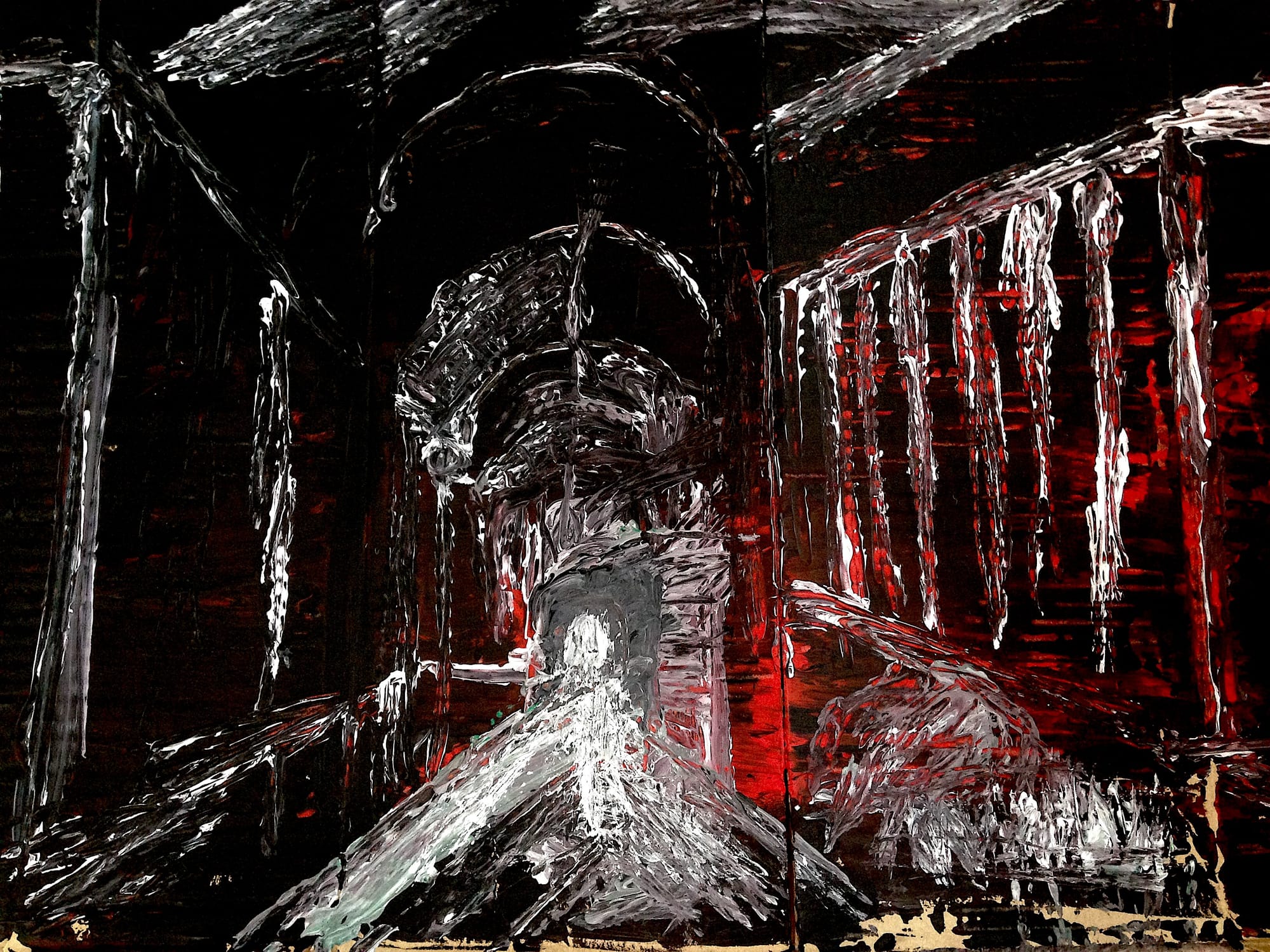
I've tried to illustrate this using the films of David Lynch as wonderful modal imagination machines. Take his breakthrough film Eraserhead, where the lever man operates from some planetary room in cosmic dark. This figure functions as a cinematic image of grounding itself. The world of Eraserhead does not obey stable causal or narrative rules. Events do not unfold according to familiar necessities. Instead, we are shown a hidden operator who pulls levers that alter what is compossible with what. (Compossible is what can coexist with what, non compossibility is where two perfectly available things aren't possibly instantiated together.)
The film is a surreal account of a strange young man called Henry. Henry’s world is structured, but the structure is opaque, partial, and locally manipulable. This is exactly the situation Fine theorises when he insists that modal facts depend on deeper structures that are not exhausted by logical consistency or empirical regularity.
The anti-onto theology critique of metaphysics tends to treat all such structuring as violence. To identify a ground is to dominate. To articulate necessity is to impose closure. This sounds very thrillingly intense and agonised but Eraserhead shows that such thoughts are much too quick and certainly not justified without a lot more work. In the film the issue is not that there is structure, nor that there is too much structure, but that the structure is hidden, uneven, and misaligned with ordinary expectations. The lever man is terrifying because he reveals that the world is governed by necessities that are not accessible to the agents within it. This is not onto-theology, but ontological vulnerability.
Fine’s apparatus allows us to describe this vulnerability. The world of Eraserhead exhibits fractured grounding. Certain facts hold in virtue of mechanisms that are not integrated into the agents’ practical or epistemic lives. This produces dread because explanation is partial and inaccessible and so we feel in the dark. Heidegger’s response to this kind of dread is to retreat from metaphysics. Fine’s response is to say no, what we need is a metaphysics sensitive to precisely these fractures.
I want to now consider how this bears on this Heideggerian rejection of natural theology. Heidegger and his successors assume that natural theology necessarily treats God as one being among others, albeit the highest. But this assumption only holds if metaphysics is conceived as an inventory of beings plus a unifying principle. Fine’s approach dissolves this picture. Grounding is not a relation between items in an inventory. It is a relation between facts, structures, and essences. To say that God grounds the existence of creatures is not to place God within the same explanatory framework as creatures. It is to say that the dependence relation terminates differently.
So much of this Heideggerian inspired theology ends up collapsing God into human experience precisely because it lacks the resources to articulate this difference. Caputo’s God of the impossible is defined in opposition to metaphysical necessity. But impossibility here is not logical or metaphysical impossibility. It is merely experiential rupture. Something feels impossible because it exceeds our expectations or capacities. Fine’s framework exposes the problem with this. Experiential impossibility does not track metaphysical structure. It tracks human limitation. Without grounding, there is no principled way to distinguish divine interruption from sheer contingency. Lynch's films help us see this mistake.
In Lynch's Lost Highway, the Mystery Man embodies experiential impossibility. He appears where he should not be, knows what he should not know. But this impossibility is neither redemptive or divine. On the contrary, it is corrosive. It erodes identity, responsibility, and agency. The Mystery Man is not God. He is a symptom of a world where grounding relations have broken down. To treat such experiences as paradigmatic of the divine, as Caputo tends to do, is to confuse affective intensity with metaphysical depth.
Kearney’s move to possibility rather than impossibility fares no better under Finean pressure. Possibility, stripped of metaphysical grounding, becomes vacuous. To say that God “may be” without specifying what kind of being this is, what its essence would be, or how it grounds anything, reduces God to an ethical horizon or narrative ideal. The Lynch films again supply counterexamples. In Mulholland Drive, for example, possibility proliferates. Characters slide into alternate identities. Futures branch. Nothing is fixed. This is modal dislocation. Without essential structure, possibility becomes vertigo.
Fine’s notion of compossibility is that not all possibilities can co-exist. Some states of affairs are individually possible but jointly impossible because they cannot be grounded together. Lynch’s worlds are saturated with incompossibility. Diane and Betty cannot both exist as they do. Fred Madison and Pete Dayton cannot be the same person in the same grounded way. The horror is not that multiple possibilities exist, but that incompatible structures are forced into proximity without mediation. Heideggerian infected theology often celebrates precisely this proximity as a site of the divine. Fine’s framework shows why this is misguided. Incompossibility without grounding is breakdown.
Sometimes Aquinas is called an onto-theologian. This bad Heideggerian theology has sometimes defended him by insisting that Aquinas avoids onto-theology because he uses analogy rather than univocal predication. But a Finean reading allows us to see how Aquinas distinguishes between essence and existence, between what a thing is and that it is. In creatures, essence does not include existence. Their being is grounded in something else. In God, essence and existence coincide. This is a claim about grounding. God is not the highest instance of being. God is that in virtue of which there is being at all.
Heidegger’s critique misses this because it assumes that any talk of ground is a form of domination. But Fine’s notion of grounding is explanatory articulation. It does not reduce what is grounded to the ground. On the contrary, it preserves asymmetry. Lynch illustrates the intuition. The lever man does not absorb Henry’s world into himself. He makes it possible. The Mystery Man does not explain Fred’s actions. He destabilises them. Grounding can be enabling, destabilising, terrifying, or sustaining. It is not inherently totalising.
The deepest problem with the Heideggerian theology that rejects metaphysics, seen through Fine and illustrated via Lynch, is that it ends up banalising what it seeks to protect. By refusing to articulate metaphysical structure, this theology reduces God to a name for certain human experiences or ethical orientations. The divine becomes interchangeable with chance, trauma, hope, or political aspiration. Caputo explicitly embraces this interchangeability. But interchangeability is precisely what robs the divine of distinctiveness. If God can be removed without altering the structure of experience, then God has no explanatory role at all. Fine’s apparatus shows why this is conceptual failure. Explanation is not violence. It is discrimination. To explain is to say why one thing holds rather than another. Without explanation, everything collapses into an undifferentiated field. Lynch’s films show what that collapse feels like. Inland Empire is not oppressive because it explains too much, but because it explains nothing in a way that stabilises agency or identity. The result is not liberation but paralysis.
The motivating worry about ideology is not misplaced. God has been used as a tool of domination. (The irony of Heidegger being in the mix here can't be ignored given his lifelong affiliation with the Nazi party!) But the Finean response is to insist on better metaphysics, not less. A metaphysics that distinguishes kinds of necessity can say that normative demands do not reduce to causal facts, that ethical obligation is not the same as physical compulsion. A metaphysics that tracks grounding can say that political authority is not grounded in divine essence in the way being itself is. These distinctions can prevent ideological misuse. Refusal to make them leaves theology defenceless.
Seen in this light I take Heidegger’s onto-theological critique as a diagnosis of a particular pathological metaphysics rather than a verdict on metaphysics as such. Fine’s framework gives us the tools to articulate non-pathological metaphysics, and Lynch’s films show us what happens when those tools are abandoned. Metaphysics thins into poetry, theology thins into ethics, and experience becomes the sole arbiter of meaning. What remains is intense, sometimes beautiful, often moving, but that intensity, beauty and effectiveness are merely simulacrums because they are grounded in structural banality. Nothing finally explains anything else. Nothing answers for anything else. The irony is that this thinning betrays the very concern for mystery that motivates this theological turn in the first place.
Mystery, in the Finean sense illuminated by Lynch, is not the absence of structure but the excess of structure over our capacity to integrate it. God, on this model, is not what escapes metaphysics, but what exceeds any single metaphysical framework while still grounding them all. Aquinas was closer to this than Heidegger could ever have imagined, not least because Heidegger was limited by pathological fear and an inability to read. Aquinas did not retreat from metaphysics because he thought God was beyond thought. He refined metaphysics because he thought God demanded it.
Lynch’s worlds are terrifying because they give us a taste of what a reality without grounding would be like. Fine’s metaphysics explains why that terror is rational. Heideggerian infected theology mistakes that terror for revelation. But without grounding, there is no difference between God and the gods, between grace and chance, between command and compulsion. The result is not reverence but confusion.
The deepest pushback Fine offers to this style of theology, then, is not that it is wrong to care about experience, vulnerability, or ethical demand. It is that without a serious metaphysics of essence, grounding, necessity, and compossibility, those concerns float free. They lose their depth. They become banal. Lynch shows us the affective cost of that banality. Fine shows us the conceptual cost. They expose why abandoning metaphysics in the name of humility does not protect theology, but hollows it out from within. In the case of Heidegger it is fraudulence masquerading as depth.