Saints of the Atlas 11
Gellner now breaks the possible illusion that the Ahansal saints exhaust the sacred landscape of the High Atlas. Gellner has given us a highly structured account of one saintly formation: the descendants of Sidi Said Ahansal, their main lodge, their secondary centres, their genealogy, their mediation, their relation to lay tribes, their use of baraka, their political location among transhumant frontiers, and their internal stratification. Now he widens the field. He asks what else counts as sacred in this society, and what happens when sanctity appears in forms that are not reducible to the Ahansal genealogy.
After tracing the inner logic of Ahansal descent, Gellner now shows that sacred authority also exists outside, above, beside, and beneath that descent system.
Gellner is asking how different kinds of sacred persons, places, objects, institutions, and powers are distinguished from one another. In this kind of society, to classify something as sacred is to place it within a moral and political order. To say that one person is an agurram, another a sherif, another a fqih, another a saint of a more impersonal sort, and another a figure linked to a legendary sevenfold grouping, is to assign different kinds of authority, efficacy, danger, protection, and legitimacy.
Gellner’s whole book has depended on a distinction between holy and lay. But he complicates that distinction by showing that “holy” itself is internally plural. There is hereditary sanctity, as with the Ahansal saints. There is prophetic descent, as with the shurfa. There is saintly founding charisma attached to a person or lineage. There are sacred places and anonymous or semi anonymous presences. There are mosques. There are literate religious specialists, the foquaha, or fuqaha, men of Islamic learning and law. There are collective or legendary sacred groupings such as the Seven Saints. There may also be sacred powers that are not quite personal in the ordinary genealogical sense. So the sacred field is not one thing. It is an array of forms.
Gellner is showing that the political role of a sacred form depends on what kind of sacred form it is. A hereditary saint mediates differently from a mosque. A fqih reads and writes differently from a saint who carries inherited baraka. A meta saint operates differently from a local Ahansal branch. An impersonal saint operates differently from a dynastic holy family. Each form has its own relation to social order.
This is where the chapter becomes theoretically important. In many discussions, religion is treated too generally, as if “religious authority” were one uniform thing. Gellner distinguishes forms of sacredness according to their social mechanism. One form works through descent, another through literacy, another through place, another through collective legend, another through impersonal sacred presence. The question is always: what does this form of sacredness allow people to do? What kind of authority does it produce? What kind of conflict can it mediate? What kind of legitimacy does it carry? What kind of social order does it support?
“The Meta-Saint” is an especially intriguing category. A meta saint is not simply another saint among saints. The prefix “meta” here means beyond, above, or at a higher level of abstraction. In this context, the meta saint can be understood as a sacred figure who stands over or behind ordinary saintly differentiation, a figure whose sanctity helps organise the field of sanctity itself. If ordinary saints mediate between lay groups, the meta saint helps make sense of the hierarchy, origin, or total order of saintliness. He is not merely a local mediator but a figure through whom saintly authority is itself classified, grounded, or transcended.
Descendants spread. Centres proliferate. Some become lay, some ambiguous, some reactivated, some rivalrous, some puritan. The meta saint addresses a higher order problem: how does the sacred field hold together when there are many sacred claimants? A meta saint can provide a principle of unity above the plurality. He is a sacred reference point through which other holy figures are located.
The idea of a meta saint also reveals something about Gellner’s structural imagination. He is interested in levels. At one level, lay tribes oppose one another. At another level, saints mediate among them. At a further level, saintly categories themselves require ordering. The meta saint belongs to this higher level. He does not merely intervene in one dispute. He helps define what saintliness is, or how saintliness is to be ranked.
Durkheim saw religion as a system of classifications dividing the sacred from the profane. Gellner is doing something more differentiated. He is not only distinguishing sacred from profane, but sacred from sacred. The meta saint is sacred in relation to other sacred forms. That means the sacred field itself has hierarchy, layering, and meta classification. Religion is not merely one boundary between holy and ordinary. It is a structure of distinctions within holiness.
“The Seven Saints” introduces another form of sacred organisation. A group of seven saints is not simply seven individual holy men added together. The number seven often carries symbolic power in Islamic and wider Mediterranean religious cultures. Seven can mark completeness, protection, cosmic order, or sacred repetition. In many Moroccan contexts, groups of seven saints are associated with towns, territories, pilgrimage circuits, or protective configurations. Gellner’s inclusion of the Seven Saints indicates that sacred power may be organised not only genealogically but numerically, territorially, and collectively.
The important point is that the Seven Saints form a sacred collective. This differs from the Ahansal genealogy. The Ahansal line is organised by descent from Sidi Said Ahansal. The Seven Saints are organised by a symbolic grouping. Their authority may not depend on one unified lineage. It depends on collective sacred pattern. The number itself helps create the form. Seven holy figures together make a structure, a constellation, a protective field, perhaps a ritual map.
A sacred collective can integrate space differently from a lineage. A lineage radiates from ancestors and descendants. A group of seven may mark a region, bind multiple places, or create a circuit of sanctity. It can distribute sacred presence across a landscape rather than concentrating it in one genealogical lodge. If the Ahansal saints represent hereditary baraka, the Seven Saints represent patterned sacred plurality. Sacred geography means the organisation of space through holy places, routes, shrines, tombs, mosques, pilgrimage circuits, memories, and protective presences. The Seven Saints are not just persons. They are ways of sacralising territory. They make the landscape legible as a field of protection, memory, and divine favour. The sacred is mapped.
This connects with Gellner’s wider argument about non state order. A state maps territory administratively, through districts, taxes, roads, courts, officials, and boundaries. Sacred geography maps territory differently, through shrines, saints, sanctuaries, pilgrimages, oaths, blessings, and stories. The Seven Saints may therefore represent another non bureaucratic way of giving form to space. They organise not by command, but by reverence and repeated recognition.
“The Impersonal Saints” thesis challenges the assumption that saintliness must always be attached to a known person or genealogy. An impersonal saint is an odd phrase, almost paradoxical. A saint usually sounds like a person, someone with a name, life, tomb, descendants, and miracles. But Gellner is alert to sacred powers that do not fit that model. These may be saintly presences, places, tombs, names, or protective forces where the personal biography is thin, forgotten, secondary, or symbolically dissolved.
This shows that the sacred can be effective even when personal genealogy weakens. An impersonal saint may lack a richly remembered life, but still possess local efficacy. People may swear by the place, fear its power, visit it, avoid violating it, treat it as dangerous or protective, and incorporate it into local ritual. The sacred does not always need a fully developed hagiography. It can attach to place, object, name, or inherited practice.
The impersonal saint therefore reveals the minimum conditions of sacred efficacy. What is needed? Not necessarily a detailed biography. Not necessarily a large lineage. Not necessarily a powerful lodge. What is needed is recognition of sacred force, a socially shared sense that this place or presence is not ordinary, that it protects, punishes, blesses, or mediates. This brings us back to baraka, but in a different mode. In Ahansal saintliness, baraka flows through descent. In impersonal sanctity, baraka may adhere to place, tomb, shrine, or name without a strong genealogical carrier.
This distinction is theoretically rich. It separates personal charisma from localised sacred force. Weber’s charisma is usually attached to persons. Gellner’s impersonal saints show that charisma can become depersonalised. It may survive as residue. It may be sedimented in a shrine. It may persist after the saint’s biography fades. It may become almost object like. The sacred here is not so much embodied in a living lineage as deposited in a location. This also invites comparison with anthropological theories of relics, shrines, and sacred places. A relic or shrine can continue to work even when the original person becomes obscure. The site itself becomes the carrier. This is a different mode of routinisation. Instead of charisma being routinised through hereditary descendants, it is routinised through place and ritual repetition. People keep coming. The place keeps being treated as holy. The biography can thin out, but practice preserves sanctity.
When Gellner turns to “Mosques and foquaha. The Uses of Literacy”. he introduces a form of religious authority different from saintly baraka. A mosque is an Islamic place of prayer and communal worship. It is sacred, but not in the same way as a saintly shrine. A mosque is oriented towards formal Islam, prayer, the Qur’an, ritual discipline, and communal worship. It is not primarily a tomb, a hereditary holy house, or a site of localised miracle. It is tied to the scriptural and legal dimension of Islam.
The foquaha, more commonly rendered fuqaha, are jurists or learned men, those who know Islamic law, scripture, ritual obligations, and sometimes writing, contracts, inheritance, and formal adjudication. The singular is faqih or fqih. Gellner’s spelling reflects local usage. The fqih is not a saint in the same sense as an agurram. His authority comes from literacy, learning, scriptural knowledge, and command of Islamic norms. He reads, writes, teaches, judges, drafts documents, interprets religious obligations, and connects local society to the wider Islamic textual tradition.
This is the major contrast of the section: baraka versus literacy. The saint carries sacred force through descent and reputation. The fqih carries religious authority through text and learning. The saint mediates through blessing, sanctuary, oath, and inherited charisma. The fqih mediates through law, writing, instruction, and scriptural correctness. These two forms can cooperate, but they are not identical. In fact, they can be in tension.
This tension is central to Gellner’s broader theory of Islam. He famously argued elsewhere that Islam has, in one dimension, a scriptural, egalitarian, puritan tendency, one that stresses the direct relation of believer to God, the authority of the Qur’an and law, and suspicion of saint worship. Yet in tribal and rural contexts, Islam can become saintly, shrine centred, hierarchical, and mediated through baraka.
The phrase “uses of literacy” is therefore not incidental. Literacy is a form of power. In a largely oral tribal society, the ability to read and write Arabic, to handle Qur’anic text, to draft contracts, to keep records, to know formulae, to teach children, to interpret law, gives the fqih a special authority. But it is a different authority from the saint’s. Literacy is portable and formal. It links the local community to a wider civilisation of texts. Baraka is local, genealogical, and embodied. It links the community to a sacred lineage or place.
This distinction has political consequences. A saint may resolve conflict through sacred prestige and recognition. A fqih may resolve or structure matters through legal forms, written deeds, inheritance rules, contracts, and Qur’anic schooling. A saint’s authority may be stronger in feud mediation, sanctuary, oath, and pastoral conflict. A fqih’s authority may be stronger in matters requiring text, calculation, law, or formal religious correctness. The two figures may be complementary, but they represent different routes to legitimacy.
The contrast helps explain why mosques differ from shrines. A mosque gathers believers for prayer before God. A shrine gathers people around a saintly presence. The mosque is universalising: in principle, every Muslim prays according to the same ritual direction and obligation. The shrine is particularising: this saint, this tomb, this lineage, this miracle, this place. The mosque points towards the unity of Islam. The shrine points towards local sacred mediation. Both are Islamic, but they organise the sacred differently. Gellner’s distinction identifies a real difference between hereditary sacred charisma and textual religious authority.
Bourdieu helps here. Literacy is cultural capital. It is a recognised competence that grants status and authority. A fqih may not possess the hereditary baraka of a saint, but he possesses scriptural capital. He can read what others cannot. He can write what others must trust him to write. He can interpret legal formulae. He can connect local transactions to the prestige of Arabic and the Qur’an. That power is not merely religious. It is political and economic. Documents matter. Land deeds matter. Marriage contracts matter. Inheritance matters. Literacy becomes a way of governing without appearing as coercive government.
We've already seen how the land deed supporting the main lodge’s claim shows that saintly authority itself may depend on literacy. The saints are not opposed to the literate religious world. They can use documents, law, and foquaha. But their primary sacred claim is not literacy. It is descent and baraka. The fqih can support, record, formalise, or challenge saintly claims. This creates a layered religious order.
Gellner has therefore shown that the sacred landscape of the High Atlas is not exhausted by the Ahansal saints. There are meta saints, groups of seven saints, impersonal saints, mosques, and literate religious specialists. Each form does something different. Some sacralise genealogy. Some sacralise number and territory. Some sacralise place without strong biography. Some sacralise text, law, and literacy. The sacred field is therefore internally differentiated.
This prevents a reductive account of saintly mediation. The Ahansal saints are central, but they are only one mode of sacred authority. Their distinctiveness becomes clearer precisely when placed next to other forms. They are hereditary, genealogical, mediatory, shrine centred, politically embedded in tribal conflict, and tied to baraka. Mosques and foquaha are more scriptural and literate. Impersonal saints are more place based. The Seven Saints are collective and symbolic. The meta saint is higher order and classificatory.
All this shows that non state society does not have one religious substitute for government. It has a plural sacred field. Different problems call upon different sacred resources. A feud may call for saintly mediation. A legal document may call for a fqih. A pilgrimage or protective ritual may call upon a local saint or group of saints. A mosque gathers the community through prayer. A shrine marks sanctuary. A genealogy ranks saintly houses. A written deed stabilises a property claim. Authority is distributed not only among tribes and saints, but among different sacred forms.
This distribution of authority is one reason the system can endure. No single institution carries everything. The sacred is not centralised in one church, one priesthood, one state clergy, or one sovereign religious court. It is scattered across lineages, shrines, mosques, texts, holy places, and learned men. This resembles the wider pattern of the society itself, which lacks a centralised state but contains many mechanisms of order. Sacred plurality mirrors political plurality.
But it also creates tensions. Saintly baraka can conflict with scriptural purism. Shrine practices can be criticised by literate reformers. A fqih may depend on saintly patronage but also represent a textual Islam that sits uneasily with hereditary sanctity. A mosque may universalise religious practice while a shrine particularises it. An impersonal saint may work locally without the genealogical discipline that the Ahansal saints possess. The sacred field is therefore not harmonious. It is a field of possible competition.
Social cohesion in Muslim society does not arise from a single belief system neatly shared by all. It arises from overlapping, sometimes competing, forms of sacred authority that can be mobilised for different tasks. Gellner’s sociology is therefore more plural than it first appears. He is not saying “religion holds society together” in some vague way. He is asking which religious form does which social work.
He also complicates the simple holy versus lay contrast. The lay tribes are not simply profane. They worship in mosques, consult foquaha, honour saints, fear sacred places, and participate in rituals. The holy are not simply saints. Some holiness is personal, some genealogical, some textual, some spatial, some collective, some impersonal. The lay world is saturated with sacred forms, but those forms are differentiated by function and authority.
By the end Gellner shifts from a lineage model of sanctity to a field model of sanctity. The lineage model asks how Sidi Said Ahansal’s descendants inherit and distribute baraka. The field model asks how multiple sacred forms coexist, overlap, compete, and support different kinds of authority. Gellner is still deeply interested in structure, but the structure is now less genealogical and more classificatory.
This enables him to understand religious roles not just by looking only at saints, nor only at mosques, nor only at literacy. It must be understood as a system of roles: saint, shrine, fqih, mosque, oath, genealogy, sacred place, and textual law.
The deepest implication is that sacred authority is modular. By “modular”, I mean that different sacred components can be combined according to social need. A saintly lineage may use a fqih to write a deed. A mosque may coexist near a shrine. A local impersonal saint may protect a place while a major Ahansal centre mediates tribal disputes. The Seven Saints may sacralise a region in a way that does not depend on everyday arbitration. A meta saint may organise the imagination of holiness itself. The society does not possess one sacred machine. It possesses a repertoire.
This repertoire is politically powerful because it allows flexibility without centralisation. A state solves problems by extending offices and rules. The High Atlas sacred field solves problems by drawing on varied kinds of recognised holiness. Where genealogy is needed, there is saintly descent. Where writing is needed, there are foquaha. Where place must be protected, there are shrines or impersonal saints. Where regional sacred unity is needed, there are collective saintly formations. Where prayer and scriptural order are needed, there are mosques. Sacred plurality substitutes, in part, for administrative differentiation.
By the end the Ahansal saints appear both more central and less exclusive. They remain the book’s main case because their hereditary baraka solves the particular political problem of mediation among segmentary tribes. But they are now surrounded by other sacred forms that reveal the richness and instability of Moroccan Islam in the High Atlas. Gellner is showing that sanctity is not one essence but a set of social possibilities. Some possibilities are genealogical, some literate, some spatial, some collective, some impersonal, some reformist, some mediatory.
Gellner prevents the reader from mistaking one saintly lineage for the whole sacred order. He also prevents a crude opposition between religion and politics. Every sacred form has political implications, but not the same implications. The saint mediates, the fqih textualises, the mosque universalises, the impersonal saint localises, the Seven Saints territorialise, the meta saint classifies. Together, they form a sacred field through which a stateless or weakly governed society can classify authority, manage conflict, remember origins, organise space, and connect local life to Islam as a wider civilisation.
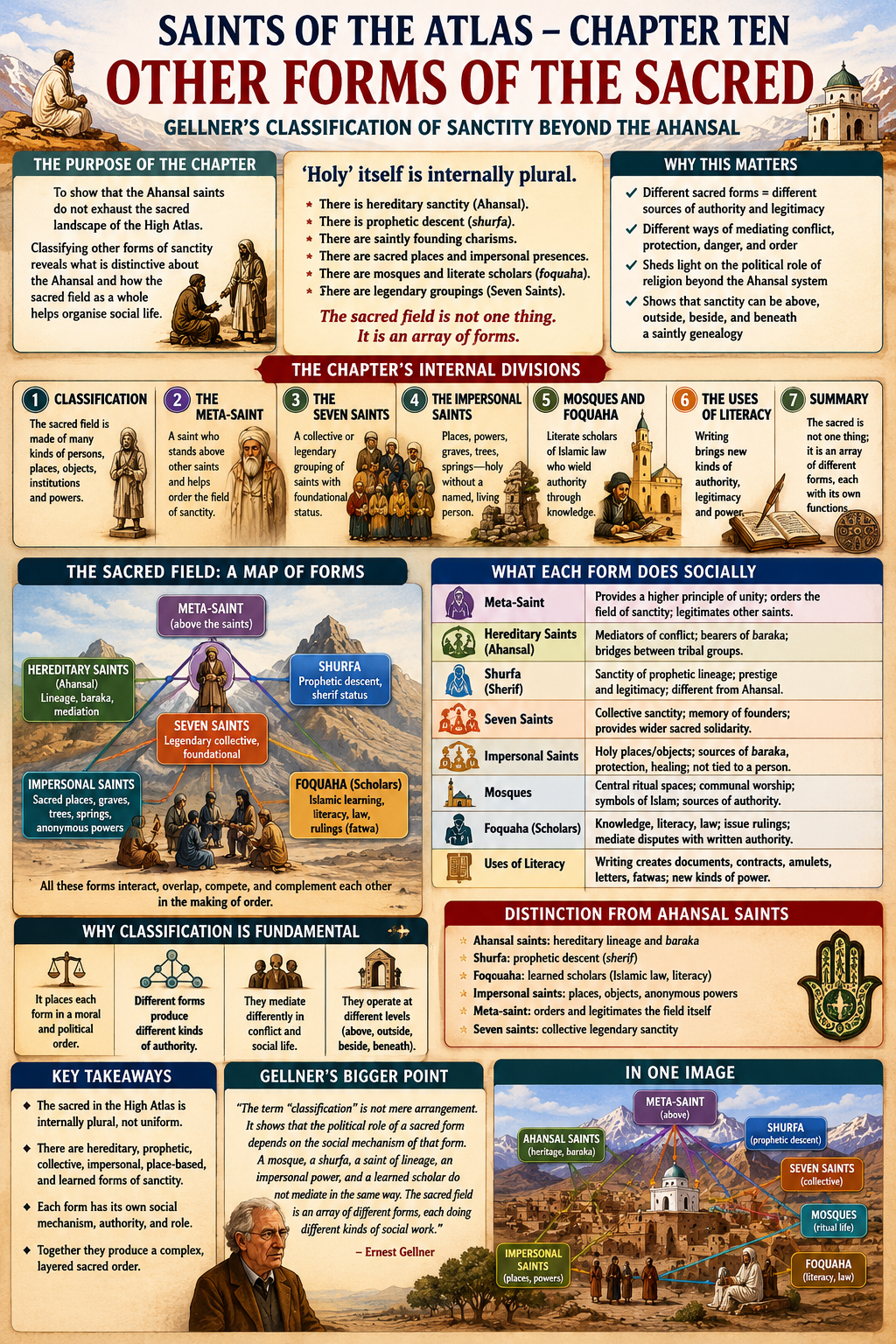
I asked AI to generate a summary poster. Gellner looks very unlike himself haha!!