Saints of the Atlas 9

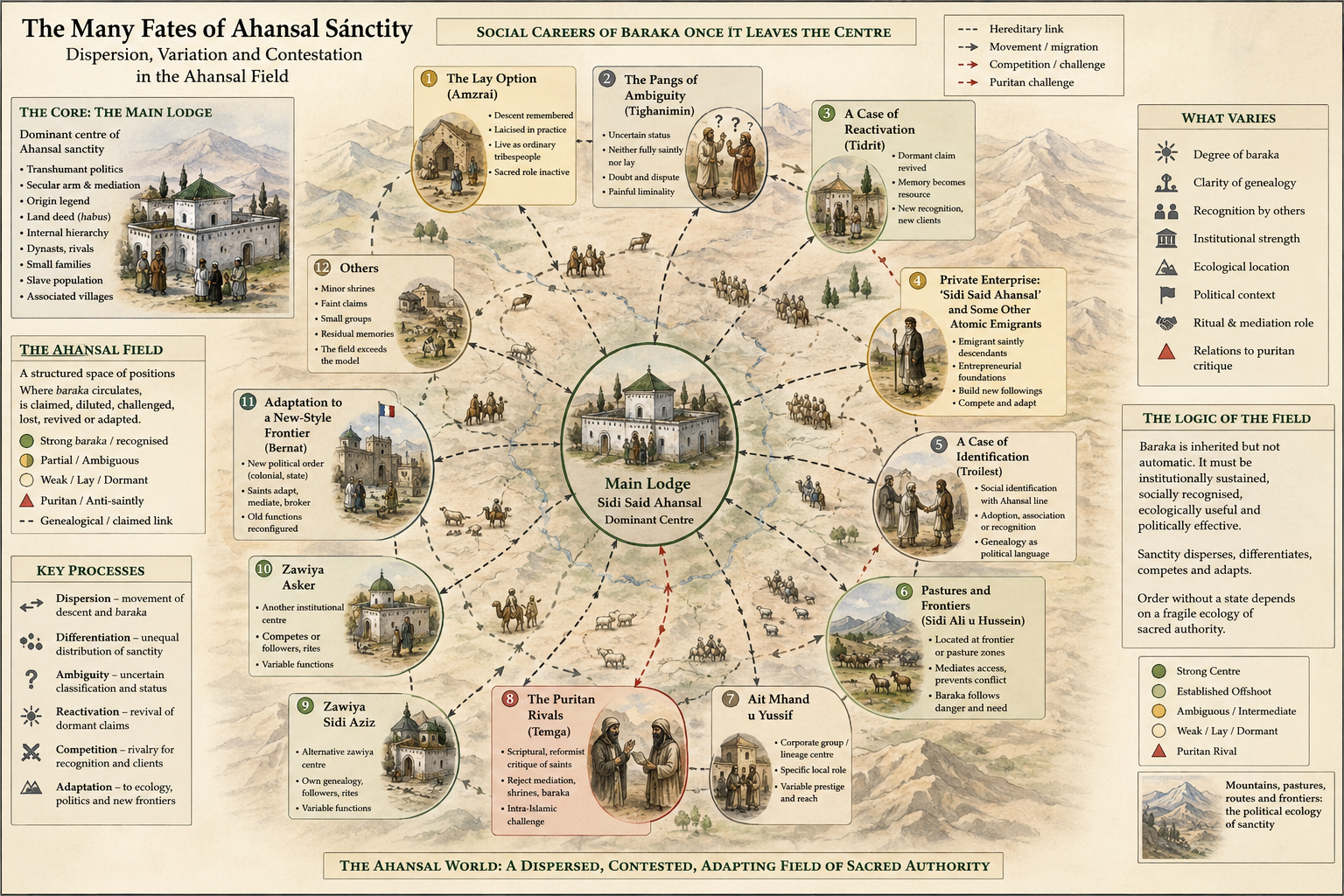
Up to this point the main lodge has dominated the account. We have seen its location, its transhumant politics, its secular arm, its origin legend, its land deed, its internal hierarchy, its dynasts, rivals, small families, slave population, and associated villages. Gellner now takes the argument outward. He asks what happens to Ahansal sanctity once it is dispersed, reproduced elsewhere, partially laicised, reactivated, ambiguously claimed, commercially entrepreneurial, frontier adapted, or challenged by puritan rivals.
The internal sections of the chapter show the movement of the argument very clearly: “The Lay Option (Amzrai)”, “The Pangs of Ambiguity (Tighanimin)”, “A Case of Reactivation (Tidrit)”, “Private Enterprise: ‘Sidi Said Ahansal’ and Some Other Atomic Emigrants”, “A Case of Identification (Troilest)”, “Pastures and Frontiers (Sidi Ali u Hussein)”, “Ait Mhand u Yussif”, “The Puritan Rivals (Temga)”, “Zawiya Sidi Aziz”, “Zawiya Asker”, “Adaptation to a new-style Frontier (Bernat)”, and “Others”. Each section is a different possible fate of saintly descent. Gellner is mapping the social careers of baraka once it leaves the most powerful centre.
The first point is that Ahansal sanctity is a field. A field, in the sociological sense, is a structured space of positions, with centres, margins, rivals, recognised claims, weak claims, newcomers, inherited advantages, and struggles over legitimacy. The main lodge is the dominant centre, but the other Ahansal centres show that saintly authority is unevenly distributed. Some places carry strong baraka. Some carry ambiguous baraka. Some are almost lay. Some reactivate a dormant saintly claim. Some are founded by emigrants. Some are frontier institutions. Some are drawn into puritan challenge. The Ahansal world is therefore not a simple sacred lineage but a differentiated landscape of saintly possibilities.
“The Lay Option (Amzrai)” shows that descent from saints does not automatically produce active saintliness. The “lay option” means that some descendants of the holy line may become effectively laicised. To be “lay” here means living more like ordinary tribespeople than like active bearers of saintly function. The term “laicisation” names the process by which a holy lineage or branch loses, suspends, or fails to exercise its distinctive sacred role. The people may retain a memory of descent, perhaps even some residual prestige, but they no longer operate as mediating saints in the full sense.
Amzrai therefore allows Gellner to pose one of the deepest problems in the book: what makes a saintly descendant a saint rather than merely a person descended from saints? Earlier chapters showed that baraka is hereditary, but though inheritance is necessary, it isn't sufficient. A line can possess genealogical connection yet choose, drift, or be forced into ordinary lay life. The sacred can become socially inactive. This means that baraka is not simply a biological or spritual substance transmitted through a bloodline. It must be institutionally sustained, publicly recognised, ritually enacted, and politically useful.
This has major theoretical consequences. Weber’s “routinisation of charisma” is again relevant, but Gellner shows its fragility. Charisma may be routinised through descent, but descent can fail to reproduce charisma in practice. A holy line can become ordinary. The routinised sacred can run down. Amzrai thus becomes an example of the entropy of sanctity, the gradual loss of active sacred distinction unless it is renewed by shrine, mediation, reputation, clients, ritual, genealogy, and political need.
“The Pangs of Ambiguity (Tighanimin)” then gives another possibility. If Amzrai represents a lay option, Tighanimin represents uncertainty. Ambiguity is a social condition in which classification is unstable. Are the people saintly or lay? Do they possess full baraka, partial baraka, doubtful baraka, remembered baraka, or merely an inherited claim? Ambiguity hurts because status matters. The “pangs” are social, political, and emotional. To be ambiguous is to be exposed to doubt, to lack secure recognition, to be neither fully inside the sacred elite nor simply absorbed into the lay world.
In anthropology, ambiguity often marks a liminal position. A liminal person or group stands between recognised categories. Tighanimin is liminal in relation to holy and lay. Such liminality is unstable because social life needs classifications. Marriage, hospitality, precedence, mediation, oath, honour, and status all depend on knowing who someone is. If a group’s identity is ambiguous, every interaction may reopen the question of rank. Can their daughters marry as saintly women? Can their men mediate? Do lay tribes defer to them? Do other Ahansal centres recognise them? Are they entitled to gifts? Can they claim sanctuary? Ambiguity becomes politically painful because it makes rights contestable.
This shows that sacred status is relational. One does not simply “have” full status privately. Others must recognise it. Tighanimin’s ambiguity is not just internal uncertainty. It is uncertainty in the eyes of others. The social world asks: what are they? And if there is no settled answer, their practical authority is weakened. Gellner is therefore developing a sociology of recognition. Sacred identity exists in a field of acknowledgement, refusal, doubt, gossip, precedent, and comparison.
“A Case of Reactivation (Tidrit)” gives a third possibility. Reactivation means that a dormant, weak, or marginal saintly claim can be brought back into active use. This prevents the model from becoming static. Sacred status may decline, but it can also revive. A line that has been inactive may rediscover, assert, or successfully renew its Ahansal identity. This can happen when political circumstances change, when a settlement needs mediation, when a genealogical claim becomes useful, when a shrine is restored, when new clients appear, or when a charismatic individual makes inherited baraka socially visible again.
Reactivation reveals that tradition is not simply preservation. It is selective retrieval. A saintly past may be dormant until circumstances make it valuable. Then memory becomes a resource. Genealogy can be reactivated. Shrine association can be reinterpreted. Descent can be brought forward as a claim.
Gellner’s structuralism is not merely about fixed categories. It allows for social processes in which categories are revived, reshaped, and reinserted into political life.
A dormant saintly genealogy is like inactive symbolic capital. It exists, but it is not producing returns. Reactivation converts it back into recognised authority. But that conversion requires a field in which others accept the claim. If no one recognises the reactivated status, it remains fantasy. If people accept it, then the past becomes effective in the present. Tidrit therefore illustrates the conversion of memory into power.
“Private Enterprise: ‘Sidi Said Ahansal’ and Some Other Atomic Emigrants” is one of Gellner’s most revealing section titles. “Private enterprise” suggests entrepreneurial saintliness, while “atomic emigrants” suggests individual or small unit migration away from the larger corporate saintly body. These are holy men or saintly descendants who move out, perhaps singly or in small family units, and attempt to establish new centres, reputations, or claims. They do not simply represent the main lodge as official delegates. They operate as relatively independent sacred entrepreneurs.
Gellner's typically playful and suggestive phrase “sacred entrepreneur” names someone who uses inherited or claimed baraka, genealogical prestige, ritual skill, and political opportunity to create a new saintly position. There is an entrepreneurial logic. The emigrant must find a niche. He must attach himself to a community that needs mediation, blessing, arbitration, or sanctuary. He must make his claim visible. He must compete with other sacred specialists. He must produce recognition. He must convert descent into a social role.
Gellner also shows the tension between corporate lineage and individual initiative. The Ahansal saintly system is genealogical and collective, but individual emigrants can break away and found new possibilities. The system reproduces itself not only through planned lineage expansion but through movement, improvisation, and local success. A saintly field is therefore both inherited and opportunistic. Gellner’s wit in calling this “private enterprise” points to the fact that holiness can be institutionally serious and socially entrepreneurial at once.
“A Case of Identification (Troilest)” means that a group or place becomes identified with Ahansal sanctity, perhaps through descent, association, adoption, recognition, or strategic affiliation. Identification is not the same as simple biological descent. It concerns the social process by which a centre comes to be known as Ahansal, or by which its saintliness becomes aligned with Ahansal genealogy. Troilest therefore raises the question of how sacred identities attach to places and people.
Genealogy is not just a transparent biological record. It is also a classificatory and political system. A group may identify with a lineage because that identification solves a status problem, creates a mediation role, connects it to a prestigious sacred network, or explains an existing cult. Conversely, others may recognise or contest the identification. Again, the point is social efficacy. A genealogy works only when it is accepted, remembered, and usable.
“Pastures and Frontiers (Sidi Ali u Hussein)” returns us to political ecology. Pastures and frontiers are the basic material conditions under which saintly authority becomes necessary. A frontier is a zone of contact, friction, negotiation, and danger. Pastures are politically charged spaces where seasonal rights, tribal honour, subsistence, animal wealth, and movement intersect. A saintly centre located in relation to pastures and frontiers has a specific function: it helps regulate access, negotiate conflict, and sanctify arrangements.
The figure or centre of Sidi Ali u Hussein therefore allows Gellner to connect the saintly diaspora to the same transhumant logic that made the main lodge important. Gellner emphasises that the High Atlas context involved huge seasonal movements of people and sheep through mountain bottlenecks, creating ideal conditions for theft and rustling, with saints helping maintain peace without claiming ordinary political control. Gellner shows that this was not only true of the main lodge. Other centres also derive importance from pasture politics and frontier situations.
A centre’s success depends on ecological placement. A saint at a frontier is useful. A saint near contested pasture is useful. A saint at a route of movement is useful. Sacred prestige becomes effective where social danger is recurrent. In this sense, baraka follows conflict. It becomes most visible where peace is difficult.
“Ait Mhand u Yussif” appears as a named group or centre within the Ahansal field. Ait means “people of” or “descendants of”, so the name marks corporate belonging, whether by descent, settlement, or lineage identity. The group must be read as a particular arrangement of saintly claim, local social position, relation to surrounding tribes, and internal status. Gellner’s method is typological but not purely schematic. He wants each centre to illuminate a different structural possibility.
“The Puritan Rivals (Temga)” introduces a different kind of challenge to saintly Islam. Puritanism here refers to a scriptural, reformist, anti saintly, or anti shrine orientation that is suspicious of hereditary holy men, miracle cults, intercession, shrine visitation, and the localisation of sacred power. In Gellner’s broader theory of Islam, this contrast later becomes central: on one side, rural saintly Islam organised around baraka, shrines, holy lineages, and mediation; on the other, more puritan or scriptural Islam oriented towards text, law, equality before God, and hostility to saint worship. What most of us now think of as Islam is this puritan form because this was the form that successfully moved into modernity as colonial rule broke down. The saintly form has largely withered away somewhat.
Temga as “puritan rivals” shows that the Ahansal saintly order does not face only lay ambiguity or internal competition. It faces religious critique. This critique is not merely external secular rationalism. It comes from within Islam. The puritan rivals challenge the theological legitimacy of saintly mediation. They argue that blessing should not be localised in hereditary saints, that shrine practices are improper, that intercession threatens divine unity, or that religious authority should be grounded in scripture and learning rather than hereditary baraka.
The struggle is not between religion and irreligion. It is between different forms of religious authority. Saintly authority is genealogical, local, embodied, mediatory, and miraculous. Puritan authority is scriptural, moralising, often anti mediatory, and hostile to the cult of saints. The conflict is therefore intra Islamic. It asks: what kind of Islam should organise social life?
Gellner’s own later writings sharpen this into a broad binary between rural saint centred Islam and urban scriptural Islam. That binary has been criticised for overgeneralisation, but here Gellner gives it ethnographic substance. Temga shows that saintly authority is contestable not only politically but theologically. A puritan rival can undermine the saint by attacking the very principle that makes him useful. If mediation through baraka is religiously suspect, then the saint’s social role loses legitimacy.
Yet the puritan challenge is also politically complicated. A purely scriptural critique might weaken the local mechanisms that preserve order in a stateless or weakly governed tribal world. If one removes saintly mediation, what replaces it? Courts? Scholars? State law? Tribal assemblies? Direct violence? Puritan reform may purify doctrine while destabilising existing forms of conflict management. Religious reform is never merely doctrinal. It reorganises authority.
“Zawiya Sidi Aziz” and “Zawiya Asker” continue the mapping of alternative holy centres. A zawiya, again, is not simply a shrine. It is a religious lodge, settlement, saintly house, place of teaching, hospitality, mediation, and sometimes Sufi association. These sections show the plurality of saintly institutions beyond the main Ahansal lodge. Each zawiya has its own sacred genealogy, local relation to tribes, degree of prestige, and institutional form. The word itself reminds us that saintly authority is spatially and architecturally embedded. It must have a place where people come, where oaths are sworn, where hospitality is given, where memory is housed.
Zawiya Sidi Aziz and Zawiya Asker function as further cases of variation in the Ahansal landscape. The important point is not only what each one is, but that Gellner is asking the reader to compare forms. Some centres are more like offshoots. Some are stronger as mediating institutions. Some may be more shrine centred. Some may be more genealogically secure. Some may be closer to frontiers. Some may be caught between competing tribal worlds. The comparative method allows Gellner to show that “Ahansal centre” is not a uniform category. It is a family of forms.
“Adaptation to a new-style Frontier (Bernat)” suggests that the older pastoral and tribal frontier is being transformed, by colonial pacification, state expansion, administrative lines, roads, markets, or new political pressures. Bernat separated from the main lodge in the 1920s in conditions arising from the French advance. This means that saintly centres do not merely belong to a timeless tribal past. They adapt to modern frontier conditions.
Bernat shows that saintly forms can respond to colonial transformation. The French advance changed the political ecology. It altered the relation between state and tribe, violence and order, route and authority, old frontier and new boundary. A saintly centre that had once mediated tribal movement now needed to mediate between local society and colonial administration, or between old forms of recognition and new forms of power. The frontier becomes “new style” because it is no longer only a pastoral tribal frontier. It is also a frontier of state penetration.
Colonial rule does not simply abolish local institutions overnight. It redirects them, appropriates them, bypasses them, or forces them to adapt. Saints may lose functions where the state monopolises law and force. But they may also gain new functions as intermediaries, symbolic authorities, or brokers between administration and local population. Bernat is an example of sacred adaptation under altered political conditions. It's undoubtedly the case that even within a reformed Puritan Islam, there are such adaptations, especially outside the main urban centres. And it is also clear that some of the attacks on Sufis in recent times reflects this intra Islamic conflict.
The final section, “Others”, signals the impossibility of total closure. The Ahansal diaspora has more forms than the main typology can exhaust. There are always minor claimants, partial centres, faint genealogical traces, small shrines, marginal settlements, memories, ambiguous holy men, and local stories that do not fit neatly into the main classification. Gellner is a consumate system builder, but the ethnography exceeds the system. “Others” quietly acknowledges that the field is messier than the model.
One can now see Gellner's larger theoretical structure. Here he's discussing what happens when hereditary sacred authority disperses. Dispersal produces variation. Variation produces ambiguity. Ambiguity produces status anxiety. Status anxiety produces reactivation, identification, entrepreneurship, rivalry, and adaptation. The Ahansal world is not simply a descent tree. It is an expanding, differentiating, competing field of sacred claims.
I'll try and hold the central anthropological terms together. Baraka is sacred blessing, but it is unevenly effective. Genealogy is descent, but also a political language. Zawiya is a shrine lodge, but also an institution of mediation. Laicisation is the loss or suspension of active sacred role. Reactivation is the revival of dormant sacred capital. Identification is the attachment of a person or place to a prestigious sacred lineage. Frontier is a zone of contact and conflict, not merely a boundary line. Puritanism is an intra Islamic critique of hereditary saintliness, not secular disbelief. Private enterprise is the individualisation of saintly expansion. Ambiguity is not conceptual vagueness but a painful social status.
Politically, Gellner shows that saintly authority is not a settled hierarchy descending smoothly from Sidi Said Ahansal. It is a struggle over recognition. Each centre must answer the same questions: what is its relation to the founder? Does it possess active baraka? Does it mediate? Is it recognised by lay tribes? Does it have a shrine? Does it control land or pasture relations? Does it solve conflicts? Is it merely lay? Is it ambiguous? Is it puritan and therefore anti saintly? Is it old, new, reactivated, emigrant, or adapted?
Earlier Gellner sometimes made the system look elegant: lay tribes balance one another, saints mediate, the main lodge stands at a frontier, baraka stabilises conflict. But he also shows the messy reproduction of that order across space and time. Some centres fail to remain holy. Some suffer uncertainty. Some revive. Some innovate. Some challenge the saintly principle itself. Some adapt to colonial modernity. The system is not a machine. It is a field of historical processes.
Gellner also gives us a more sophisticated account of the relation between centre and periphery. The main lodge is the dominant centre, but peripheries are not passive. They reinterpret, dilute, extend, challenge, and sometimes renew the centre’s authority. A peripheral centre may depend on the prestige of the main lodge, but it may also develop its own local power. An emigrant saint may carry the central genealogy outward, but in doing so he creates something partly independent. A reactivated centre may draw legitimacy from the past while responding to present conditions. Peripheral sanctity is therefore derivative and creative at once.
This complicates the notion of orthodoxy. Within the Ahansal world, what counts as proper saintly status? The main lodge may claim centrality, but other centres claim variations. Puritan rivals reject the entire saintly structure. Ambiguous groups suffer uncertain classification. Reactivated groups test the boundaries of recognition. The saintly field has no single bureaucratic office that can issue final certification. Recognition is distributed. This makes the system flexible but unstable.
Weber helps us see hereditary baraka as routinised charisma, but that routinisation is never complete. Durkheim helps us see sacred classification, but contested. Evans Pritchard helps us see segmentary contexts, but that segmentary balance requires saintly differentiation and that saintly differentiation itself fragments. Bourdieu helps us see sacred capital being accumulated, lost, converted, reactivated, and contested.
The most important political implication is that non state authority is not simpler than state authority. It is, in many ways, more complex and delicate. A state can certify judges, draw districts, appoint officials, tax, police, and archive. The Ahansal saintly field must do analogous work through genealogy, shrine, reputation, sacred stories, mediation, oath, settlement, and recognition. It has no central registry of sanctity. It has no final court of saintly status. It has no police force to impose classification. Therefore classification itself becomes social practice. People become saintly by being recognised as saintly, and recognition must be sustained.
Gellner thus argues that order without central government requires differentiated forms of authority, but those forms are themselves unstable and historically variable. The saints are not simply the solution to tribal disorder. They are a second problem, a sacred field that must reproduce, classify, rank, and legitimate itself. The other Ahansal centres show the many fates of holiness once it moves away from the main lodge: it can become lay, ambiguous, reactivated, entrepreneurial, identified, frontier based, puritan, institutionalised in new zawiyas, adapted to colonial frontiers, or left in residual minor forms.
Gellner's Ahansal world appears less like a single holy lineage and more like a dispersed political ecology of sanctity. The main lodge remains central, but its centrality is not enough. Around it are centres that show decline, pain, revival, experiment, theological rivalry, ecological placement, and historical adaptation. Gellner’s saintly system is rich and untidy. Baraka is no longer merely inherited sacred force. It is a mobile and contested social resource, strongest where genealogy, place, need, recognition, and political opportunity converge.
(To be continued)
Previous Parts here.