Joshua Braver, We, the Mediated People: Popular Constitution-Making in Contemporary South America
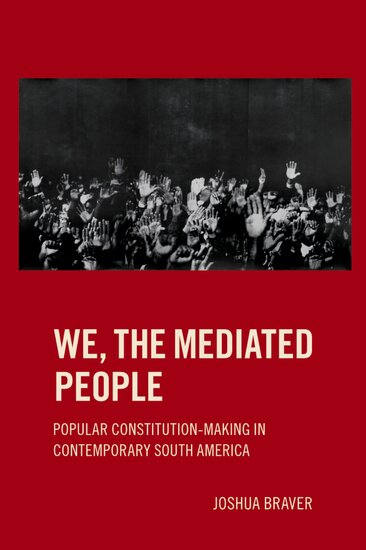
Joshua Braver, We, the Mediated People: Popular Constitution-Making in Contemporary South America (Oxford University Press, 2023)
Whether or not constituent power is, like Freud’s id, some sort of uncontrollable monster, there can be little question that it has nearly taken over current democratic theory. There is not only the immense new Oxford Handbook on the subject, but also several of the items that have recently been reviewed here. Lucia Rubinelli (one of the editors of the aforementioned handbook) has given us a careful history of le pouvoir constituant (see this), J.H. Snider (see this) has provided a detailed program for how it ought to be unleashed so that new constitutions can be forged in U.S. states, Stephen Legomsky (see this) has suggested that fundamental changes can never get a head of steam in America so long as the U.S. is a federal republic, and, of course, there is a steady stream of apparently endless Carl Schmitt scholarship.
The subject text today, Joshua Braver’s We the Mediated People, is a timely and fact-filled addition to this literature. It is in some ways a strange book, because, while the author is clearly sympathetic to various causes around the world that many would consider radical, his proposals for getting them in place are partly Madisonian, even arguably Kendallian (see this). While Braver’s preferred outcomes seem to jibe closely with those of Legomsky, he considers any sort of unifying of a polity extremely dangerous because he holds that constituent power is indeed id-like, utterly uncontrollable without the help of ego/superego-type restraints that radical democrats often denounce, such as separation of powers, bicameral legislatures, and strong independent judiciaries. Without proper treatment, constituent power is taken to be so insubordinate that, even if its heart is in the right place, it is too dangerous to uncage.
Braver adduces substantial empirical evidence for his fears, mostly from the recent histories of Venezuela, Ecuador, Colombia, and Bolivia. And he makes a compelling case that, even if Carl Schmitt’s ideas can only be summoned in classrooms (or secret society basements) in certain countries, those views are called upon quite openly elsewhere. Hugo Chavez, for example, had no compunctions about distinguishing “friends” from “enemies.” And he had no hesitation about making democracy relate only to friends (i.e., the real “people”) and then designating himself and, perhaps, some handpicked constitutional assembly, the sole and perfect representative of this preferred group.
Partly because of contemporary demagogic uses of the ideas and words of Schmitt (as well as Sieyes, Hobbes, and Rousseau), Braver spends a good deal of time discussing the works of those thinkers. The material on Schmitt seems to me particularly good, especially where it focuses on what the Weimar jurist took to be the leader’s free choice of criteria for distinguishing friends from enemies. As Braver points out, that is just one additional facet of Schmitt’s decisionism: it is included in the leader’s unlimited flexibility to decide nearly every matter. Braver generally accepts the Tuckian view of Hobbes and the Schmittian interpretation of Sieyes. But, while he insists in a footnote that his views of the latter are consistent with Rubinelli’s, the two texts don’t bear out that contention. While Braver claims that Sieyes called for an immensely powerful unified government, Rubinelli denies that Sieyes even took the people to be sovereign, as that term is generally understood. As I see this matter of historical exegesis, Braver deduces from various remarks of Sieyes that because the third estate should have ALL the power to make laws and execute them (and the nobles should have none), the people must be extremely potent. I believe Rubinelli would say that is a mistake, similar to calling the motive power of a toy car with a rubber band engine extremely formidable (and therefore dangerous) because nothing else is involved in making that item move. Braver adopts Schmitt’s interpretation of Sieyes, and that take is criticized at length in Rubinelli’s book. This matter, of course, can be considered scholastic hairsplitting and neither here nor there for purposes of political activism. For even if Schmitt was wrong about what Sieyes believed — that sole power implies unlimited potency — it doesn't follow that Sieyes was correct in denying that connection. That is, exclusivity of power may imply unlimited potency whether or not Sieyes realized or was willing to admit it. Thus, an empirical investigation of exactly the sort Braver conducts may be what is necessary for those interested in the real-world effects of unleashing constituent power.
Braver's sympathies, as I noted at the outset, lie with causes that are recognizably of the left — indigenous rights, redistribution, and resistance to neoliberal retrenchment — and those sympathies are not merely implicit in his choice of case studies. They surface directly in his own words: “For hundreds of years the underclass of the indigenous and workers have suffered immense stigma and discrimination. Inequalities of wealth in South America have long been among the worst in the entire world, fueling class prejudice. Adding insult upon injury, the 1990s saw the beginning of decades of neoliberal policies and corruption that shredded the social safety net, eviscerated the workers' movement, and exacerbated long-standing inequality. The status quo was unjust. It was rightly changed….” Such remarks appear throughout the book, making Braver’s own leanings unmistakable.
But progressive as the outcomes he seeks may be, Braver is always cognizant of what he takes to be the only safe means of achieving them. If illegal steps are often required, complete lawlessness is always to be avoided. Why? Because he follows Hobbes in taking both civil war and utter anarchy to be even worse than neoliberal injustice to various classes, races, or ethnic groups. Extreme, even illegal measures may sometimes be required, but never complete disregard of law, because Madisonian devices are needed for purposes of both safety and efficacy. Even where governmental forces are going to be under the control of “friends,” there must remain some influence by “enemies,” and, in Braver’s view, the only way to achieve that is by retaining fragments of previously enacted liberal artifacts. As even new constitutions cannot be created out of whole cloth, they must at least contain remnants of the older materials. In other words, if the old guard can’t have the reins, they may well be calmed by being provided with keys to the stable and a curry comb. Given nothing at all, they will likely fight — and, as in Conrad's Nostromo, power will simply change hands, back and forth, indefinitely.
In fact, based on his research, Braver is fairly confident about the particular items of tack that should be distributed, whatever the old (and now possibly “moribund”) requirements may contemplate. For example, he argues that, in 1999, regardless of any specific provisions in the 1961 constitution, the Venezuelan Supreme Court – which Braver says did a creditable job in trying to handle the extremely powerful new Constituent Assembly – could have done better. While the Court developed a “promising concept of extraordinary adaptation,” the concept itself is said only to have been “nascent.” As a result, the guardrails the Court attempted to put in place in order to prevent a complete fall into lawlessness didn’t quite work. This failure was not a result of insufficient application of old constitutional or legal provisions, however, but of failing to “fully develop the implications of the third principle of inclusion so as to make the crucial decisions about the content of electoral rules necessary to restrain Chavez.” Whatever the old laws might have prescribed, the Court needed to act in ways that would “increase the likelihood that the electoral rules would be inclusive and permit a more proportionate representation for the opposition in the Constitutional Assembly.”➹
In this instance, Braver demonstrates a willingness to substitute his own views about democratic principles for those expressed in any prior documents or decisions when that seems necessary, which is a move he regularly condemns in autocrats. I myself think such substitutions of principle for what one may happen to find lying around in the historical record can be absolutely appropriate (even when politically unhelpful), but I am uncertain that the architecture of Braver’s book allows him to make the case for such substitutions without seeming to engage in the same sort of authoritarian-style shenanigans for which he criticizes Chavez and others. The key to getting this right, I think, is to recognize the foundations of good democratic theory and start with them rather than any historical artifacts – though the latter may still prove useful in selling those principles to the public. It is also crucial to attempt to separate in one’s own mind those proclamations that are thought to be good steps because of their estimated political utility from those that are considered absolutely essential to any democratic polity, regardless of the current political headwinds. It’s not always clear that Braver has carefully and consistently made that distinction when giving his recommendations.
I said above that Braver relies on an empirical study of several Andean nations to arrive at his theses, which chiefly involve what he calls “extraordinary adaptation” of new legal foundations. These are formally illegal (but not lawless!) enactments that require both that multiple previous rule-following attempts at overhauls have failed and that the illegal processes eventually used are exceedingly inclusive.# Such inclusivity is said to imply that the adoption method allows at least some voice to one or more antagonistic parties (the above-mentioned “enemies”).
Of course, a well-known requirement when attempting to derive value statements from empirical data is that, to avoid the suspicion that one has produced an “ought” conclusion from exclusively “is” propositions, there must be normative, perhaps unstated, axioms at play as well. Braver’s values are easy to see from the quote above, but will those with different political perspectives agree with his axioms? Consider: Braver divides partisans into two main groups, radicals (those who are willing to go the lawless route to get desired changes) and legalists (liberal, rule-of-law backers who oppose radicalism). Extraordinary adaptation, Braver’s reasonable suggestion for splitting the difference between those two perspectives, may be impatient enough for radicals even though it does not take matters entirely off the legal rails. If we concede that, where brand new constitutions are needed, anything other than extraordinary adaptation is highly likely to produce utter chaos, I think we can grant that legalists will also reluctantly get on board. After all, even if they don’t like unlawful enactments, civil wars are even worse for the rule of law. Though extremely progressive, Braver is evidently in that camp too. The central question that remains seems to me to be whether radicalized chattel or proletarian slaves will agree with Braver’s compromise. I think that’s uncertain, since chaos may be (or be thought to be) better for them. Their choice may be a matter of exactly how bad off they are – and of how long they have suffered. And that, of course, will vary by jurisdiction.
Putting aside the question of whether people in certain horrific conditions are likely to assent to Braver's values, we can consider the different problem of whether his political universe includes all the available positions. I am inclined to deny that his continuum, which extends from legalist liberals to lawless radicals, covers the entire landscape. For example, I myself give democratic principles priority over the sorts of outcomes that either right- or left-wing radicals or legalists seek.* So, while I too would hate civil unrest much more than living in a merely ostensible democracy, my main complaints (and I think Sieyes’s position is more similar to this than Braver recognizes) do not involve outcomes that I believe to be unjust, but instead focus on processes like bicamerality, supermajority requirements, absence of recall (and other Madisonian/Kendallian “prior compact” magic) that I believe serve mostly to prevent majorities of equally treated people from getting what they want from their governments. So it’s not so much the illegality here that is likely to be concerning to proceduralists. The problem is that what extraordinary adaptation seems to require in the way of anti-democratic gizmos is precisely what majoritarian democrats oppose in liberal systems. Thus, we proceduralists stand to gain very little, regardless of which of two outcome-oriented parties wins.
While I do not suggest that strictly procedural interests are likely to lead thinkers like Sieyes (or Bentham or Kelsen) to prefer inevitably chaotic consequences to their much milder dissatisfaction over, say, a filibuster rule, my sense is that both legalists and radicals are more likely to be convinced by proceduralist arguments for democratic alterations than by anything put forth by their arch-enemies. And that fact may make proceduralists more sanguine – if less devious than legalists – about delay. I mean, Chavez supporters know what authentic majoritarian democracy might mean for them, and legalists are certainly likely to prefer tweaks like unicameralism and recall to utter abandonments of democracy like Schmittian authoritarianism. Naturally, each of these three parties thinks it is correct, but which one can offer each of the others something that is not overtly contrary to its principles? No doubt, I am being overly optimistic here: it’s quite possible that the proceduralists would eventually have to disappear from the battlegrounds (like Sieyes) or “be disappeared” (like Condorcet). I nevertheless take a bit of comfort from the recognition that this is the common fate of small third parties, even ones offering something that may actually maximize prudential value for the entire population.
Braver’s histories of the various goals and methods he describes for forming “WE/THEY” juggernauts in Ecuador, Bolivia, and Colombia are extremely interesting and informative, especially with respect to the quite different attitudes taken toward indigenous populations in each country during these takeovers. Readers without extensive backgrounds in comparative government or South American history (like me) stand to learn a lot. Particularly illuminating is the fact that this nonuniformity is not a strict function of either left-versus-right views or population totals of the various cohorts. For example, while Rafael Correa and Evo Morales joined Chavez in excoriating the rich, “patriarchal” elite, Correa differed by also demonizing left-wingers, unions and the indigenous. That tactic may seem risky, particularly since the latter group makes up as much as a quarter of the Ecuadoran population. But Correa determined that they were divided and poorly organized during his quest for power. So, it turned out to be more useful to him to unify his coalition by casting the indigenous as enemies. He found numerous “Trojan Horses” to attack, including “leftism, ecologism and infantile indigenism” and dismissed them all as the new reactionaries. Furthermore, happy to ignore mirrors, Correa was quick to fault “organizations that do not represent anybody but that behave as though they represented everybody.”
Braver’s chapters on Colombia and Bolivia are equally excellent: wonderfully detailed and replete with scholarly references that include the key arguments found in those texts. I found the discussion of emergency decrees and their relevance to constitutional alterations especially thought-provoking. But the tales of battles between constituent assemblies, congresses, and courts are generally fascinating throughout these chapters. We learn that Bolivia and Colombia availed themselves of extraordinary adaptation and kept their new and brittle constitutional “vases” intact; Venezuela and Ecuador relied on lawless sovereignty and shattered theirs. While the names, circumstances, and results obviously differ for the several polities, Braver’s main themes remain. His moral again is that constitutional overhauls may require illegality when traditional methods have repeatedly failed, but such lapses should neither be nor be considered instances of total lawlessness. For a fundamental replacement of a legal structure to succeed, not only must there be wide popular support for the change, but the procedures involved must be broadly inclusive and, where possible, involve such devices as proportional representation. Although constituent power is the most basic of political forces and therefore extremely difficult to harness, there are rival powers available in the form of natural attachment to precedents, societal calm, continuity of institutions, and common notions of justice. Use these countervailing forces wisely, and both anarchy and Schmittian-style despotism might be avoided.
If the conclusions in Braver’s book occasionally seem a bit overconfident or suggest a certainty that will likely always be unobtainable in the real world🗡 (and if the copyediting is less than meticulous throughout), this may just reflect the impatient exuberance of youthful scholarship. We, the Mediated People is a fine work that may well serve as a valuable manual in any future revolutionary era. And this is the case even though I don't share Braver's confidence that radicals are simply wrong to find a unifying quality in “the people.” I demur here because, to my mind, the absolutely equal treatment of citizens and their wants is exactly that quality, and it's something that liberal legalists tend to miss. Nevertheless, after reading Braver's book, those who wonder at the ingenuity and audacity of the U.S. framers — a group that might have seemed to have had only the Articles of Confederation to work with — may come away with a new appreciation for how many tools were actually available to the framers themselves, and with a broader perspective of their own for considering that transformative moment.
---------------------------------
➹ Braver actually suggests four different alternative electoral strategies the Court could have utilized that might have prevented it from “flopping” at this crucial moment. These range from substituting proportional representation for an existing FPTP rule to changing the requirement for referendum success from plurality to majority. The Congress is also faulted for failing to recognize what Braver thinks would have been its own most prudential moves at the time.
# In an interesting discussion of two writers who have influenced him, Braver praises Hannah Arendt for recognizing the importance of inclusivity but faults her for being hesitant to embrace illegality when necessary; and he lauds Bruce Ackerman for his willingness to accept illegality when necessary but believes he assigned too little importance to the inclusion of hostile interests in constitution creation.
* For details, see this, this, or (for the briefest possible, lightning round version) this. To be honest, nearly everything I have written over the last decade touches on this point. See also Everett Hall’s 1943 paper “An Ethics for Today” (The American Journal of Economics and Sociology), which has inspired a good deal of my thinking and writing on democratic theory.
🗡To give a couple of examples, Braver tells us with assurance that “there is nothing particularly wrong with supermajority voting requirements within assemblies.” Calhoun would agree. And, apparently based largely on an article by Jeremy Waldron, Braver seems satisfied that separation of powers is needed not only to prevent tyranny but to “protect law’s generality.” Well, maybe. But the success of numerous parliamentary systems seems to me to put such claims in doubt. Rational deliberation often survives there, and any alleged “colonization of the executive” may result in more democratic administrations than can be found in separated systems. My point is only that such contentions are controversial – just like nearly all the proclamations regarding the essentials of good government that were put forth by Montesquieu or Madison.
About the Author
Walter Horn is a philosopher of politics and epistemology.
His 3:16 interview is here.
Other Hornbook of Democracy Book Reviews
His blog is here