Saints of the Atlas 8
Gellner now asks: what kind of society exists inside the holy centre itself? If the lodge is the institutional body of baraka, sacred blessing, how is that body internally organised? Who ranks above whom? Which families matter? How does saintly descent become hierarchy? How do internal rivalries develop among people who all, in some sense, share sacred ancestry? What happens to a system of inherited charisma when the descendants multiply and settle into different households, factions, offices, reputations, and degrees of wealth?
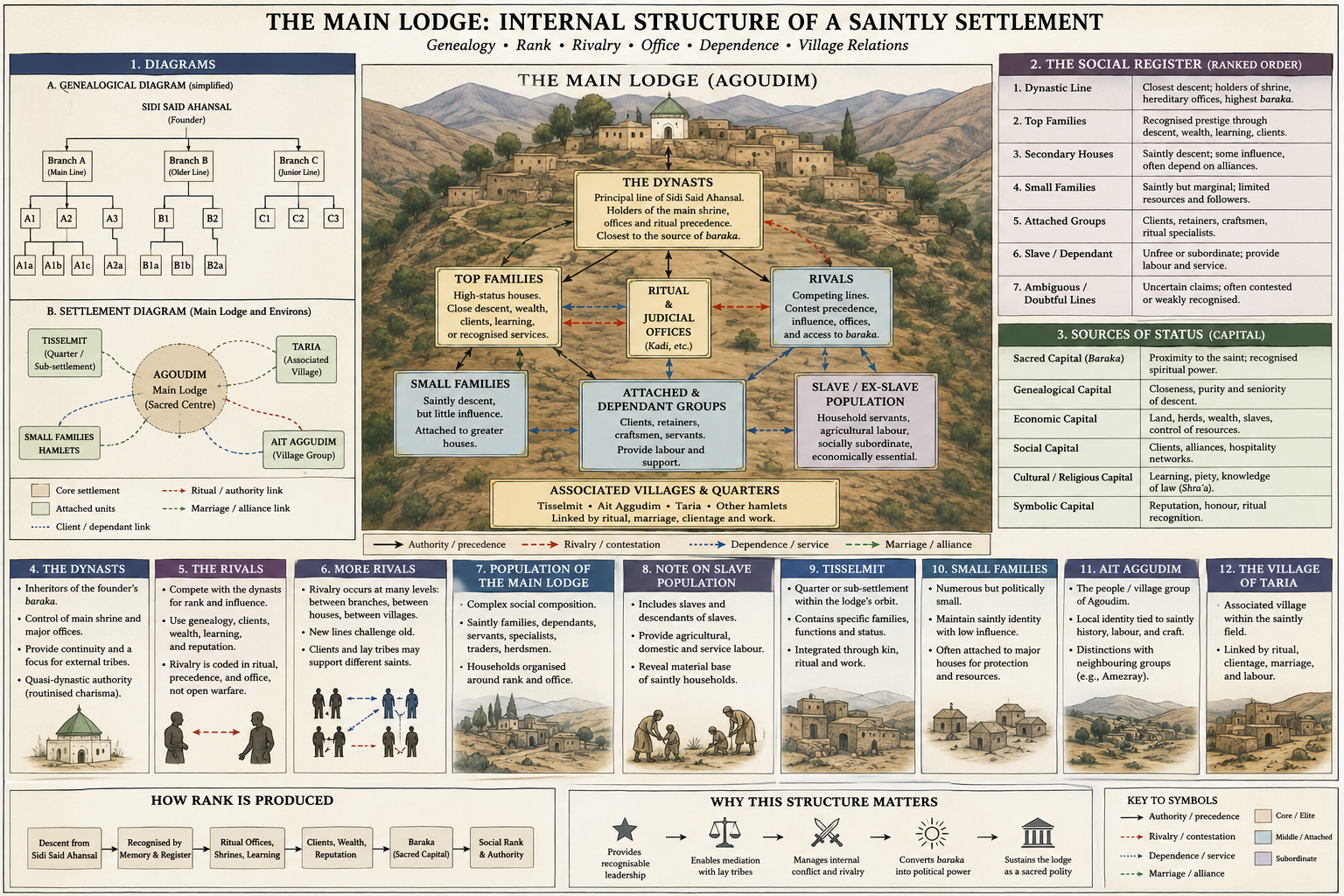
The chapter’s internal divisions are themselves revealing: “Diagrams”, “Top Families”, “The Dynasts”, “The Rivals”, “The Social Register”, “More Rivals”, “The Population of the Main Lodge”, “A Note on Slave Population”, “Tisselmit”, “Small Families”, “Ait Aggudim”, and “The Village of Taria”. Gellner is doing a kind of political anatomy. He cuts into the saintly settlement and shows that it is not a homogeneous sacred community but a stratified and contested field. The table of contents confirms this architecture and places the chapter immediately after the discussion of the main lodge’s location, which is important because Gellner is deliberately moving from external position to internal composition.
In the first section, “Diagrams”, Gellner is trying to make visible a social order that cannot be understood through a simple narrative list. Genealogical diagrams, settlement diagrams, and classificatory schemata are necessary because the lodge’s internal structure is a structure of descent, rank, segmentation, and remembered relationship. A diagram in this kind of anthropology is an analytical instrument. It shows how households and descent lines are placed in relation to each other. It reveals who is close to the founding line, who branches off, who competes, who belongs to the dominant stratum, who has marginal status, and how political claims are embedded in kinship form.
Genealogy in Gellner’s world is a political language. To say that one family descends from a particular ancestor is to locate that family in a hierarchy of legitimacy. In a saintly settlement, genealogy is intensified because descent is not merely descent from a lay ancestor but descent from a bearer of baraka. Genealogy therefore becomes a conduit of sacred capital. It explains why some families are closer to the main line, why some can claim greater prestige, why some have stronger rights to mediate, and why some are treated as secondary, ambiguous, or marginal.
Yet Gellner is too sociologically alert to imagine that genealogy by itself determines everything mechanically. Diagrams clarify claims, but social life tests them. A family may have descent, but does it have wealth? Does it have clients? Does it have learned men? Does it control a shrine? Does it possess a reputation for sanctity? Does it have political allies? Does it have descendants numerous enough to matter? Does it have a history of effective mediation? Descent supplies the grammar of rank, but it does not automatically settle the whole politics of the lodge.
In “Top Families” we see that the saintly population is not a flat body of equal holy descendants. Some families are recognised as leading houses. “Top families” are those with superior standing within the lodge, whether because of proximity to the dominant genealogical line, possession of offices, control of ritual resources, wealth, client networks, or a history of recognised authority. Their superiority is not the same as ordinary political sovereignty. They do not become a central state. But within the lodge they occupy a ranked position.
The saints are not simply “the sacred” standing above “the lay”. Within the sacred stratum there is further stratification. The saintly world has its own elites, rivals, dependants, small families, ambiguously placed groups, and subordinate populations. Sacred hierarchy does not erase internal politics. It generates internal politics.
Stratification here means socially recognised ranking. It differs from simple difference because it involves higher and lower, more prestigious and less prestigious, central and peripheral. The main lodge is stratified because some saintly houses possess more recognised baraka, more genealogical prestige, or more political authority than others. The fact that all may be Ihansalen, descendants of Sidi Said Ahansal, does not mean that all are equally placed. Sacred descent creates a field of eligibility, but within that field there are sharp distinctions.
“The Dynasts” then names the most explicitly political form of this internal hierarchy. A dynast is a member of a ruling or dominant family line. In this context, the word must be used carefully, because the main lodge is not a monarchy in the formal state sense. There is no king of the lodge in the modern constitutional sense, nor a bureaucratic office with sovereign command. Gellner’s use of the term points to a family or set of families whose authority has become quasi dynastic. They hold inherited prominence. They stand closest to the institutional heart of the lodge. They are the main possessors, or at least the principal public representatives, of the lodge’s sacred and political capital.
Weber’s idea of routinised charisma helps. A founder’s charisma, his extraordinary sacred force, cannot remain merely personal after his death. It must be transmitted. In the main lodge, it is transmitted through descent and household rank. The dynasts are the result of that transmission. They are not simply charismatic individuals. They are inheritors of an institutionalised charisma. Their authority is routinised because it has become regular, genealogical, and socially expected. Yet it remains charismatic because its foundation is still baraka, not merely administrative office.
The dynasts also show why saintly authority is not the same as lay chieftaincy. A lay chief, or amghar, is usually temporary, often selected through rotation or local procedure, and embedded in tribal balance. The dynastic saintly line is more enduring. It is not elected in the same way. Its authority rests on sacred descent. The contrast is fundamental. Lay office circulates to prevent domination. Saintly prestige concentrates to provide continuity. The lay world distrusts permanent political power. The saintly world requires some permanent sacred authority in order to mediate the lay world’s conflicts.
But the chapter immediately complicates dynastic dominance through “The Rivals”. If there are dynasts, there are also rivals, and this is decisive. The main lodge is not a harmonious sacred family. Rivalry exists within holiness. This rivalry follows from the structure itself. If baraka is hereditary, and if descendants multiply, then more than one line can claim connection to the founding saint. If certain families dominate, others will contest their pre-eminence. If offices, gifts, hospitality, clients, marriage alliances, shrine access, and arbitration roles are at stake, then saintly men will compete.
This internal rivalry must be expressed under the ideological constraint of sanctity. Ordinary lay rivalry may be open, armed, honour based, and segmentary. Saintly rivalry cannot simply take that form without damaging the sacred image of the lodge. The saints are supposed to be peaceful, mediating, set apart from ordinary feud. Their rivalries therefore tend to be coded through genealogy, reputation, ritual precedence, claims to superior descent, control of shrines, connection to clients, possession of learning, or association with more effective baraka. The rivalry is political, but it must not look political.
A social register is a ranked list of who counts, who belongs, who is prestigious, who is marginal, who may marry whom, who is recognised as noble, who is merely attached, who is remembered, and who is almost forgotten. Gellner is analysing a register of status. In a society where formal bureaucracy is limited, social memory performs classificatory work. People know, or claim to know, which families are high, which are lesser, which are legitimate, which are doubtful, which are attached by clientage, which are saintly in full status, and which occupy ambiguous positions.
Status is socially recognised standing. It differs from mere economic wealth because it involves honour, rank, and legitimacy. A poor saintly family may retain high status because of genealogy. A wealthy but low status family may remain socially inferior ( just like in England we have 'new money' and 'old money'). Yet wealth and status interact. Wealth can support hospitality and therefore prestige. Prestige can attract gifts and clients. Clients can support political influence. Influence can enhance the appearance of baraka. Gellner’s social register is a living map of the conversion between genealogy, wealth, recognition, and sacred authority.
The lodge contains multiple lines of competition. The main dynasts may be challenged by one set of families, but other families may contest other forms of rank. Rivalry can occur between close branches, between older and newer lines, between wealthy and poor descendants, between families with ritual standing and families with political clients, between those who possess learning and those who possess inherited prestige, between families based in the central village and those linked to neighbouring settlements. The saintly community is internally plural.
This destabilises any idea that the saints form a single corporate actor. Chapter Seven shows that this collective term 'saints' hides internal divisions. “The saints” are a category in relation to lay society, but inside that category they are a stratified population. This is a common anthropological problem: a group may appear unified from outside but deeply divided from within. The external relation simplifies. The internal relation complicates.
“The Population of the Main Lodge” broadens the view from elite families and rivals to the whole settlement. Population here is not merely demography, though numbers matter. It is social composition. Who lives in the main lodge? Which families are saintly? Which are clients? Which are servants? Which are slaves or descendants of slaves? Which are small families attached to larger ones? Which are ambiguous? Which neighbouring villages are linked to the lodge? The lodge is a sacred centre, but it is also a village with households, labour, dependencies, gendered relations, property, and everyday social life.
“A Note on Slave Population” forces into view a dimension that can easily be hidden by the language of sanctity. Holy settlements may include slaves or ex slave populations, dependants, servants, and socially inferior groups. This shows that sacred authority sits within a broader social hierarchy that includes unfree or formerly unfree labour. The saints’ capacity to host, maintain households, cultivate land, and sustain ritual life may depend on subordinate labour. The sacred institution has a material underside.
Gellner’s saints mediate disputes, protect sanctuary, carry baraka, and help regulate tribal order but they are also embedded in relations of inequality. The holy does not abolish domination. Sometimes it organises it. The presence of slaves or slave descendants reminds us that “stateless” does not mean free, equal, or benign. A society may lack a central state and still contain harsh forms of dependency. The absence of bureaucracy does not imply the absence of hierarchy.
Slavery in Morocco had varied forms, including domestic, agricultural, military, and status based forms, often shaped by trans Saharan histories and local hierarchies. In Gellner’s lodge, the important point is that unfree or dependent populations help reveal the material and social base of saintly life. The saintly house is not simply a gathering of holy descendants. It is an estate like formation, or at least a ranked domestic and settlement structure, in which labour and status are unequally distributed.
“Tisselmit” then appears as a specific internal or associated component of the lodge’s structure. Gellner is distinguishing a named social unit within the main lodge’s orbit. Such named units show the lodge’s internal structure is spatially and genealogically articulated. A saintly centre is not just one undifferentiated village. It has quarters, sub settlements, neighbouring communities, ranked lines, attached groups, and remembered divisions. Each name carries social information. To know the name is to know something about origin, status, relation to the main line, and place in the local hierarchy.
In the section “Small Families” Gellner is attending to minor saintly or attached households. Small families may have saintly descent but little influence. They may be attached to greater families as clients or dependants. They may possess marginal claims. They may provide labour, marriage connections, ritual participation, or local knowledge. Their smallness is not necessarily numerical alone. It is political smallness, a lack of major recognised standing.
The category of small families also returns us to the overproduction problem discussed earlier. Hereditary sanctity multiplies descendants. Not all can become major saints. Some become small families within the holy settlement. They remain within the sacred universe but at a lower intensity of recognition. This is one of the ways the system absorbs excess saintly descent. It does not deny their ancestry, but it ranks and marginalises them.
“Ait Aggudim” links the people of the lodge to a specific village identity. The modern ethnographic work of Stefan Holdermann notes that Agoudim was historically the village of the main lodge and saintly houses, and that this history continued to shape local distinctions, including claims about dance, work, craft, and social identity in relation to neighbouring Amezray. This later observation shows that Gellner’s chapter was not dealing with an abstract lineage diagram only. The internal structure of the lodge had lasting village consequences. The saintly past remained legible in local ideas of status, labour, and propriety.
The name 'Ait Aggudim' follows a Berber naming pattern in which 'Ait' means “people of” or “sons of”. Such names often mark descent, locality, or corporate belonging. In this context, Ait Aggudim evokes the people associated with Agoudim, the village of the main lodge. The point is again that saintly structure is not simply genealogical but territorial and residential. To belong to a named village group is to occupy a place in the social geography of sanctity.
“The Village of Taria” extends the internal analysis beyond the main saintly village to an associated settlement. This is typical of the chapter’s method. Gellner does not allow “the main lodge” to remain a single dot on the map. He disaggregates it into component settlements and related villages. Taria must therefore be understood as part of the lodge’s local social field, whether as neighbouring, attached, subordinate, rival, or functionally linked. The sacred centre is not just a shrine but an ecology of settlements. Authority radiates through nearby places. Labour, marriage, clientage, ritual participation, and status distinctions are distributed across them.
Chapter Seven shows that sacred authority has an internal class structure, although “class” must be used carefully. In a Marxist sense, class refers to relations to production, property, and labour. The main lodge does have economic differentiation, property, slaves or ex slaves, and dependants. But its hierarchy is not reducible to class. It is also genealogical, sacred, reputational, and political. A family’s place depends on its relation to baraka, descent from the founding saint, recognised rank, settlement location, access to clients, and material resources. This is a multi dimensional hierarchy.
Maybe Bourdieu’s concept of different forms of capital is helpful here. Economic capital means wealth and resources. Social capital means networks and connections. Cultural capital means recognised competence, learning, style, or refinement. Symbolic capital means prestige recognised as legitimate. In the main lodge, sacred capital is a form of symbolic capital grounded in 'baraka'. The top families hold more sacred capital than small families. Dynasts possess institutionalised symbolic capital. Rivals contest it. Slave populations lack it or are structurally excluded from it. The social register records its distribution.
But Gellner’s model is less interested in subtle habitus than in institutional function and structural position. His question is always: how does this internal hierarchy allow the saintly lodge to perform its external role? The answer is that internal hierarchy gives the lodge continuity and recognisable leadership. If the lodge were internally formless, lay tribes would not know whom to approach. If every descendant claimed equal authority, mediation would fragment. The dynasts and top families provide focal points. The social register stabilises expectations. Rivalry threatens this stability but also renews it by testing claims.
This is where internal structure connects back to the politics of the surrounding tribes. The lodge mediates lay conflicts, but it must first manage its own conflicts. A divided lodge may weaken saintly authority. A dominant line may stabilise it. Rival lines may offer alternatives to clients. Lay tribes can exploit saintly rivalries, choosing one saint over another. Saints can use lay clients in internal competition. Thus the boundary between internal and external politics is porous. The lodge’s internal divisions are not merely domestic matters. They shape the wider field of mediation.
This also complicates Weber’s typology. Weber distinguishes traditional, charismatic, and legal rational authority. The main lodge combines elements of all three, though in a non modern form. It is traditional because authority is inherited and sanctified by custom. It is charismatic because the ultimate source is baraka. It is quasi legal because the lodge contains rudimentary judicial roles, and earlier we mentioned figures known as Kadi, the Koranic judges, within saintly lodges.
In a state organised Islamic system, a judge might be appointed within a legal hierarchy. In the main lodge, the role is embedded in a saintly settlement. This reveals the fusion of sacred descent and scriptural legality. The saints arbitrate partly because they are holy descendants, but their judgements gain force by being described as Shra’a, or Islamic law. Yet as Gellner observes in the earlier quoted passage, there is a tension: for local people, Shra’a can come to mean what the Prophet’s own flesh, the saints, decree, though the more proper textual meaning is not entirely ignored.
So the lodge’s internal structure includes not only genealogical rank but also roles that approximate legal authority. Sacred descent needs learned or judicial expression. The top families may need men capable of speaking law. The Kadi translates saintly authority into a juridical idiom. But this translation is unstable. Is the judgement authoritative because it is Koranic? Or because the saintly lodge issues it? Or because lay tribes accept it? Or because refusal would be impious and politically dangerous? The answer is all of these at once.
Durkheim helps explain another aspect of the chapter. The main lodge is a sacred collective body. It distinguishes sacred persons from ordinary persons, high families from low families, pure descent from subordinate attachment. Such classifications produce social order. To classify a family as dynastic, rival, small, slave, or attached is to place it within a moral universe. Classification is power. The social register is a sacred classification system.
But Gellner exposes a limit in Durkheim. Sacred classification here does not create simple solidarity. It creates rank and rivalry. It binds the lodge together, but by differentiating its members. It gives everyone a place, but not an equal place. The sacred is not only collective effervescence. It is social sorting.
Again Evans Pritchard and Fortes remain relevant because the chapter is concerned with descent and segmentary structure. Yet Gellner’s saintly descent does not work exactly like ordinary segmentary lineage. Lay segmentation produces balanced opposition among equivalent or near equivalent groups. Saintly descent produces ranked proximity to sacred origin. The main lodge therefore has a descent structure, but not a purely segmentary egalitarian one. It is genealogical hierarchy, not simply genealogical balance.
This distinction is fundamental. In lay tribal society, descent often says: we are equal segments, and our opposition is balanced. In saintly society, descent often says: some lines are closer to the source of baraka than others, and rank follows from that closeness. Lay genealogy distributes fighting solidarity. Saintly genealogy distributes sacred rank. Both are descent systems, but their political logics differ.
Henry Munson later critiqued Gellner’s segmentary analysis and argued that Gellner’s depiction of the Ait Atta in terms of balanced and complementary opposition bore little resemblance to actual political structures and criticised the empirical plausibility of the segmentary model. But we can see that Gellner’s account cannot be reduced to simple segmentary balance. The main lodge is not a neat segmentary machine. It is internally stratified, historically layered, and politically messy. The saints are needed precisely because balanced opposition is not enough. So Munson and others arguing that Gellner oversimplified segmentary society are reading him poorly.
The chapter also raises the issue of gender, even if Gellner’s explicit categories remain largely male and genealogical. Descent, dynastic rank, marriage, household reproduction, slave population, and family status all involve women, yet the public political language is overwhelmingly male. This is typical of the segmentary and saintly idiom, where agnatic descent through men structures public belonging. But one should not mistake analytical invisibility for social insignificance. Women are central to marriage alliances, reproduction of saintly lines, domestic labour, hospitality, and status transmission. If saintly men carry public baraka, households reproduce the conditions under which that baraka persists.
The internal structure of the lodge is not only a structure of male descent and office. It is also a domestic and gendered structure. Who cooks for guests? Who maintains households? Who marries whom? Which women are marriageable into which lines? How is saintly purity protected through marriage? How are daughters used in alliances or withheld to preserve status? Gellner’s political model is powerful, but read carefully we can also see the gendered labour of sacred reproduction.
I'm interested in how the philosopher Kit Fine thinks about social ontology and it seems to map nicely onto the Gellnerian model. The lodge is not identical with the sum of its inhabitants. Its essence is not captured by counting families. It has a form: dynasts, rivals, small families, attached populations, villages, judicial roles, shrine status, genealogical memory, and relations to lay tribes. If one changed some inhabitants, the lodge might remain the same institution. If one destroyed the structure of rank, shrine, descent, and recognition, the same population might no longer constitute the main lodge. Fine would agree I think that Gellner is really analysing a formed social object, not a mere aggregate.
The internal structure is therefore hylomorphic in the broad sense: matter and form together. The matter consists of people, houses, land, slaves, families, villages. The form consists of genealogical hierarchy, sacred rank, institutional memory, offices, rivalries, and recognised relations. The main lodge exists only where both are present. Gellner’s diagrams display the form that makes the population into the lodge.
The deepest political thought of the chapter is that mediation requires internal organisation. We might imagine a saintly mediator as a single holy man standing above conflict. Gellner shows instead that durable mediation requires a whole social apparatus. The main lodge has dynasts, rivals, judges, dependants, small families, villages, and registers of status. The holy man is backed by a holy institution. The institution is backed by land, descent, labour, rank, and recognition. Personal sanctity becomes politically effective only when embedded in such a structure.
This changes how we understand baraka. Earlier, baraka could sound like a personal quality, a sacred, maybe mystical force inherited from a saintly ancestor. This chapter reveals its institutional distribution. Baraka is concentrated in top families, claimed by rivals, diluted among small families, denied or withheld from subordinate populations, attached to villages, invoked in judicial roles, and converted into social rank. It is not simply present or absent. It is graded, contested, localised, and socially organised.
By the end the main lodge no longer appears as a serene sacred centre placed among tribal frontiers. It appears as a complex internal polity. It has its own aristocracy, its own challengers, its own lesser houses, its own dependants, its own villages, its own legal idioms, its own memories, and its own tensions. It mediates the world outside because it has already organised a world inside. But the internal order is not peaceful simplicity. It is a carefully maintained hierarchy of sanctity, genealogy, labour, and reputation.
Gellner prevents the saints from becoming symbols. He gives them sociology. The saintly settlement is not just a shrine. It is a ranked community. It is not just a carrier of sacred blessing. It is a political organism. It is not just a mediator of tribal society. It is itself a site of rivalry, dependence, and stratification. Gellner’s wider theory of saints, tribes, and order depends on this internal anatomy, because without it the main lodge would remain too abstract, too pure, too functional. Gellner shows that the sacred centre is effective because it is internally structured, and that its holiness is inseparable from the social machinery that sustains it.
(To be continued)
Previous parts here