Saints of the Atlas 7
(continuing)
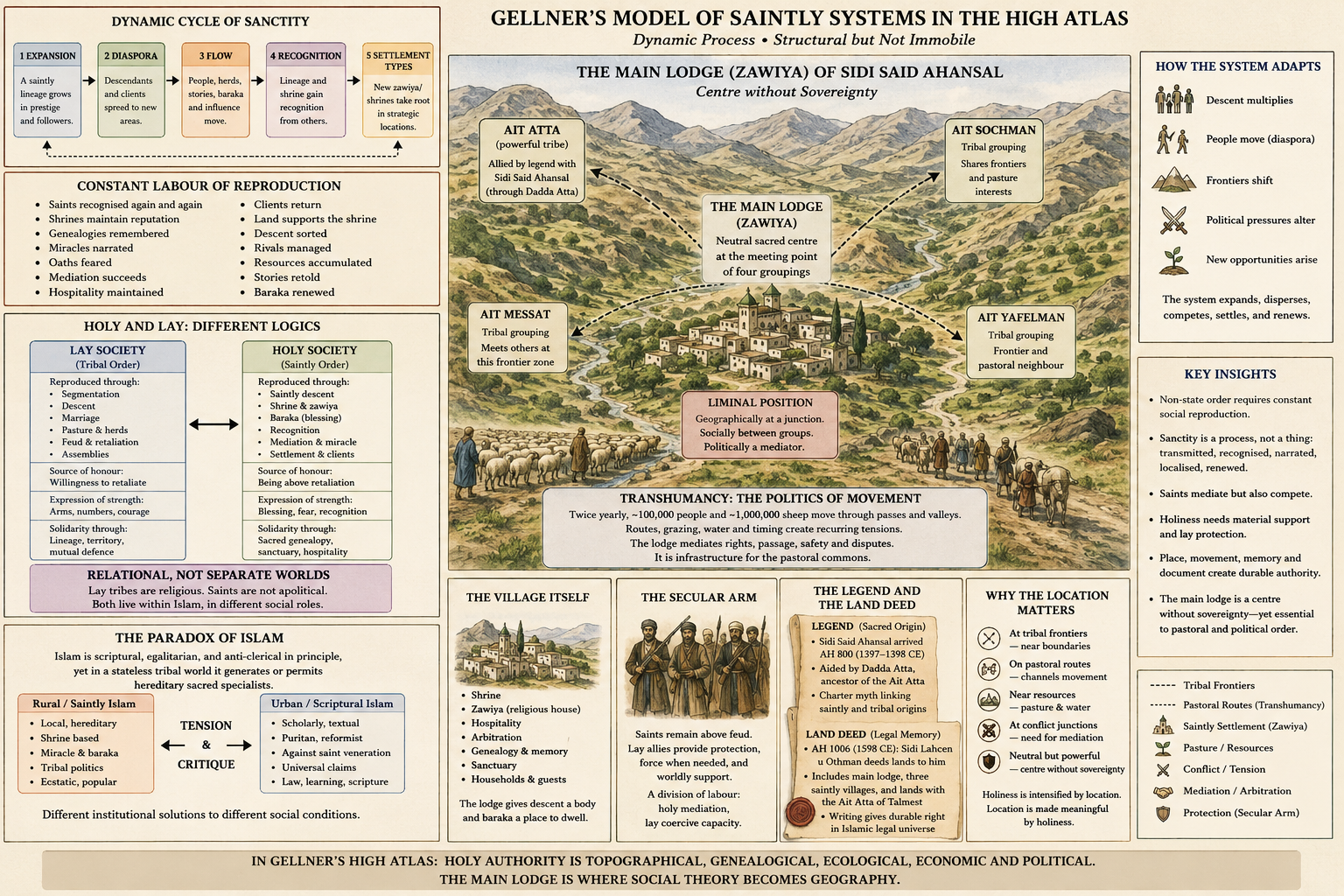
Gellner's analysis contains a dynamic model explained functionally: expansion, diaspora, flow, recognition, settlement types. The saintly system changes because descent multiplies, people move, frontiers shift, political pressures alter, and new opportunities arise. The model is structural, but not immobile.
The political theory is subtle. It suggests that non state order is not simply maintained by tradition. It requires constant reproduction. Saints must be recognised again and again. Settlements must sustain their reputations. Genealogies must be remembered. Miracles must be narrated. Oaths must be feared. Mediation must succeed often enough. Hospitality must be maintained. Clients must return. Land must support the shrine. Descent must be sorted. Rivals must be managed. The stateless order is not primitive simplicity. It is a labour intensive system of social reproduction.
This also returns us to the difference between lay and holy. Lay society is reproduced through segmentation, descent, marriage, pasture, feud, and assemblies. Holy society is reproduced through saintly descent, shrine, baraka, recognition, mediation, miracle, and settlement. The two orders depend on one another but reproduce themselves differently. Lay lineages reproduce fighting capacity and solidarity. Saintly lineages reproduce sacred distance and mediation. Lay honour depends on willingness to retaliate. Saintly honour depends on being above retaliation. Lay strength is visible in arms. Saintly strength is visible in blessing, fear, and recognition.
That contrast can be overstated, and Gellner knows it. Saints have interests, resources, rivalries, and sometimes indirect power struggles. Lay tribes have religion, piety, and sacred commitments. The distinction is not between secular people and religious people. It is between different social roles within a shared Islamic world. The lay tribes are not irreligious. The saints are not apolitical. “Holy” and “lay” are relational categories, not separate worlds.
All this deepens the whole book’s central paradox: Islam is, in Gellner’s terms, in many respects a scriptural, egalitarian, anti clerical religion, theoretically lacking a priesthood, yet in this tribal environment it generates or permits hereditary sacred specialists. This is not because Islam is secretly “really” clerical. It is because social conditions push religious forms towards particular institutional solutions. A stateless tribal world needs mediators. The available religious idiom supplies baraka, descent from the Prophet, shrine, zawiya, saintly genealogy, oath, and sanctuary. The result is a form of hereditary sanctity inside a religion that can also generate puritan critiques of saint worship. (I suggest that had this been taken more seriously the consequences of removing Gaddafi in Libya would have been more predictable. Although the middle east is a different context I think the recent tragedies unfolding in Gaza, Palestine and Iran would also have been better understood if Gellner's theory of Islamic politics had been in the minds of the Americans.)
That tension would later become central to Gellner’s wider theory of Islam: the contrast between urban, scriptural, puritan, scholar centred Islam and rural, saintly, ecstatic, shrine centred Islam. The saints are local, hereditary, shrine based, miracle associated, and embedded in tribal politics. They are vulnerable, therefore, to reformist or puritan criticism that sees such practices as improper mediation between believer and God. But in the High Atlas, their function is so deeply tied to social order that a purely scriptural critique would not simply correct belief. It would destabilise a political ecology.
Gellner shows how a religious tradition can be institutionally bent by political needs without ceasing to be recognisably religious. It shows how charisma can be hereditary without being automatic. It shows how divine favour can be socially recognised without being merely invented. It shows how sacred genealogy can become a political resource without becoming ordinary sovereignty. It shows how holiness can multiply, disperse, compete, settle, and adapt.
Sanctity is not a thing but a process. Baraka is spoken of as a blessing, but in social terms it has to be transmitted, recognised, localised, narrated, selected, and renewed. A saint’s life is the visible trace of that process. It begins with a holy person, but it becomes a lineage. It begins with an event, but it becomes a settlement. It begins with divine favour, but it becomes public reputation. It begins with miracle, but it becomes institution. It begins with biography, but it becomes political order.
By the end of Chapter Five, one can no longer think of the saints merely as supplementary figures attached to a tribal system. They are an expanding and internally differentiated sacred population whose own reproductive logic generates new tensions. They are not just mediators between lay tribes. They are also competitors within the field of sanctity. They do not simply preserve order. They must preserve their own recognition. Their lives are therefore not decorative legends but the medium through which authority, memory, settlement, and grace are made durable.
In the next chapter Gellner turns the “main lodge” into the concrete centre of the whole analysis. The chapter’s internal sections are “The Village Itself”, “The Location”, “The Politics of Transhumancy”, “The Secular Arm”, and “The Legend and the Land Deed”.
Gellner begins with the settlement as a physical and social fact, then widens the lens to its geographical position, then shows why seasonal pastoral movement makes that position politically charged, then examines the lay force attached to saintly authority, and finally returns to origin stories and legal memory. The chapter is therefore an argument about how sacred authority becomes effective because it is placed at the right point in a tribal, pastoral, and political landscape.
The main lodge is a zawiya, a saintly settlement associated with the descendants of Sidi Said Ahansal. A zawiya is not merely a village, though it is partly that. It is a shrine centre, a religious house, a place of hospitality, a point of arbitration, a store of genealogy, a sacred landmark, and a political institution. Gellner’s genius in this chapter is to show that such a place cannot be understood if one treats religion as a separate sphere. The lodge is holy, but its holiness is spatially organised and politically useful. Its sacred standing is inseparable from where it is, whom it serves, what routes pass near it, what tribes surround it, and what conflicts require its mediation.
In “The Village Itself”, Gellner’s attention falls on the lodge as a built and inhabited place. This is essential because baraka, sacred blessing, is not just imagined as an invisible quality floating above society. It is housed. It is located. It has walls, lineages, households, shrines, paths, rooms, guests, local memories, and relations with neighbouring groups. The village is not merely a residence of holy people. It is an apparatus for making holiness socially durable. A saintly lineage that had only a genealogy but no recognised centre would be much weaker. The lodge gives descent a visible body. It allows pilgrims and clients to know where to go. It gives disputes a place to be brought. It gives oaths a sacred setting. It gives hospitality a material base. It turns inherited sanctity into a public institution.
The anthropological term “corporate group” becomes useful. A corporate group is a social body that persists beyond the lives of its individual members and can hold property, reputation, rights, and duties across generations. The main lodge functions as such a corporate sacred group. Individual saints die, but the lodge endures. Individual descendants may be strong or weak, but the house, shrine, and lineage remain. The sacred institution therefore has temporal depth. It is not dependent on one charismatic personality. It is a routinised structure, to use Weber’s term, where charisma has been stabilised through descent, place, and collective recognition.
In “The Location”, Gellner makes the crucial political move. The main lodge stands near the meeting point of several major tribal groupings of the central High Atlas. The dramatis personae names the Ait Atta, Ait Sochman, Ait Messat, and Ait Yafelman as the four large groupings whose frontiers meet near the main lodge, and explicitly notes that this helps explain its importance. A saintly centre is powerful not simply because it is holy, but because its holiness is positioned at a junction of conflict, movement, exchange, and mediation.
Sacred centrality depends, therefore, on political marginality. The lodge is important because it is near boundaries. Boundaries are dangerous places. They are where tribes meet, dispute pasture, negotiate passage, arrange alliances, fear raids, and require neutral mediation. A saintly centre placed at such a frontier can serve more than one group precisely because it does not belong straightforwardly to one lay segment. Its location makes its claim to supratribal authority plausible. If it were buried deep inside one tribe’s territory, it might look like that tribe’s instrument. At a frontier, it can appear as a sacred mediator between powers.
This is a theory of “liminality”. Liminality means being at a threshold, neither simply inside nor outside. The main lodge is liminal geographically and politically. It is at the meeting point of tribal worlds. It is also liminal socially, since the saints are neither ordinary lay tribesmen nor state officials. The lodge’s physical situation mirrors the saints’ social position. They are between groups because their settlement is between groups. Their mediating function is built into the landscape.
Transhumancy is seasonal pastoral movement, especially the movement of herds between winter and summer pastures. In the central High Atlas, this movement is politically explosive because routes, passes, grazing rights, water, and timing all matter. Gellner’s world is not a static mountain village society. It is a moving pastoral ecology. Groups pass through one another’s zones. Herds need access. Bottlenecks become dangerous. Shepherds are moving each spring into high pastures and back each autumn, involving “a hundred thousand people” and “a million or so sheep” crossing mountain passes twice yearly.
Transhumancy creates predictable crises. It is not accidental conflict, but seasonal, recurrent, structurally generated conflict. Every year, movement must happen. Every year, groups must pass. Every year, rights can be challenged. Every year, violence is possible. The saintly lodge therefore becomes important because it helps regulate recurrent pastoral pressure. It is not merely a shrine for devotional visits. It is part of the infrastructure of seasonal order.
A modern state might regulate movement through police, cadastral maps, courts, permits, and bureaucratic records. In the High Atlas world Gellner analyses, regulation occurs through tribal balance, customary rights, oath, mediation, sanctuary, and saintly prestige. The lodge helps manage what one might call a pastoral commons problem. Many groups require access to scarce resources, but no central state effectively enforces rules. The saints provide a non state solution. Their authority does not abolish competition, but it makes negotiation possible.
The term “commons” here does not mean that all land is freely open to all, as in England. It means that pasture and movement depend on shared, contested, and negotiated regimes of access. The politics of transhumancy is therefore a politics of routes and timing as much as land ownership. Who may pass? Who may graze? Who guarantees safety? Who settles disputes? Who remembers prior arrangements? Who can bless or curse the violation of agreements? The saintly lodge answers these questions not by becoming a state, but by being a recognised sacred mediator.
“The Secular Arm” section of this chapter shows that saintly authority is not pure spirituality. The phrase suggests that holiness requires a lay support structure, an armed or politically effective adjunct that can do things saints, as saints, should not do directly. In Christian ecclesiastical history, the “secular arm” often refers to worldly power enforcing religious judgement. In Gellner’s High Atlas, the term has a more local and tribal meaning. Saints are ideally pacific, mediating, outside feud. Yet their position needs protection, clients, allies, and sometimes force nearby. The holy cannot survive without the lay.
This is a complication of any romantic reading of saints. Their authority is sacred, but it is not disembodied. They may not fight as ordinary tribesmen fight, but they are embedded in a landscape where fighting capacity matters. They need lay allies. They need dependent tribes or neighbouring groups who can act in worldly ways while allowing the saints to preserve the ideology of peaceful mediation. This is not hypocrisy but a structural division of labour. The saints must not look like warriors, but their lodge cannot exist in a violent world without some relation to warriors.
Here Gellner is implicitly working with a distinction between legitimacy and coercion. Legitimacy means recognised rightfulness. Coercion means force or threat of force. Modern states combine the two, ideally. The saints cannot combine them openly in the same way without ceasing to be saints. Their legitimacy depends on sacred distance from ordinary violence. But legitimacy without any worldly backing would be fragile. The “secular arm” solves this problem by displacing force onto lay associates. The saintly centre can remain holy while being protected by non holy power.
This also clarifies the relation between holy and lay as a form of political complementarity. Lay groups possess arms, numbers, pasture claims, mobility, and retaliatory capacity. Saints possess baraka, sanctuary, arbitration, genealogy, and supratribal prestige. Each lacks what the other has. Lay groups need mediation. Saints need protection and recognition. Their relation is mutual dependence, but asymmetrical mutual dependence. The saints stand above the lay in sacred rank, yet materially depend on lay society. The lay defer to the saints, yet sustain them. This circular dependence is one of the book’s central insights.
The “secular arm” also helps explain why saintly authority can be politically effective without becoming chieftaincy. A chief commands through lay force and faction. A saint mediates through sacred prestige. But if a saintly centre can draw upon a secular arm, it can have practical weight without directly becoming a chiefdom. It gains force at one remove. Direct coercion would compromise sanctity. Indirect coercive support preserves the distinction between holy and lay.
“The Legend and the Land Deed” binds myth, law, genealogy, and property together. Gellner’s chronology notes that according to legend, Sidi Said Ahansal arrived in the region in AH 800, 1397 to 1398 CE, and founded his zawiya. It also records that seven years later he was aided by Dadda Atta, ancestor of the Ait Atta. Later, in AH 1006, 1598 CE, his great grandson Sidi Lahcen u Othman signed a land deed transferring lands to him, lands associated with the saints of the main lodge, three adjoining saintly villages, and the Ait Atta of Talmest.
This shows that the lodge’s authority rests on two different but mutually reinforcing forms of memory. The legend gives sacred narrative. The land deed gives documentary title. The legend says why the saintly presence is cosmologically and morally meaningful. The deed says why the saints have a recognised relation to land. One belongs to hagiography, the other to legal record. Gellner’s point is not that one is “myth” and the other “fact” in a crude hierarchy. The point is that saintly authority needs both narrative and document.
The legend of Sidi Said Ahansal and Dadda Atta is especially important because it links the saintly ancestor to the tribal ancestor. This gives the relation between saints and Ait Atta a founding form. The two orders, holy and lay, are distinct, but the story binds them at the origin. It says that tribal power and sacred power were not accidentally adjacent, but historically and morally connected. This is charter myth in the anthropological sense. A charter myth is a narrative that legitimates a present social arrangement by projecting it into a meaningful past. It does not merely recount origins. It authorises relations.
The land deed performs a different kind of authorisation. It brings the saintly claim into the world of writing, transfer, property, and legal memory. Islamic civilisation gives high prestige to writing, law, and documentary forms, even in regions where much everyday politics is oral, customary, and segmentary. The deed connects the lodge to a broader Islamic legal universe. It says that the saints’ land is not merely held by force or custom, but by an act of recognised transfer. This is crucial for a holy lineage whose authority depends partly on being more than just another local faction.
The coexistence of legend and deed also complicates any simple opposition between oral tribal society and literate state society. The main lodge belongs to a tribal world, but it is not outside writing. It is embedded in oral memory, but it also possesses documentary claims. It mediates between customary law and Islamic legality. It is neither wholly local nor wholly universal. It is precisely this in between character that makes it powerful.
The land deed also shows why the material base of sanctity matters. Holy authority cannot survive on blessing alone. Hospitality requires resources. Arbitration requires a recognised place. Shrine maintenance requires property. Descendants require livelihoods. Guests must be fed. Ritual occasions require animals, grain, rooms, paths, and labour. The sacred needs an economy. This is not a reduction of holiness to economics. It is the recognition that holiness becomes socially operative only when materially supported.
The lodge has a material base, land, settlement, labour, access, and relations with pastoral movement. Its sacred superstructure, to use Marxist vocabulary, does not simply float above this base. But Gellner is not a reductionist as Marx was. He does not say that baraka is only ideology masking property. Rather, he shows a more complex relation. The material base enables sacred authority, and sacred authority protects and legitimates the material base. The deed and the legend reinforce each other. Property sustains holiness. Holiness sanctifies property.
Gellner's approach is more recognisably Weberian. The founder’s sanctity is transmitted through descent, localised in the shrine, supported by property, recognised by tribes, and stabilised through institutions. Charisma has become durable. But it has not become bureaucracy. It remains genealogical, sacred, and personal, even as it has institutional continuity. This is why Gellner’s case is so interesting for Weberian theory. It shows a route of routinisation that is neither modern office nor church hierarchy, but hereditary shrine based mediation.
Durkheim is applicable especially in the way sacred place creates collective recognition. The lodge is a sacred centre around which groups orient themselves. It is not merely believed in privately. It is enacted publicly. People travel to it, swear at it, tell stories about it, recognise its inviolability, and place disputes before it. Sacredness is collective, but again, Gellner’s Durkheim is conflictual. The lodge does not express a simple moral unity. It manages divisions. It is a sacred centre for a society whose ordinary condition is segmentation and rivalry.
Evans Pritchard and segmentary theory are likewise present in the background. The main lodge is significant precisely because segmentary balance alone cannot explain stable order. Balanced opposition produces a pattern of countervailing lineages, but it does not easily provide neutral arbitration. The lodge supplements segmentation by standing at the point where segments meet and clash. It is not outside the segmentary world entirely, but it is positioned so as to mediate it.
This chapter therefore gives us a theory of location as social form. Location is relational. A place matters because of what it connects, separates, channels, blocks, and enables. The main lodge is important because it sits where tribal frontiers, pastoral routes, sacred genealogy, land claims, and mediation needs converge. Its holiness is intensified by its location, and its location is made meaningful by its holiness.
This has a wider political implication. The state often claims centrality by occupying capitals, roads, courts, forts, and administrative nodes. The main lodge claims a different kind of centrality. It is not a capital. It does not command a territory. It does not tax like a state. It does not administer uniformly. But it is central to a field of movement and dispute. It governs by being where conflict needs sanctified mediation. This is non state centrality, a centre without sovereignty.
That phrase, “centre without sovereignty”, captures much of Chapter Six. The lodge is central but not sovereign. It is powerful but not governmental in the modern sense. It is holy but entangled with land. It is pacific but supported by a secular arm. It is local but tied to Islamic sacred descent and documentary legitimacy. It is old, but continually renewed by seasonal movement and political need.
You can now see that Gellner’s saints cannot be understood merely through genealogy or belief. They must be mapped. Their authority is topographical, ecological, economic, and political. The main lodge is a sacred settlement placed at a strategic frontier. It mediates because it is believed to be holy, but also because it is situated where mediation is necessary. Its legend gives it moral origin. Its land deed gives it legal and material foundation. Its secular arm gives it worldly protection. Its location gives it political range. Its village form gives sanctity a body.
This is why I think Chapter Six is a decisive consolidation of the book. Earlier chapters gave the model: segmentary tribes, holy lineages, mediation, *baraka*, hereditary charisma. Chapter Six gives the model a place. It shows that the saintly system is not merely a structure of ideas but a spatial institution rooted in a particular valley, a particular set of tribal frontiers, a particular pastoral rhythm, a particular land claim, and a particular legendary past. The main lodge is where social theory becomes geography.
(To be continued)
Previous parts here