Saints of the Atlas 6


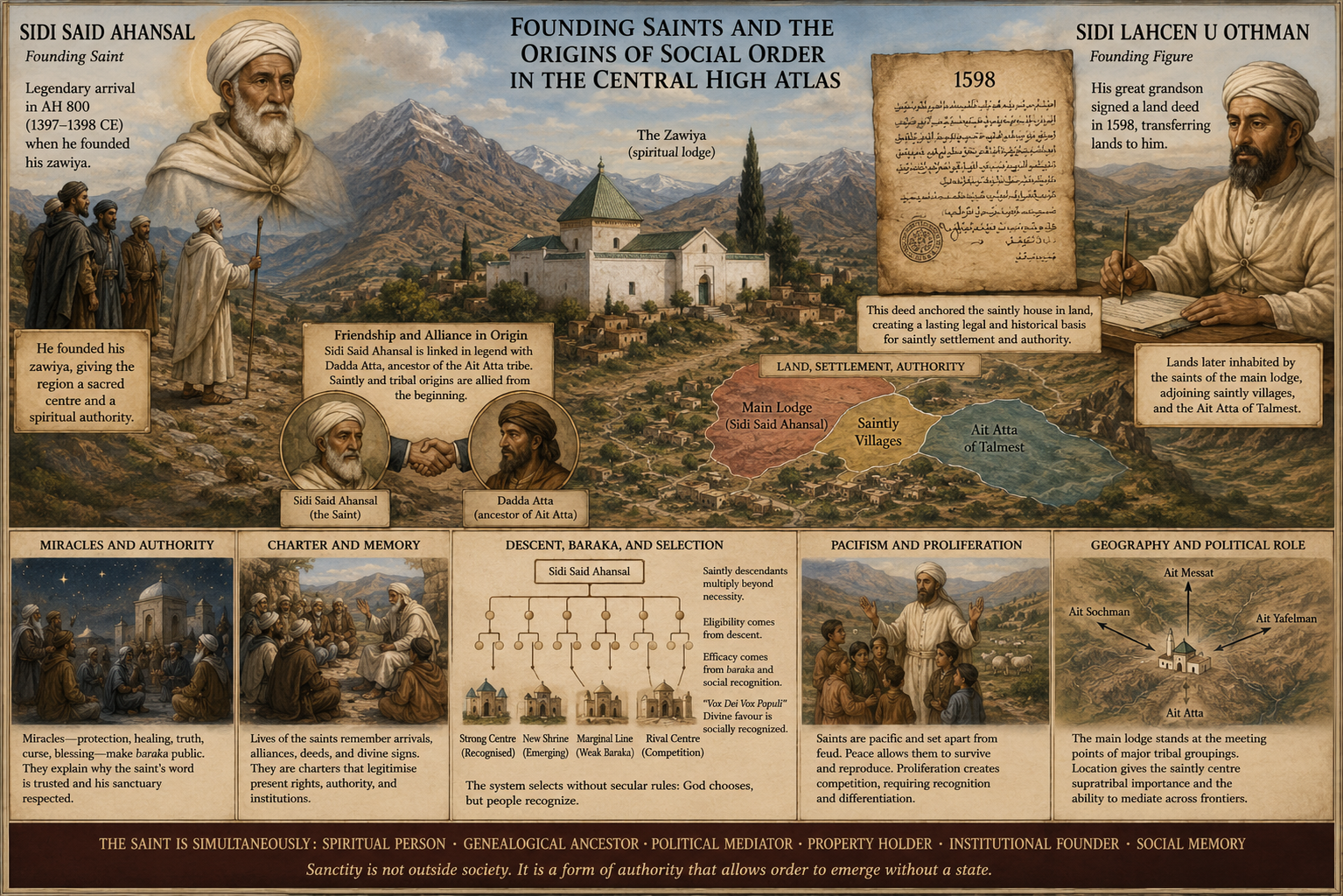
The individual saints themselves, especially Sidi Said Ahansal, therefore have to be understood both as persons in legend and as founding principles of social order. The legendary date of Sidi Said Ahansal’s arrival in the region is AH 800, or 1397 to 1398 CE, when he founded his zawiya. Sidi Lahcen u Othman is also an important founding figure and his great grandson, who in 1598 signed a land deed transferring lands to him, lands later inhabited by the saints of the main lodge, adjoining saintly villages, and the Ait Atta of Talmest
Sidi Said Ahansal is not merely an ancestor in a family tree. He is a founding saint whose arrival explains why the region has a sacred centre. His foundation of the zawiya gives the saintly order a beginning. The association with Dadda Atta, ancestor of the Ait Atta tribe, links saintly and lay origins. This kind of legendary friendship between a saintly ancestor and a tribal ancestor is politically important because it gives a mythic form to the later structural relation between saints and tribes. The saints and tribes are distinct, but their origins are narrated as allied. Sanctity and tribal power are not identical, but they are bound together from the beginning.
Sidi Lahcen u Othman’s land deed introduces another dimension: document, property, and legal memory. A land deed is not just an economic instrument. In a society where sacred descent and oral tradition matter, a written deed anchors claims in a different register. It ties sanctity to landholding. It creates a legal historical basis for the saintly settlement. It says, in effect, this sacred lineage is not simply wandering charisma. It has place, title, possession, continuity. The presence of such a deed also complicates any simple opposition between oral tribal custom and written Islamic legality. The saintly order can draw on both.
This means land is never merely land. Land anchors autonomy, wealth, hospitality, marriage, and authority. A saintly house that can host petitioners, feed guests, maintain a shrine, and support dependants needs resources. Without material base, baraka may remain symbolically potent but institutionally thin. The saintly essence, if one may put it that way, is not reducible to land, but it requires land to persist as a social form. Sacred status is not simply in the soul. It is embodied in property, settlement, genealogy, and recognised service.
Gellner’s treatment of saintly lives therefore undermines any crude separation between religion and politics, or between belief and economy. The saint’s life is simultaneously spiritual narrative, genealogical charter, political claim, property title, institutional foundation, and social memory. The saint is a holy man, but the story of the saint is also an explanation of why certain people possess authority now. Hagiography is political sociology in sacred form.
This is why one must not read the miracle stories merely as irrational embellishments. In many saintly traditions, miracles show that the saint possesses extraordinary closeness to God. But in Gellner’s analysis, miracle stories also mark political competence. A saint who miraculously protects, deflects bullets, resolves danger, reveals hidden truth, curses liars, or blesses fertility is being represented as someone whose sacred power has practical consequences. The point is not about whether such events “really happened”. Gellner’s question is sociological: what does the story do? A miracle story makes baraka public. It converts invisible grace into remembered evidence. It helps explain why people should fear violating the saint’s sanctuary, why a false oath may be dangerous, why a mediator should be trusted, why a shrine has power, why a descendant has status. The miracle is a narrative technology of authority.
This brings us close to Durkheim, though Gellner’s tone is much less reverential. Durkheim argued that religion is not merely belief in supernatural beings but a system of sacred classifications and collective practices through which society represents itself to itself. The saints are sacred figures, but they also crystallise the society’s need for mediation, continuity, and authority. Their lives tell the society how order can emerge without state coercion. Yet Gellner differs from Durkheim because he does not present religion primarily as collective solidarity. He presents it as a way of managing conflict. The sacred here does not dissolve antagonism into unity. It gives antagonism a set of limits and channels.
Evans Pritchard and segmentary lineage theory remain in the background. In the Nuer model, balanced opposition between lineages helps explain order without central government. Gellner accepts the importance of balanced opposition, but shows why it is inadequate on its own. Segmentary lineages can explain opposition, alliance, and equilibrium, but they do not explain why certain figures can stand outside the immediate line of opposition. The saints fill that gap. They are not simply segments. They are differentiated sacred lineages whose life stories justify their capacity to mediate between segments.
Gellner’s account is subtler than a crude functionalist model. The excess of saintly descendants, the uneven flow of grace, the need for popular recognition, and the variety of holy settlements all show instability, not a perfectly harmonious machine. Saints multiply “beyond necessity”, as John A. Hall’s intellectual biography of Gellner summarises the problem: the number of saintly descendants expands while the number of openings for recognised mediators remains relatively fixed, so some selection procedure is needed, and local belief attributes true baraka to divine favour.
So the saintly system is not simply hereditary aristocracy. If it were, all descendants would have equal and automatic standing. Nor is it purely elective charisma. If it were, descent would matter little. It is a hybrid. Descent gives eligibility. Recognition gives efficacy. Divine favour gives ideology. Social success gives proof. Settlement gives durability. The system selects without admitting that it selects in secular terms. It can say God chose, while the sociologist sees that people, circumstances, ecology, clients, settlement patterns, and political demand also choose.
This hybrid selection mechanism shows how a society can manage overproduction of sacred claimants. Some descendants remain attached to strong centres. Some found new settlements. Some become marginal. Some are absorbed into lay life. Some reactivate claims under new circumstances. Some become rivals. Some become what might almost be called sacred entrepreneurs. But the society does not need a central committee to decide who is truly holy. Recognition emerges through practice.
“Sacred entrepreneur” may sound too modern, but it captures something real in the saintly diaspora. A saintly descendant who moves to a new area, establishes a shrine, attracts clients, mediates disputes, and builds a reputation is creating a new institutional node. He is not a capitalist entrepreneur, but he is operating in a field of opportunities. His capital is genealogy and baraka. His market, if one may use the word cautiously, is the demand for mediation, blessing, arbitration, and protection. His success depends on whether people accept his claim.
This is why “Vox Dei Vox Populi” is so important. Popular recognition is not democracy. It is not egalitarian voting. It is not modern public opinion. It is the cumulative social judgement that a holy claim is effective. It appears as divine favour, but it is socially registered through the behaviour of clients and neighbours. People come, swear, give, ask, fear, remember, marry, and transmit stories. The saint’s holiness is not created by a ballot, but by a dense field of recognition.
Here the relation between saint and lay becomes even more nuanced. The lay tribes need saints, but saints also need lay recognition. This means that saintly superiority is dependent on lay validation. The sacred hierarchy is not simply imposed from above. It is reproduced from below. The tribes submit to saintly mediation because it serves their needs, but in submitting they reproduce the saint’s superiority. The saint appears above lay conflict, but his elevation depends on lay people continuing to treat him as above it. This is a beautiful and disturbing circularity.
It also clarifies the politics of humility and pacifism. Saints are expected to be peaceful. Their pacific nature distinguishes them from the armed lay tribesmen whose honour is bound up with feud and retaliation. But pacifism is not weakness. It is a political position. By not participating as ordinary warriors, saints become available as mediators. Their refusal of lay violence gives them access to another kind of power. This is the paradox of non violent authority in a violent world. The saint is powerful because he does not fight like other men.
Yet this pacific character has demographic consequences. Saints, partly because of their pacific nature, produce an excess of children. This is a darkly sociological observation. The warrior lay world loses men to violence. The saintly line, protected by sacred status and ideally exempt from feud, may reproduce more securely. Peace generates proliferation. Proliferation generates competition. Competition generates the need for selection. Selection generates new forms of saintly success and failure. Thus the pacific sacred order produces its own internal pressures.
This is one of the system’s most elegant structural ironies. The very condition that makes saints useful, their removal from feud, helps them multiply. Their multiplication then threatens to dilute the distinctiveness of sanctity. If everyone descended from the saint were equally effective, saintly authority would become unmanageable. The system therefore needs a way to distinguish true or active baraka from merely nominal descent. Divine favour supplies the ideological answer. Social recognition supplies the practical answer.
The discussion of types of holy settlement then becomes a classification of outcomes produced by this pressure. Some settlements remain central and powerful. Some are secondary but recognised. Some are new offshoots. Some are ambiguous. Some are rivals. Some are specialised around a shrine. Some are linked to particular tribes. Some emerge from frontier conditions. Some are reactivations of dormant claims. The point is that saintly society is not homogeneous. It has its own internal stratification.
“Stratification” means ranked differentiation. The lay tribal world often presents itself as egalitarian, at least among male lineage groups. The saintly world is differently stratified. Some holy houses are more prestigious than others. Some descendants are closer to the founding line. Some shrines are more effective. Some settlements possess stronger genealogical claims. Some enjoy better political location. The sacred stratum has its own hierarchy, rivalries, and distinctions. “The saints” are not one uniform block.
There is also a political geography to this hierarchy. The main lodge is important partly because of its location near the meeting points of major tribal groupings. Ait Atta, Ait Sochman, Ait Messat, and Ait Yafelman are major central High Atlas groupings whose frontiers meet near the main lodge, helping to explain its importance. A saintly centre located at a tribal intersection has greater political utility. It can mediate across boundaries. It can serve multiple groups. It can become a supratribal sacred hub. So, again, sanctity is not detached from geography. The successful saintly centre is where sacred genealogy meets political location. The main lodge’s prestige is not only because of descent from Sidi Said Ahansal, but because that descent is spatially placed where it can matter. A saint in the wrong location may remain holy but politically marginal. A saint in the right location can become central.
So Gellner gives us a theory of the circulation of baraka. Grace flows through descent, but also along routes of conflict, pasture, migration, settlement, and recognition. It becomes strong where it is needed and acknowledged. It becomes weak where no one uses it. It is divine in ideology, but infrastructural in practice. That does not mean the belief is false. It means that belief has conditions of social efficacy.
In anthropology, efficacy refers to the capacity of a ritual, institution, or symbol to produce effects. A saint’s baraka is efficacious if people act on it and if those actions produce order, healing, settlement, protection, or recognition. The question is not merely what people believe, but what belief makes possible. This is why Gellner is asking what sacred belief does.
He also gives us a theory of institutional memory. The lives of the saints preserve the past in a form usable by the present. They remember founders, migrations, miracles, deeds, alliances, land transfers, rivalries, and divine signs. But they do not remember neutrally. They remember in ways that authorise current structures. A saint’s life is a charter. A charter is a story that explains and legitimates an institution. When people tell of Sidi Said Ahansal’s arrival, his founding of the zawiya, his relation to tribal ancestors, or the later deed of Sidi Lahcen u Othman, they are not merely recounting the past. They are giving reasons why present claims should be honoured.
This charter function links Gellner to Malinowski, who famously argued that myth in many societies acts as a charter for social institutions. A myth says why a rule, privilege, hierarchy, ritual, or land claim exists. Gellner’s saints’ lives work similarly. They are myths in the anthropological sense, not because they are simply untrue, but because they are socially authoritative stories. They are remembered pasts that organise present rights.
But Gellner is also more historically alert than a simple Malinowskian reading would suggest. The saintly diaspora changes. New centres emerge. Bernat, for example, is identified in the dramatis personae as a centre that separated from the main lodge in the 1920s due to conditions arising from the French advance. ([dokumen.pub][1]) This detail shows that saintly organisation is historically adaptive. Colonial pressure did not simply destroy saintly forms. It created new conditions under which saintly centres could split, adapt, or reconfigure. The sacred system is not timeless.
Previous Parts here