Ned Foley, Ballot Battles: The History of Disputed Elections in the United States
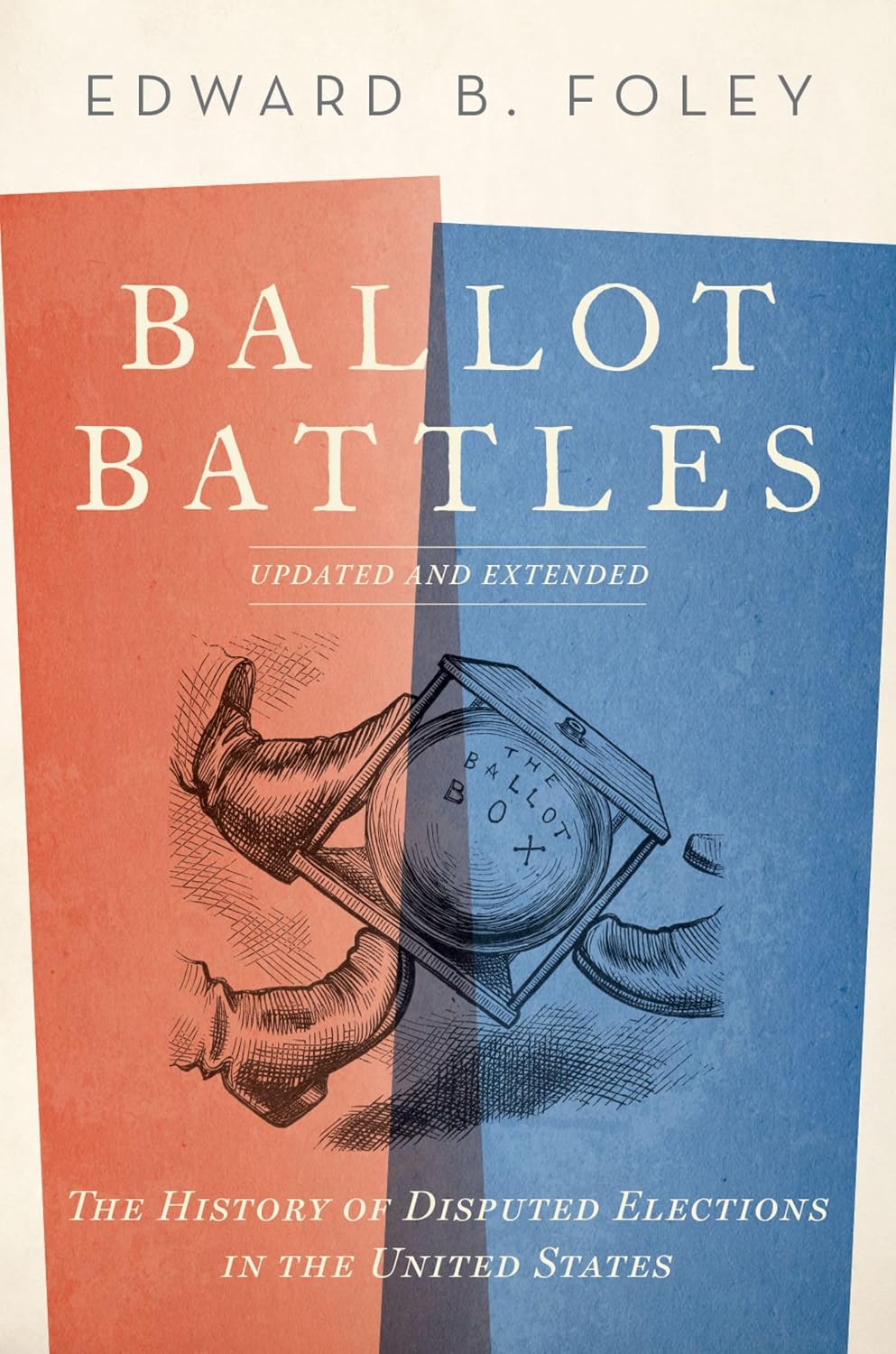
Ned Foley, Ballot Battles: The History of Disputed Elections in the United States – Updated and Extended Edition (Oxford University Press, 2024)
As is quite well known at this point, Donald Trump claims he won the 2020 election. Perhaps the two most frequently repeated reasons he has given for insisting that everyone should agree with that claim are that (i) late on election night he was ahead in several states that he was subsequently declared to have lost; and (ii) it’s inconceivable that anyone as fabulous in every way as he is could possibly lose an election to Joe Biden. His legal team made a few other arguments, mostly about alleged fraud, before numerous judges, a number of whom Trump had appointed himself, but none of them produced the desired result. Undeterred by those losses, Trump summoned his supporters to Washington on the day Congress was to certify the result and, after reportedly having been told that some in the crowd were armed and angry, nevertheless exhorted them to “fight like hell.” People died, over a thousand Jan. 6 defendants were pardoned, and democracy in America took a very big hit. So it is natural to wonder whether this episode was a one-off or the sort of thing we can expect from now on. Answering that question is a central concern of Ned Foley’s history of election disputes and denials in the United States.
Of course, distinguishing trends from outlying events is the sort of puzzle regularly faced by actuaries, climate predictors and sports statisticians. We know, for example, that hurricanes are generally unusual, so they aren’t treated the way common events like thunderstorms are when homeowners insurance rates are set. A two-home-run game may not be taken too seriously by bettors who understand that the 33-year-old outfielder who pounded them has averaged only five four-baggers a year for the last decade. However, it’s notoriously hard to know when something unusual isn’t merely an outlier, but is instead the beginning of a new trend. After all, global climate change or a new type of bat might be having effects that will last.
These statistical questions are less familiar in democratic theory. Yet they turn out to be important to ask when writing a history of election disputes and denials. A historian may be called on to opine regarding whether some new event is an outlier that can be reasonably overlooked or is likely to be part of a new long-term trend. With good reason, Foley, a legal theorist-turned-historian, frets over this matter at some length in the new edition of his exhaustive history. He is generally sanguine about the trajectory of democratic norms surrounding the peaceful transfer of power here since the signing of the Constitution, but is sensibly concerned with what has happened since Vice President Al Gore gracefully accepted the Supreme Court decision that he would not be the 43rd President of his country.
Foley demonstrates his general optimism with remarks like this: [T]he especially egregious fiasco of the 2020 election—culminating in the first-ever violent attempt to prevent Congress from declaring the winner of a presidential election—may be a temporary (albeit severe) aberration from the overall positive trajectory of the nation’s capacity to handle vote-counting disputes peaceably pursuant to law, and even with increasing fairness and impartiality. Recognition of this general trend gives one reason for cautious and tempered optimism, even in the aftermath of 2020, that further progress toward fulfillment of the ideal may be possible as America moves through the remaining decades of the current century. I don't share that rosy view myself: 2020 looks less like an aberration than a preview to me. But what may be most interesting about his discussion here is the manner in which Foley interweaves his optimism with what may first seem a substantially different debate, that between Hamilton and Madison over how a losing candidate should behave.
First, Foley distinguishes between “normal circumstances” and “exceptionally close” elections, noting that some observers find it reasonable to expect “partisan power grabs” in very close elections, and hold that “a system is inappropriately rigged if in a routine election a candidate decisively chosen by valid voters, based on what a fair count would show to be a clear-cut margin” is nevertheless counted out. Foley tells us that Hamilton took that view, and it led him to suggest to John Jay and other losers of close votes that they just lick their wounds and work harder the next time around. Madison’s views are contrasted. He apparently took the position, which Foley sees as contrary to Hamilton’s on this point, that (as Foley puts it), in each election, the vote-counting process should strive as best it can to produce a fair count—meaning awarding the victory to the candidate who genuinely received the most valid votes—and if it did not, that was an inappropriate result regardless of what might happen in the next election.*
Donald Trump, who won’t stop insisting he was cheated in 2020, thus ironically turns out to be the (warped) Madisonian in this dispute. But not only might a vote be (or seem to be) “close” precisely because of massive cheating, a recommendation for tranquility subsequent to an electoral defeat might be made for many reasons, some having nothing at all to do with whether continued post-count fighting is likely to produce anything like victory for the harmed party. Where I part ways with Foley, I think, is that he tends to treat what an impartial observer, correctly applying the relevant law, would deem the "fairest" count as something that should always prevail, rather than as one consideration among others that must sometimes yield to what I take to be the primary goal: capturing the majority's actual will. Indeed, he provides a number of telling examples in which revising an election's outcome to make the count more meticulously "fair" would mean fewer residents' actual votes being counted — a result that may satisfy Foley's goals, but that I believe would move us further from genuine democracy, not closer to it.
A Federalist lawyer, John Trumbull, thus seems to me to have displayed a deeper understanding than Madison when, in 1792, they both objected to the determination of a “joint legislative canvassing committee” regarding an election in New York. That committee's decision, which held that a truly fair and dispositively legal procedure required the disallowing of all votes cast in Otsego County, cost the Federalist standard-bearer, John Jay, the governorship, handing the office instead to the incumbent, George Clinton. Trumbull objected that “Had the Legislature directly enacted that the votes of Otsego County should not be canvassed, every person would consider this act unconstitutional and void.” Rufus King put the same point this way: “The election law is intended to render effectual the constitutional right of suffrage. It should therefore be construed liberally.” The upshot is that while Madison and Foley write as though there's always a fact of the matter regarding which votes were "genuinely" and "validly" cast — though one they'd concede isn't always easy to discover, Otsego County suggests a deeper problem: whether a ballot counts as valid often turns on exactly the kind of judgment call Trumbull and King were making, not on some fact waiting to be found. Given the frequency of such ambiguities, the right interpretive instinct, I think, is to construe election law in whatever way best captures the majority’s will, rather than allowing for the disqualification of real votes over technicalities in the name of "fairness.” For what's really at stake beneath all these technicalities is self-governance itself.
To his credit, Foley recognizes that there are a multitude of interesting and controversial issues that surround the assessment of the desires of U.S. populations through voting: not all could be covered. There are, for example, questions about proportional representation, use of the Electoral College, incessant gerrymandering, the effects of federalism, the usefulness of ranking choices, etc., etc. It therefore makes sense to have restricted the book’s focus as Foley’s does here: how easy or difficult voting is, honest counting, and subsequent fights about those tallies. He states his preferred solution quite early on: having impartial (most importantly, non-partisan) panels determine outcomes whenever there are disputes. These may be specially appointed commissions or courts (so long as the commissioners or judges are not elected officials). The essential point is that the deciders should not have any personal investment in who wins. I must say that, whether this particular desideratum can be separated from the electoral scheme in effect, or how much of a difference it makes if a public official is appointed or elected, is not entirely clear to me. After all, (i) certain counting methods (ranked-choice, for instance) can produce winners who are merely the least-disliked options — folks who need not share any particular partisan leanings with the majority of the electorate, (ii) appointments are generally made by people (or Legislatures!) who have themselves been elected, and (iii) bribery of a wide variety of kinds remains a common practice in the country. Thus, a lot of mischief would remain possible even if Foley’s fairly modest wish were to be granted. For example, it obviously matters who has appointed the Justices currently sitting on the U.S. Supreme Court, even though those appointments last until retirement or death. And ‘perfect phone calls’ regarding ‘finding votes’ can be made to anyone with the power to alter a result, including election commissions. Foley likes the idea of one-from-team-A, one-from-team-B and an impartial arbiter agreed upon by those two, suggesting that such an arrangement is preferable even to a court, but concedes that there is no silver bullet, especially after what we’ve seen subsequent to the 2020 Presidential election. It’s worth mentioning here, too, that in today's hyper-partisan climate, even genuinely neutral arbiters are routinely painted as partisan operatives by the losing side. Thus, the institutional trust required for Foley's solution to work has already been eroded by the very phenomenon he is trying to fix.
The pervasive feel left by this book, at least for one living through the Trump era, is sure to be plus ça change…. In fact, the first electoral kerfuffle Foley takes us through in detail, a 1789 fight over competing Congressional slates in New Jersey, is quite likely to remind one of how long it takes for both vote collections and counts to be completed in some jurisdictions even today. Should there be hard cut-off dates for such tallies, even if it seems there are (or could be) more votes out there? Reasonable observers continue to differ. In addition, depending on one’s attitude toward James Madison, one may conclude either that he was dead right about the dangers of polarized factions (here, Federalists and Anti-Federalists), or utterly confused about the claim that, in a republic the size of the U.S., ‘cross-cutting cleavages’ would be sufficient to defang even the most impassioned partisans. When the result of every sort of decision-making body can be fairly easily predicted by the party preferences of its members, it seems implausible that we could depend upon any reviews where the decision-makers are not completely blind to which candidate is said to have received this or that number of votes. (And how in the world can such assessments be arranged?) This, I think, is a symptom of a larger problem that I have discussed elsewhere (see here): that is that for nearly everyone, winning takes precedence over values like fairness or rule-following — indeed, almost always trumps every competing goal.#
An apparently perpetual problem involves settling on an appropriate remedy when there is agreement that electoral norms have been violated. As early as 1793, a disputed Congressional election in Virginia involved “voter suppression.” This was agreed to have occurred when Francis Preston beat Abram Trigg by a mere ten votes, and there was little doubt that “Preston’s brother, a captain in the federal military, had marched troops to one of the polling places for the purpose of preventing pro-Trigg voters from casting ballots.” While both the facts of the matter and their consequences for the tally were universally understood (it being “well-established that soldiers under Captain Preston’s command threatened to beat any person who should vote in favor of Trigg” because they were “under orders” to do so), a fix was problematic. For one thing, such activities were seen to be a common practice, at least in the South. And, no different from today, (i) revotes are costly and messy, but (ii) determining a different winner without a new election is speculative and perilous. Thus, the path of least resistance is generally to let things slide…this one time, anyhow.
It would be fun (and for me, educative) to drill deeply into each of the many electoral disputes carefully and engagingly described by Foley in this encyclopedic work.$ But as his book is over 550 pages, were I to take that tack, the length of this review would likely itself reach triple digits. So I will instead focus on two momentous votes, one before and one after the elder Justice John Marshall Harlan had gotten his wish for a liberal reading of the 14th Amendment’s application to voting rights. I pick these two because, while one election involved huge numbers of fraudulent ballots and the other almost none, they both show the limits of any sort of “resolution procedure.” Also, each shines a bright light both on issues where I think Foley and I agree, and the overarching principle of his to which I object.
The first of these extremely consequential elections took place in Kansas in 1855. Under the Missouri Compromise of 1820, Kansas was to be closed to slavery, but the Kansas-Nebraska Act of 1854 — attractive to those who favored the practice — repealed that prohibition and substituted "popular sovereignty," under which something like a plebiscite would be held there so that "the people" could determine their own fate. The election itself was a complete farce: a prior census established that there were only about 2,900 residents in the territory who were eligible to vote, but 6,307 ballots were cast. Worried about such visitor votes, the Governor of the territory, Andrew Reeder, required all those wanting to vote to swear they lived in Kansas and were intending to stay there. But, well, people, apparently mostly Missourians, were perfectly happy to lie to allow ownership of human beings in their neighboring territory. So, unsurprisingly, there were fights about the outcome, and not long afterward, a terrible civil war. Foley writes, “Even with the hindsight of history, it is difficult to see how a different resolution of the disputed election could have avoided the ‘reign of anarchy’ that ensued.” Absolutely right: but why? I think he would say that people were just too fired up about this issue for there to be a possibility of a cool-headed election in which the losers gracefully conceded. That’s true too, but I don’t think it gets to the heart of the matter.
On Foley’s view, it would have taken a “strong military presence of federal troops” for any sort of peaceful election to take place in the Kansas of 1855, but that would not have been enough to make it a fair, democratic one, because “the rule of law really had not yet fully taken hold in the territory.” But is that really what was lacking? Suppose the pro-slavery Lecompton Constitution had been ratified rather than rejected in Kansas and that its provisions had been faithfully followed by the citizenry there. Would this new devotion to the rule of law have made for fair elections? Can’t laws be bad?
But if a meticulous attachment to the rule of law is not the answer, what is necessary to produce a truly democratic realm? In my view, it requires top placement to the fundamental principles of majoritarianism. And that, in turn, requires both acceptance of the equality of human beings and devotion to the ideas of equal treatment of all those residing in the relevant jurisdiction.
Consider an election in Kansas that stacked the deck as heavily as the pro-slavery side could have wished. Suppose (though it is patently false) that women, those under 21, those without property, and all Black residents, enslaved or free, did not deserve a vote, so that the electorate was limited to white, property-owning men over 21. And suppose the rules were meticulously followed, with no border ruffians and no fraud. Would either side have remained comfortable with the election and its result, whichever way it went? I doubt it. Free-Staters would ask what affirmation of Kansas’s status as a future slave state would mean for any future chance of fair elections there. The other side, as represented by South Carolina Congressman Preston Brooks, had no problem with the Missourians’ efforts to make Kansas a slave territory. Brooks wrote in early 1856 that Kansas’s admission as a slave state was “a point of honor with the South,” and warned that if it became a free state, slave property in neighboring Missouri would fall to half its value. With stakes like that, and with Brooks urging like-minded Southerners to send money and even armed emigrants to the territory, it is hard to imagine him supporting the idea that the question of slavery be left to a mere count of the preferences of the territories’ residents.
Even the extreme curtailment of the franchise outlined above would have been insufficient for the pro-slavery side, since nothing guaranteed that even that hand-picked electorate would reliably vote the “right” way. For many of those who agreed with shared Brooks view that Kansas being an eventual slave state was a “point of honor,” what was actually needed, as Carl Schmitt would later theorize, was a ruling cohort consisting only of “friends” in a far stricter sense: not merely white, male, and propertied, but ideologically unified behind “the peculiar institution.” In fact, dissent among that narrower group itself had to be suppressed (as it was, by territorial statutes imposing severe penalties on anyone who spoke or wrote against slaveholding). It didn't matter what any other “faction,” big or small — even one lurking within the eligible electorate — might want. That’s the problem that is created when any goal dislodges majority rule of all adult residents as a first principle: it puts democracy in extreme peril. And even devotion to the rule of law can be such a dislodging goal.
When we jump forward to the 2020 debacle, we see that while Foley is appropriately hard on Trump (who obviously thinks that no election can be fair unless it concludes with him winning in a landslide), he doesn’t forget to mention the related, if admittedly lesser, sins of Stacey Abrams and Hillary Clinton. He also reminds us of what now seems the quite venial Al Gore transgression of conceding the 2000 election before having a change of heart. Those mentions seem to me appropriate. And Foley’s discussions of the Rudy Giuliani-led litigation campaigns in Pennsylvania, Georgia, Arizona, Nevada, Michigan, and Wisconsin subsequent to Trump’s 2020 loss are both thorough and enlightening. I did expect, however, to find at least one reference to Christopher Krebs, the Director of the Cybersecurity and Infrastructure Security Agency (CISA) for about two years, beginning in the Fall of 2018. For it was CISA, under Krebs, that released a joint statement from the election officials' coordinating councils declaring the 2020 election “the most secure in American history.” CISA also maintained a “Rumor Control” webpage that debunked election fraud claims. Unsurprisingly, Trump fired Krebs shortly afterward via tweet. There’s no mention of that in the book.%
Just as in 1850s Kansas, authentic evidence was not merely of secondary importance to one of the parties: it was of no interest at all. All that mattered was winning. The significant strategies in both cases were more akin to Shakespearean depositions of the monarch-removal type than to the kind of depositions that involve sworn testimony and stenographers.
In considering whether a revote is the right way to address suspicious elections in the future, Foley concedes that “in some circumstances, it is simply unclear whether a fair count entails the inclusion or exclusion of disputed ballots” and concludes that “candor requires acknowledging that the simple idea of a fair count…does not logically dictate an answer one way or the other to these subsidiary issues in these specific circumstances.” Well, yes and no. If we have no fundamental principles to rely on, but are stuck with nothing but laws and their judicial interpretations, that is hard to deny. But if we also have the axioms that surround the concept of popular sovereignty at our disposal, we may often find we can make additional progress. Turning matters over to a neutral arbiter is a lovely idea (if any actual neutrals can be found), but this person or committee must have more to go on than facts, statutes, and decisions, for those will often fail to be dispositive. Presumably, Foley himself is as impartial an arbiter as we are ever likely to find, but it is noteworthy that he is reluctant to decide a number of the disputes discussed in his book. I don’t believe this is for fear of displaying partiality, or an insufficient understanding of all the relevant legal nuances. It is not even because there isn’t always enough empirical evidence regarding what happened. In my view at least, Foley’s hesitancy stems from a failure, shared with Madison, to put the value constituent desire fulfillment first, and that missing plank also explains why this carefully researched and readable history left me less optimistic about electoral trends than its author professes to be in his Introduction. Humans seem unable to move winning from its place atop our pyramid of goals. So, optimism is difficult. But there is another moral to be found: substituting a devotion to the rule of law for an obsessive quest for victory — however unlikely that attempted replacement is to succeed — might just leave us with a different sort of dystopia.
—--------------------------------------
*It’s interesting to consider how the Madisonian and Hamiltonian approaches would have handled a referee misstep in an FA Cup football match between Mulbarton Wanderers and Woodford Town. Mulbarton had apparently won the match, 2-1. But Woodford Town appealed, claiming that a clear referee error on a penalty kick they had successfully converted in the 30th minute was (or at least may have been) responsible for their loss. Under the rules, the goal should have been chalked off (as it was), but the penalty kick should have been ordered to be retaken (which it wasn’t). Whether or not that is a good rule, the referee clearly failed to follow it, and the FA required that the entire game be replayed – regardless of the costs, inconveniences, etc. The deciders — who, presumably, had no partisan stake here — concluded that, since a clearly applicable rule had not been followed, the clearly affected result had to be annulled. Election disputes are so often messier on both fronts, however. It's frequently unclear not only whether a rule was actually violated, but also whether any alleged violation changed the result. So even perfectly impartial judges might not always be depended on to provide a solution.
#I don’t mean to suggest that getting this stuff right is easy or trivial: far from it. For an excellent discussion of some of the nearly intractable difficulties, see Joshua Braver’s We, the Mediated People, which I have reviewed here.
$While it may not be as much fun to read as Nick Seabrook’s Surprising History of Gerrymandering in America (reviewed here), it is quite engaging throughout, in spite of its significantly higher value for legal and democracy theorists.
% One compensating inclusion is that Foley makes quite clear that any heroism displayed by Vice President Pence was a one-off. Pence’s own memoir indicates that in the weeks before the attack, he met with members of Congress preparing formal objections to Biden's electors — including Mo Brooks and Jim Jordan — and, just two days before Jan. 6, told a Georgia rally crowd that Congress would “hear the objections and hear the evidence.” He also welcomed Sen. Hawley's decision to co-sponsor the House objections. Trump's deep disappointment with Pence on Jan. 6 was thus entirely unsurprising. And Foley also includes a lovely remark about Sen. McConnell’s attitude toward Sen. Cruz’s suggestion that an electoral commission be appointed to investigate alleged election fraud: “[I]t would be wrong for the Senate not to accept a state’s electoral votes based on nothing more than public distrust generated by a candidate’s own mendacity.” (Ah, that McConnell, we hardly knew ye.)
About the Author
Walter Horn is a philosopher of politics and epistemology.
His 3:16 interview is here.
Other Hornbook of Democracy Book Reviews
His blog is here