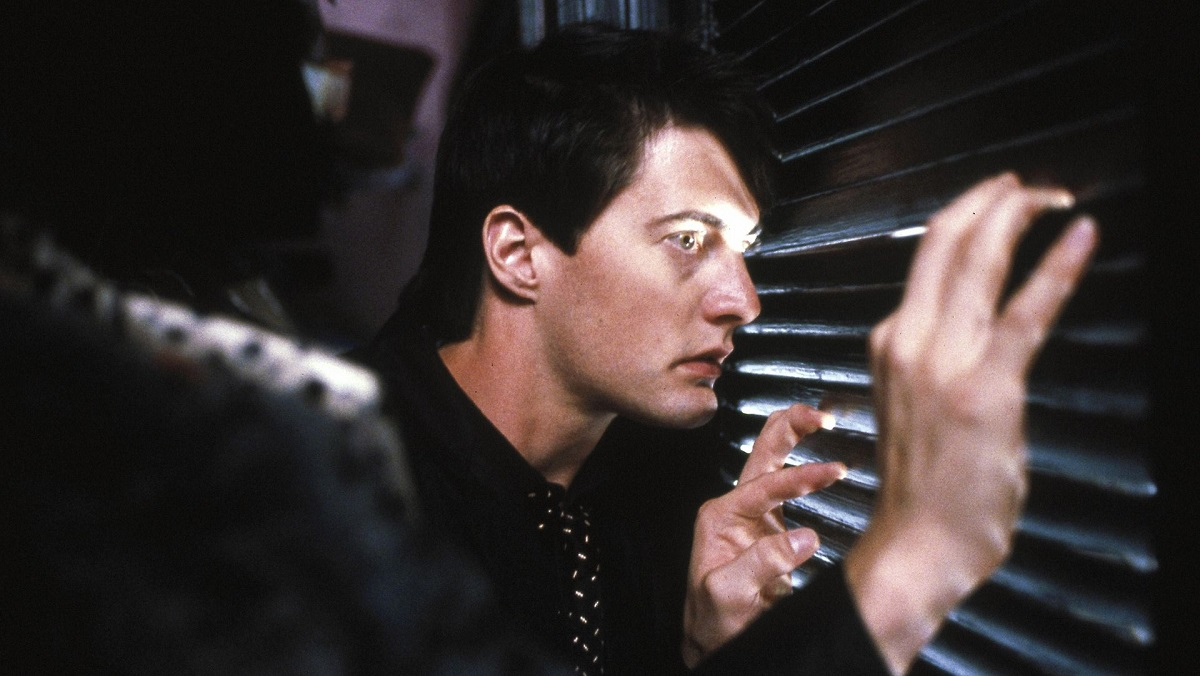
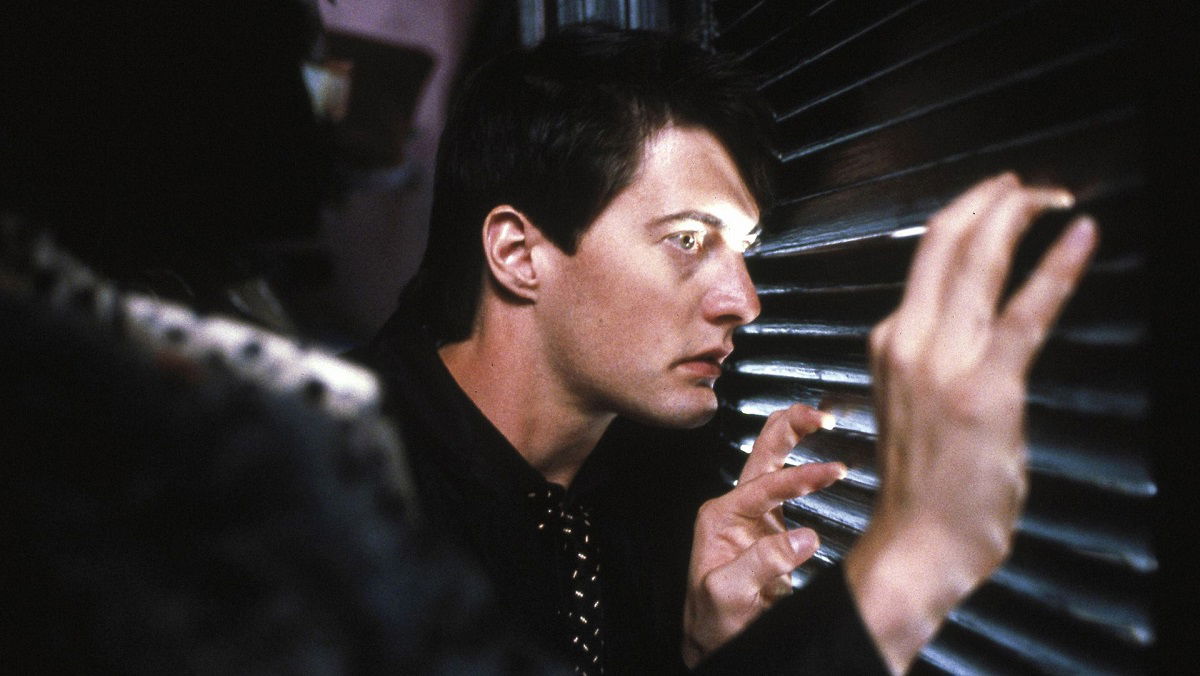
So I've written far too much about contemporary analytic metaphysicians Timothy Williamson and Kit Fine and their respective approaches to modality, attempting to understand their claims via the lens of Lynch's films (and vice versa). I'll assume some of this has been absorbed.
So, if we now let this Finean way of thinking about bodies, embodiment, and form range freely across the Lynch films already in play, Mulholland Drive, Lost Highway, and Inland Empire, a unifying pattern emerges that is deeper than narrative fragmentation, dream logic, or psychoanalytic allegory. What links these films is not simply that identities fracture, double, or loop, but that bodies are repeatedly asked to sustain incompatible embodiments without any guarantee that there is a single underlying form that could reconcile them. The horror, the eroticism, and the metaphysical unease arise precisely where that reconciliation fails, not because something impossible is represented, but because too many necessities coexist without collapsing into one. Mulholland Drive tempts the viewer most strongly toward a unifying explanation. Betty and Diane appear to invite a before and after story, an illusion and a reality, or a fantasy and its traumatic correction. A Williamsonian reading is naturally drawn here. It wants to say that there is a determinate individual who necessarily exists, and that the film presents different epistemic or psychological states of that individual. The confusion, on this view, lies in our access to the facts, not in the facts themselves. The metaphysics is stable, the presentation unstable. Fine’s approach cuts across that comfort. Betty and Diane are not simply the same person under different guises, nor are they merely two people one of whom is imagined by the other. What the film stages is a variable embodiment whose manifestations are not hierarchically ordered. Betty is not simply unreal because Diane later appears. Nor is Diane simply more real because she is miserable, guilty, and doomed. Each is a rigid embodiment structured by different relations, different affective economies, different normative expectations. Betty’s body is integrated into a form that includes optimism, romantic openness, theatrical sincerity, and a world that seems to reward intention. Diane’s body is integrated into a form that includes resentment, sexual humiliation, failure, and a world that punishes longing. These are not mere moods. They are constitutive relations. They determine what counts as success or failure, what actions are available, what gestures make sense. The famous audition scene makes this vivid. Betty’s body performs intensity, vulnerability, and sexual menace in a way that seems to astonish everyone present. The performance is not simply good acting within the fiction. It is the moment at which a particular embodiment coheres. Her body, her voice, the script, the camera angles, the silence in the room all lock together to form a rigid whole. This is an ontological claim about what Betty is at that moment. When Diane later appears unable to function within the Hollywood system, it is because the embodiment that sustained it no longer holds. Fine’s metaphysics allows us to say this without declaring one scene illusory. The necessities governing Betty’s world are not the same as those governing Diane’s, and neither reduces to mere possibility relative to the other. This also clarifies the role of Rita. Rita’s amnesia is often read psychologically, as repression or trauma. But from a Finean perspective, it is a suspension of form. Rita’s body persists, but the relations that would ordinarily structure it into a socially recognisable person are absent. This does not make her indeterminate or incomplete. It makes her available for multiple embodiments. She can be lover, victim, mystery, object of care, reflection, without any one of these exhausting what she is. When Rita later appears as Camilla, this is not simply memory returning. It is a re embodiment that retroactively destabilises the earlier one. The film’s unease lies in the fact that neither embodiment can claim priority. They are not ordered by necessity in a single hierarchy. Lost Highway pushes this further by removing even the temptation of narrative linearity. Fred and Pete are not plausibly two phases of one person’s life. Nor are they convincingly separate individuals connected by fantasy. The film insists instead on bodily persistence without identity stability. Fine’s distinction between rigid and variable embodiment becomes indispensable here. Fred’s body is manifested as Fred, with a particular affective flatness, a particular relation to music, jealousy, and silence. The same body is later manifested as Pete, with a different affective register, different sexual access, different social affordances. These are not psychological disguises layered over a single essence. They are different forms imposed on the same matter. The prison transformation scene makes this metaphysically explicit. Lynch does not film it as a dream or hallucination. He films it as a physical event. The body on the bed writhes, screams, suffers. The matter persists, the form changes. This is exactly the sort of case Fine’s metaphysics is designed to handle. An enduring object can be manifested by incompatible rigid embodiments across time without there being a deeper fact that reconciles them. The viewer’s discomfort arises because we are trained to expect such reconciliation. We want to know who Fred really is. The film refuses to answer because, on this view, there is no single answer. There are only different embodiment regimes, each with its own necessities. The Mystery Man intensifies this. He is not simply supernatural in the sense of violating physical laws. He is ontologically indeterminate in a more precise way. His body does not integrate cleanly into the social embodiments that structure the rest of the film. He appears where he should not be, knows what he should not know, speaks from places he does not occupy. A Williamsonian approach might be tempted to say that he exists necessarily across possible worlds, perhaps as a fixed point in the modal structure. But Fine would urge caution. The Mystery Man is not best understood as a necessary being. He is better understood as a structural anomaly, a figure whose embodiment is incomplete or overdetermined. He participates in multiple rigid embodiments without being fully integrated into any. His unsettling effect comes not from omnipotence but from ontological misalignment. Inland Empire radicalises all of this by refusing to stabilise even the level at which embodiment occurs. Bodies here are fragmented across media, across levels of fiction, across ontological registers that the film never cleanly separates. The actress, the character, the prostitute, the abandoned wife, the girl lost in Poland are not revealed to be the same or different. They are layered embodiments that sometimes overlap and sometimes collide. Inland Empire is saturated with affective necessity. Dread, despair, compulsion, and repetition are not contingent features that could be peeled away to reveal a neutral substrate. They are necessary within the embodiments they help constitute. The woman’s body cannot simply choose to exit the cycle of suffering because the cycle is part of what she is at that time. A Williamsonian approach that insists that all these bodies necessarily exist and that the differences lie in how they are described risks flattening precisely what Lynch insists on preserving. The film’s reality is not exhausted by existence. It is shaped by which necessities hold and which do not. The use of digital video in Inland Empire reinforces this metaphysics. The image is grainy, unstable, overexposed. Bodies flicker, blur, dissolve into darkness. This is a visual analogue of variable embodiment. The medium refuses to stabilise form. Faces emerge and recede. Spaces fail to cohere. The body is continually on the verge of slipping into another manifestation. Fine’s ontology can accommodate this. There is no need to posit hidden worlds or ultimate realities. There are only overlapping embodiments whose conditions of manifestation are fragile and often hostile. Across all three films, then, a consistent picture emerges. Lynch is not interested in denying identity or affirming chaos. He is interested in showing how much work identity does, and how easily it can fail when bodies are forced to sustain incompatible forms. Fine’s metaphysics provides the conceptual resources to say this precisely. Bodies are not bare matter waiting to be interpreted. They are nodes in networks of relations that can shift, fracture, and reassemble without dissolving into nothing. This also clarifies why Lynch’s films resist moral resolution. Responsibility, guilt, and innocence are themselves properties of embodiments. Fred is guilty as Fred in a way that does not straightforwardly transfer to Pete. Diane is guilty as Diane in a way that Betty cannot access. The woman in Inland Empire is guilty, innocent, exploited, complicit, depending on the embodiment she inhabits. This is not relativism. It is ontological pluralism. Different necessities govern different forms, and moral predicates track those forms. Williamson’s necessitism insists that everything necessarily exists. That thesis is not false here, but it is thin. It does not explain why existence matters less in Lynch than form, relation, and affect. Fine would say that Williamson’s framework risks smuggling in an essence at too high a level, treating the world itself as a single necessary object whose internal distinctions are secondary. Lynch’s films resist that move. They insist that necessity fractures along multiple axes, psychological, social, aesthetic, affective, and that no single modal structure can subsume them without loss. Seen through this lens, Lynch’s cinema becomes a sustained exploration of plural necessity and fragile embodiment. The body is where this exploration is most intense because the body is where matter and form meet most painfully. These films ask what it takes for a body to count as something, someone, somewhere, and what happens when those conditions come apart. Lynch’s images pressure the philosophical theses. They show what happens when we take seriously the idea that identity, necessity, and existence are not monolithic, that bodies can be real in too many ways at once, and that the cost of that excess is not conceptual confusion but lived horror. The point is to see whether Fine’s way of thinking about objects, forms, embodiment, manifestation, and dependence can actually make visible structures in the films that standard psychoanalytic, cultural, or auteurist commentary leaves flattened or overdetermined. Blue Velvet showed how Fine’s distinctions allow us to treat scenes not merely as representations of desire, violence, or ideology, but as staged ontological configurations in which bodies, roles, identities, and relations come apart and recombine under pressure. From there it becomes possible to see Lynch’s recurring images of the body not as symbols pointing elsewhere, but as sites where different kinds of embodiment are tested against one another. Fine’s framework is particularly well suited to Lynch because Lynch is obsessively concerned with bodies that are structured wholes whose identity is unstable because the relations that constitute them shift while the underlying material remains stubbornly present. A Finean approach resists the temptation to say that these bodies “stand for” trauma, fantasy, capitalism, patriarchy, or the unconscious, although all of those may be implicated. Instead, it asks what kind of object this body is at this moment, what relations hold it together, what would count as its persistence, and what kind of failure or excess of form is being staged. In Blue Velvet the body is first presented as paradigmatically ordinary. Jeffrey’s father watering the lawn, collapsing mid-task, the camera descending beneath the grass to reveal insects writhing in the soil. The body here is a familiar variable embodiment, stable across time, socially legible, integrated into a reassuringly banal environment. But the descent beneath the lawn already signals a shift from one mode of embodiment to another. The insects are a different kind of whole, a swarm whose unity is not grounded in self-reflexive attitudes or social roles but in physical cohesion and blind activity. Fine’s distinction between different operations of embodiment helps explain why this cut feels so violent. The film moves from one regime of individuation to another without mediation. Dorothy Vallens’ body introduces a far more troubling configuration. She is neither simply a person nor merely an object of desire. In the famous scenes with Frank Booth she appears as a rigid embodiment structured by relations of domination, threat, and ritualised violence. Her identity as Dorothy in these scenes is inseparable from the relations that bind her to Frank, Jeffrey, the hostage child, and the missing husband. Fine’s insistence that identity can be essentially relational helps explain why Dorothy cannot simply step out of this role. She is not a substance bearing accidental properties but a structured whole whose form is imposed through coercive relations. The violence is erotic because eroticism here is the name for a mode of embodiment in which agency, vulnerability, and identity are redistributed across a structure rather than located in a single subject. When Frank enters the room in Blue Velvet, the shock is not only affective but ontological. Frank’s body is staged as a grotesque compound of infantile dependence, sexual aggression, and theatrical performance. His inhaler, his ritualised speech, his oscillation between childlike need and sadistic authority all point to a failure of integration. Fine’s notion of rigid embodiment helps here. Frank is a structured whole whose internal relations are unstable. The inhaler is not a prop but part of the structure that allows this embodiment to persist. Remove it and the object disintegrates. The erotic charge of the scene comes from witnessing a form held together by violence rather than coherence. This way of seeing bodies becomes even more necessary as we move to Mulholland Drive. Here Lynch radicalises the instability of embodiment by allowing the same material body to manifest different persons under different narrative regimes. Naomi Watts’ character is a variable embodiment whose manifestations are governed by incompatible structures. Diane and Betty are not two mental states of one person but two rigid embodiments realised by the same underlying matter under different relational configurations. The audition scene is crucial here. Betty’s body suddenly acquires a different form, a different authority, a different erotic charge, not because something inside her is revealed, but because the relational structure shifts. The same physical body is now integrated into a different whole. Eroticism in Mulholland Drive emerges precisely at these moments of reconfiguration. The love scene between Betty and Rita is erotic here because it stages the temporary success of a fragile embodiment. Two unstable identities form a structured whole that briefly holds. The tenderness of the scene is inseparable from its ontological precarity. This is why its collapse later in the film feels catastrophic rather than merely disappointing. The object that was momentarily realised cannot persist under the weight of the surrounding structures. Lost Highway pushes this logic further by severing any stable connection between body and identity. Fred Madison and Pete Dayton share no obvious psychological nor physical continuity, yet the film insists on their identity in a way that frustrates representational explanations. Fine’s distinction between identity and manifestation becomes indispensable. We are not asked to decide whether Fred “is really” Pete. We are shown a variable embodiment whose manifestations are governed by radically different structures of guilt, desire, and violence. The erotic scenes in Lost Highway are cold, opaque, and disturbing because they do not stabilise embodiment but exacerbate its fragmentation. Sex here exposes the failure of form and so cannot bind anything. The Mystery Man’s body is perhaps the clearest case of Finean impossibility made cinematic. He violates the conditions under which a rigid embodiment could be specified. He is present without being locatable, causally efficacious without occupying a determinate position in the structure of events. This is why he cannot be reduced to a hallucination or symbol. He is an object whose mode of existence does not fit the ontological grammar of the film’s world. Erotic menace is inseparable from ontological threat. Inland Empire represents the culmination of this trajectory. Bodies dissolve into performances, performances into fragments, fragments into echoes. Laura Dern’s character does not just lose her identity. The very operations that would allow us to specify a variable embodiment break down. Fine’s framework reveals its own limits. We are confronted with scenes in which no stable rigid embodiment can be identified, and no clear rule governs manifestation. Erotic imagery becomes raw, abrasive, often humiliating. Sex is no longer even a failed attempt at integration. It is a symptom of ontological exhaustion. Across these films Lynch repeatedly returns to images of the female body exposed, threatened, or abjected. A Finean reading resists both moralising condemnation and psychoanalytic normalisation. What matters is what kind of objects these bodies are made to be within the films. In each case eroticism marks a point where embodiment is strained to breaking point. The body is asked to sustain incompatible roles, relations, and demands. Violence emerges when no stable structure can hold. What Fine helps us see is that these films are about the conditions under which objects, including persons, can exist at all. The horror and eroticism are intrinsic to these ontological experiments. Lynch stages worlds in which the operations that usually secure identity, persistence, and agency are unreliable. Bodies become sites where these failures are made visible and felt. Seen this way, Lynch’s films form a sustained inquiry into embodiment under late modern conditions, where social roles, erotic scripts, and narrative identities no longer align. Fine’s metaphysics sharpens our attention to the exact points where form is imposed, withdrawn, or corrupted. It allows us to say why these films disturb rather than merely shock, and why their eroticism feels inseparable from dread. What Lynch gives us are not symbols to decode but objects to confront, fragile, overdetermined, and held together only by violence, fantasy, or momentary grace.