Lynch's Modal Bodies and Eroticism (3): The Ontological Laugh
What is the “matter” out of which the person on screen is composed, bodies, voices, clothes, rooms, names, memories, institutional roles, photographs, and who designates which parts count as spatial parts and which as temporal parts. In the college example, the fellows can be temporal parts without fixing the college’s location. In film terms, a character’s lovers, fears, and humiliations can be temporal parts of the character, without being spatially where the character is. That is banal in life, but Lynch makes it visible.
What is the “form” that makes this pile of matter into this character, or this relationship, or this world. A married couple exists only under the marriage relation, John and Mary as a mere sum would exist anyway. Lynch repeatedly gives you a man and a woman who are “there”, but the couple as a couple is precarious, sometimes it exists only under a delusion, sometimes only under an institution, sometimes only under a shared performance. That maps cleanly onto Fine’s insistence that structured wholes are not linguistic conveniences, they are extra organisation.
How does the film treat location. Mulholland Drive is exemplary here. Los Angeles is not just a place, it is a modal field, a set of possible arrangements of the same “matter”. It behaves like Fine’s rainbow. There is no single underlying “real LA” that the rest is merely a projection of. The film’s LA is where it is from inside the audition scene, and elsewhere from inside the Club Silencio scene, and the film is not simply misleading you about a fixed substrate. It is showing you a perspective relative ontology.
How does the film treat time. Lost Highway is structured around the possibility that you can have one “whole” person manifested as different more particular persons at different times or under different counterfactual conditions, and that this is not necessarily just metaphor or psychosis, it is a kind of variable embodiment. Inland Empire turns that screw until the screw strips.
Now shift from general identity to eroticism. Lynch’s eroticism works by making sexual, romantic, and bodily predicates latch onto different aspects of the same complex whole, and by forcing those aspects to diverge. The same woman can be “visited” as an image, “joined” as a role, “possessed” as a body, “lost” as a name. The felt unease comes from the way the predicates refuse to unify smoothly. Eroticism in Lynch is less about explicit sex and more about forms of attachment, entitlement, fantasy, and shame that try to stabilise a whole, a couple, a self, and keep failing. That is why his film feels sexual even when nothing “sexual” is happening, because the film is staging the ontological pressure points of desire. Desire tries to make a structured whole out of unstable parts.
In Mulholland Drive the most basic temptation is to split the film into “dream” and “reality”. Fine’s complaint about certain philosophical manoeuvres is relevant here. Philosophers, he says, often invent a story about how language must work because their ontology cannot accommodate what people say. With Lynch, viewers often invent a story about how the film must work because their ontology cannot accommodate what the film plainly shows. The dream solution is a version of that mistake. It functions as an ontological retreat, an attempt to keep the objects simple.
A Fine like approach asks instead, what complex whole is being presented, and how does it manifest? The characters are not merely swapped, they are re related. The “same” woman appears with different names, but what changes is not merely a label, it is a network of relations, admiration, envy, debt, sexual dependency, professional judgement, and humiliation. This is where eroticism sits, in the relations that compose the person as an object in the social world.
Think about the audition. It is erotic without being sex, because it is a scene where bodies and voices become instruments of recognition. A role is a form that takes over the matter, a person becomes a character, and the room becomes a tribunal. Some kinds of properties are special, context sensitive, not reducible to a uniform rule. “She is alluring” targets an aspect of a complex whole, her voice, her control, the gaze of the room, the implied sexual history of the script, the fact that the lines are a form of coercion. Lynch stages the “special feature” character of erotic predicates. They do not pick out a single simple part. They select an aspect.
Club Silencio is a metaphysical sermon. It is a scene about the gap between a performance and what it seems to be, but it does not conclude that there is nothing there. It concludes, more like Finean rainbows, that the object’s mode of being is not the one you assumed. The voice can be there without the singer singing, the affect can be there without a stable cause, the love can be there without the lovers cohering as a couple. That is eroticism as ontological shock. The body reacts, tears, dread, desire, even when the causal story is unstable. The film does not say, therefore nothing is real. It says, the conditions for this kind of presence are not what you thought.
Lost Highway is more overtly about identity, but Fine’s point about circularity is the deeper hook. In social ontology, the committee can depend on attitudes that refer, directly or indirectly, to the committee itself. In Lost Highway, the self depends on attitudes, jealousy, self narration, erotic suspicion, that refer to the self as the kind of thing it is trying to be. “I am not that man” is a constitutive stipulation. The film’s loop is ontological. The man’s attempt to ground his jealousy in “facts” repeatedly slides into identity based holism. What he is cannot be specified without reference to the social and erotic objects he is entangled with, husband, betrayed husband, desired man, humiliated man, dangerous man, watched man. The self is a structured whole whose structure is partly made of reflexive attitudes.
Eroticism here is violent not because the sex is violent, or sex is violent per se, but because erotic recognition is treated as a scarce resource that anchors identity. If she desires someone else, the husband’s form collapses, and he tries to rebuild it by re manifesting as someone else. That is variable embodiment as defence. The film’s famous identity shift is then a metaphysical dramatisation of how a person can be re constituted by a different role network, with different social permissions. It is the same underlying matter in some respects, a body, a face, a voice, but under a different form, a new “committee”, so to speak, with different offices. Lynch makes the form do violence to the matter.
Inland Empire pushes perspective relativity even further. Viewers often want an underlying story, a single “true location” of the plot. Fine’s rainbow analogy suggests a different posture. Perhaps the film’s ontology is not a single region with different projections, but a function from perspectives to regions. Each scene gives you a location, emotional, social, bodily, and there may be no further fact about which is the underlying one. This is not nihilism. The rainbow is still there.
Eroticism in Inland Empire is the sensation of being caught in roles. The body is a site of casting, judgement, violation, and haunted repetition. A kiss can feel like a line being read. A gaze can feel like surveillance. The erotic becomes uncanny because it is not owned. It is distributed across perspectives, across frames. The character’s desire is not a private interior, it is an external structure, like an economy or a transport system, that moves through her.
An image of a body is a strange object. It has a physical substrate, celluloid or digital data, it has a spatial location, on a screen, but it also has an intentional location, it is “of” someone, “about” someone, it points beyond itself. Something can be a constituent without contributing its physical presence. The image can contain the body as a non spatial part, in the relevant sense. The body’s physical mass is not in the image, but the body as an object of attention is.
Lynch thrives on this. Photographs in Lost Highway are not evidence, they are ontological provocations. The video tapes are seem to place the house under an alien gaze. The house is “there” twice, as a place and as an image. Fine would say the object is complex. “The house is being watched” is a predicate that targets the house under a certain form, house as socially vulnerable, house as penetrable, house as a site of intimacy. The tape does not merely depict, it changes the structure that composes the couple as a couple. It injects a new relation, being observed, into the rigid embodiment.
Eroticism enters through this re structuring. Many erotic scenes in Lynch are not “sex scenes” but scenes of being positioned. A woman framed in a doorway, a man watching from a corridor, a camera lingering on hair, fabric, lipstick, does not simply show a body, it installs a form, desirable object, dangerous object, guilty object. “Erotic” is not a simple property like “red”, it is a context bound aspect selection.
Lynch makes that obvious by letting the same body be erotic in one scene and horrifying in another without changing the body, only the relational structure.
Film is already a machine for raising endurance questions. Is a character wholly present at each moment, or are they a spread out temporal entity, a worm through scenes? Lynch weaponises that. In Mulholland Drive, the two name sets and role sets look like temporal parts of a single extended object, the “woman in Hollywood”, but also like two different enduring manifestations. Fine’s own preference for distinguishing modes of presence can help here. You can say, the character exists at the moment, but is extended through the narrative, and Lynch plays games with which sense you are allowed to use.
Now add the rainbow. Erotic images in Lynch are rainbow like. Their location is not merely on the screen. It is where they are from this perspective, from the man watching, from the woman being watched, from the viewer implicated, from the institutional gaze of Hollywood, from the criminal gaze in Lost Highway, from the cursed production in Inland Empire. There is no single underlying “true erotic meaning” that the rest are projections of. There is only the function from perspective to affective location. This stops you reducing Lynch’s eroticism to either psychology or symbolism. If you treat it purely psychologically, you hunt for the dreamer. If you treat it purely symbolically, you hunt for the key. Fine’s rainbow posture suggests that some cinematic objects are irreducibly perspective relative. The image’s erotic “where” is in its perspectival deployment.
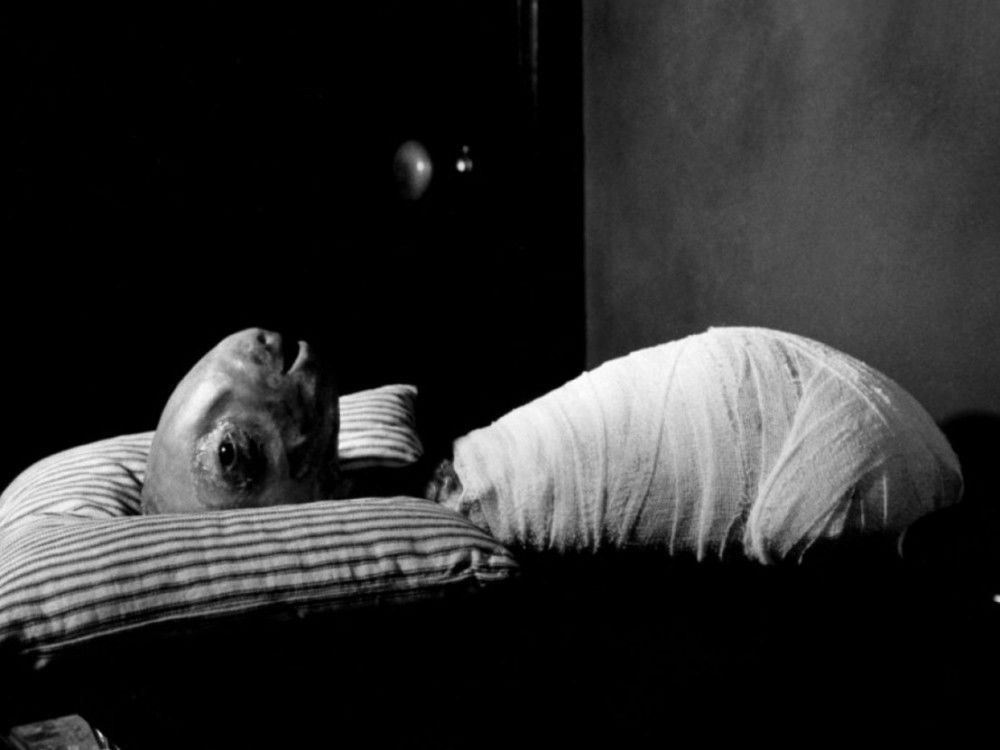
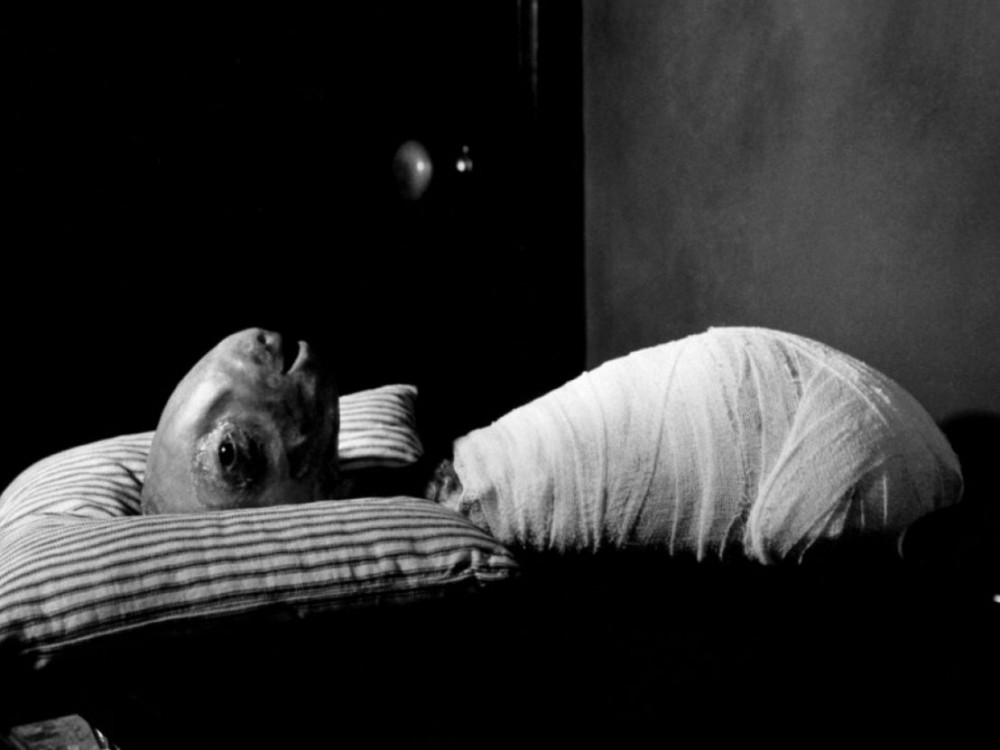
Eraserhead is the ur text for Lynch’s ontology of the body, because it treats bodily processes as alien institutions. Pregnancy, birth, childcare, and sexuality appear not as private experiences but as oppressive systems with their own machinery. Henry, Mary, the baby, the room, the radiator, the industrial landscape, the neighbour, the chicken dinner, the Lady in the Radiator, the Man in the Planet, the levers, all of these are “matter”. The question is, what structured wholes do they compose, and what kinds of parts are they, spatial parts, temporal parts, normative parts?
The apartment is not merely a setting. The couple, as a social object, is where the apartment is, even as the members are psychologically elsewhere. The institution of family is presented as a rigid embodiment with hostile form, parent and child as roles, but the roles feel imposed. The baby is the most brutal illustration of mixed character. It is a body, but also a duty, a guilt object, a punishment, a surveillance device, a noise. Predicates that ordinarily cohere, “my child”, “my responsibility”, “a living being”, split apart. The film’s horror is in that splitting.
Eroticism in Eraserhead is saturated. Sex is presented as sticky, risky, contaminating, and at the same time as a desperate attempt to escape the institution one is trapped in. Henry’s sexual encounter with the neighbour has the feel of a modal escape hatch, a possible world in which he is not bound into fatherhood. But Lynch refuses to let it become stable. The erotic is presented as both lure and threat, because it is another form that reconstitutes the self, not a private pleasure.
Now let's examine the strange lever pulling creature, the Man in the Planet. In Fine, when you form a structured whole you can designate which constituents count as spatial parts and which as temporal parts, and different wholes will have different signatures. The Man in the Planet is like a grotesque metaphysician, or technician, who assigns signatures. He pulls levers that seem to control the emergence of the foetus-like baby, the sperm-like fragments, the conditions for Henry’s world. He is not simply “God” in a straightforward sense, he is closer to a bureaucrat of ontology, an operator of the rules by which manifestations occur.
If you treat him as Fine might treat the rainbow, you ask, from what perspective does he have location, what is the framework of location in which he appears? He occupies a different spatial framework and the film refuses to translate it cleanly into Henry’s apartment geometry. The planet room is not behind a door, it is another mode of presence. That is why the lever pulling feels so eerie. It is causal without being local.
The Man in the Planet looks like the figure who makes the world by manipulating the very conditions that define what counts as the world’s objects. He is a cinematic emblem of identity based holism, the sense that the identity of the object depends on rules that already quantify over the object. The baby exists because a certain “committee” of forces consents, but the consent is built into the very identity of what counts as the baby in this world. The levers are the visualisation of that consent mechanism. They show stipulation as machinery.
The Lady in the Radiator is then another kind of form. She is not simply a fantasy object. She is a structured possibility, a world in which the baby’s burden can be annulled, in which annihilation is presented as sweetness. Her song is an ontological promise, that you can be re made. If the Man in the Planet is the operator of the film’s physics, she is the operator of its ethics, of the affective valuation of existence. “In heaven everything is fine” is not about heaven, it is about a modal space where the burdensome forms dissolve.
Plot, as usually told, is simple enough. Henry is pressured into marriage after a pregnancy. He and Mary try to care for a premature, inhuman baby. The domestic space becomes unbearable. Mary leaves. Henry is drawn to a neighbour. The baby becomes more demanding. Henry’s psychic world fractures into visions of the radiator stage and the planet room. In the end he kills the baby, the world ruptures, and he dissolves into the embrace of the radiator figure.
Cinematography and sound are what make this plot into a metaphysical experience. The black and white is ontological austerity. Surfaces become primary. Skin, fabric, steam, ash, all look like the same substance under different forms. That collapses the ordinary hierarchy by which we distinguish the living from the industrial. Fine’s “matter” becomes visually promiscuous. Everything is stuff.
The camera tends to isolate Henry as a kind of enduring object trapped in an extended environment. Long takes, static framing, cramped compositions, make him feel like he exists at a time while the world extends around him as a hostile field. The industrial drone functions like a constant background condition, an “infrastructure” of the world, closer to a transport system or economy than to a local noise.
In Eraserhead, the system is the world, it is not merely a group of people. The factory-like ambience is a social object in Fine’s broad sense, a structured whole whose functional parts we do not grasp, but which governs the characters. Acting in Eraserhead is performative in the strict sense. Faces are held, reactions are delayed, dialogue is stilted. This produces the sense that roles are not second nature but imposed forms. Henry’s blankness is not emptiness, it is a refusal, or inability, to integrate.
That is exactly what Fine’s rigid embodiment picture highlights. Integration is what makes a structured whole, and Henry looks like a man failing to be integrated into husband and father. He remains matter that cannot settle into form. Conventional commentaries tend to cluster around anxiety about sex, fear of fatherhood, industrial alienation, the grotesque of reproduction, Catholic guilt, the horror of domesticity, the uncanny of the infant, the film as dream. Many of these are plausible at the level of content, but Fine helps you shift from content to ontology. The question becomes, what kinds of objects are these, and what kinds of dependence relations hold among them?
So now we can treat the family as a social object with a shifting signature. At the start, the “family” is called into being by an institution, the dinner, the parents, the pressure, the marriage. It is a committee formed by coercive consent. Its spatial part is the apartment. Its temporal parts are the obligations and the shame, which follow Henry even when Mary leaves. The baby functions as both spatial and temporal part. Spatially it is in the room, temporally it is the future, the consequence. This mixed part status is why it feels monstrous. It is not only a creature, it is a time.
We can also now treat the baby as a variable embodiment of erotic consequence. In ordinary life, sex and reproduction are connected but not identical. In Eraserhead, Lynch turns that connection into an ontological tether. The baby is the manifestation of sex under a punitive form. That is why eroticism is everywhere even when sex is off screen. The baby is sex as an enduring object, sex that will not stop being present. Fine’s existence and extension distinction can be used almost literally. The sexual act is an event extended through time, but its consequence becomes an object that exists at times, intruding into each present moment. The film’s horror is the invasion of event into object, the conversion of an extended episode into an enduring burden.
We can now also treat the Man in the Planet as the emblem of modal control. A variable embodiment can manifest differently at different times or under different counterfactual conditions. Eraserhead’s planet room is where counterfactual control is staged. The levers are not levers in Henry’s world, they are the visual grammar of “had things been otherwise”. The creature is the caretaker of the film’s space of alternatives, the operator who keeps selecting which manifestation occurs, baby, worm like, eraserheads, collapse. In other words, he is the image of the mechanism by which the film’s world keeps being re selected.
We can treat the radiator stage as the site of a different social ontology, a fantasy institution. It looks like a theatre, a public space, but it is private. The Lady performs for Henry, but also for the film. This is an institutional form, entertainment, consolation, salvation, that exists by self reflexive attitudes, the shared thought that this is the place where it is fine. Self reflexive cohesion applies here, except it is a one person group, a monadic committee. The “we” of “everything is fine” is Henry plus the fantasy that sustains him.
We can also return to the lever pulling creature alongside eroticism. What is erotic here is not the creature’s body, it is the film’s insistence that erotic life is governed by an alien bureaucracy. Henry’s desire, fear, and relief are not owned by him, they are administered. That is why the creature is so disturbing. It is not violent, it is managerial. It shows that the deepest horror in the film is governance, the sense that bodily life is run by rules you did not author. The rules that define the objects of this world, husband, baby, family, are the very rules that the world seems to be produced by, and the film gives you a literal operator of those rules.
So the film treats the body, and the social and erotic forms that organise the body, as structured wholes whose identity conditions are partly self referential (like a committee) and partly perspective relative (like a rainbow), and it refuses the viewer the comfort of a single underlying location, a single substrate story, because if the objects it depicts are rainbow like, their mode of being is bound to the standpoint from which they appear.
That is also why the film stays funny. Fine keeps a dry impatience with the philosophical habit of saying “strictly speaking, chairs don't exist etc etc”. Lynch turns that impatience into black comedy. The dinner scene is a lecture on the incoherence of that "strictness". The tiny chickens, their rotating legs, the oozing, the family’s forced politeness, it is the absurdity of trying to preserve ordinary predicates, “nice meal”, “family gathering”, when the object has become mixed character in the most grotesque way. The laughter is an ontological laugh, the laugh of predicates losing their grip.