A Turd in the Punchbowl: Initial Thoughts On Christoph Shuringa’s A Social History of Analytic Philosophy Or: An epigone Crashes the Party
By EJ Spode
When I was first hired as a junior professor of philosophy in 1987, I joined a department (at Stony Brook University) that had three “wings” – one in continental philosophy, one in systematic philosophy, and one in analytic philosophy. This demarcation was a reflection of a schism in 20th-century that even then, was not making very much sense. I was already unclear what the distinction even came to. It’s not like there was some doctrine that continental philosophers believed that analytic philosophers didn’t or couldn’t. It was more of a sociological distinction having to do with your professor’s professor’s professor, who you read, and what your style of communication was like.
Originally, as we will see, the rift had quite a lot to do with Jewish analytic philosophers fleeing Europe during World War II, and finding safe havens in United States universities. Understandably, they were not fans of Continental philosophers like Martin Heidegger, who had been completely in the tank for Hitler, and they were particularly put off by claims that analytic philosophy was “bloodless” or “ungrounded in culture.” They had heard that one before, albeit in another context. This led to some unfair blowback against continental philosophers in general, which led to unfair blowback against analytic philosophers in general, and on and on it went until people decided that enough was enough (more on this later).
By 1987, for sure, some retirement-age philosophers held ancient grudges, but even in the case of the professors who had been victims of the Analytic/Continental wars (e.g., the purges of Continental philosophers at Yale), the victims were ready to let bygones be bygones. There were bigger fish to fry in the age of Ronald Reagan.
Indeed, by the late 1980s, continental philosophers and analytic philosophers were discovering that they had quite a lot in common, including a shared mandatory reading list that spanned well over 2300 years of philosophical common ground. It should come as no surprise that the common ground extended beyond shared background literature. They were apt to find themselves closely aligned politically and socially, and on pretty much anything, including (surprisingly often) who the smart students were, who the better teachers were, and where the best food was near campus.
If it seems that I am painting a kumbaya moment, well, perhaps I am. It was like a freshman mixer, with people from diverse backgrounds getting together for the first time and finding out, while they stood over the punch bowl, that they had much in common.
Apparently, not everyone has been enjoying this kumbaya moment – certainly not Christoph Schuringa, who has recently stepped into this happy freshman mixer and dropped a giant turd into the punchbowl, in the form of his new book. A Social History of Analytic Philosophy.
The book’s central thesis is that analytic philosophy was born into economic privilege and that it has been carrying water for the status quo ever since. It has been a force defending bourgeois liberal ideology and marginalizing radical alternatives like Marxism. It is somehow a cheerleader for colonialism and capitalism. These are also the messages that readers of the book are getting. So, for example, Žižek’s takeaway from the book is that “analytic philosophy is not politically neutral, it is deeply rooted in capitalist liberalism and its struggle against Leftist engagement.” Adam Knowles, in Radical Philosophy, takes the point to be that analytic philosophy is “an intellectual tradition harbouring colonial ambitions.” He adds that “Schuringa produces a persuasive case for analytic philosophy’s fundamental role as a powerful intellectual tool of bourgeois liberal ideology.”
Schuringa not only has a thesis, but he also wants us to know that he is not messing around. He is serious!
The tradition of empiricism-liberalism represented by Hume, continued by analytic philosophy in spite of its ignorant self-image as just philosophy as such, rightly trembles at the wrath that might be unleashed by the powerful critical forces that its hegemony helps to keep suppressed.
Wowzers, that quote is some Conan-the-Barbarian smack talk, but my first thought was: Hume? What? In any case, I thought I might take some time off from my trembling and write some thoughts about Schuringa’s book.
And my point here, now, is that for better or for worse, analytic philosophers have been at the vanguard of progressive and radical social movements since it was forged in early 20th Century Vienna and Cambridge University, it retained its radical socio-political edge through the Cold War, and it retains that radical edge today. My more important point is that we are approaching an “all hands on deck” moment, and it is critical that analytic and continental philosophers need to unify in countering the very real dark forces that are at work in the politics of today.
The Myth of Socially Disconnected Analytic Philosophy
Let’s be clear on what the claims on the table are. One claim is that analytic philosophy is ahistorical and uninterested in anything that has to do with the social or political. It is, by virtue of this alleged disinterest, that it can serve as a tool of liberal bourgeois ideology. As Schuringa puts it in the opening line of his book:
Analytic philosophy, today the hegemonic form of academic philosophy in the English-speaking world and beyond, tends to think of itself as removed from the changing scenes of history. It acts as if it were pursuing its questions from a vantage point situated nowhere in particular, unaffected by social and political reality. It thus operates as a tradition that manages to think of itself as no tradition at all.
Later, he says that this ahistorical, disconnected perspective can be found in the very style of analytic philosophy and the topics that it engages.
The analytic style is highly ahistorical and acultural. ... Analytic philosophy tends to remain ignorant of large bodies of theory, particularly those concerned with culture, politics, anthropology, psychology, sexuality, religion, literature, and so on.
Neither of these claims are true of analytic philosophy as it is. They are not even true of analytic philosophy in its origins. As Schuringa surely knows, the founding document of analytic philosophy – the manifesto of the Vienna Circle, speaks directly to this point. Consider, for example, the concluding paragraph of that manifesto.
Thus, the scientific world-conception is close to the life of the present. Certainly it is threatened with hard struggles and hostility. Nevertheless there are many who do not despair but, in view of the present sociological situation, look forward with hope to the course of events to come. Of course not every single adherent of the scientific worldconception will be a fighter. Some, glad of solitude, will lead a withdrawn existence on the icy slopes of logic; some may even disdain mingling with the masses and regret the ‘trivialized’ form that these matters inevitably take on spreading. However, their achievements too will take a place among the historic developments. We witness the spirit of the scientific world-conception penetrating in growing measure the forms of personal and public life, in education, upbringing, architecture, and the shaping of economic and social life according to rational principles. The scientific world-conception serves life, and life receives it.
This does not sound like people who are “ahistorical” (to the contrary, their “world-conception is close to the life of the present.”). Nor does it sound like people who are “situated nowhere in particular, unaffected by social and political reality.” To the contrary, they say that their world-conception is penetrating “the forms of personal and public life, in education, upbringing, architecture, and the shaping of economic and social life,” albeit according to “rational principles,” which may be the thing that Schuringa is really objecting to.
Now Schuringa knows that this is the, or at least a, founding document of analytic philosophy, but here and elsewhere he deploys a strategy of deception that he will conduct for some 330 pages, in which he acknowledges what he must (although, if he can get away with it, he will suppress it), and then spin up a story that the person in question was not really saying what they appear to be saying and doing. He will downplay the radicalism of radicals, and he will downplay the social engagement of the socially engaged. The end result is an astoundingly dishonest document, from its very first page to the last. I understand that that sounds harsh, but hear me out. We are going to walk through this book, claim-by-claim, defamation-by defamation, deception-by-deception, to try and sort this out.
What I intend to show is that, counter to Schuringa’s claims, it is absurd to say that analytic philosophy is ignorant of “culture, politics, anthropology, psychology, sexuality, religion, literature.” It is absurd to say that analytic philosophy has recoiled from radical and revolutionary political thought. Analytic philosophy has been engaged with all of these topics from the beginning. And the place we will start is with the Vienna Circle.
There is this mythology about the positivists that they were caught up in logic, and the language of science and nothing else. But the positivists, living in early 20th-century Vienna, were neck deep in the culture, politics, anthropology, psychology, etc. of their age. They were key figures in the culture of their age, and they were working to find a way forward in the post-World War I wreckage of the Austro-Hungarian Empire. This is clear from Philipp Frank’s list of people they were reading: Franz Brentano, Alexius Meinong, Hermann von Helmholtz, Heinrich Hertz, Edmund Husserl, Sigmund Freud, Bertrand Russell, Alfred North Whitehead, Vladimir Lenin, and Gottlob Frege. Despite the press they get, the members of the Vienna Circle were interested in everything.
To give just one example, members of the Circle had regular contact with the Bauhaus artists in Berlin. Otto Neurath was invited to the opening of the New Bauhaus in Dessau. Herbert Feigl and Rudolf Carnap also lectured there, and all were directly engaged with avant-garde artists of the age – Walter Gropius, Paul Klee, Vassily Kandinsky, László Moholy-Nagy and Josef Albers.
As Peter Galison notes in an article on their connection, the Vienna Circle and the Bauhaus were also drawn together by their common enemies: “the religious right, nationalist, anthroposophist, völkisch, and Nazi opponents.” Everyone knows the story about how Jewish artists and philosophers had to flee the Nazis, but I don’t think most people appreciate what they were actually up against philosophically. And the best way to illustrate this is in the case of the assassination of Circle leader Moritz Schlick and the aftermath of his assassination.
Schuringa is not impressed by the manifesto of the Vienna Circle, and he points to the carve-out in the final paragraph, for people who “lead a withdrawn existence on the icy slopes of logic.” But as we will see, even the members of the Circle who were not political, who led a “withdrawn existence on the icy slopes of logic,” were, in the context of their times, inherently political. There is no better illustration of this than the death of Moritz Schlick, who did not self-identify as one of the political members of the Circle. But in context, he was very much politically engaged. And sadly enough, the place where we can best see this is in his assassination in 1936.
The Death of Moritz Schlick
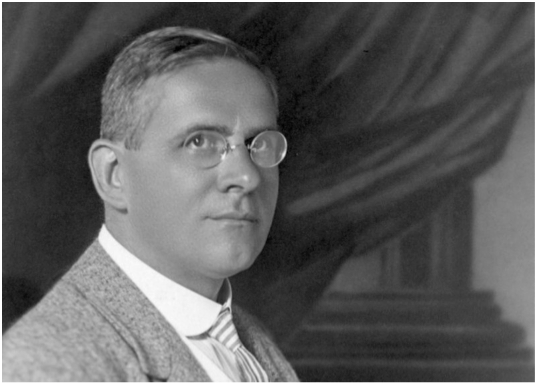
All Schuringa says about this critical event is that “Schlick was murdered by a mentally ill student in 1936.” Full stop. And well, the student probably was mentally ill, but it ignores the way that the right-wing press in Vienna celebrated Schlick’s murder. His murder, and the response to it in the press, are illuminating, for they show the kind of world that the Vienna Circle was inhabiting, how completely radical they were in that context, and the horrific abuse they had to endure because of their philosophical stance. It is somewhat surprising that Schuringa skips this event entirely, as I would have thought they would be the centerpiece of any social history of analytic philosophy.
There are two very fascinating books about this topic: by The Murder of Professor Schlick: The Rise and Fall of the Vienna Circle. (Princeton, 2020), by David Edmonds, and Exact Thinking in Demented Times, by Karl Sigmund.
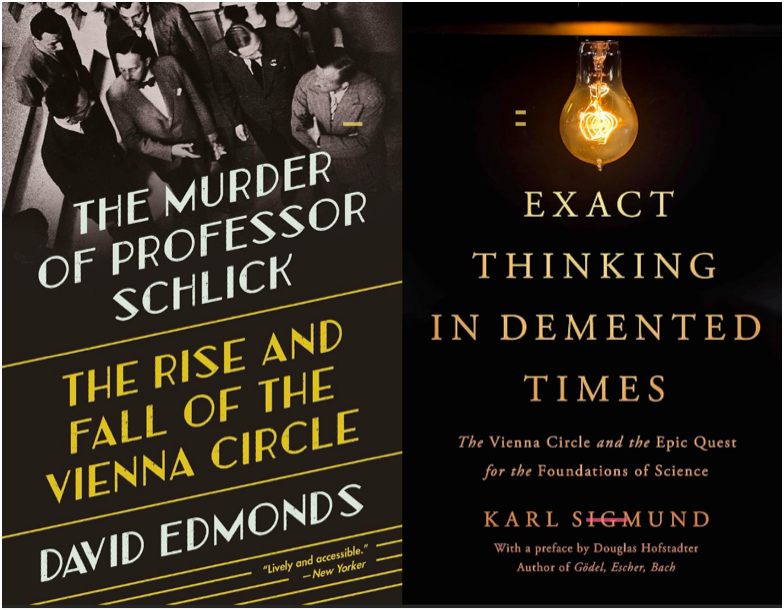
As both books report, there was a cascade of articles in the local Vienna media, using the murder of Schlick to put the philosophers of the Vienna Circle on trial in the court of public opinion. The real victim, they seemed to be arguing, was the killer.
For example, on July 10, the Linzer Volksblatt ran an article condemning Schlick for corrupting "the fine porcelain of the national character." This bit is fleshed out by Sigmund, in Exact Thinking in Demented Times:
In the daily Linzer Volksblatt, one Bernhard Birk wrote about the problematic activities of Moritz Schlick: “For a full fourteen years, young, tender flowers of humanity were forced to drink from the poisonous vial of positivism as if it were the very water of life. The effect must have been horrible.” Robust souls would simply throw up, said Birk. However, “there also exist delicately organized minds, fragile porcelain from the roots of the Volk, patriotic children of the Austrian soil, people who yearn for the beautiful and the noble. To pour the doctrine of positivism into these wide-open minds is like pouring chloric or nitric acid down their throats.”
Two days later, in the intellectual weekly paper Schönere Zukunft (Better Future), came out with this:
The Jew is a born anti-metaphysician and loves logicality, mathematicality, formalism, and positivism in philosophy—in other words, all the characteristics that Schlick embodied to the highest degree. We would like to point out, however, that we are Christians living in a Christian German state, and that it is up to us to determine which philosophy is good and appropriate.
This was followed by a lengthy article under the pen name “Prof. Dr. Austriacus”. Edmonds describes the thesis of the article as follows:
Nelböck (the killer) had been turned into a psychopath by Schlick's radically destructive philosophy. This loathsome philosophy was antireligious and anti-metaphysical. The bullet that had killed Schlick was “not guided by the logic of some lunatic looking for a victim, but rather by the logic of a soul, deprived of its meaning of life.”
The Vienna Circle, the article continued, had come to be seen abroad as representing Austrian philosophy, “much to the disadvantage of Austria's reputation as a Christian state.” But Schlick had not pursued his philosophical project alone, of course. Among his collaborators was his “close friend,” the communist Otto Neurath.
As Edmonds notes, the article didn’t say that Schlick was Jewish (he wasn’t). But the assumption (or allegation) was plain. If not a Jew, Schlick was at the very least Jew adjacent; he was philosophically aligned with them. He represented a degenerate Jewish strain of thought. Among other charges directed at Schlick in the article was the claim that he had Jewish research assistants (Friedrich Waismann and two Jewish women). The article concluded that while killing was not strictly speaking a good thing, perhaps some good would come from the killing:
Let the Jews have their Jewish philosophers at their Cultural Institute! But the philosophical chairs at the University of Vienna in Christian-German Austria should be held by Christian philosophers! It has been declared on numerous occasions recently that a peaceful solution of the Jewish question in Austria is also in the interest of the Jews themselves, since a violent solution of that question would be unavoidable otherwise. It is to be hoped that the terrible murder at the University of Vienna will quicken efforts to find a truly satisfactory solution of the Jewish Question.
Prof. Dr. Austriacus is believed to have been Johann Sauter, a philosopher at the University of Vienna, a Kantian, a Nazi, and an ally of Othmar Spann, the ultranationalist sociologist and economist.
It is not surprising that Schuringa would want to bury all this, as his own critique of analytic philosophy reads as if it were cribbed from those articles celebrating the death of Schlick. All you have to do is replace the word ‘Jew’ with the phrase ‘analytic philosopher’: “The [analytic philosopher] is a born anti-metaphysician and loves logicality, mathematicality, formalism, and positivism in philosophy.”
Once again, Schuringa glosses all of this as “Schlick was killed by a mentally ill student.” Full stop. That’s your social history.
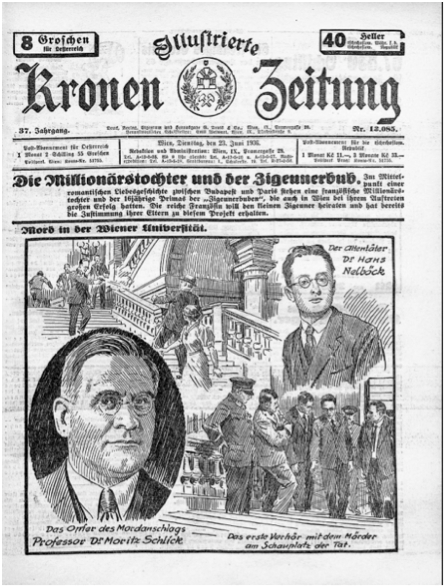
Murder on the Philosophers’ Staircase
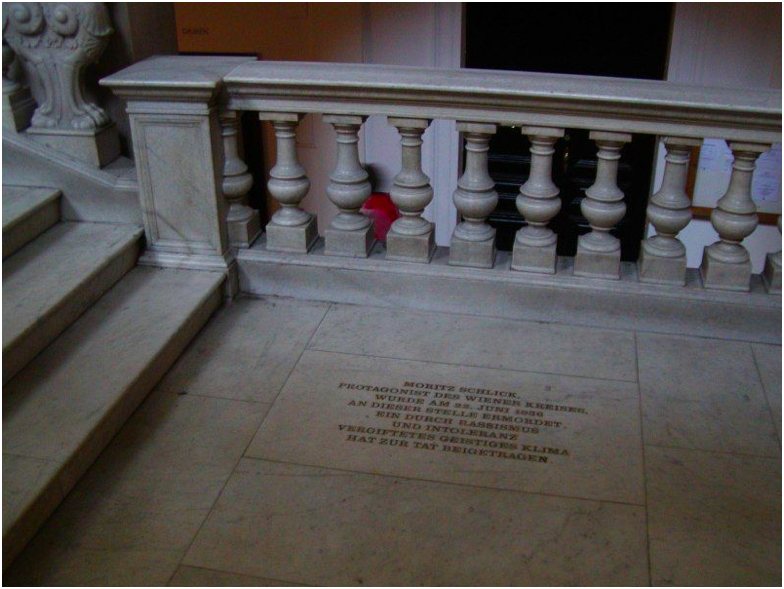
Staircase where Schlick was assassinated
The Vienna Circle takes on the German Philosophical Society
While we are in the business of context-setting, let’s back up a few more years and further contextualize Schlick’s murder. As we will see, there were some broader events that help to explain how we got to where we are with the analytic/continental split, and a lot of that split has to do with the nature of philosophy in the German-speaking world in the 1930s. That brand of philosophy was not in a good place, and a great conflict was already in motion by 1933. Here is how Peter Galin described the philosophical events of that year.
With both Marxists and positivists on the run, the German Philosophical Society celebrated the Nazis' election to power. Their meeting of October 1933 opened with the collective singing of the "Deutschland Lied" and "The Horst Wessel Song." Now, the Nazi representative proclaimed, philosophy would be applicable to the people and fulfill the spiritual needs of the Volk. Hitler telegraphed a laudatory greeting, part of which read: “May the forces of true German philosophy contribute to the building and strengthening of the German worldview.” The philosophers complied with talks on Deutschtum, Volk, Soul, and Spirit.
A month prior to this conference, Martin Heidegger had been named rector of Freiburg University. Not only did he publicly celebrate his joining of the National Socialist Party, but he even took to lecturing while wearing a Nazi stormtrooper brown shirt. Heidegger declared, “Adolf Hitler, our great leader and chancellor, with his National Socialist revolution, has created a new German state, which will safeguard for its people the stability and continuity of its history. Heil Hitler!” (Heidegger, early August 1933, in Collected Works, vol. 16, 151)
About that storm trooper brown shirt -- the Sturmabteilung (aka “storm division,”) shirt: In case you forgot, Wikipedia will remind you that the business of the Sturmabteilung was, “protection for Nazi rallies and assemblies, disrupting the meetings of opposing parties, fighting against the paramilitary units of the opposing parties, especially the Roter Frontkämpferbund of the Communist Party of Germany (KPD) and the Reichsbanner Schwarz-Rot-Gold of the Social Democratic Party of Germany (SPD), and intimidating Romani, trade unionists, and especially Jews.”
People sometimes argue that Heidegger was just being opportunistic here, and wasn’t really a Nazi Nazi (despite the brown shirt), but this is altogether too charitable. He was clearly in the tank for Hitler two years earlier, as the following Christmas letter to his brother’s family shows.
18th of December, 1931Dear Fritz, dear Liesl, dear boys,
We would like to wish you a very merry Christmas. It is probably snowing where you are, inspiring the hope that Christmas will once again reveal its true magic. I often think back to the days before Christmas back at home in our little town, and I wish for the artistic energy to truly capture the mood, the splendor, the excitement and anticipation of this time.
[…]
It would appear that Germany is finally awakening, understanding and seizing its destiny.I hope that you will read Hitler’s book; its first few autobiographical chapters are weak. This man has a remarkable and sure political instinct, and he had it even while all of us were still in a haze, there is no way of denying that. The National Socialist movement will soon gain a wholly different force. It is not about mere party politics—it’s about the redemption or fall of Europe and western civilization. Anyone who does not get it deserves to be crushed by the chaos. Thinking about these things is no hindrance to the spirit of Christmas, but marks our return to the character and task of the Germans, which is to say to the place where this beautiful celebration originates.
Heartwarming.
These developments were the backdrop for the events of 1934, in which many of the Nazi philosophers from the German Philosophical Society would collide with the members of the Vienna Circle at the International Philosophy Congress in Prague, in a pivotal event in the history of analytic philosophy and one which of course is mentioned nowhere in Schuringa’s book. The Vienna Circle crew arrived in Prague, and they were ready to drop the hammer on the Nazis. Here is how Galison (1990) described the event.
Less than a year later, when the Vienna Circle confronted the right-wing philosophers at the International Philosophy Congress in Prague, a clash was inevitable. The principal nationalistic philosophy journal reported excitedly that the Congress had revealed philosophy to be at a turning point, as “a certain Volk” took its place in the development of the World Spirit. One of the heroes of nationalist philosophy, Hans Driesch, presented a plenary lecture, arguing for vitalism and guarding a place for metaphysics. [Driesch would soon be retired for not being Nazi enough.]
Here the Vienna Circle jumped into the fray with what its enemies characterized as a “vehement and well organized attack,” in which the Circle decried metaphysics as meaningless. Viewed from the right, the positivists “stood in the way” of the metaphysical concept of the world that was to underwrite the German worldview. Reichenbach blasted Driesch’s organicism as “mystical,” while Carnap denied that Driesch's organicism was sufficiently lawlike to make it scientific. Schlick remained silent, but the next day he presented an entire lecture, “On the Concept of the Totality,” in which he claimed that while the distinction between totalities and aggregates might be linguistic or pragmatic, it was not a substantive distinction: there was no whole over and beyond the sum of parts.
Schlick’s paper was abstract on the face of it – something about totalities vs aggregates. But his message was quite clear. There was no Germany above and beyond the individual Germans. People should not be submitting themselves to an abstract metaphysical concept of Germany. Perhaps, to our eyes, his work wasn’t political. To our eyes it was just some shit about totalities and aggregates. But, in that context, it was the most political thing you could possibly say. And hang on to that thought, because it is not always clear what is political and what is not. You cannot make that distinction in a vacuum.
People sometimes want to say that the Naziism of philosophers like Heidegger was distinct from their philosophy. But the members of the Vienna Circle saw it another way. In their view, this was what you got when you started trafficking in metaphysical notions and started talking about abstracta like the Volk. It was a natural outcome of such views. They had been warning people about it for years. Fuck around with metaphysics and find out. It wasn’t just internally bad philosophy. It was bad because of what it led to politically and socially.
In this context, it is obviously absurd to suggest that the members of the Vienna Circle were “ahistorical.” They very much knew their place in the history of Europe, and they very much knew that they were at a historical inflection point. They also knew that their philosophical reflections were not inert in their times. They couldn’t be. Thus, when Schuringa says that analytic philosophy “tends to think of itself as removed from the changing scenes of history. It acts as if it were pursuing its questions from a vantage point situated nowhere in particular, unaffected by social and political reality,” what he says is not true. It was not true of the members of the Vienna Circle. Nor, as we will see, would it be true of subsequent analytic philosophers.
Of course, Schuringa’s central project is not to claim that analytic philosophy is merely culturally inert, but also that it is politically conservative – that it is in the bag for the liberal capitalism. As we will see, this claim is false, and it is certainly absurd when applied to the members of the Vienna circle. Many members of the circle were socialists, including Otto Neurath, Rudolph Carnap, Philipp Frank, Edgar Zilsel, and Hans Hahn. The founding manifesto of The Circle name-checked the Austro-Marxists Otto Bauer, Rudolf Hilferding, Max Adler. They, and the Circle’s socialists (Neurath et al.) were co-inhabitants of Red Vienna’s institutions – party press, adult education, municipal reform, Ernst Mach Society – sometimes directly interacting, always moving in the same tight ecosystem. Since Schuringa defames these philosophers individually, we will address those defamations individually, and we begin with the case of Otto Neurath.
Otto Neurath
Above all, the fight against metaphysics and theology means the destruction of bourgeois ideology.
--- Otto Neurath, Empirische Soziologie, 1931
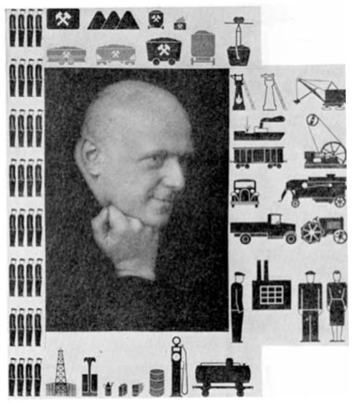
Otto Neurath and icons from his ISOTYPE iconic language
Schuringa can’t deny that members of the circle were politically active, but he can downplay their political activism. Well, he can try anyway. For example, while everyone I know would identify Otto Nerath as a socialist, Schuringa isn’t having it. In his view, Neurath’s political project fell “short of even the most minimal precepts of socialism.” Hmmm, let’s see about that…
We can start with a little history. At the end of the First World War, in 1918, as the war turned against Germany, Kurt Eisner of the Independent Social Democratic Party (USPD) mobilized antiwar protestors and then members of the army against the Bavarian government, and in so doing forced the abdication of King Ludwig III of Bavaria. Eisner became minister-president of the newly proclaimed Free State of Bavaria (or People's State of Bavaria). In 1919, Eisner offered Neurath a chance to pitch his economic ideas to an actual socialist government. Neurath thus traveled to a wildly turbulent Munich to meet with Eisner and his political party. There were bumps in that road.
On February 21, 1919, Eisner (who was planning to resign his position) was assassinated by right-wing extremist Anton Graf von Arco auf Valley. Pandemonium broke out in parliament, shots were fired, and MPs fled through windows and down drainpipes. March 7, 1919, The Social Democratic Party (SPD) took control and nominated former schoolteacher Johannes Hoffmann as new leader. Hoffman appointed Neurath to his administrative position in the government. Officially, Neurath was Präsident des Zentralwirtschaftsamtes (President of the Central Economic Office). Then things got messier.On April 7, 1919, the Communisty Party (the KPD) and the USPD proclaimed the establishment of the Bavarian Soviet Republic, forcing Hoffman’s SPD government into exile. Neurath somehow convinced the new government that his office was “nonpolitical” and that he should stay on to carry on his economic work. A social activist and poet, Ernst Toller, was declared the new leader of the revolutionary government.
The new government consisted of the Central Council, dominated by anarchists and intellectuals; among them were anarchist writer Gustav Landauer, merchant Silvio Gesell, and playwright Erich Mühsam (we will return to all three shortly). Toller referred to the event as the “Bavarian Revolution of Love,” and his government became widely known as “the regime of the coffeehouse anarchists.” It lasted for six days.
On April 13, Toller's government was ousted in a putsch organized by the Communist Party (KPD). The new head of state was now Russian-German Bolshevik, Eugen Leviné. Back in Russia, Vladimir Lenin was delighted to get this news, and announced that “The liberated working class is celebrating its anniversary not only in Soviet Russia but in… Soviet Bavaria.”
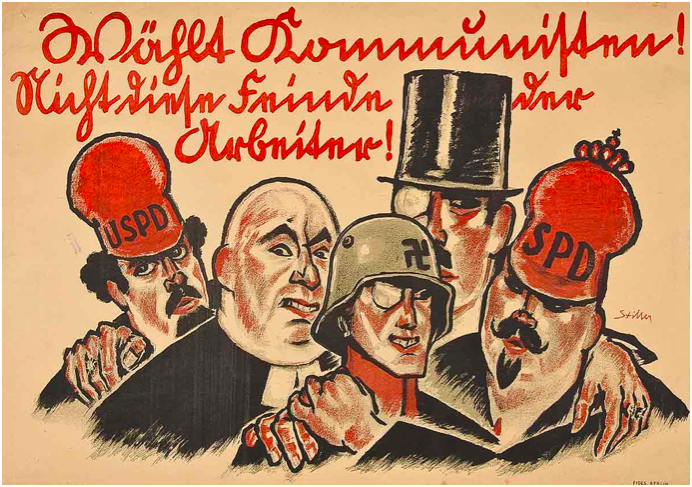
Vote communists![PDK] Not these enemies of the workers!
Neurath was still there, only now the communists gave him a promotion! Neurath was promoted to the Council of Ombudsmen, where he continued implementing his socialization plans, but now Gesell was placed underneath him to handle more pedestrian financial issues. Neurath was the economic planner now. On April 13, Hoffmann's SPD government-in-exile sent forces to Munich. The first armed clash occurred, resulting in 80 injured and 21 deaths, but Leviné’s PDK forces won. But then, on May 3, the German Army (under control of the SPD) came in and shut down the Bavarian Soviet Republic for good. It had lasted less than a month in total, with two distinct phases: Toller's anarchist-influenced government (6 days) and Leviné’s Communist government (about 3 weeks). Neurath was there for it all.The free state was abolished, and its leaders arrested or executed. Neurath was charged with being an accessory to treason and sentenced to eighteen months of confinement, although ultimately his sentence was commuted, and he was banished from Bavaria (I would say that is a win-win for Neurath).
This leaves us with the question of what Neurath was up to in his economic office, and the simplest way to put it is that he had definite ideas about how a socialist state could and should be organized. Here is how Thomas Uebel laid out Neurath’s economic project in a 2020 paper called “Intersubjective Accountability: Politics and Philosophy in the Left Vienna Circle.”
The politics at issue here are not simply the reformist policies of the Austrian Social Democratic Party (SDAPÖ) – which both Neurath and Carnap were members of – but much more radical schemes of social transformation. Importantly, what I here call Neurath’s socialization theory were his plans for the economic reorganization of society and their theoretical underpinnings – not whatever normative arguments may be used to agitate for these plans.
Neurath developed his socialization theory and promoted the associated program mainly in the years 1917–1921, so his involvement anticipated but also outlasted the revolutions in Germany and Austria at the end of World War One. At issue for him was a reorganization of the entire economy of a nation that did not concentrate on the appropriation of the ownership of the means of production by the workers’ state and their organs, but on the appropriation of the executive power to decide the use of these means of production. This meant the abolishment of the market and its “invisible hand” in coordinating the economic actions of state, firms and individuals. The economy was to become subject to a comprehensive plan by which the conditions of life of all members of the society were to be improved, and every enterprise within the economy was to play its designated role.
Neurath’s work differed from the socialism that we became accustomed to seeing in the 20th-century – top-down social planning in which elites in Moscow or some such place dictated how things were to be managed. Neurath had a different vision. He was a bottom-up socialist. The idea was to have planned economies, but to have the proletariat actually choose those plans. So, for example, the role of experts was not to decide and implement policy, but to present and explain options for plans that the people’s representatives would vote on. It then became critical for the planners to present the options in a way that everyone could understand. And this is where the pedagogical part of Neurath’s project came in, and this is what ultimately motivated his icon-base ISOTYPE system. It was part of his idea that planners needed to help workers make informed decisions. It is also a source for the demand for clarity in analytic philosophy, a theme we will return to later.
Again from Thomas Uebel:
Here we reach a point that is all too easily lost when we think of Neurath as a theoretician of planned economies and associate the latter only with the Soviet Union. There the economic plans were weapons of the vanguard party that made decisions for the proletariat. Neurath’s schemes, however, did not embody this top-down approach. Even though he generally bracketed questions of the organization of political power (a point on which he was criticized by fellow socialists) … his numerous economic organizational plans, varied for different audiences and circumstances of application, all have this in common: the planners had to submit their plans as proposals for evaluation and possible approval to the “people’s representatives.” The experts did not have the last word: their role was to show what was doable, but they did not make decisions about what was to be done. Neurath’s conception of the planner’s role was non-prescriptive and democratic.
... To make rational decisions possible, the planners had to show not only what was doable, but also how it was doable. Thus they were not just tasked to develop one comprehensive economic plan, but several. The people’s representatives were not constrained to accept or reject one more or less fully developed plan, but free to select one from different plans on offer. This highlights what can be called the “empowering” aspect of the enlightenment ambition of Neurath’s conception: it is not just choice that is the matter here, but informed choice, for any such choice was to be made in awareness of what alternatives are foregone.
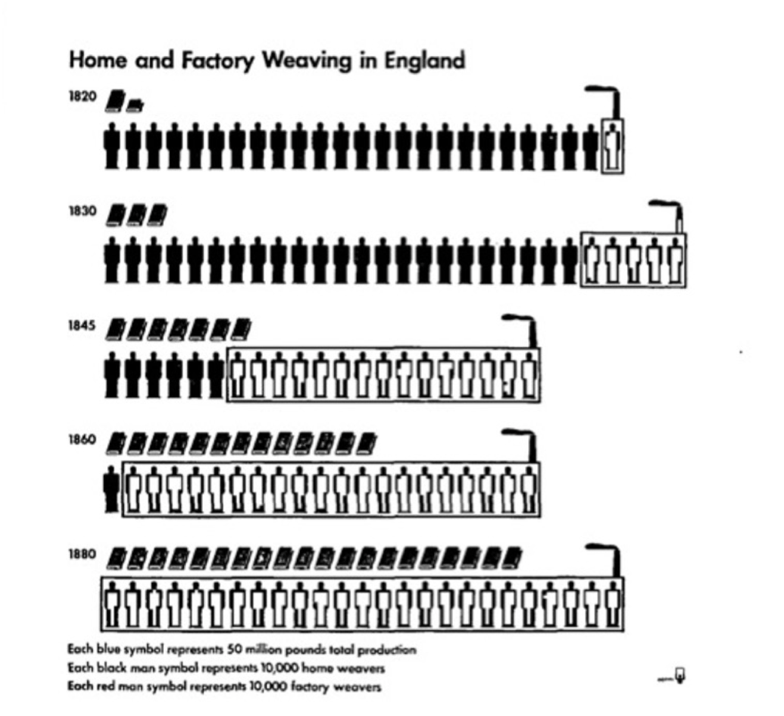
Illustration of home vs factory weavers in Neurath’s ISOTYPE system.
Given all this, why does Schuringa think he can say that Neurath’s socialism fell “short of even the most minimal precepts of socialism?” How is this not socialism on any conception of socialism? Well, Schuringa has “arguments” but they are pretty thin.
Schuringa draws on exactly two criticisms, neither having anything to do with Neurath’s theory, but rather from what went down in 1919, according to the personal history of the Bavarian Republic by the aforementioned anarchist writer and playwright, Erich Mühsam (who was later tortured to death by Nazis). And here, we have to understand that the criticism is not coming directly from Mühsam, but rather from Mühsam as filtered by Schuringa’s scholarship. First, Schuringa says that Mühsam “criticized the indiscriminateness with which Neurath presented his ideas to the bourgeoisie, as well as to the working class.”
One minor problem here. Mühsam, strictly speaking, didn’t say that. He was reporting what some others thought of Neurath. Here is the relevant passage in Mühsam’s account:
[Neurath] presented himself to the RAR (Revolutionary Workers’ Council), was invited by the Munich Workers’ Council to deliver a lecture, and aroused strong interest among the workers, although he was personally met with some suspicion. This suspicion was grounded in the complete indiscriminateness with which Neurath presented his ideas even to the most backward/unenlightened bourgeois circles. [my translation/my emphasis]
Still, you can see why there would be some suspicion. Why was this Austrian professor blabbing to the bourgeoisie about the plans for a socialist state? In this, Neurath simply couldn’t help himself. He was addicted to explaining his ideas about everything to everybody.
Schuringa’s second objection to Neurath is that Mühsam claimed Neurath was “dilettantish.” I think Schuringa wants us to read that in the English language sense of “dilettantish” as saying Neurath was just someone with a casual interest in such matters and that he was ill-informed. That is a crazy charge to throw at Neurath, who was obsessed with the administration of socialist economies and wrote volumes on the topic. He had at that point devoted the better part of his adult life to it. Once again, Schuringa misrepresents what Mühsam was writing. “Dilettantish” is just a bad translation of “dilettantische,” – it’s a false cognate here. In the context of 20th-century German political writing, the expression means something more like “politically naïve.” This certainly makes sense in the context of Mühsam’s writing, if we replace “Dilettantish” with “politically naïve.”
The [political naïvete] of his approach consisted only in this: he believed these measures could be carried out without interfering with the political constitution of the country. He was fond of saying that he would work with any government that allowed him to work undisturbed—whether it was an absolutist-monarchist one or a council republic was all the same to him.
Naïve in hindsight, perhaps, but in the case of Bavaria he was almost successful in this, since he did convince three governments in succession to implement his plans. It worked. Until it didn’t and he got charged with being an accessory to high treason.
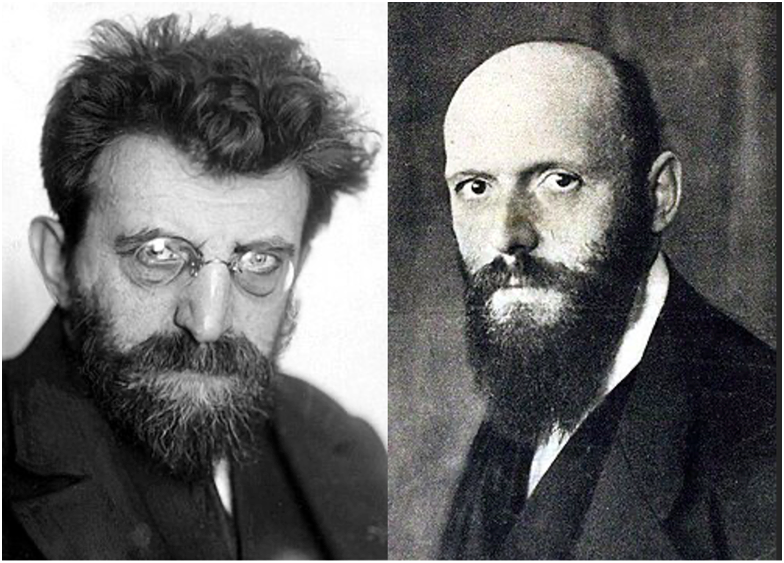
Erich Mühsam and young Otto Neurath
Whether Neurath was naïve or not, it is not correct to infer that Neurath’s views were not radical by socialist standards. As we noted, it was part of his project to eliminate money, not eventually, but right away.
There are other socialists who have advocated the same, including Pyotr Kropotkin, Anton Pannekoek and the council communists, and Anarcho-syndicalist Spain (1936–39), where wages actually were abolished in many collectivized industries and replaced with communal vouchers or direct provision. Neurath’s project was much more radical than what was happening in the Soviet Union at the time, which had adopted a system of money and wages.
My point here is not that Neurath was right, or that he wasn’t politically naïve, but that it is just insane to say that his political radicalism was “falling short of even the most minimal precepts of socialism.” Neurath’s ideas and projects were squarely within the socialist project and were radical, even by today’s standards.
The other important thing to understand was that for Neurath, this kind of socialist, informed-worker economic planning was completely interwoven with the project in logical positivism. In particular, Neurath’s socialism was directly tied to his attacks on metaphysics. For Neurath, metaphysics, like religion, was a great obstacle to economic justice.
It may even run a bit deeper than that. Jason Ā. Josephson-Storm, in his book The Myth of Disenchantment, argues that Neurath felt that by undoing the bourgeois metaphysical structures, the natural life of the proletariat could be restored.
Positivists have often been criticized for being apolitical, but Neurath, at least, put his politics into practice in a way unmatched by any of the major thinkers in the Frankfurt School. Neurath made explicit the political motivations for the revolt against metaphysics in Lebensgestaltung und Klassenkampf (Lifestyle and class struggle, 1928). As a whole, the monograph is largely an attempt to emphasize that “Scientific attitude and solidarity go together.” Neurath’s main argument is that science is a natural complement to the lifestyle of the proletariat; members of the working class are naturally grounded in a commonsense scientific outlook because they are interested in concrete and practical matters like working conditions, safety, access to safe food, and clean drinking water. In a similar fashion, he argued, they are also unencumbered by the intellectual traditions that govern the life of the bourgeois class.
Those “intellectual traditions that govern the life of the bourgeois class” were, as I noted, their abstract metaphysical and formal religious theories. Such theories were corrupt, serving only the bourgeoisie, directing their energies toward projects that benefited no one. Such theories also numbed people to the concerns of individuals while fetishizing abstract concepts such as the German State. In other words, the entire positivist project was not some doctrine that cut people off from their everyday concerns, as Schuringa contends. To the contrary, the entire project was specifically designed to restore concern for the practical everyday needs of people.
On Neurath’s view, class revolution required overthrowing both theology and metaphysics. His campaign against metaphysics was Marxist. In his words, “The cultivation of scientific, unmetaphysical thought, its application above all to social occurrences, is quite Marxist.” The critique of metaphysics, therefore, functioned first and foremost as a critique of ideology. And this brings us back to the epigraph from Neurath at the beginning of this section: “Above all, the fight against metaphysics and theology means the destruction of bourgeois ideology.”
Rudoph Carnap
Schuringa describes Philipp Frank and Rudolf Carnap, as “both of them rather moderate leftists,” and as you can probably guess by now, that is understating the reality of Carnap’s political beliefs. I suppose it all depends on what you mean by a “moderate leftist,” but I don’t know of any understanding of that label on which it would be true of Carnap.
Carnap once remarked to a friend: “If you want to find out what my political views were in the twenties and thirties, read Otto Neurath’s books and articles of that time; his views were also mine.” Well, we just took a tour of Neurath’s politics, and saw that it was a conception of socialism that was bottom-up, relied on an informed proletariat, and deployed a controlled economy that was to function without money. Is that what moderate leftism looks like these days?
Digging into the specifics, we can find that in many respects, Carnap’s were even more radical than Neurath’s in important respects, in that he advocated abandoning the state, and had a vision that would be the stuff of nightmares of right-wingers in the United States – one world government organized by socialist principles.
Carnap’s political identity started to emerge during and immediately after World War I. He opposed the war but served and saw heavy action on the front lines. Already, he was developing an opposition to nationalism and to the very idea of nation-states. His pacifism seems to have intensified after seeing war up close, and that pacifism stayed with him the rest of his life.
Schuringa notes that Carnap soon became a big fan of the anarchist Gustav Landauer.
Carnap followed [his friend] Bittel in his admiration of the anarchist Gustav Landauer. In Bittel’s words, with which Carnap enthusiastically agreed, Landauer advocated ‘freideutscher socialism: against Marxism, materialism, centralisation, state socialism and for communal cooperative socialism in the spirit of brotherhood’.
That is to say, Landauer was advocating a kind of decentralized, bottom-up socialism that rejected Marx’s materialism and the role of the state.
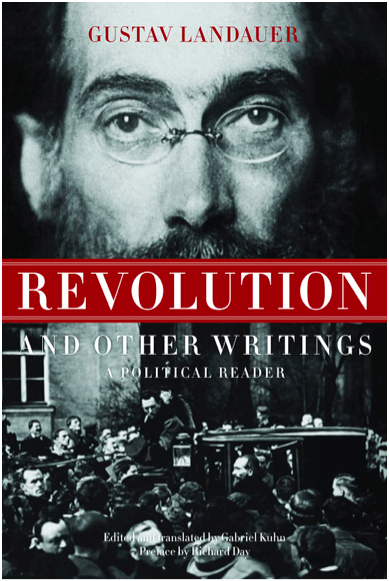
Landauer was an interesting case. He was a persistent critic of Marxism, but an outlier as an anarchist as well, since he was a passivist. I’m not sure how that went over with Kropotkin.
There is a famous quote from Landauer, which reads that “the state is a social relationship; a certain way of people relating to one another. It can be destroyed by creating new social relationships; i.e., by people relating to one another differently.” People have puzzled over that quote because how could the way we relate to each other dissolve the state and form something new? But I think it does make sense. I suspect it made sense to Carnap as well. And I wonder if that thought wasn’t running in the background as he sought to engineer modes of communicating that had been expunged of metaphysics. Would that naturally lead to new forms of human relations?
In the Introduction to Revolution and Other Writings, Gabriel Kuhn with Siegbert Wolf observe that there has been an attempt to depoliticize Landauer, which is pretty remarkable, and also ironic, given the external attempts to depoliticize Carnap as well.
I suspect that there are two forces at work in this nerfing of political activists – and we will see both at work in this review. First, there are attempts to make intellectual figures seem “safe.” These are the people who play down the politics of people like Landauer and Carnap to make their other work more digestible. On the other hand, there are forces that dismiss the work as not radical enough, and thus not worthy of attention. Schuringa is definitely in the latter camp, as we will see. But it must be said that radical political thought comes in more than one flavor, and it is perhaps a mistake to think that Marx is the most radical option available, or that the iterations of Marx that followed him were actually radical, as opposed to merely derivative, and in some cases psychopathically inhumane.
What Schuringa doesn’t mention is that Landauer had been involved in the Bavarian Soviet Republic with Neurath (you may have noticed that we name-checked Landauer earlier). However, things did not end as well for Landauer as they did for Neurath. When the SPD-controlled German army retook Munich, Landauer was captured. The end, as described by Rudolph Rucker, was grim.
One of [the soldiers] hit Landauer over the head with a whip handle. This was the signal to kill the defenseless victim. An eyewitness later said that Landauer used his last strength to shout at his murderers: ‘Finish me off – to be human!’ He was literally kicked to death. When he still showed signs of life, one of the callous torturers shot a bullet in his head. This was the gruesome end of Gustav Landauer – one of Germany’s greatest spirits and finest men.”
It seems to me that Carnap carried a number of Landauer’s ideas with him for the rest of his life. Certainly, his pacifist beliefs, his rejection of the state, his socialism, but also Landauer’s idea that if we just relate to each other correctly, the state will, as it were, wither away. We know that Carnap subsequently admired Kautsky and Austrian social democracy and was no Bolshevik. He was certainly no Stalinist. He believed socialism had to be democratic, parliamentarian, and scientific. As I said, it was bottom-up socialism. However, in his diaries, he did entertain a Marxist reading of his paper “Überwindung der Metaphysik” or as we know it, “The Elimination of Metaphysics Through Logical Analysis of Language.” (See Rudolph Carnap Papers, 025–75–10, Special Collections, University of Pittsburgh Library.)In the 1930s, his immediate concern was the rise of fascism, and he bravely took public stands against it. Thus, in April 1933, Carnap was one of the signatories of the “Declaration of the 93” (“Aufruf der 93” – a petition protesting the dismissal of Jewish and liberal professors and the politicization of academic appointments.
Carnap moved to Prague in 1935, and then to the United States in 1936, where he took a position at the University of Chicago. There is a kind of received view that the surviving members of the Vienna Circle became apolitical when they arrived in the United States. Schuringa certainly perpetuates that narrative, and we will examine it more closely later, but whatever we might say about that narrative, it does not describe Carnap’s political trajectory.
Once in Chicago, Carnap renewed his ties with socialist groups, supported anti-fascist refugeesIn the 1940s through the 1960s, Carnap actually became more political, not less. This is when he further developed his ideas that the nation-state system causes war, and argued that we should abandon the idea of nation-states and move toward peaceful supranational institutions. He was thus an open supporter of the World Federalist Movement and postwar efforts to create stronger global institutions. I’m not saying that these were good ideas; I’m only saying that they were political ideas and that they flew in the face of where America was during the Cold War.
Also going against the flow of the politics of the 1950s, Carnap supported desegregation, liberal immigration, and was openly in opposition to McCarthyism. He signed petitions defending politically targeted academics. He refused a job at UCLA until they lifted their loyalty oath. He became an anti-nuclear activist, signing petitions and joining campaigns for scientific responsibility. He continued to engage in discussions of the role of philosophy in preventing war.
While it was true that Carnap was never public a Marxist, he certainly respected Marx as a social scientist. What he rejected in Marx was not the social goal, but what he regarded as the problematic metaphysics – he rejected dialectical materialism as metaphysical. He also recoiled from the centralizing tendencies that were latent in Marx’s thought (as Bakunin observed). He did support socialist economic planning of the sort Neurath advocated, so long as it was, in some way, bottom-up.
Of course, the best way to understand someone’s politics is by seeing what their political enemies say, and Nazis had a LOT to say about Carnap and, as we saw in the aftermath of Schlick’s death, the Vienna Circle itself.
Paul Krannhals, a Nazi philosopher, Wrote an essay on “German Philosophy and the National Revolution.” In that essay, Krannhals attacked Carnap (by name) as “the theoretician of a rootless scientific worldview (wurzellose Wissenschaftlichkeit) that denies the Volk, history, and destiny.” If that wasn’t enough, he continued to say that “Such men must be excluded from German intellectual life.” (Peter McLaughlin, Carnap and the Legacy of Logical Positivism (Cambridge UP, 2009), p. 39.)
We will look at some further evidence of Carnap’s political activism a bit later (I want to save the best for last), but in the meantime, we need to address a question. Why do people think he was apolitical? In cases like Schuringa’s book, it is pretty obviously a disinformation campaign. But sometimes the depoliticized vision of Carnap is not intentionally hostile. Sometimes it was just people trying to protect him. And sometimes department chairs, deans, and university presidents sanitize the politics of their stars to avoid scrutiny from right-wing politicians. And so too, there is a kind of media filter in which the media sanitizes academics to make them palatable, or perhaps less of a threat to the social order.
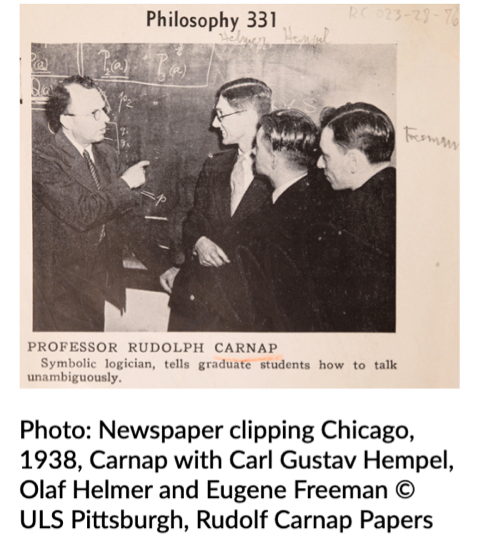
The nerfed Carnap they wanted you to see. (probably not from a newspaper, but a U of C publication.)
The bottom line is that Carnap was anti-militarist, socialist-democratic, anti-nationalist, anti-fascist, pro–world government, pro–civil rights, anti-nuclear proliferation. All visibly so. In the Cold War! And Schuringa is calling him a “moderate leftist.”
My point here is that Carnap was not some apolitical logician. In fact, he was never apolitical. As we will see, he did not become apolitical when he moved to the United States, nor when the FBI investigated him, nor when Cold Warriors threatened him. As we will also see, he was deeply political until his last dying day. He was not a “modest liberal.” He was not “bloodless.” He was not, as in Schuringa’s formulation, “removed from the changing scenes of history.” He was not acting as if he was “pursuing … questions from a vantage point situated nowhere in particular, unaffected by social and political reality.” He was not ignorant of or uninterested in “culture, politics, anthropology, psychology, sexuality, religion, literature.” Those are the accusations of his political enemies. And they are false.
Hans Hahn
The third author of the Circle’s manifesto was Hans Hahn. Hahn is best known as a hardcore mathematician – certainly the most mathematical of the Circle members, with the exception of Gödel, who was Hahn’s student. In fact, Gödel’s dissertation was his proof of the incompleteness of arithmetic! But despite being very mathematically inclined, Hahn was also a member of the Left Wing of the Circle, perhaps one of the left-most members.
With respect to mathematics, he was all about pure mathematics – especially analysis and related areas. Some of the main things he’s known for are his work on measure theory and integration (he’s known for the Hahn decomposition theorem), functional analysis (super famous for collaborating with Banach on the Hahn-Banach theorem), and he also did work on ordered groups and series (giving us the Hahn embedding theorem). He also did some work on the foundations/philosophy of mathematics, working on the role of logic in mathematics, the crisis of intuition in mathematics after Cantor, and also wrote about non-constructive proofs. Hahn was politically aligned with (and often described as a leading intellectual of) the SDAPÖ. He was, in that milieu, a key Social Democratic public intellectual. Like other members of the circle, he was involved with teaching in Volkshochschule Wien (Workers’ Adult Education / People’s University), bringing modern mathematics and science to the Social Democratic base. He was also one of the central organizers and leading figures in Verein Ernst Mach (the public-facing part of the Vienna Circle, that included public lectures on philosophical topics – basically the TED talks of that era).
We will return to the issue of worker education a bit later, when Chomsky wonders what exactly happened to that, and asks why the left abandoned such initiatives. It is a good question. But for now, we need to view this effort through the headspace of Hahn and the other members of the Left Wing of the Vienna Circle. This education in mathematics and science was not undertaken as a side hustle, nor as some sort of apolitical project to educate people. Adult education was, at the time, considered to be a kind of pillar of the revolutionary movement. The proletariat needed the tools of science and mathematics, not to cash in, but to be effective in that revolutionary movement.
Before we leave Hahn, however, there is a little known fact about him that sheds light on the true nature of the Vienna Circle, and illustrates that it was not so very far apart from the philosophers of the Frankfurt school, and their quasi-Heideggerian critique that positivism was attempting to “disenchant” the world.
Here I draw an a longish story about one Eleonora Zugum, a 11-year-old Romanian Girl, as reported by in Jason Ā. Josephson-Storm’s The Myth of Disenchantment: Magic, Modernity, and the Birth of the Human Sciences.
Eleonora became the center of a series of unusual events. Witnesses reported that they saw objects shudder and levitate in the girl’s presence. Soon, Eleonora developed a bad reputation in the village; as the locals would later tell a visiting researcher, “The grandmother could not die because some evil spirits would not permit her, and thus she had sent for the child, in order, by means of witchcraft, to transfer them to her.” Presently Eleonora herself became convinced that she was suffering from demonic possession.
Eleonora’s father and a group of concerned villagers took her to the house of an old priest. No sooner had they arrived than an iron vessel exploded into pieces. Jugs cracked, heavy objects began to shift around, and the windows suddenly shattered. The priest attempted an exorcism, but the phenomena continued. Fearing Eleonora was still cursed, her family deposited her at the monastery and convent of Gorovei (Mănăstirea Gorovei) in Talpa. Even there, she seemed to be at the mercy of invisible powers that smashed and moved things. The monks became frightened and wanted to expel Eleonora, but were prevented from doing so by the prior of the monastery.
This was no fairy tale, and it was at this point that Eleonora’s story enters the historical record. Kubi Klein, a reporter for the Jewish German-language newspaper Czernowitzer Allgemeine Zeitung, came across Eleonora and published his account of her case on April 18, 1925, under the title “Das verhexte Dorf” (The bewitched village). News about the cursed girl spread through the region. Soon journalists and paranormal investigators were all clamoring to study Eleonora in greater detail. Fearing the impact of this attention, her family committed to her to a mental asylum, where she was kept in isolation.
Fortunately, Eleanora came to the attention of the international parapsychology community, and she was rescued from the asylum and brought to Vienna. There she met the famous mathematician and founding member of the Vienna Circle, Hans Hahn. Hahn was also part of an elite team of paranormal researchers that tested Eleanora’s psychical powers, and he later testified to their authenticity.
What is going on here? It seems that Hahn, like other members of the circle (Carnap, Frank, Feigl, and Hahn’s student, Gödel), was fascinated with things magical and paranormal. Hahn was a founder and member of the executive board of the Austrian Society for Psychical Research (Österreichische Gesellschaft für Psychische Forschung, ASPR). He was a ghostbuster! How do we make sense of this?
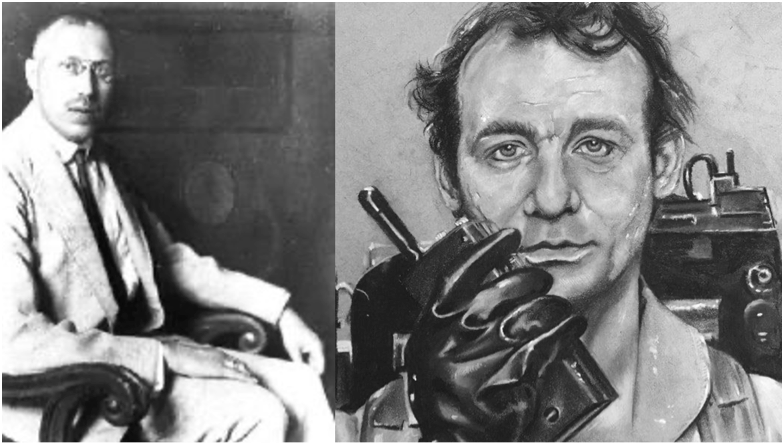
Hans Hahn. Mathematician, Logical Positivist, Socialist, and precursor to Peter Venkman?
Were the positivists not the enemies of all things metaphysical? The answer is layered. One take is that they were trying to disenchant these phenomena, but that isn’t so clear. They took these phenomena to be facts that had to be taken seriously, and if we had to adjust science to account for them, well, then science would have to be updated.
Would the positivist really revise the laws of nature to accommodate this type of phenomenon? My friends, even Feigl thought so!
If it were fully established that the phenomena of extrasensory perception, i.e., clairvoyance and telepathy, and perhaps even precognition and psychokinesis, do not result from experimental or statistical errors . . . then our conception of the basic laws of nature may well have to be revised at least in some essential aspects. (Inquiries and Provocations, 314.)
While these sorts of phenomena might find themselves in the “Metaphysics” section of your local bookstore, that isn’t what the positivists meant when they called the target of their critique, “metaphysics.” The positivists were opposed to the metaphysics of the intellectual class – Idealism, organized religion etc. – but there is another notion of metaphysical, the kind you see in bookstores, that has to do with magic and the esoteric. The positivists didn’t necessarily have a problem with that. To the contrary, as Josephson-Storm claims, they saw their project as continuous with that kind of bookstore “metaphysics.” They were the new magicians, and the thought was that they were reconnecting with the natural esoteric beliefs of ordinary folk – rejecting the abstract metaphysical notions that carried intellectual water for the bourgeoisie, German politicians, and the Church. Here is how Josephson-Storm puts it in The Myth of Disenchantment:
For Neurath, instead of science as the culmination of disenchanting Protestant thought, modernity is the return of sorcery. In effect, magic must reappear in order to challenge theology and empty metaphysics. Occult revivals and scientific revolutions would seem to come together. In sum, Neurath was positioning positivism and its unified science as a return, and in that sense as a completion or fulfillment of primitive magic. As he put it elsewhere: “Unified science is the substitute for magic which also once encompassed the whole of life.”
That idea is not just in Neurath. It is in the Circle’s Manifesto itself. Consider this passage from the Manifesto:
The representatives of the scientific world-conception resolutely stand on the ground of simple human experience. They confidently approach the task of removing the metaphysical and theological debris of millennia. Or, as some have it: returning, after a metaphysical interlude, to a unified picture of this world free from theology, which had, in a sense, been the basis of magical beliefs (Zauberglauben) in early times.
(There is a relative pronoun antecedent ambiguity in that translation. It is the “unified picture” that was the basis of magical beliefs, not “theology.”) This lines up with the politics of the members of the Circle, because the idea is that the magical realm (which is continuous with their project) is, as it were, at war with the false Ideologies of the ruling class.
We are going to come back to this, because, in the end, I am going to make the case that the positivists and the Frankfurt School were not so far apart. Collaboration was, and remains, possible.
There are three more members of the Vienna Circle that I want to discuss, because they are going to return at points during our contra-Schuringa story. One member that will play a key role after immigrating to the United States, is Philipp Frank.
Philipp Frank
Philipp Frank was a physicist and a Student of Boltzmann, which is impressive in itself. He was definitely part of the Left Wing of the Circle, but was certainly not as far left as Neurath or Haahn. He was, like many other members of the Circle, a liberal-socialist / Social Democratic sympathizer, closely allied with Hahn and Neurath in the Red Vienna intellectual projects. He was, of course, involved in the Verein Ernst Mach and the Volkshochschule / workers’ education program, teaching modern physics.
Frank is going to play a big picture in our story during the Cold War, when he came under scrutiny from the FBI and when he was trying to raise money for the Unity of Science Project, but there is one important point that I want to make concerning the understanding of the Enlightenment that the members of the Vienna Circle had.
Schuringa, as is clear from his book, is not a big fan of Enlightenment philosophy, and he works hard to situate the members of the Vienna Circle within the Enlightenment project. And for sure, the members of the Circle did view their project as being part of the “Enlightenment,” but they were not using that word in the same way we do today. For example, Neurath considered Marx to be an Enlightenment thinker (see his Empiricism and Sociology, 315). And you can see how that would make sense – it was, at least for Marx, a social-scientific project. It was evidence-based. It worked to overthrow ideologies just as earlier Enlightenment thinkers had. Perhaps all the members of the Circle felt this way about Marx. But there was someone else that they loved too: Nietzsche!
Frank spoke of Nietzsche as a “great Enlightenment thinker,” you can see how they would think of Nietzsche as a continuation of the Enlightenment project, even if, in the end, it seemed destructive of that very project. But Frank notices things in The Will to Power that were aligned with the thinking of the Circle.
Nietzsche’s most significant expression of the positivistic world conception is probably given in the aphorism, called “On the Psychology of Metaphysics,” where he attacks with cutting sharpness the employment of very frequently misused concepts:
This world is apparent: consequently there exists a true world;— this world is conditional: consequently there exists an unconditional world;— this world is full of contradictions: consequently there exists a world that is free from contradictions;— this world is changing: consequently there exists a permanent world;— all false conclusions: (blind faith in the reasoning: if there is A, there must also be its antithetical concept B). [Will to Power, 252.]
It is not to be denied that the philosophy of enlightenment possesses a tragic feature. It destroys the old systems of concepts, but while it is constructing a new system, it is also already laying the foundations for new misuse. For there is no theory without auxiliary concepts, and every such concept is necessarily misused in the course of time. The progress of science takes place in eternal circles. The creative forces must of necessity create perishable buds. They are destroyed in the human consciousness by forces which are themselves marked for destruction. And yet, it is this restless spirit of enlightenment that keeps science from petrifying into a new scholasticism. If physics is to become a church, Mach cries out, I would rather not be called a physicist. And with a paradoxical turn, Nietzsche comes out in defense of the cause of enlightenment against the self-satisfied possessor of an enduring truth.
Apologies for the length of that, but it highlights two important points that we are going to return to throughout this review. The first is the idea that one wants to be suspicious of the sketchy arguments deployed to justify metaphysical concepts. But the second point, and one that speaks to analytic philosophy as well, is the last paragraph in which Frank observes that science (and I would say philosophy) is at its best when there is not a stable set of doctrines – when it is a constant demolition derby of ideas. As we will see, this seems to be a feature of analytic philosophy that Schuringa absolutely cannot abide.
Edgar Zilsel
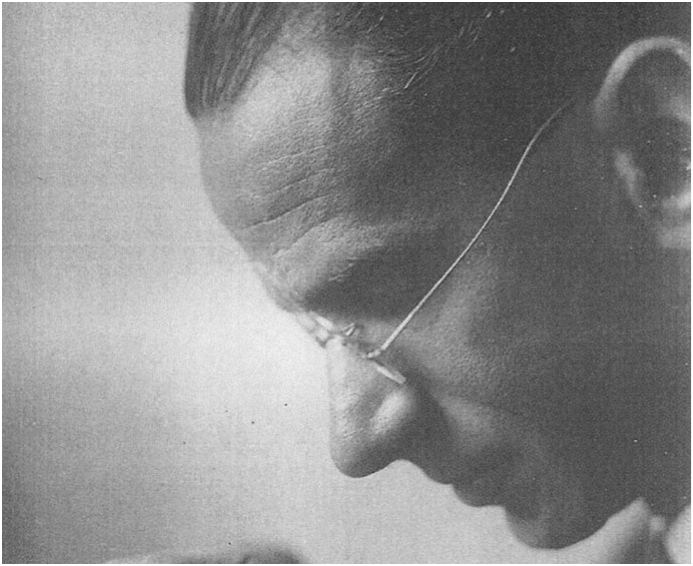
Edgar Zilsel
It baffles me that Schuringa shows almost no interest in Zilsel – he identifies him as a member of the Circle, relegating him to a few notes regarding his comings and goings and saying nothing about his work. The baffling thing is that Zilsel himself was an important social historian of science. His thesis about the sociology of science – “The Zilsel Thesis” – is laid out in “The Sociological Roots of Modern Science” (1942) and related pieces collected in his book, The Social Origins of Modern Science.
The Zilsel Thesis deserves a mention here because it embodies everything the Vienna Circle was about. The basic idea was that modern science emerged via a fusion of artisans’ empirical skills plus scholars’ theoretical traditions in urban/capitalist social structure. So, to take one of his examples, Galileo’s achievements would not have been possible without the culture of instrument makers, the mechanical knowledge of artisans, and the blending of mathematics with practical craft. Surveyors, navigators, and instrument builders became mediators between scholars and trades. Of interest to the Circle was the idea that modern science is a kind of fusion between practical craft and scholarship. It was not one or the other. The two cannot be separated.
How does someone writing a social history of anything miss Zilsel? In any case, Zilsel was definitely part of the “Left Wing” of the Vienna Circle and was a key component in Red Vienna. He was an Austro-Marxist; he joined the Austrian Social Democratic Party in 1918, wrote for their house journal, Der Kampf, was briefly arrested after the 1934 Austrian civil war, and eventually, forced out of his teaching job. In 1939, he fled Europe for the United States and tried to cobble together some research jobs in California Universities. Destitute and struggling with everything that comes with being an émigré in the United States, he took his life in 1944.
His interest in Austro-Marxism was not purely political; he fused it into his theoretical research. Zilsel explicitly endorsed historical materialism and saw Marxism as a crucial resource for philosophy. His strategy was to blend Marx/Engels with ideas from Boltzmann’s statistical mechanics to argue for empirical laws in history and society that could emerge from lots of random events at the individual level. This is sometimes called the Law of Large Numbers (LLN). Marxists have picked up the LLN as a way to discuss how “necessity” emerges from messy individual events – especially in economics, social statistics, and history. It serves as a kind of bridge between dialectical talk of “tendencies” and the hard math of probability. So Zilsel used LLN-style thinking to naturalize Marxist claims. The key idea is that social laws are no more mysterious than gas laws; both are emergent statistical regularities of huge ensembles.
Happily, Zilsel’s work is making a comeback. In 2017, Jérôme Lamy (historian and sociologist of science at CNRS) and Arnaud Saint-Martin (a member of La France insoumise (LFI)) started a journal on the sociology of science called “Zisel,” in honor of the work of Edgar Zisel.

Some issues of the journal Zilsel
In an article explaining their choice of name for the journal they noted that there may have been some attempt to erase Zisel’s work from the record. It was only rediscovered in the 1980s and is now seen as a precursor to science and technology studies (STS).
Rose Rand
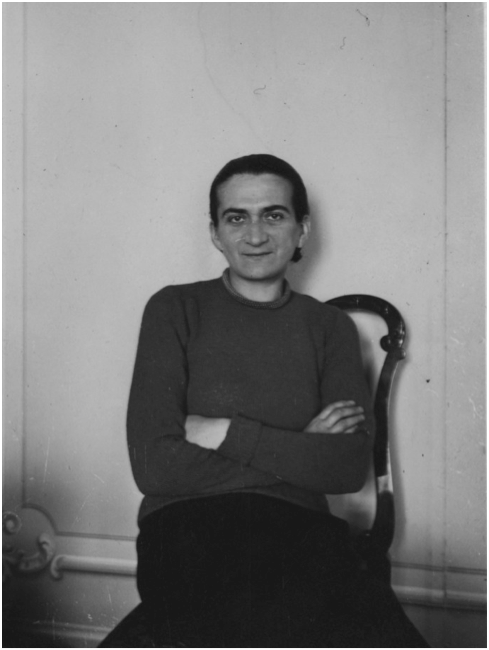
Rose Rand
At least Zilsel got mentioned by Schuringa. Schuringa does not mention Rose (Róża) Rand once, not even in a footnote. I suspect Rand will be remembered as the most revolutionary, and ultimately one of the three most important members of the Vienna Circle (along with Neurath and Carnap). Rose Rand, was born in what is now Lviv, Ukraine and emigrated to Vienna in high school. At the University of Vienna she studied under Schlick, and ended up writing on the Polish logician Tadeusz Kotarbinski, which is already badass. Like the other Circle members, she participated in the adult education programs in Red Vienna, but also worked as a researcher in a Psychiatric Hospital. In Vienna. In the age of Freud. Think about that.
A theme that I will return to in this review/essay is the role of the scribes of the revolutionary movement. If we think of the project of the Vienna Circle as being revolutionary, and it is hard not to see it as revolutionary in the aftermath of Schlick’s murder, then Rose Rand was the scribe of this revolution. She took detailed minutes of Circle meetings for a period of about three years. Most famously, she took notes during the meeting in which Gödel presented his results about the incompleteness of arithmetic to the Circle. She also preserved an enormous amount of correspondence with members of the Circle and other contemporaries, leaving behind a huge archive of documents – over 1600 of her letters are now kept at the University of Pittsburgh library, along with a treasure trove of unpublished manuscripts and notes in Russian, Polish, German, and English, and her own shorthand. People are just now beginning to sift through what is an intellectual goldmine. (You can see part of her archive here.)
Online records are inconsistent, but in either 1938 or 1939, Rand (who was Jewish) escaped continental Europe with the help of the British philosopher Susan Stebbing (we will discuss Stebbing next). Once in England, however, finding academic work was not easy. Thanks to Stebbing, Rand had some financial support at Cambridge (allowing her to interact with Wittgenstein), but she lost that support in 1943 and had to work as a nurse and as a worker at a metal fabrication factory while also teaching night classes on German and psychology at area technical colleges. In 1954, she moved to the United States, and did not fare much better, cobbling together occasional adjunct teaching positions and jobs translating papers by Polish logicians. Her financial position was precarious until the very end.
When I say that I think she was the most revolutionary of the members of the Vienna Circle, what I mean is that she was able to meld their two projects in a way that the others had not, perhaps with the exception of Zilsel. My thought is that running through the history of the Vienna Circle, there were two distinct projects – one having to do with social engagement and the other having to do with logic and mathematics. Those projects were unified in that the scientific project could free us from metaphysics, which in turn could free us from right-wing bourgeois ideology. Zilsel more directly unified these projects by applying formal ideas from statistical mechanics to sociology. Rand also pursued a more direct integration; she pursued the idea of extending formal logic from a logic that could describe or represent states of affairs (the task that it served in Wittgenstein’s Tractatus, for example), to a logic for demand, serving as a precursor to what is now called deontic logic (a logic of obligation).
In 1939, more than a decade before deontic logic emerged within 20th-century formal logic (usually credited to von Wright), Rand published a paper titled “Logik der Forderungssätze” in a journal on legal theory called Revue Internationale de la Théorie du Droit, 1(1), 308–322. Basically, she was extending the domain of formal logic to include demands (for example, legal demands), and she talked about the logic that they obeyed – what could be contradictory demands, what could be the negation of a demand (not the absence of a demand but a demand to not do something), how demands can be iterated, etc. The paper was revolutionary in two ways. First, it was an early attempt to develop a logic for non-representational phenomena. Second, it is the idea that logic is not static, and it can be extended to the domains of the practical and legal. One way to put it is that it was a logic deeply aligned with the Vienna Circle’s manifesto.
Rand’s paper was republished in English in Synthese in 1962, so it was on someone’s radar, but I do not believe people fully understood how revolutionary Rand’s work was. Or perhaps some of them did; the same year her paper appeared in German (1939), the Yale logician Fredric Fitch reviewed her paper in the Journal of Symbolic Logic. Two years later, Fitch acquired a new student, named Ruth Barcan. Logicians have precursors, too.It is somewhat criminal that universities in England and the United States would not hire Rand when she left Vienna. The reasons they didn’t are pretty obvious: a single Jewish woman who was reportedly “socially awkward” would have had a tough go getting hired in the 1940s, and it might also be the case that her ideas were just too radical as well. You have to imagine what the ethicists would have thought of her work, extending logic to the holy realm of the ethical. Or imagine what the logicians would have thought of her gumming up their sacred Aristotelian logic, or their propositional logic, with talk about obligations and demands.
Even in the 1980s, when I was a graduate student at Columbia, I remember Ruth Marcus delivering a talk on deontological logic. I was thinking, some 40 years after Rand had published her pioneering work, what the hell was that? It was still bleeding-edge stuff 40 years later. So, like I said, it is criminal that Rand was not hired by an anglophone university, and that was a clear injustice for her, but it also makes me wonder about the responsibility of universities to their students. Each and every university in England and the United States had the opportunity to hire a person who was not merely doing cutting-edge work, but who had sat there at the table with the Vienna Circle, taking copious notes on work that laid the foundations for 20th-century philosophy, logic, mathematics, and science. She could have told the students about meeting Einstein, or what it was like being a researcher in a Viennese psychiatric hospital in the age of Freud, or what it was like to be in Vienna during the rise of fascism and the murder of Schlick, or what it was like to flee from Nazis, or to take a class from Wittgenstein, or what it was like to be sitting at the table, taking notes, the day that Gödel informed the world that arithmetic was fucking incomplete.
Not one university cared enough about their students to hire her and thereby give them first-person access to the deep intellectual history of the 20th Century. Like I said: fucking criminal.
Oh and also: too bad Schuringa didn’t have space to mention her once in his 336 page work on the history of analytic philosophy.When Schuringa turns his gaze to England and the early days of British analytic philosophy, he persists in his strategy of downplaying the political activism and social engagement of analytic philosophers. And we can begin with is treatment of Susan Stebbing, the woman who helped Rose Rand emigrate to England.
Susan Stebbing
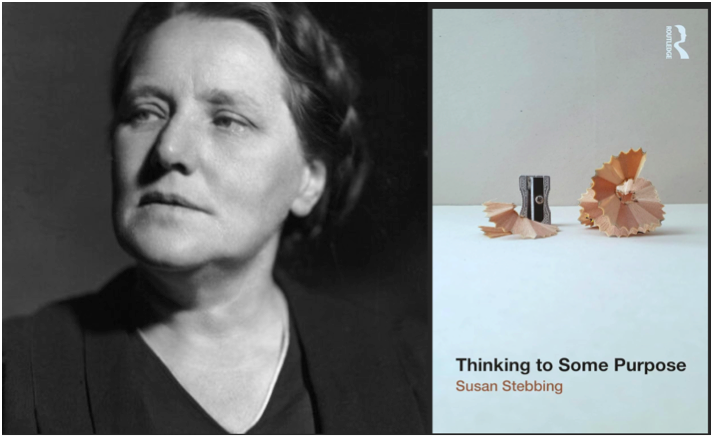
Susan Stebbing and Thinking to Some Purpose. Still in print.
Susan Stebbing was one of the giants of 20th-century analytic philosophy and was the very first woman in Great Britain to receive a chair in philosophy (at Bedford College in London). Her work was very much in the Moorean tradition, but applied to the state of the world. That is, while G.E. Moore called for clarity and common sense about whether he had a hand, Stebbing was calling for clarity and common sense as a foil against totalitarianism around the world. Like the members of the Vienna Circle, she was proposing exact thinking as an antidote for demented times.
Schuringa’s potted biography informs us that Stebbing was “Born in a middle-class home, and privately educated at James Allen’s Girls’ School in Dulwich,” but neglects to tell us that she was orphaned at age 16, suffered from some unspecified childhood disease, and also suffered her entire life from Ménière’s disease – a condition that could lay her up for days with severe vertigo. She acquired cancer around 1941, and subsequently died of it in 1946, at age 56.
Stebbing was perhaps more closely aligned with the Vienna Circle than anyone else in England, even more than Wittgenstein, oddly enough. And I would say certainly more so than AJ Ayer, in that her understanding of the project was closer to what was going on in Vienna. (Ayer is one of the people who suppressed the political aspect of their project, thus giving ammunition to detractors like Schuringa). Stebbing, unlike Ayer, seemed to understand and internalize the Vienna Circle project – in particular, the idea that the point of scientific philosophy and rejecting metaphysics was to better the human condition. Before receiving her Chair in England, she was a visiting professor for two years at Columbia University in New York, and one of her students, named P. Magg, had this to say about her project
Logic had been to us a field in which we were supposed to be objective, rational, neutral, scientific and even aloof from the affairs of the world .... But here we found a different kind of logician ... who made it clear that reason and logic, mind and science, had important services to perform in the very problems of the relation of society to man, of man to society.
Her book Thinking to Some Purpose, which is still in print, pursued this idea, bringing with it an early analysis of propaganda. There is also a section on “potted thinking,” which would be useful to some writers today. One of her famous lines is that a free press and democratic institutions are insufficient to maintain a democracy when confronted by “our stupidity and by those who take advantage of that stupidity.” A sort of intellectual hygiene was required in addition to the free flow of information.
This positivist approach was also reflected in her projects to communicate with the general public and not merely with specialists. Her biographer, Siobhan Chapman, described some of her projects in her book Susan Stebbing and the Language of Common Sense.
Stebbing was one of a group of writers and thinkers who established a new journal for a general educated readership, The Modern Quarterly, in 1938. It was an explicitly left-leaning journal, published by the Socialist Victor Gollancz, and associated with The Left Book Club, an organisation committed to fighting Fascism. The opening statement of aims for the journal, to which Stebbing as editorial council member implicitly added her name, comments on the link between idealism and the dangers of Fascism. It identifies a recent trend towards scepticism concerning the validity of scientific thought, and continues: ‘From scepticism of this kind to that mysticism which would deny the existence of a world outside the mind or the possibility of knowing anything about it is a short step. Already in the Fascist countries this tendency has reached its most extreme expression, as a national cult cynically enforced by an authoritarian state’.
Schuringa wants us to know that he is unimpressed, and his dismissiveness of Susan Stebbing is something to behold. Here is what he says.
Stebbing’s efforts, which might be compared to present-day efforts to apply ‘critical reasoning’ to political issues, are disappointing. With little to contribute other than her toolbox of Moorean analysis – containing tools that no one had as yet managed to sharpen – and lacking much knowledge of the social world, the promise of Stebbing getting some significant purchase on the real world remained unfulfilled.
Susan Stebbing was “lacking much knowledge of the social world?” My friends, she started a girls school in Hamptead, London in 1915, which she had to move to Tintagel, Cornwall, during World War II. During the German “Blitz” bombing of London, in 1941, she was president of the Ethical Union. That was an organization that, in its history, engaged in activities building non-religiously based projects in social welfare. Thus, over the years, it was involved in providing non-religious weddings and baby-namings, and sponsoring a series of lectures on themes ranging from women's rights and racial equality to raising children without religion. More generally, the movement provided a platform for social work and progressive campaigning outside the auspices of churches and other religious organizations.
Now, we don’t know what the Ethical Union was involved with when Stebbing was president from 1941-1942, but we do know that she managed to keep it operational during the Blitz bombing campaign against England and in its immediate aftermath. It is also a fair guess that the Ethical Union was involved in religion-blind wartime assistance to the civilian population in England, because those were her interests at the time. We also know that Stebbing’s concerns at the time included helping Jews and other minorities escape Nazi Germany, as she assisted Rose Rand in her immigration to England, and, with the help of a letter from Albert Einstein, was able to get Otto Neurath and his partner out of incarceration (on their arrival in England they were classified as “enemy aliens.”) But she wasn’t just helping philosophers.
With her school and residence (Kingsley Lodge) vacated and all her students in Cornwall, Stebbing opened it to Jewish refugees and impoverished English children. She received money for the school from the friends she made while teaching in New York. Here is Chapman’s account of her correspondence with one of her donors (I believe, with Sidney Hook’s wife).
In this [letter] she explains that Kingsley Lodge is now home to ‘at least 50’ refugee children, as well as a number of English children from impoverished families, who paid no fees. She describes one example: “Heinz Rosenbaum has been with us just over a year. He was six when he came. His father, a Jew, had been in Dachau concentration camp; he managed to get out and come to this country, a complete nervous wreck. We did not know what had been happening to Heinz, but he was terrified. He would scarcely speak, never smiled, and shrank away in terror from all strangers. Now he has begun to talk to grown-ups, and sometimes to smile, and he looks likely to become a cheerful child in time.”
Mind you that all this is going on while she was still running her school (now evacuated to Cornwall), fighting cancer, teaching at Bedford College (now evacuated to Cambridge), writing, and running the Ethical Union. All of it in the middle of the German bombing campaign.
I want to close this section by coming back to Schuringa’s take on Stebbing as “lacking much knowledge of the social world.” He actually wrote that. About Susan Stebbing. And he published it. In a book. And he put his name on the cover of that book.
Russell and Moore
At this point, I probably don’t even need to tell you what Schuringa is going to do with Russell and Moore. Yes! How did you know? He is going to minimize their political activities. Of course, Schuringa can’t exactly ignore that Russell protested England’s involvement in World War I and went to prison for that, nor that GE Moore was part of a group (co-founded by Russell) that also protested the war. But he can poo-pooh it. Schuringa assures us that we don’t have to be impressed by Russell’s political activism, because, after all, he was the brother of an Earl, and he got special accommodations in prison. Well, yes, he did. But he also went to prison. And the operative question has to be this. In what way was Russell in the tank for the establishment here? And the second question is, what was everyone else doing at the time?
The second question is particularly apt. Here we have a case where the analytic philosopher, Russell, despite plenty to lose, protested the war, while his contemporaries at Cambridge, who were Idealists, were busy flying the Union Jack for the war. George McTaggart Ellis McTaggart, a fellow at Cambridge’s Trinity College, got Russell fired from his lectureship at Trinity.
It is also somewhat bizarre to play up Russell’s connection with British aristocracy, and for several reasons. First, Russell did argue against the privilege of his class and the actions of the empire, and it might occur to someone that his background in analytic philosophy gave him a framework from which he could see the flaws in the social order from which he came. He did not have to feel beholden to or rooted in an idealized conception of British culture. He was not compelled to defend British Imperialism. He was free to think in other, counter-establishment ways, just as the positivists had. Note: this is not to say he acted from a position outside of history; to the contrary, just as the members of the Vienna Circle were very much acting within their historical setting, by resisting what they saw, so too was Russell. It was not a view from nowhere; it was an ability to be critical of where you were standing.
Parenthetically, what are Schuringa’s potted biographies supposed to show us? We all know that Russell came from the aristocracy. That’s why he was called “Lord Russell.” But radical thinkers often come from the aristocracy, or at least from the Bourgeoisie. Engel’s father was an industrialist who owned several textile factories. Bakunin came from Russian nobility. Fidel Castro’s family owned a sugar plantation. Che Guevara came from the Chilean aristocracy. Even Mao and Pol Pot came from land-owning families (Pol Pot, famously, was able to study in Paris). Schuringa’s biographies are sometimes interesting, but he wants them to be more than interesting – he wants them to be evidence of the complicity of analytic philosophy being in the tank for the establishment, thus he dishonestly spins the biographies to achieve his ends (we saw this in action with Susan Stebbing, but we will look at some additional interesting examples, later).
Schuringa’s general strategy here, as it was when he discussed the members of the Vienna Circle, is to briefly note the very courageous political stances that analytic philosophers have taken and then dismiss them with a wave of a hand, not reflecting for even a moment on what their contemporaries were up to.
For example, while yes, the Russell and McTaggart incident is mentioned, Schuringa says that Russell lost his lectureship through “conniving” by McTaggart, but why isn’t McTaggart the one in the hot seat here? And I would have called it a flat-out “betrayal” myself.
In the same section, we are also told that G.E. Moore was not really a lefty lefty because he was only in The Union of Democratic Control (UDC) (“a moderate organization”). WTF is that? They were tarred as being pro-German, and the British government prosecuted UDC secretary E. D. Morel, who was imprisoned for six months in 1917 for sending a UDC pamphlet to Switzerland, allegedly an offense under the “Defence of the Realm Act.” The group was banned from holding meetings at Cambridge, so Moore took it upon himself to write to the University to get the meetings reinstated on campus. So, while it was true that the UDC was not the most radical organization in the world or even England, it was radical enough so that its meetings were banned, and one member went to prison for distributing their writings.
By the way, although Schuringa mentions Russell’s imprisonment for his anti-war activities in World War I, he doesn’t have another word to say about Russell’s political activities – a shocking omission, given the central theme of the book (analytic philosophers are allergic to progressive politics). The reality is that Russell was very much engaged in political causes until the very end of his life.
Russell, after a brief dark period after World War II (we will come back to that), became a leading voice in the anti-nuclear movement. He co-authored the Russell-Einstein Manifesto in 1955 and was a founding member of the Campaign for Nuclear Disarmament. In 1961, Russell was once again imprisoned (this time for a week) for his anti-nuclear protesting. He was 89 years old at the time. Given his age, the magistrate offered to exempt him from jail if he pledged himself to “good behaviour,” to which Russell replied: “No, I won't.”
Beginning in 1963, Russell began work on a variety of additional issues, including lobbying on behalf of political prisoners under the auspices of the Bertrand Russell Peace Foundation. He also organized the Russell Tribunal to investigate American actions in Vietnam, which concluded that the U.S. had committed genocide.
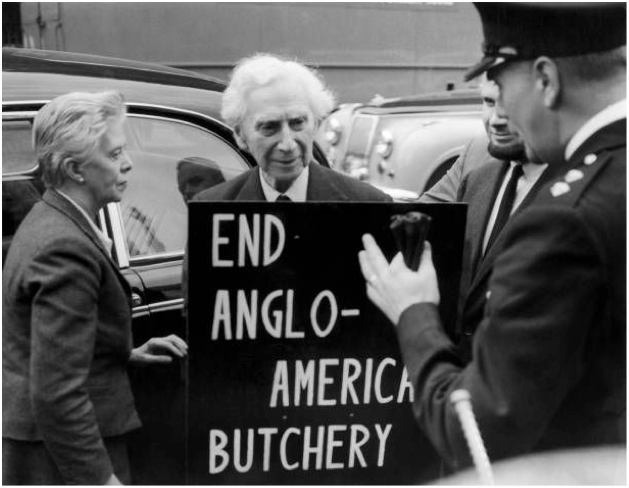
The Committee of 100 was a British anti-nuclear organization that Russell helped create because he felt that the Campaign for Nuclear Disarmament (CND) was not being aggressive enough. He felt that civil disobedience was called for, given the gravity of the situation.
Remarkably, none of this is even mentioned in Schuringa’s social history.
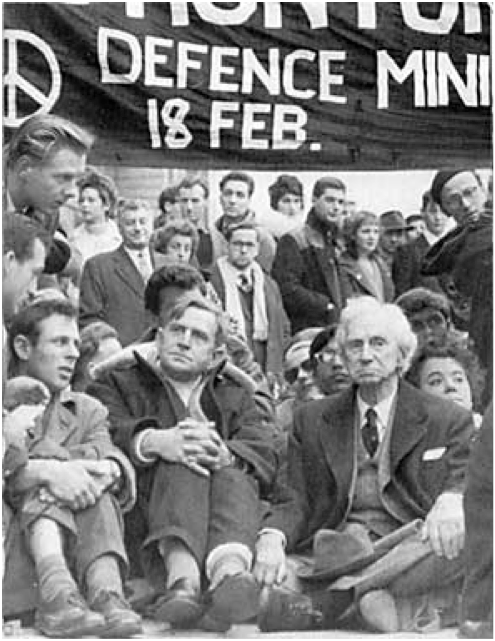
89-year-old Bertrand Russell protesting
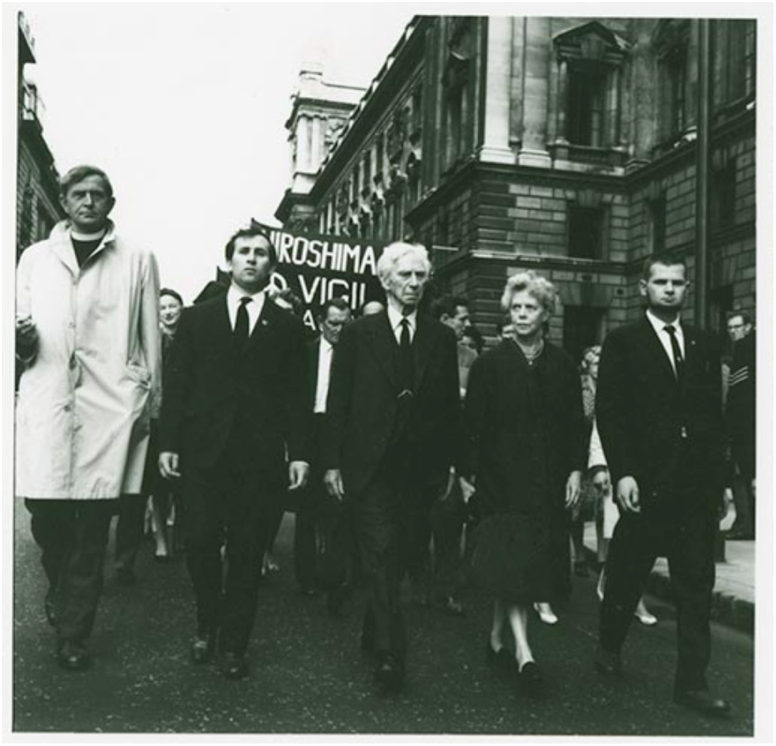
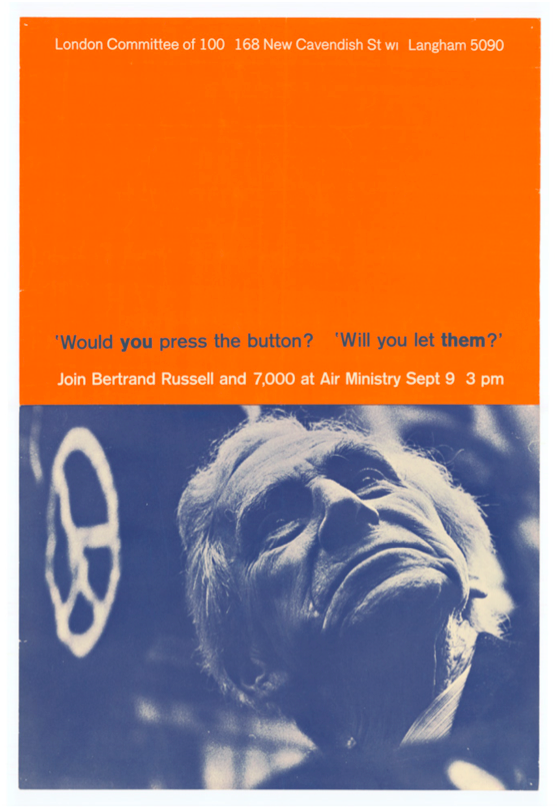
Serious Russell on demonstration flyer
Michael Dummett
Michael Dummett was a lot more politically active than most people realize. From the late 1960s onward, Dummett was deeply involved in campaigns against racist immigration policies in the UK. He and his wife, Ann, did casework with immigrants and refugees and saw – up close – how the UK’s rules were being applied in a discriminatory way. He helped found or worked closely with groups like Justice, the Joint Council for the Welfare of Immigrants (JCWI), and later the All-Party Parliamentary Group on Race and Community. He wrote a whole book about it: On Immigration and Refugees (Routledge, 2001), which is basically the fruit of decades of his activism.
I want to stress that a lot of his work involved “feet on the pavement.” A friend of his told me that Dummett and his wife, Ann, went almost every day to assist immigrants with legal issues. (She was an immigration lawyer.) Whether that was an exaggeration, I cannot say, but it is clear that Dummett was very committed to this cause – a cause that seems particularly topical today.
Dummett spoke publicly against the National Front and other racist movements in the 1970s–80s. Dummett was also obsessed with fair voting systems. He argued that “first-past-the-post” voting misrepresents voters’ preferences. He wrote a book called Voting Procedures (1984) and another called Principles of Electoral Reform (1997), where he analyzes different systems and defends more proportional/expressive ones.
Schuringa, of course, wants us to believe that this was just a whole lot of nothing. He describes Dummett’s political work in two sentences, and then dismisses it based on a quote, lifted from Dummett’s book On Immigration and Refugees, in which Dummett says that an “indigenous culture” was not to be “submerged.” Schuringa tells us that Dummett is just channeling Margaret Thatcher’s quote about not swamping English culture with immigrants. What a wildly dishonest representation of what Dummett said.
What Dummett is clearly talking about is not England being submerged by immigrants (a thesis which he calls “utterly ridiculous”), but the right of minority groups to not have their culture submerged. To illustrate what he means by culture-submerging, Dummett uses the example of how the American holiday of Halloween, and the custom of trick-or-treating, are submerging the Day of the Dead celebrations in Mexico. I can testify that that is definitely an issue in Mexico.
As to the question of whether the immigrants coming into England could “submerge” it, Dummett, to avoid any misrepresentation like the one Schuringa is putting forth, takes the readers by the hand and very slowly walks them through the reasons why that is absolutely NOT what he is saying:
There is a right which opponents of immigration will rejoice to see enunciated. They should not rejoice too exuberantly, for it is of extremely limited application. It is nevertheless worth stating at the outset, lest it be overlooked among more general considerations. The right is one possessed by groups united by race, religion, language or culture: such groups have a right not to be submerged. Formulation of this principle requires the greatest precision, since the standard complaint of racists and xenophobes who object to any level of immigration that is taking place, however low it may be, is that the country is being swamped; for this reason I have deliberately chosen the word ‘submerge’ in place of the more emotive ‘swamp’. Mrs Thatcher made the utterly ridiculous assertion that the English people and English culture – or perhaps the British people and British culture (she was not specific) – would feel themselves swamped by the proportionately tiny number of people of Caribbean or Indian origin who had entered the country. No minorities of so small a size could possibly have swamped Britain or its cultures.[my emphases]
Dummett then goes on to point out that because of its long history of submerging minority cultures, “Britain would indeed be in no position to complain of being swamped, even if any real danger of its being so existed.”
How can Schuringa, or anyone, pack so much dishonesty into a single book? I don’t know, but the effect is somewhat similar to the strategy deployed by American right wing advocate Steve Bannon: He calls it “flooding the zone with shit,” or what we used to call a “firehose of falsehood.” The idea is to flood the discourse with so much falsehood and disinformation that no one has the time or energy to correct it all. If someone does take the energy to correct it, then the tactic is to say the person making the corrections has been triggered, or their need to constantly correct the record must be evidence of some bias on their part. Or that there must be something true in the flood. Then too, there is the implicit threat that anyone who objects will have the firehose of shit turned upon them. We have seen this strategy play out in the US political theater. It is sad to see a philosopher wielding a similar tactic.
But again, just to be clear, this deliberate misrepresentation of Dummett’s point about submerging a culture is Schuringa’s entire case against Dummett’s lifetime of political work. And it comes at a time when you would think that work in support of immigrants would be celebrated and not ridiculed.
Schuringa’s philosophical hallucinations.
Schuringa is not merely in the business of misrepresenting Dummett’s political work, but he also wants to be dismissive of Dummett’s philosophical projects – or at least one part of it in particular. For those that don’t know, one of Dummett’s philosophical projects was to get philosophers to take a closer look (or at least a new look) at Gottlob Frege’s work in the philosophy of language. And Frege certainly had been a key figure in the early days of analytic philosophy. He corresponded with Russell and met Wittgenstein. He taught Carnap. He was on the Vienna Circle reading list. Although he was a fringe figure in mathematics, he was there at the inception of analytic philosophy and remains a towering figure in analytic philosophy today. But, somehow, Schuringa thinks that Dummett had things all wrong here; Frege was just a math guy.
Frege was principally presented, remarkably, not as the mathematician he had understood himself to be, but as an innovator in a field he himself had never heard of: philosophy of language. Dummett claimed that Frege had been ‘the first to have fashioned a genuine theory of meaning’. Consideration of Frege as a philosopher of mathematics was relegated to a second, slimmer volume, Frege: Philosophy of Mathematics, which came out in 1991. Frege was a tremendous innovator, of profound importance for the development of twentieth-century philosophy. But his innovations were not those Dummett foisted on him. Frege’s actual achievement was a revolution in logic, achieved from within mathematics.
I cannot begin to describe just how batshit crazy this is. First, how could Schuringa possibly know that Frege “had never heard of” the philosophy of language? I mean, are we really asking whether he had heard the expression “sprachphilosophie,” which was in use by 1820? Is that where we are?
But of course, who knows? As Jamie Tappenden has noted, we have really terrible records of who Frege interacted with: “Setting out to understand Frege, the scholar confronts a roadblock at the outset: We just have little to go on. Much of the unpublished work and correspondence is lost, probably forever.” Challenges for us, maybe, but not for Schuringa. He just knows. Frege never even heard of the philosophy of language.
Except…well, we do know about one of the philosophers that Frege was familiar with. That would be HIS FATHER. Here I am going to draw on an essay by Jens Lemanski, snappily titled “Frege’s Father was a German Idealist.” The father, Alexander Frege, wrote on many topics, including some pedagogical materials on language instruction incorporating ideas about language from his teacher/mentor, Karl Christian Friedrich Krause. And here is the crazy-ass thing: Krause did have his own earlier attempt at a “pasigraphy” – a universal written language or concept-script. And Krause’s work, like Frege’s later Begriffschrift, also had a similar 2-dimensional character.
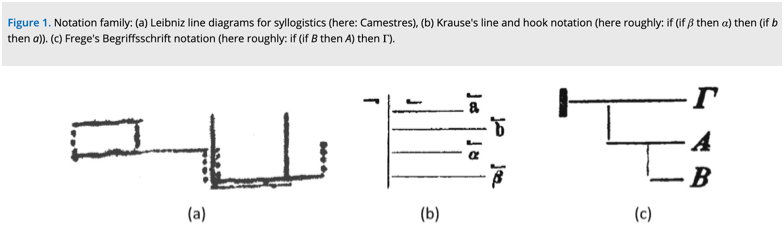
Ppasigraphies by (a) Leibniz, (b) Krause, (c) Frege (Illustration from Lemanski’s paper)
Of course, so far none of this definitively tells us that Frege had, indeed, never heard of sprachphilosopie, except, it seems, Krause wrote a book titled…checking notes… Zur Sprachphilosophie. And guess what? It is still in print today! You can buy it on Amazon.
Now sure, I suppose it is possible that Gottlob Frege hated his father and wasn’t interested in his work and it was all just a crazy coincidence that Frege ended up executing a pasigraphy that looked a lot like Krause’s. You know, shit happens with families. But then …was Frege also ignorant of Friedrich Adolf Trendelenburg (AOS philosophy of language, logic, philology – he the author of the famous etymology of the word “person”), who even used the term “begriffsschriftt” in his work? Why should we believe that Frege was aware of Trendelenburg’s work? I dunno, maybe because Frege cites it in…checking notes again…the Preface to the Begriffsschrift?
Apart from the question of how Frege could possibly not have heard of the philosophy of language, there is the question of whether what we call the philosophy of language was important to Frege’s project. Schuringa, who I guarantee you knows nothing about mathematical logic, insists that all this philosophy of language stuff was just some added-on stuff to clean up a few puzzles. Let’s take a minute to sort this out.
In the footnotes to A Social History, Schuringa makes several references to a collection of papers entitled From Frege to Gödel: A Source Book in Mathematical Logic, 1879–1931, edited by one Jean van Heijenoort. Schuringa even celebrates the collection for including the preface to the Begriffsschrift, and he claims to be using that preface to build his case that Frege was not interested in the philosophy of language (Frege didn’t even know what it was!) How Schuringa missed the reference to Trendelenburg in that preface is a question that we set aside here.
Had Schuringa consulted the author of that Source Book he was citing, Jean van Heijenoort, he would have learned a couple of interesting things. First, in 1967, the same year that the Source Book came out, van Heijenoort published a paper entitled “Logic as Calculus and Logic as Language” in which he argued that what set Frege apart from other logicians of his era Boole/Peirce/Schröder, was that Frege did not view logic as a mode of calculation, but rather as a universal, perspicuous language in which content is expressed.
So, on van Heijenoort’s view, the biggest advance was not the introduction of quantification, or function-argument application to replace subject-predicate form, but rather Frege’s idea that logic was fundamentally a universal language in which not only mathematical inquiry could be conducted, but also in which all forms of inquiry could be conducted. (You can see elements of this idea in the title itself – Begriffsschrift, or concept writing.) It seems to me that understanding this goes a long way toward explaining why Russell, Wittgenstein, and the Vienna Circle were all so into Frege.
Here is a way to think about this: van Heijenoort’s paper provides a map of two different ways Western logicians have thought about what a logical system is. He uses that map to argue that there’s a real conceptual split in the history of logic, with Frege on one side and the Boole/Peirce/Schröder tradition on the other. If I read van Heijenoort correctly, the alternative (calculus rather than language-based) approaches to language are not even entitled to call what they are doing “logic.”
Now, it is true that Frege wasn’t giving a theory of natural language – he was giving a theory of an ideal language. But it was still language. This just means he wasn’t doing linguistics. He wasn’t Herder or Humbolt. The language he was building was an ideal one, optimized for clarity. But in building such a language he had to think about what properties it would have to have, because it would have to be designed for all forms of thinking (not just mathematical thinking), and this, ultimately, gets him into issues about sense and reference, and indexicals, and speech acts, and on and on.
But a bigger issue is this: Even if Frege somehow, someway, had never heard of the philosophy of language, or heard of it and didn’t care about it, and even if he thought it had nothing to do with his project on the foundations of mathematics – even if he wrote it all down on the back of an envelope just for the fucking hell of it – well, his work would be just as important. His work on the philosophy of language, even if he just called it “a bunch of shit that popped into my head,” would have had monumental importance, just as it continues to have monumental importance today.
There is a second point I wanted to make about Jean van Heijenoort. He is otherwise unmentioned in Schuringa’s book, but it must be noted that he is yet another example of an analytic philosopher that is a counterexample to Schuringa’s thesis that they are all in the tank for neoliberalism. My friends, van Heijenoort was also the personal secretary and bodyguard to Leon fucking Trotsky! (I know what you are thinking, but van Heijenoort moved to New York a few months before Trotsky was assassinated.) Trust me when I tell you that we are coming back to this!
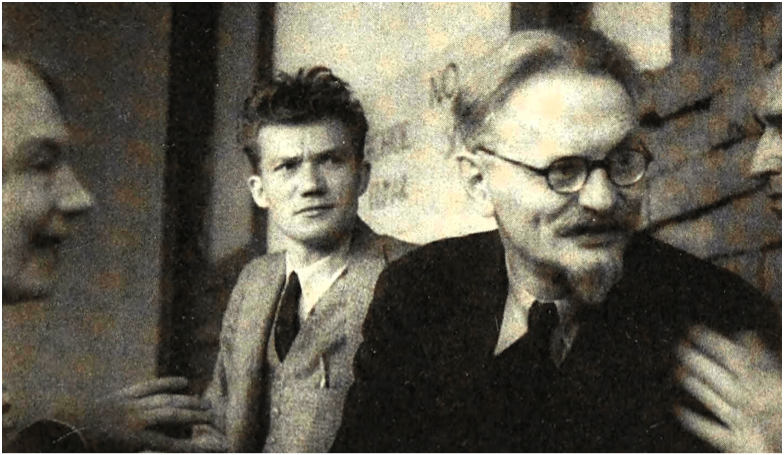
van Heijenoort with Leon Trotsky (to be continued…)
Before we move on from Frege, I have two observations. In one classic moment, Schuringa complains that “Frege had never spoken of a ‘theory of meaning’.” Were this true, it was probably a mistake for Frege to title his most famous paper, “Sinn und Bedeutung.” Now perhaps Schuringa was trying to say that Frege never successfully constructed a theory of meaning or a theory of sense and reference, and if by “theory” we mean “finished theory,” then that would be true. But Frege’s great accomplishment was not that he gave us a finished theory for us to venerate as though it were the end of science. He gave us something better: a research program that is still being pursued a century later. You know, it is a theory in the sense that Darwin’s theory of evolution is a theory – it is a theoretical research program.
Final note: Schuringa also takes issue with the fact that in his final version of Frege: The Philosophy of Language, Dummett did not include references to the locations in the text he was referencing. I agree that that is annoying. It would have sped up some of the Frege scholarship that followed in the wake of Dummett’s book. Schuringa, however, is outraged by this and is amazed by “Dummett’s ability to get away with such scholarly standards.” Perhaps the criticism is fair, but I don’t think that Schuringa is the one to deliver this message.
Schuringa’s confident yet unsupported and bizarre, upside-down statements about Frege are just one example in a flood of additional claims, in which Schuringa weaves a tapestry of Bizarro World takes on what analytic philosophers must be saying and believing.
For example, did you know that Donald Davidson’s T-theories give truth conditions without a metalanguage? I shit you not, Schuringa said that. What was he trying to show? Who knows. But, of course, the whole point of a Davidsonian truth theory is that you give the truth conditions in the metalanguage. Now, there is no reason that Schuringa needs to know about this, but if he chooses not to understand it, why is he blathering on about it? This isn’t some minor error. It would be tantamount to saying that Marx rejected materialism, or Freud rejected the unconscious.
At one point, we are told that the logical truths are analytic truths, like “Bachelors are unmarried.”
So-called analytic truths (statements true merely by definition, such as ‘Bachelors are unmarried’) – the logical truths – faced a problem. They relied on synonymy, which Quine persuasively showed was a far more slippery notion than one might suppose.
Ooof, just brutal.
At yet another point we are told that Wittgenstein destroyed Russell’s type-theory project in logic – i.e., that type theory was abandoned in the face of Wittgenstein’s criticism of Russell. What? In the first place, while Wittgenstein was an important 20th-century Philosopher, no one gives a flying fuck what he thinks about logic. And type theory was not at all abandoned. It stands at the foundation of many logics, including categorial grammars of the sort that are nearly universally used by semanticists in linguistics departments around the world (see, for example, the semantics textbook by Irene Heim and Angelika Kratzer). Meanwhile, I can think of over a dozen computer languages that are grounded in type theory. I’m not even going to get into the use of type theory in the foundations of mathematics, because I mostly don’t understand most of it, but I know enough to reliably inform you that it is still very much in use.
Then there is this: Schuringa somehow got it into his head that analytic philosophers have been fans of behaviorism, and when they aren’t behaviorists, they immediately become fans of Artificial Intelligence (AI). Here is the passage in question.
But analytic philosophy is much more intimately bound up with what we find elsewhere in the academy than such a schema recognizes. There are close affinities, in particular, with marginalism in economics, and with behaviourism in psychology.
After 1959, when Noam Chomsky’s damning review of B. F. Skinner’s Verbal Behavior drove long nails into the coffin of behaviourism, its basic impulses were redirected, into a preoccupation with computers as taking the place of conscious agents. Today, this trend finds its counterpart in analytic philosophers’ obsession with ‘artificial intelligence’ as supposedly analogous to conscious minds.
Let’s set the business about economics aside for the moment (I can only sort out one confusion at a time). What’s this about behaviorism? He thinks analytic philosophers are behaviorists! Or they were until Chomsky wrecked behaviorism, and they all became AI maxis.
I would really love to know who these behaviorists are that Schuringa is talking about. Quine no doubt, but who are the others? Some people have said that Wittgenstein and some of the Oxbridge ordinary language philosophers were “logical behaviorists,” but then we get into the whole Wittgenstein passage about the “beetle in the box.” Is this who Schuringa has in mind? He doesn’t say.
As to driving long nails into the coffin of behaviorism, what is Chomsky if not an analytic philosopher? (We will come back to this.) Critically, Chomsky did not end behaviorism all by himself, and many analytic philosophers were also engaged in that difficult project. Figures like Hilary Putnam (with his papers about super-Spartans) and Jerry Fodor, and many others were involved in the battles against behaviorism in the academy.
Even in the 1980s, when I was at Stony Brook, behaviorism was alive in psychology departments. I started a cognitive science group to give the non-behaviorist minority within the psychology department at Stony Brook a safe space. We invited Jerry Fodor to come give a talk, and the behaviorists who (unwisely) came to heckle him got a full dose of Jerry Fodor. This was in the late 1980s. So no, analytic philosophers were not behaviorists; they played important roles in dismantling behaviorism.
On the “obsession with ‘artificial intelligence’ as supposedly analogous to conscious minds,”What in the name of All Holy Hell is Schuringa talking about? Schuringa himself mentions Chomsky’s review of Skinner’s Verbal Behavior but he does not mention that Chomsky has also been a persistent critic of AI, most recently in a coauthored piece in the New York Times, entitled “The False Promise of ChatGPT.” It is not just Chomsky fanbois and fangrrrls that are going to find middle ground here. I don’t know of a single behaviorist philosopher since Quine passed away on Christmas Day in 2000, and I only know of one philosopher that is in the tank for artificial intelligence. Everyone else is engaged in some sort of philosophical reflection in which we have some form of consciousness, some level of agency, and in which it is not at all obvious that AI agents do or ever will have such things.
We can even quantify how many analytic philosophers might hold the view that Schuringa is attributing to them. In a survey reported by David Bourget and David Chalmers, roughly a thousand, predominantly analytic, philosophers were asked (among other things) if they thought current AI systems were conscious. 3.4% said yes. For context, 23% thought earthworms were conscious. 2% thought that atomic particles were conscious.
The list could go on. Bit by bit, page by page, we learn by induction that Schuringa has no idea what he is talking about. His understanding of the doctrinal parts of analytic philosophy is completely hallucinated.
Along the way, Schuringa can’t help but pause to toss more turds in the punchbowl – in that there are these random, pointless detours that Schuringa makes just to say something nasty, and, as it would happen, also false.
These detours are really quite something to behold, often taking the form of pronouncements uttered as if from Mt. Olympus, with supreme confidence, when it is clear that he is in no position to make them. We already covered one case in which he said, based on nothing, that Frege never heard of the philosophy of language. Another example of this is when he claims that Bertrand Russell was incorrect in saying that British Idealism was dominant in Cambridge when Russell was a student.
There is no sense in which Cambridge was simply dominated by idealism at the time Russell and Moore were students in the 1890s: there was no monolithic ‘idealist tradition’ for them to react against.
As if we are supposed to imagine that Schuringa knows more about 1890s Cambridge philosophy than Russell and Moore. Who were there.
To support his thesis, Schuringa notes that there only four dons in philosophy at Cambridge in the 1890s.
In the 1890s, when Russell and Moore were students, there were just four dons: Sidgwick, James Ward, G. F. Stout and McTaggart. Ward and Stout were psychologists as well as philosophers.
Right now you are asking, what does the number of dons have to do with this? And the answer is that I have no idea. Also, does Schuringa think that psychologists can’t be Idealists? Who knows, but come on, please… Ward, for example, advocated what he called “Spiritualistic monism” – a kind of panpsychist British Idealism influenced by Lotze. He was defending an anti-materialist, mind-suffused universe. Sorry, but that sounds like philosophical idealism to me. Stout certainly began as an Idealist; I don’t know where he ended up. McTaggart is obviously an Idealist, and as for Sidgwick, there is a famous essay by one C.J. Dewey (not that Dewey) in which he describes Sidgwick as idealist-influenced. Meaning, his project was armoring ethics against Idealism. In other words, Sidgwick was reacting against the same Idealist tradition that Russell and Moore were.
But these are just the dons. What of all the college fellows? Does Schuringa think he knows what their philosophical proclivities were as well?
Perhaps I can say something helpful. First, there is William Ritchie Sorley. While he didn’t become a don until 1900, he was there, as a fellow, at Trinity, when Russell was there. And he was an idealist. I hope no one is going to try and dispute that. Then there is John Stuart McKenzie who was a fellow at Trinity up until 1896. He’s the guy who said “... the distinction between what is real and what is imaginary is not one that can be finally maintained.” Sounds like an idealist to me.
As for all the other tutors and fellows, let’s hope some of them knew their Idealism, because that was a subject on the Tripos exam. According to the 1891 Guide to the Moral Sciences Tripos edited by James Ward, the ethics syllabus explicitly included "Idealistic Ethics" as one of the four main schools of ethical thought and it recommended Bradley's Ethical Studies and Green's Prolegomena to Ethics as representative works of Idealistic Ethics, adding this: “Green’s Prolegomena to Ethics may be strongly recommended as the most important English book dealing with the relation of Metaphysics to Ethics.”
And I get it, Bradley and Green weren’t at Cambridge. They were at Oxford. But that doesn’t mean they could not influence the intellectual culture of Cambridge for Russell and Moore, since, you know, they were on the reading list! For the Tripos exam! But wait, there’s more.
After we are told that Idealism wasn’t really a thing at Cambridge, we get this:
[Russell and Moore’s] target was a view they themselves had come to relatively recently (Russell in 1894, just before completing his Tripos), and was far from imposed on them by their teachers.
What is the logic here? It seems to be this: Russell wasn’t an Idealist when he showed up at Cambridge, but by the time he finished his Tripos he was an idealist, and therefore his becoming an Idealist had nothing to do with his education at Cambridge. Did I get that right?
If you thought Schuringa was out over his skis with his bold, god-like proclamations about the origins of Frege’s ideas and the character of philosophy in Cambridge in the 1890s, well, all that was just a warm-up for the 10th and final chapter of the book: “Colonizing Philosophy.” Or, as he also puts it: “Columbusing philosophy.” Who are these Columbuses, and what are they Columbusing/colonizing? What they are colonizing are areas like gender studies, race studies, and, I suppose, queer studies, but he doesn’t mention that last one. And who is doing the colonizing? Well, that is where shit gets wild, because Schuringa is about to name names.
The people colonizing gender studies and feminist philosophy are Sally Haslanger, Rae Langton, Catharine MacKinnon (not an analytic philosopher, I know, but tell that to Schuringa), and Miranda Fricker. You are perhaps thinking, what? There are feminist philosophers in every philosophy department in the US and Britain; why are these four singled out for scorn?
Who knows. The point here, now, is that Schuringa sees them as the four horsewomen of the apocalypse, charging off of the Niña, the Pinta, and Santa Maria, swords drawn in the Colombusing of feminism
Now, I am aware that if you have come this far in my review, you perhaps consider yourself an intelligent person, and are thus already asking yourself questions, like: How are those four women supposed to be colonizing feminist theory? They are women. Well, silly reader with your liberal, Columbian, sexist logic… what you fail to see is that those four are either (a) not the right women to be working on women’s issues, or (b) they are not doing it the right way! Which is to say that they aren’t doing it the way that Christoph Schuringa thinks women should be executing feminist philosophy. Ballsy. But there is a difference between being a Chad and trying to teabag an alligator.
Schuringa isn’t just telling women how to conduct their liberation movements. He has things to tell black folk as well. Here he zeroes in on Anthony Apiah, and my former colleague (now deceased) Charles Mills.
For good measure, he tosses in some scorn for Chike Jeffers, Quayshawn Spencer, and Joshua Glasgow. You may think of these philosophers as heroes of a sort – articulating the nature of racial oppression in a way in which you had not understood it before. But all this explaining and understanding is just a bunch of liberal Colombusing of racial studies. I don’t know exactly what Schuringa wants them to say instead, but I’m sure it has something to do with Marx circa 1948. In any case, they are either (a) the wrong black guys to be doing black studies, or (b) they are doing it all wrong – i.e. not the way Schuringa wants them to do it.
It is pretty easy to see where this project goes next. If someone is working on the nature of oppression for some group – women, blacks, Asians, whatever – they are going to have to get approval from a white guy, Christoph Schuringa, teaching somewhere in London. If he likes what they are doing and (more importantly) how they are doing it, he will nod approvingly in their direction. But if he does not like the way they are conducting their own liberation movement, he will say that they are “Columbusing” their field of study.
I don’t mean to suggest that Schuringa doesn’t introduce arguments against what these people are doing, but even I, a kind of outsider to their field, can see that he is wildly misrepresenting their positions (no surprise there, I guess). Whether these misrepresentations are intentional or the product of the challenging nature of basic reading comprehension is the fundamental question of Schuringa’s book.
In this case, the key misrepresentation is the idea that analytic race studies turns on how people use the word ‘race’ (in his words, “a question they largely examine by asking how ‘competent users of English’ use the word ‘race’”). Sorry, but these people are in the business of studying race and the concept of race, not how we use certain words. Word usage can be evidence for the structure of our concepts, but that is not the object of study. Even if they were interested in the lexicon of ‘race’, as I am, there would be questions about the norms governing the correct application of words like ‘race’, which would in turn raise empirical issues about biological and social facts about the world. But beyond this point, they are also proposing that we can ameliorate these concepts if some good can come from that. They are in the business of engineering concepts, not just accepting them as given.
When Schuringa then turns to the Columbusing of Marxist studies it is at least marginally less offensive, except for the fact that the juxtaposition of the cases suggests that Schuringa finds himself to be an oppressed minority, just like women and blacks, by virtue of being some flavor of Marxist/non-analytic philosopher: “Analytic philosophy simply cannot help thinking of itself as just philosophy as such – not unlike the way in which, as Charles Mills underlined, whites simply cannot help thinking of themselves as just humanity as such.” (Imagining what Charles’s reaction to that would have been fills me with mirth.)
But back to Marxist studies. Who is the colonizer here? The people he is attacking here are analytic Marxists like Jerry Cohen, Jon Elster, and John E. Roemer, but they were doing Marxist studies before Schuringa was born. It would be years before he was wearing short pants and sailor suits, and still more years before he read Marx and decided he knew more about it than all those who came before.
I aim to return to analytic Marxism later, after we have covered a few more background topics, but it does seem to me that Schuringa doesn’t really have a criticism of the work, so much as just a sneer and one background thought, which is this: That shit is not how Marx would have done it! True, I suppose, of Marx trapped in 1848, but what forms of scientific investigation and technologies would Marx have availed himself of in the 20th and 21st centuries? We will come back to this, but for now, we have to move on to a new issue.
In the middle of all his hallucinated ideas about what analytic philosophers believe, and in the middle of his project to dump on the quality and integrity of analytic philosophy writ large, and in the middle of all the random, pointless defamations, pseudo-arguments and breakdowns in scholarship, Schuringa decides that there are movements within analytic philosophy that are in some sense good, or at least better. For some reason, he thinks that modal logic must be a good thing, or at least a better thing than the alternative, which is no modal logic.
Does Schuringa understand what modal logic is? Clearly not, but we are beyond all that. What I believe is driving this exemption for modal logic is an online lecture by the logician Max Cresswell, who had a very political spin, that modal logic was the logic of the people, and the philosophers against it were rich mfers like Quine, whose father owned a tire mold company in Akron, Ohio. (A veritable titan of industry.) Cresswell’s argument here, as he admitted, was pretty thin, resting on the fact that Quine was undeniably a right-wing Nixon supporter, and that there was one logician, William T. Parry, who went to the Soviet Union (also Vienna in 1932, btw) and became a socialist. Or…Cresswell wonders … maybe Quine just didn’t like his dissertation advisor, C.I. Lewis. Too late to consider that last possibility; Schuringa has already grabbed onto the first idea, and he is not letting it go!
Whether this take on modal logic makes any sense is not the point. What matters to us now is that Schuringa positively eats it up. And thus, he carves out a space within analytic philosophy where good guys can be found – in the modal logicians! They are like a sleeper communist cell, hidden in plain sight at the very center of analytic philosophy. This is already deeply nutty (in part because everyone except Quine believes in modal logic), but it gets even nuttier. Schuringa starts applying his patented method to it, which is to say he provides potted biographies intended to show that modal logicians are good, hardworking children of the proletariat, whereas the people against modal logic (as far as I know, that would be Quine, full stop) were the scions of tire mold manufacturers. This becomes hilarious when Schuringa steps in to hype Ruth Marcus and Saul Kripke.
In the case of Kripke, we are told he was “the son of a rabbi and the grandson of a Polish-born bottle and barrel salesman.” The story could be put to violin music. What Schuringa doesn’t say, or somehow doesn’t know, is that Kripke’s father was rabbi and friend to Warren Buffett, and thus became an early investor with Buffett’s Berkshire Hathaway company and thus became insanely rich. How rich? All we know for sure is that in 1999, the Kripke family made a donation of $7 million dollars to refurbish the library tower at the Jewish Theological Seminary in New York. It's now named “The Kripke Tower.”

The Kripke Tower
In the case of Ruth Barcan Marcus, we are told that “Her parents, Sam and Rose Barcan, were Russian Jewish immigrants who had settled in the Bronx. The household was socialist (though not communist); as in Lewis’s parental home, Eugene Debs was a ‘sainted’ figure. Young Ruth attended the Red Falcons (‘Marx for tots’).” Promising!
Schuringa has a needle to thread here, since he has to deal with the allegations that Kripke “plagiarized” some of Marcus’s key ideas. He settles on the idea that this is “a distraction”: “The controversy about plagiarism is, however, a distraction from the more important issue. Even if it can be allowed that Kripke did not plagiarize Marcus, it remains true that, as she herself pointed out, for a long time her work in intensional and modal logic was not properly recognized or acknowledged. Kripke’s work, by contrast, was received with adulation.” In other words, it wasn’t Kripke’s fault that those analytic philosophers didn’t give Marcus the adulation she deserved.
Probably a more on-point thesis would be that logicians rarely get adulation because people rarely understand what they are up to, and in this case, it took Kripke’s lectures on naming and necessity to explain to people what the so-called Barcan formula even meant, how it worked, why it could be used to model metaphysical reality (complete with arguments!) and why it was important to philosophers. And in all honesty, he saw that it was important in ways that even Marcus had not seen.
The absolutely bizarre thing about Schuringa’s love for Marcus is that he seems to be completely unaware of her role in the 1980s as the Grande Inquisitor against continental philosophy. Most of what I know about this is filtered through continental philosophers that I knew at the time, but in their view, she had “purged” the Yale philosophy department of continental philosophers and was generally on the warpath against continental philosophy. She was already a leading protagonist (antagonist?), when the New York Times ran a story about the analytic/continental split in December of 1987, during the Eastern APA meetings.
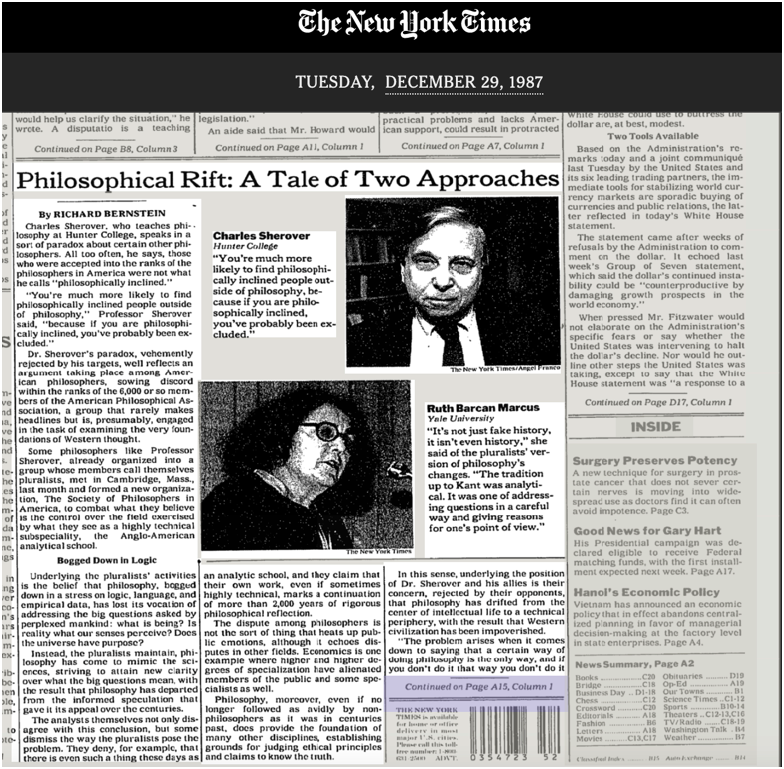
The NYT article does a pretty good job of laying out the dispute as it was drawn in the 1980s, and I believe as it still exists in Schuringa’s mind.
Professor Smith, Professor Sherover, and others dismiss this sort of thing as a bright but empty game played by the dreaded SMAG, the Singleminded Analytical Group, and they promote a return to the more freewheeling, literary traditions of Europe, where Nietzsche, Heidegger and Sartre provided a more soulful alternative to the analysts’ brainy but dry logic. Many of the anti-analysts refer to themselves as Continentals. They in turn are disdained by some of the analysts as fuzzy, airy, ignorant of the empirical data, and more attached to feeling than to thought.
Marcus, quoted in the article, isn’t having any of it, and the first point she makes is pretty good: It is just false to think that concern for logic and mathematics is a new development that came with analytic philosophers – philosophy has been obsessed with these issues from the beginning.
“It’s not just fake history, it isn't even history,” she said, speaking of the pluralists’ version of philosophy's changes. “The tradition up to Kant was analytical. It was one of addressing questions in a careful way and giving reasons for one's point of view.”
“There was also a close connection between philosophy and science,” she said, dismissing a common pluralists’ charge that the analysts, whether they exist as a category or not, pretentiously mimic the sciences. “Plato’s Academy bore the inscription: ‘Those who have not studied mathematics shall not enter here.’ Leibniz invented the calculus. Spinoza wrote up his Ethics like geometry. Nobody is more analytical than Descartes. They had tremendously high standards of clarity and a healthy regard for good reasons.”
Towards the end of the article, Marcus dropped the hammer.
“I’ll tell you what the issue is,” she said. “There are some people whose notion about philosophy is that it is something that you do. There's some issue - knowledge, truth, the meaning of good - and they try to answer philosophical questions about it. Then there are a whole lot of other people who write about other philosophers, who interpret their work. A lot of the people who call themselves pluralists are interested in studying other people’s work.”
Professor Marcus’s point is that the prestige departments - such as those at Berkeley, Harvard and Princeton - hired from the group that “does philosophy” leaving the resentful others on the sidelines, from where they have mounted a political counterattack.
Bejeebers, Schuringa picked a crazy ally there. A lot of good “Marx for tots” did her! Now, of course, Marcus is being unfair, but that was the state of the profession in the minds of leading philosophers all the way into the 1980s. Apparently, some philosophers still see the world divided up in this way, and Schuringa’s book is Exhibit One for that. But there is no reason we need to see it that way. And there is good reason not to see it that way.
Before we leave the subject of modal logicians not getting the adulation they deserve, there is the matter of the modal logician Oskar Becker. Why didn’t he get more credit for his work on modal logic during the 1930s? Was it because he was an assistant to Husserl and incorporated ideas from Heidegger? Or was it because he was too metaphysical for the taste of the logical positivists? Or… was it because he was another fucking Nazi?
And what a Nazi Becker was! This was the guy who argued for a “Nordic Metaphysics” and celebrated the fact that the meter of Nietzsche's Dionysian-Dithyrambs could be heard in the marching cadence of the Sturmabteilung (aka “storm division,” aka “storm troopers,” aka “brown shirts”, aka “fashion consultants for Heidegger”).
But wait! We haven’t even gotten to the dark part of Becker’s philosophy! That part was his idea, which he called “paraontology.” In it, he treats things like “race,” “Volk,” “historical destiny,” etc. as deep conditions that shape how a people experiences and discloses the world. In other words, different races/peoples have different basic “styles” of world-disclosure, grounded in their racial being. My friends: He’s using phenomenology to ground racism! What does this have to do with math and logic? Becker’s idea is that mathematics arises from phenomenological structures tied to race becomes entangled with the claims that different Völker have different existential structures, therefore different mathematical possibilities, therefore mathematics has a racial dimension. And that my friends, is why Jews are so shitty at math, and ultimately why Aryan science is so much better than Jewish science – you know, the shit they were doing in The Vienna Circle.
Schuringa is aware of all this but doesn’t seem to be particularly bothered by it.
Needless to say, Becker’s reputation was tainted by this – suffering in particular, during the post-war years, in the eyes of those who had fled Nazi persecution.
Yes, “tainted reputation” is one way to put it. But, you know, it was only tainted “in the eyes of those who had fled Nazi persecution.” But hey, who cares what the fuck they think.
Just to be clear, I’m not arguing that Nazism and racism are inevitable consequences of some kinds of metaphysical philosophy any more than I would say that they are consequences of doing modal logic. And let’s be honest, Frege was a rabid antisemite too. But, in the historical context of the 1930s and thereafter, one can understand how people came to have this thought. That might be worth exploring, if…you know… you were writing a social history of analytic philosophy.
The real puzzle is why Schuringa is so smitten with essentialism and essential properties. Every continental philosopher I know is always complaining about people who essentialize things. That is a bad thing! They don’t want it! The positivists didn’t want it. Quine didn’t want it. Derrideans certainly don’t want it. The other continental philosophers don’t want it either. No one wants it! It’s the only thing that everyone can agree on. But apparently, Schuringa wants it.
Schuringa practically adores Kripke (and invents his safe biography for him) because he imagines that Kripke is the defender of metaphysics, essentialism, and essential properties. But this shows a failure to understand what Kripke accomplished – at least on my understanding of Kripke. Indulge me for a paragraph or two.
It was a thesis of Kant that there are “synthetic a priori” propositions (the positivists didn’t believe in them but set that aside). These are propositions that are informative, but which are known without the help of experience – for example, that 5+7=12. What Kripke showed was that there are propositions that are, in some sense, the inverse of that: They are necessary yet a posteriori. That is to say, there are necessary truths, or essential truths, that are empirically discovered. Science discovers essences! So, for example, it is an essential property of the water in my glass that it is composed, in part, of H2O. Now, the thing is, we might (epistemic might) be wrong about this. Science may discover that water is actually made of something else. That is fine. Then we revise our understanding of what the essential properties are.
Ok, let’s put this idea in context. The reason that the positivists were opposed to metaphysics and essential properties is because they did not want religion, or authority, or armchair reflection about what “must” be the case to dictate our theories of what is the case. And honestly, metaphysical reflection had handicapped our understanding of the world. Kant thought it was an a priori truth that there were six planets. Aristotle thought it was an essential truth that men had more teeth than women (they don’t; ask your dentist!).
So, what Kripke showed (and, by the way, what Marcus did not show) should have been compatible with the motivations underlying positivism, and Quine’s project, and any continental project that rejects essential properties. We can have essential properties as long as we understand that we are free to reject them as soon as we can see that they are wrong.
This notion that you can reject an idea that you once thought important (maybe even an essential truth) is something that Schuringa just cannot wrap his mind around. Why do these analytic philosophers keep saying that things are supposed to be necessary and then rejecting the very same ideas? More generally: WHY DO THEY KEEP CHANGING THEIR MINDS!?. How is that allowed???
This is a real problem for Schuringa, because if his attack on analytic philosophy is to work, he has to show that analytic philosophy is not just accidentally bad, or temporarily bad, but he has to show it is essentially bad. It is irredeemable. You can’t fix it. But how and why is analytic philosophy essentially anything? No matter, Schuringa is apoplectic that the analytic philosophers are not telling him what those necessary and sufficient conditions are. And isn’t that their job after all?
Schuringa’s frustration with the ability of analytic philosophers to adopt and then reject essential properties like tissues at the psychotherapist’s office is nothing compared to the frustration he feels about the way analytic philosophers use what they call “intuitions.” What is that about? They use intuitions one day and then toss them in the used intuition bin the next day. Again, how is that even allowed?
Kieran Setiya, in his review of Schuringa’s History in the Los Angeles Review of Books attempts to help Schuringa understand: When you say it is an intuition, you are merely making your assumptions explicit. An intuition is a premise that you are offering, and which, for the moment, you believe to be true. Timothy Williamson has argued that analytic philosophers shouldn’t call these intuitions – they should call them “judgments,” like when you judge the height of someone. Judgments are not set in stone. You are allowed to revise your judgments. People do it all the time. It works like essential properties work post-Kripke.
Whatever. Schuringa is now obsessed with intuitions, and he cycles through case after case, noting the intuitions/judgments that are called on, and completely forgets to tell us what ideas those judgments were in the service of. For example, he talks about Putnum’s XYZ thought experiments, and sneers a bit, and then moves on, completely ignoring the philosophical project that those judgments were in the service of. And what they were in the service of was trying to help people see that we can be anti-Cartesians about word meanings and mental content. In other words, the thought experiments were illustrations in a project rejecting 400 years of Cartesianism! This project was advanced by a number of analytic philosophers, including Davidson, Putnam, Tyler Burge, and, to some extent, by Schuringa’s beloved Kripke. Why should we trust such judgments (or intuitions or whatever you want to call them) in these cases? Well, geez, maybe the idea is that we have some access to the contents of our own thoughts. Is that supposed to be a wacky idea to Schuringa?
Of course, we also get the obligatory sneering about Trolley cases, as though reflecting on whether we should switch the train to kill one person instead of five was just some form of irrelevant analytic-style mental masturbation. But you know, even as you read this very essay, people are designing self-driving cars to do this very thing. Wouldn’t it be lovely if philosophers had a role in reflecting on these cases, rather than leaving it up to Elon Musk to sort it all out for us?

Whatever love that Schuringa has for Kripke and Marcus he despises all the analytic metaphysics that came after them. (I guess the idea is: You saved essentialism for me, now go home.) Schuringa weirdly has particular scorn for Ted Sider and Jonathan Schaffer, who Schuringa takes to be among those philosophers who traffic in intuitions (aka judgments). He has extra particular scorn for Sider’s book about four-dimensionalism. Why does Schuringa have an axe to grind about four-dimensionalism? I don’t even know anymore, but based on Schuringa’s angst, you would think that Sider pissed in Schuringa’s Cheerios.
We are told that “Effectively, Sider has no methodology.” We are also told that “This methodological decrepitude has not gone unnoticed, and the armchair metaphysics of the likes of Schaffer and Sider has attracted criticism from some quarters within analytic philosophy.” And then there is this: “Although [Sider] professes to have ‘no good epistemology of metaphysics to offer’, that does not make his approach worthless, he thinks, because no epistemology can be established for any enquiry before embarking on it.”
Unaddressed by Schuringa is the following question: Did Sider say something false?
Nevermind that. All this methodological decrepitude has Schuringa asking questions: “One wonders what the institutional and social mechanisms are that serve to maintain the remarkable lack of methodological self-scrutiny that allows this to continue.”
Yes, right, why doesn’t the Ideological Department of the Central Committee of Analytic Philosophy put a stop to this decrepitude?
If you don’t know Sider’s work, you might be sitting here asking yourself, jeezuz what did that fucker do? I mean, Schuringa is handing out get-out-of-jail-free passes to Nazi philosophers left and right. Sider’s methodology must be some deeply Satanic shit.
And well, in Sider’s own words, in his own book, the methodology comes to this:
I will lay out some presuppositions of a more metaphysical nature that will guide the argument of the book. I will argue for these presuppositions whenever I can. Where I cannot, I simply flag them as my own prejudices.
And this sounds a lot like what Kieran Setiya was saying about how intuitions/judgments are used. They are ways of making your basic premises explicit.
I wonder about Schuringa’s handwringing over Sider’s lack of an epistemology for his metaphysics. I mean, we don’t even have an epistemology for mathematics, and finding one is a project that consumed 19th and 20th-century philosophy of mathematics. That was part of what was driving Hilbert’s formalism, until it got nuked by Gödel. It drives much work in intuitionist/constructivist work in the foundations of mathematics, and Charles Parsons devoted much of his career to sorting out an epistemology for Gödel’s Platonism about mathematical objects (Gödel didn’t offer one). I mean, even Soviet mathematicians were at work on the problem. At one point, Hartry Field decided we should throw in the towel; he wrote a book called Science Without Numbers, in which he argued that the epistemological problem of mathematical objects is so dire, we should find a way to do science without numbers. But the last time I checked, scientists still use numbers!
In saying all this, I don’t mean to suggest that I agree with Sider’s book Four-Dimensionalism. Quite to the contrary, I have a view that is, for all intents and purposes, the complete opposite of Sider’s. We even had an event at Cornell many years ago in which Sider and I presented our competing theories. My view was published in a widely unread book called Semantics, Tense, and Time. In saying that Sider is completely wrong about everything, however, I don’t find fault with his methodology. To the contrary, his methodology helps make explicit the different premises on which, for now, we cannot agree. His position is logically consistent, consistent with science, and consistent with Sider’s judgments about things metaphysical.
But getting back to Schuringa’s search for the essence of analytic philosophy, he gives up on waiting for analytic philosophers to tell us what their necessary and sufficient conditions are for analytic philosophy, and so he tells us himself: It is inherently Humean.
[Analytic philosophy] is in fact unable to see itself as the local, ideologically specific tradition that it is: philosophically, an outgrowth of Hume that has bypassed everything in European philosophy since Kant; ideologically, the perpetuation of eighteenth-century liberalism.
I bet you didn’t have that one on your bingo card! But you should have seen it coming, because it was in that Schuringa quote that I began this review with – the one about critical forces crushing its Humean enemies, seeing them driven before it, and hearing the lamentation of their women. But why Hume? I mean, why is analytic philosophy not fundamentally Cartesian, or Leibnizian, or Kantian, or Spinozan, or … you know, all of the above? But no, Schuringa assures us that it is Humean. It is British Empiricism at its very core, and to back this up he quotes A.J. Ayer. Well, that settles that!
As convinced as Schuringa is that analytic philosophers are all in the tank for British Empiricism, that idea doesn’t exactly line up with the views of actual analytic philosophers. Earlier, I cited the survey published by Bourget and Chalmers. Let’s look at that survey again. From about 1000 predominantly analytic philosophers, we are told that 72.9% believe in a priori knowledge. Not a good start for the empiricists. We are also told that only 31.3% are Humeans about laws of nature. Ooof, it’s rough when even the science part of your project isn’t Humean.
Nevermind all this nitpicking about what people actually believe, Schuringa has a theory. This Humean-analytic philosophy project, which, he assures us, is a thing (we aren’t talking him out of that), is responsible for many of the ills of today’s world. Did you know …
Empiricism is the view that all knowledge is derivable from sensory experience; liberalism exalts the autonomy of the subject. Together, they form the ideology of the bourgeois class that rose in the seventeenth and eighteenth centuries. The rise of the bourgeoisie was driven by capitalism, whose success in imposing itself as the global economic logic was in turn secured by the European colonial exploitation of the ‘new world’. The empiricist–liberal tradition, one of whose earliest and most ardent spokesmen was John Locke in the seventeenth century, reached its high point in the mid eighteenth century in the work of David Hume.
You may find that passage befuddling, which is too bad, because it’s supposed to be his core thesis. But what is that thesis? Is he saying Humean empiricist-liberalism led to all this colonial expansion and capitalism? Or is he saying Humean empiricist-liberalism was spread by this colonial expansion? Like, it was the beneficiary? Or is he saying that it just happened to be the ideology of the people who made bank in the colonial expansion – you know, the house religion of the winners in the spread of capitalism and colonialism? There are a lot of options on the table, but not one of them makes a lick of sense.
I’m not entirely sure how Humean empiricist-liberalism could be the cause of European colonial expansion, or the beneficiary, or even just a fellow traveler. I mean, there were French Colonies. And there were Spanish Colonies. And there were Portuguese Colonies. And German and Belgian and even the Italians had colonies. Why wasn’t continental philosophy the big winner in European colonial expansion? And apart from whatever ideology was driving colonial expansion, or profiting from it, what does any of it have to do with Hume? I mean, both North and South America had been colonized before Hume was born. Hell, they had been colonized before Locke was born. The East India Company had been formed and was in business in India before a single British Empiricist drew their first breath.
So, what is the connection between these things? In the end, you just have to understand that you can’t read this through the lenses of your Humean empiricist-liberal eyes. It will make more sense if you understand that he is just slamming a bunch of things that he doesn’t like into a single paragraph and hoping you associate them: colonialism, capitalism, exploitation, bourgeoisie, Hume.
Now it may be that where Schuringa lives, in London, elite folks are in some sense the intellectual children of Hume, so who knows, maybe that is the house ideology of British capitalists. I don’t know. But did it ever occur to Schuringa that capitalism isn’t tied to a single philosophical ideology? We already saw that Neurath, living in Vienna, thought that continental Idealism was the ideology of the bourgeoisie. But why should capitalism even be limited to only two ideologies? ]Schuringa might want to ask himself if either British Empiricism or Continental Idealism are the ideology of Jack Ma (Alibaba), or Mukesh Ambani (Reliance Industries), or Li Ka-shing (CK Hutchison, Cheung Kong), or Gautam Adani (Adani Group), or Masayoshi Son (Softbank), or Zhang Yiming (TikTok), or Mohammed Al Amoudi (MIDROC), or Aliko Dangote (Dangote Group). Short answer: no, there are lots of Buddhists and Confucianists and Muslims on that list and they likely do not give a fuck about Hume. Or Hegel. But they are capitalists. Capitalism no longer looks like it looked in 1848.
The one thing I know for sure is that Lockean-Humean liberalism/empiricism is not the house ideology in the United States, nor for titans of industry, nor anyone else, it seems, and that is a topic we will return to later. But for now, let’s forget all that contemporary capitalist ideology shit; we have to get back to Schuringa’s world. Back? Good. Next, you have to transcend your empiricist-liberal mind and slay your inner Hume. After you do that, Schuringa wants to tell you about a missed opportunity.
On the European continent, philosophy after Hume was shaped by the systematic philosophy of German idealism and its aftermath. In Britain, this systematic idealist philosophy never fully took hold, although it aroused interest there in the earlier nineteenth century… for a brief period at the end of the nineteenth century – the period in which Russell and Moore emerged – idealism secured for itself a newfound kudos. In light of this brief success of the ‘alien import’ of absolute idealism, the Oxford philosopher G. J. Warnock could write that Russell ‘symbolically joins hands with at least two centuries of British philosophy, across a gap of a few years occupied with new and strange things’.
What Schuringa is saying is that there was this one brief period of hope when philosophy in England was good and when it wasn’t in the tank for colonialism, and that was when continental Idealism ruled the seas of British philosophy (except, apparently, not at Cambridge). He says we can thank Carlyle, Coleridge, and de Quincy (the author of Confessions of an English Opium Eater) for bringing Idealism to England. Then Russell wrecked this one brief moment of hope and restored Hume to the throne of British philosophy. If only it had stuck to continental idealism, England could have avoided all its 20th-century imperial ambitions. Like Germany did.
Deep down, or maybe not so deep down, Schuringa must know he is peddling bullshit with this Hume talk, because, as he keeps cycling through analytic projects to piss on them, he must have noticed that very few of them have anything to do with Hume. Or Locke. Or really anything to do with empiricism. And he cannot hide the fact that the sheer diversity of all these projects is infuriating to him.
Schuringa just cannot come to grips with how analytic philosophy spins through idea after idea, never settling on one idea, wrecking their own projects left and right. And he clearly has an alternative idea of how philosophy should proceed: There should be a big theory (Idealism, for example) with a set (if unclear) methodology, and people should follow that. But analytic philosophy is more like the game Nomic, invented by the philosopher Peter Suber, in which you can change the rules as part of the gameplay. As long as you are clear about what you are up to, you are free to reconstruct the rules of philosophical inquiry. It’s not that there are no rules. It’s just that the rules are dynamic. Changing the rules is part of the rules. That is why analytic philosophy lends itself to radical projects, and why there are so many spectacular philosophical crashes. It is a constant philosophical demolition derby, but also a source of projects that challenge the status quo. It never provides the view from nowhere, but it often yields the view from somewhere new.
The agony of it all for Schuringa is that in their continuous project of wreckage, analytic philosophers have achieved (he believes) a level of hegemonic control over philosophy worldwide. It isn’t fair! And it never occurs to Schuringa that the global successes of analytic methods have not been due to official doctrines that appear along the way and which must be venerated, but from the fact that the project is dynamic, open to revision, and particularly open to iconoclasm. It is egalitarian in that anyone, anywhere in the world, can morph the rules as they see fit. Above all, analytic philosophers love to smash their idols. Of course, continental philosophers love to do all this too (especially Derrideans), which makes me wonder what Schuringa is defending. It isn’t exactly continental philosophy – it is more like an imagined golden age of continental philosophy in which some bearded sage (in Schuringa’s case, Marx) told us what was what, and that was that.
Analytic Philosophy in the Cold War Deep Freezer
There is a thesis, vaguely endorsed by Schuringa, that when the members of the Vienna Circle arrived in the United States, they shed their political interests – or (on his story) what feeble political interests they had. The theory is that analytic philosophers either sold out, or were cowed into submission, or just gave it all up. Or maybe they just became Americanized and stopped being political. Schuringa likes the latter version of this idea:
A leading role was played by logical positivist émigrés, driven from Europe by Nazism, who came to occupy significant positions in American philosophy departments. As they acclimatized to American conditions, they became newly professionalized, conceiving of themselves not as scientists with philosophical interests, as they had been in Vienna, but as exponents of a special academic discipline called ‘philosophy of science’. As logical positivists became philosophers of science, their programme was shorn of its social dimension, and they now adopted a stance of political neutrality.
Schuringa probably should have stuck to some version of this as his central thesis, because it is far more plausible than his absurd strategy of downplaying the political activism of people like Neurath, Zilsel, Hahn, Carnap, Rand and Frank in Vienna. The more plausible idea is that they toned down the politics when they arrived in the United States. It at least has a certain logic to it. They were political refugees. Most had barely survived the rise of fascism in Europe (some didn’t). Who could blame them if they kept their heads down in their new home? It's a plausible thesis, but mostly false when mishandled. When Schuringa gets hold of it, it’s like watching a toddler play with a Faberge egg.
Fortunately for us, there is some more sure-handed work which addresses this idea, and it comes in the form of a book by George A. Reisch, entitled How the Cold War Transformed the Philosophy of Science: To the Icy Slopes of Logic.
Conceding that the members of the Vienna Circle were at least politically progressive if not also revolutionary, we have a perfectly good question: Did the Cold War put the political aspect of their project in a metaphorical deep freeze? Here we see what an actual social history of analytic philosophy looks like, as Reisch dives into old archives and studies correspondence (including the margin notes on documents), FBI records, and the internal communications of professional societies and funding organizations like the Rockefeller Foundation.
The end result is not helpful for Schuringa’s project, as Reisch’s research sends torpedo after torpedo into the burning hull of Schuringa’s central thesis. First of all, it is clear that Reisch is going to have no time for anyone who tries to downplay the original politics of the Vienna Circle members or who says that their project was disconnected from everyday life.
[M]ost early logical empiricists, though not all, were as passionate about problems in culture and politics as they were about technical philosophy and epistemology….
The movement promoted the task of unifying and coordinating the sciences so that they could be better used as tools for the deliberate shaping and planning of modern life. And it sought to cultivate epistemological and scientific sophistication among even ordinary citizens so that they might better evaluate obscurantist rhetoric from reactionary and antiscientific quarters and better contribute to planning a future unified science that would assist society’s collective goals….
… logical empiricism was conceived by its founders in part to assist the coordination and coordinated use of scientific knowledge, to help modernize and improve life, education, and social and economic organization.
But this, of course, leaves open the question of whether something happened during the Cold War that prompted members of the Vienna Circle to keep their heads down and, at least for the moment, suppress their political project. The answer to this question ends up being nuanced.
Part of the problem is that by the end of WWII, many of the positivists were dead. Hans Hahn had died in 1933. Moritz Schlick, of course, died in 1936. Zilsel took his life in 1944 (suggesting that perhaps, contra Schuringa, they were not all that “acclimatized to American conditions”). Neurath, a frequent visitor to the United States and the driving force behind the Unity of Science project, died in 1947. So, by the time the Cold War arrived, there weren’t that many left to fight the good fight, even if that was possible. But the interesting discovery in Reisch’s work was that philosophers like Rudolph Carnap and Philipp Frank did not duck their heads so much as they were deplatformed. Or more accurately, the entire Unity of Science program was deplatformed by US funding agencies.
Here is where Reisch’s hard work starts to shine, as he dives into internal documents at the Rockefeller Foundation and other funding agencies. In an early memo, one officer at the Rockefeller Foundation (circa 1947) registered approval, even though he expressed some reservations: “sounds good, only I hope there’s no faint tinge of pink in it.” Despite that “tinge of pink,” the Foundation funded the organization … until it didn’t.
What would that tinge of pink be? Probably trigger words like “social” and “unity.” That is not a joke. On viewing an early proposal about setting up an institute for the Unity of Science, an officer named Lumis wrote, “The most striking word in the Vienna Circle’s vocabulary is ‘unity.’… Frankly, I ask what does it mean?”
The Foundation funded what they called “the Vienna boys” for a while, but then Frank found that he was running out of Rockefeller Foundation love. By 1951, it was basically over. Frank tried to pitch his project as a way to fight totalitarianism, but a Rockefeller officer, working in the natural sciences division, wasn’t buying it. As he wrote in his diary, he found Frank’s argument “very tenuous and unconvincing.” But the real problem, as Reisch reported, is that the Foundation had found someone else: The Congress for Cultural Freedom.
[C]olleagues … in the Humanities Division were already supporting international conferences of the Congress for Cultural Freedom. These conferences, unlike those Frank proposed, were not designed to fight totalitarianism with empiricism, pragmatism, or any kind of scientific philosophy that might sever its metaphysical roots. Instead, they pitted absolute values of the West against those of the Soviets and sought to influence nonpartisan European intellectuals (“neutralists,” the Congress organizers called them) before they fell under the spell of Soviet propaganda. Into an ongoing war of values and propaganda, in other words, Frank proposed introducing the tools of intellect and reflective epistemological analysis. It is perhaps less surprising, therefore, that Frank came to be viewed as an outsider in the foundation’s circles.
Compared with the Congress for Cultural Freedom, Frank’s institute and its projects had weak antitotalitarian credentials. That was not only because the Congress was dedicated to anticommunism, but because the goal of unifying the sciences became increasingly associated with radicalism after the war.
Don’t worry, we are going to get to the CCF, I can promise you that. The point I want you to focus on now is that Frank and the Unity of Science project didn’t sell out to The Man. They didn’t drift to the right. They didn’t become part of the military-industrial complex. They were deplatformed.

While Philipp Frank was getting rejected by funding agencies, he was about to learn that he was under investigation by the FBI, for allegedly being a communist sympathizer, or maybe worse. Then, in their investigation of Frank, the FBI found a bigger threat to the free world; the name “Carnap” began coming up. When this new name came to the attention of the FBI’s Director, J. Edgar Hoover, old J. Edgar got a giant raging hard-on, and he put all his field offices to work on this new threat. Reisch has a more scholarly way to put this same point.
As the investigation began, several offices around the nation were involved. These included Hoover’s office as well as the field offices in Washington, D.C., Newark, Chicago, and Indianapolis. In addition, since Carnap had just taken a position at UCLA, overall control of the investigation was given to the Los Angeles office. At nearly all of these offices, September 16, 1954, might have been called Rudolf Carnap Day at the FBI. In a flurry of memo writing, agents across the country shared information that continued to build a picture of Carnap as a potential political subversive.
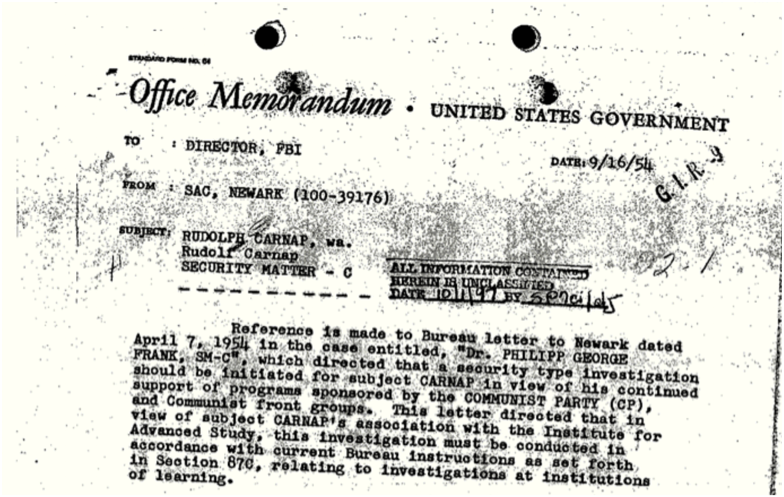
FBI Newark field office report on Carnap, Sept. 16, 1954, Rudolph Carnap Day at the FBI!
It wasn’t like all those agents came up with nothing.
The FBI’s list of activities and causes that Carnap supported grew longer and more detailed as these memos shuttled across the country. Beginning in 1949, Carnap's name appeared on two public statements on behalf of the International Workers Order (as a signatory to a brief amicus curiae and to an open letter to Thomas Dewey, governor of New York State, where the IWO was being prosecuted). It appeared twice in the Daily Worker and once in the New York Herald Tribune against the anticommunist McCarran Act. Carnap also supported the American Committee for Protection of the Foreign Born in the Daily Worker and signed an open telegram to the Attorney General in support of deportees. Carnap also called for official recognition of the People’s Republic of China and gave his name five times in support of the American Peace Crusade. Referred to by anticommunists as Moscow's “peace offensive” (allegedly designed to ease a Soviet takeover by lulling Americans into pacificism), the crusade consisted of various conferences and letter-writing campaigns in support of international peace, disarmament, nonmilitary treatment of tensions in Korea, as well as free-speech rights for citizens wishing to promote these causes
Still, at the end of the day, he wasn’t actually meeting with any known Soviet agents. They asked Soviet informants, but the informants had no idea who Carnap was. Did that mean he was just a super deep Communist agent? Hoover wondered. But eventually the investigation ran out of steam.
Carnap certainly knew about the FBI investigation. Did any of this deflect Carnap’s work in any way? It is hard to know. But we have some idea about how he responded to pressure that came from inside philosophy – in this case, from John Dewey’s student, Sidney Hook.
Schuringa and I don’t agree about much, but I’m sure we are on the same page about Hook. Hook began as a full-fledged Marxist, but by 1949 seemed to believe that if you weren’t rabidly anti-communist, you were basically Stalin himself. Hook is perhaps most famous for dropping dimes on intellectuals who were, or even had been, socialists of some stripe. Here again, we get some fascinating insights from Reisch’s archival research.
In 1949, shortly after lending his name to support the upcoming Cultural and Scientific Conference for World Peace, Carnap received a letter from Sidney Hook regarding the conference (also called “The Waldorf Conference” because it was to be held at the Waldorf Hotel). The Conference’s literature had all the suspicious buzzwords that could trigger a Cold-Warrior – words like “World,” and “Peace.” Hook could not abide Carnap’s participation in such an event and expressed his concern in a way that might illuminate the pressure that academics would face during the Cold War. Reisch reproduces the letter with the parts that were underlined by Carnap.
Dear Carnap,
I have just learned from Dr. Jacobs of the Voice of America that your name has been cited (presumably abroad) as a sponsor of the forthcoming Cultural and Scientific Conference for World Peace. I hope this is not true. If you actually have enrolled yourself as a sponsor, I am confident that you are unaware of the real auspices of the Conference. It is being run by people whose first act, if they came to power, would be to liquidate you and people like you…. I am enclosing some materials which I earnestly beg you to read very carefully. My experience with this Conference is decisive.
Next to the line about liquidating Carnap and people like him, Carnap wrote a “?!” in the margin. I understand this as Carnap’s version of “WTF!” As he kept reading, Carnap underlined more WTF moments in Hook’s letter.
… This business is no ordinary thing, as you will learn by developments in the next few days. Anybody who is still a sponsor by the time the Party-line begins to sound off at the conference, will be marked for life as a captive or fellow-traveler of the Communist Party. You are not a Communist and you are not a political innocent.
Forgive me for writing so strongly. It is a measure of the respect I have for you and your life-work. There are mistakes and mistakes. This one can be positively fatal if not rectified.
Sincerely Yours, Sidney Hook
Today, those words sound comical, but at the dawn of the Cold War, those were serious threats and posed a very real possibility that Carnap might be ending his career or worse by supporting the meeting. Carnap, to his credit, ignored the implicit, although not exactly implicit, threats in Hook’s letter and continued to lend his support to the Waldorf conference. Frustrated, Hook helped organize a competing conference the following year in Berlin, a conference that eventually evolved into the aforementioned Congress for Cultural Freedom (which, again, we will come back to. I promise!).
Carnap’s activism was, as we learn from this case and those that caught the attention of the FBI, involved letter-writing and providing similar forms of support. I don’t think we should diminish that. And it must be acknowledged that while Neurath and Frank had definitive ideas about how their philosophy should be applied to everyday life, Carnap did not. That didn’t mean it wouldn’t be connected: it just meant that he would not be doing the connecting. The way Carnap saw it, his philosophical project involved a syntactic, a semantic, and a pragmatic component – the last being the part where the rubber met the road. In Carnap’s words, he was “compelled to leave the detailed work in this direction to philosophically-interested sociologists and sociologically-trained philosophers.”
I suppose a person can take issue with that. Some philosophers want all philosophy to be socially connected right now, and if they can’t yet see how it is connected, it must be shit. But even if it were true, the objection does not speak to if or how or why analytic philosophy was in the deep freeze during the Cold War, and here we need to return to Reich’s careful analysis.
There are several key observations from Reisch’s book: First, it is incorrect to think that it was only analytic philosophy that went silent during the 1950s. The entire academy in the United States went silent. So whatever conclusions you want to draw from Reisch’s work, it cannot be that analytic philosophy alone was complicit, or a victim, or deplatformed, or playing possum, or hibernating, or however you want to describe it.
The second point that Reisch makes is that the professionalization of philosophy and the lack of concern for everyday life (to the extent they happened) were not permanent conditions for analytic philosophy. With the close of the 1950s, matters began to thaw, and you certainly saw a storm of politically active analytic philosophers throughout the 1960s. Hilary Putnam became a Maoist and was the faculty representative for the Students for a Democratic Society (SDS). You can find old articles in the Harvard Crimson in 1969 describing him as one of “the most radical faculty members.” And we will get to the case of Noam Chomsky and others below.
Reisch concluded his penultimate chapter with the following passage:
[I]n 1973, owing largely to the efforts of Robert Cohen, the first volume of Neurath’s selected writings appeared in English (see Neurath 1973). Only then, after student activism for civil rights and against the Vietnam War had begun to thaw the McCarthyite, Cold War culture on many campuses, were memories of the Unity of Science movement rekindled. Subsequent generations of philosophers then began to see that the movement's breadth and ambition could never have been contained on the icy slopes of logic.
In other words, their ideas were now out of the freezer, but the internal logic of the movement would have never let them remain in the freezer anyway. Not to put too fine a point on it, but Reisch is saying that far from being inherently or essentially apolitical, the movement’s internal political breadth and ambition pushed back against the external forces that tried to make it apolitical. The internal forces were stronger than the external forces that attempted to sanitize analytic philosophy.
Reisch then makes the point that to the extent there remains a chill, it must be noted that the entire academy is still feeling that chill – at least in North America (I assume he is only talking about the US and Canada, but maybe he intends Mexico as well), and that blame for this chilling effect cannot be placed on the internal logic of analytic philosophy or any other academic enterprise. The pressure is coming from outside.
That North American intellectuals continue to question their small voice in public affairs (especially when compared with European intellectuals, who were never so attacked) suggests again that this depoliticization did not issue from within intellectual culture. Rather, it was created by a now largely unknown, external set of pressures and agents that, as the Foucauldian theory of subjectivization would have it, concealed its operations.
In touching on this point, Reisch folds in a deeper point about the academy in general, and here he again draws on ideas from Foucault to make his point.
Perhaps the postwar ivory tower functioned rather as a kind of concentration camp into which intellectuals were herded by a largely anti-intellectual society and then permitted to indulge in any sorts of inquiry they liked, as long as their scholarship remained visibly disconnected from radical politics. Radicals may indeed become tenured, that is, but only if they remain either invisible within the ivory tower or incomprehensible to all but insiders and self-chosen initiates or students.
Academics think of universities as being safe spaces that protect them from the anti-intellectual rabble outside. But what if they function more like prisons for academics, even today? If they obey certain intellectual standards and stay within reasonable limits politically (on both the left and the right), they will be rewarded with wine and cheese and conferences in exotic locations, but the sad reality is that they are in a kind of “Club Fed” for intellectuals. Reisch asks whether philosophy wasn’t better placed in the coffee houses of old Vienna, or in teaching classes and giving lectures to adults in Red Vienna. Are universities even good places to be doing philosophy? Or anything? It’s a good fucking question, but it is a question that applies to all philosophers and all academics, and not just analytic philosophers.
We must return to our long march through the intellectual wasteland that is Schuringa’s book, but before we move on, there is an incident involving Carnap, at the very end of his life, that is worth calling attention to. The case is interesting because it shows that analytic philosophy is far more diverse and radical than Schuringa imagines it to be, and because it highlights the importance of the kind of activism that Carnap was engaged in. He wasn’t manning the barricades or running interference with the Black Bloc, but he was nevertheless doing important work.
There is a Spanish-language Trotskyist publication called La Izquierda Diario (The Left Daily), and in that publication, there was an article about a Mexican analytic philosopher and Trotskyist named César Nicolás Molina Flores. This article in turn cites a formal academic article by Víctor Manuel Hernández Márquez – a philosopher at Universidad Autónoma de Ciudad Juárez (UACJ). The story told in these publications is fascinating.
César Nicolás Molina had been a devout Trotskyist (at his death, he is supposed to have had one of the largest libraries of Trotskyist literature in Mexico), but he was also one of the first Mexican philosophers to engage with analytic philosophy – in particular, with logical positivism. His book, Matemática y filosofía (Reflexiones para la delimitación del territorio filosófico), which he self-published in 1954, sits at the core of scientific philosophy / logical positivism. Subsequent to that book, in the 1960s, he translated some of Carnap’s work.
Molina was very much on the margins of academic philosophy (he was working as a high school teacher), but Carnap befriended him at a conference in 1963.
October 2, 1968, ten days before the opening of the Summer Olympic Games, in the Tlatelolco section of Mexico City, there was a protest by a large number of (mostly) students. During that protest, the Mexican Armed Forces opened fire on the unarmed protesters, killing many of them. (It should be remarked that it is widely believed that this was instigated by the then Mexican government, possibly with support from US security forces, but that is a topic for another day.) Reliable numbers for the subsequent carnage are hard to come by here. The Mexican government claimed that “only” a few dozen protestors died, but the students claimed that as many as 500 had been killed and over a thousand were injured. By any measure, the event dwarfed what we in the United States call “The Kent State Massacre,” in which four were killed. (Neil Young did not write a song about these Mexican victims.) We have some agreement that about a thousand protestors were arrested – some of them at the event, and some of them swept up later by police.
Among those arrested in the aftermath were two philosophers: Molina, and Elí de Gortari – the latter being a famous logician and Marxist, working both in traditional mathematical logic and Marxist dialectical logic. They were both arrested without warrants and placed in Lecumberri prison with many of the other protesters. According to Hernandez, the subsequent charges against Molina were "INCITATION TO REBELLION, CRIMINAL ASSOCIATION, SEDITION, DAMAGE TO PROPERTY, ATTACKS ON GENERAL COMMUNICATION ROUTES AND LOOTING." [his upper case]
News of their arrest eventually made its way to the United States and to the American Philosophical Association, which formed a committee that included Rudolph Carnap. Astoundingly, Carnap, then 78 years old, flew down to Mexico to try to meet with the prisoners.
1968 protestors being processed
Lecumberri prison
Lecumberri prison cells
Once in Mexico, Carnap relied on Rafael Ruiz Harrell to be his intermediary with the prison. Ruiz was a professor in the Faculty of Law at the University of Mexico, who also taught in the Department of Philosophy, and who Carnap had met in 1963. Ruiz put Carnap in contact with de Cortari’s wife. In his report, Carnap talked about de Cortari’s wife helping him navigate through several bureaucratic hoops, then walking down long corridors in Lecumberri prison and eventually to a building called "El Polígono" [The Polygon]. There, he was able to gain access to de Cortari and, ultimately, Molina.
Carnap spoke with both prisoners for a while and learned that the protesters had come in for some rough treatment from some of the non-political prisoners. Molina’s work and his typewriter had been destroyed by other prisoners.
Ultimately, they hugged goodbye, and the two prisoners said it had been their best day since September 1968. Carnap returned home and wrote up his report for the APA shortly after his 79th birthday. He passed away on Sept. 14, 1970. His report was published in the notes and news section of The Journal of Philosophy three months after his death.
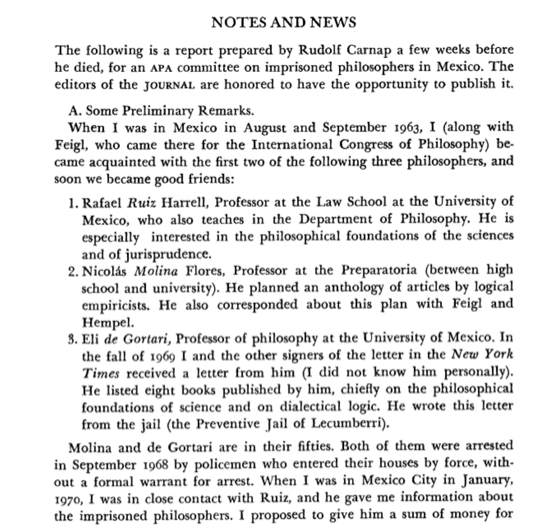
Carnap’s report appears in The Journal of Philosophy
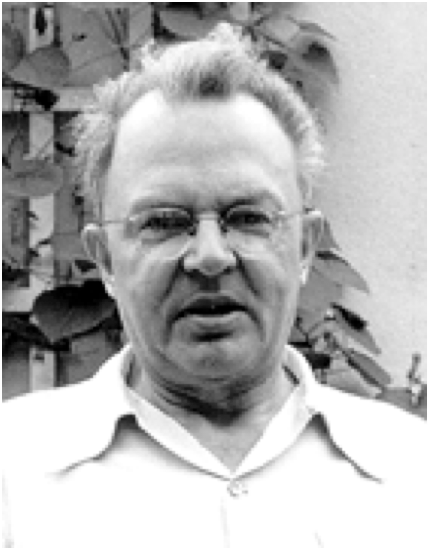
Rudolph Carnap. Fucking legend.
The Carnap-Molina story is instructive for several reasons. First, it shows that political activism is not merely about standing in the front row of a protest march. Sometimes it involves actions like lending moral support to political prisoners and victims of oppression. But the story also shows that sometimes political activism goes completely unseen, and sometimes we deliberately unsee it. So Schuringa does not want to see the political activism of analytic philosophers like Carnap, which is one thing. But he also wants to unsee the political activism of less famous, often marginalized, analytic philosophers around the world, writing them out of his history altogether – Molina is just one case in point.
Part of the problem here is that it is easy to unsee activism, and it is easy to unsee it because traditional institutions like universities and corporate media will do what it can to obscure activism. If the activism must be noted, it will often be demonized. So, it is easy to unsee things if your vision is filtered through corporate media. All you have to do is let the magician distract you. But if you bother to see past the magician’s tricks, you can see plenty of activism, often taking the form of mutual aid, and often at the level of bridging liberation movements. Unity, solidarity, and fraternity (although triggering words to the Cold War funding agencies and to Schuringa) should not be triggering to us.
If you were to travel around the globe and visit analytic philosophers in places like Brazil, Mexico, Argentina, etc., you would find a vast network of politically active philosophers, all unknown to Schuringa. I’m not going to mention the living philosophers because I don’t want to put them at risk, but I can say this. Some years ago, I was visiting a university in Brazil, speaking to analytic philosophers and linguists. After the talk, many of them went to a protest against Bolsonaro. As they were talking about it, they explained the role of the Black Bloc to me – as they explained, it is “not a group but a diversionary tactic, and they are there to protect us.” I know, I was an idiot for not knowing that, but my point is that those unmentioned philosophers and linguists were all feet-on-the-pavement activists, protesting Bolsonaro.
I said I can’t mention the living, but I can talk about the dead, and I want to mention a couple of figures in latin@ analytic philosophy. We already mentioned Molina in Mexico, but I also want to mention Luis Villoro. Historically, he was one of the central figures in the rise of analytic philosophy in Mexico; he studied Ayer, Carnap, Russell, Wittgenstein, and was among the drivers of Mexican analytic work in the 1960s–80s. At the same time, his mature work included work on history, ideology, indigenous movements, and Zapatismo.
In Brazil, you could point to many examples, but there is one really big, obvious example:José Arthur Giannotti (University of Sao Paolo). He taught symbolic logic at USP and was part of the early analytic/logic scene there. But he also had a strong Marx focus; his 1966 thesis/book Origens da dialética do trabalho was a study of “the logic of the young Marx.” Later, Giannotti become a major interpreter of Wittgenstein and analytic philosophy of language: he translated Tractatus Logico-Philosophicus into Portuguese and spent decades working at the intersection of logic, language, and Marx’s categories. He was forced into early retirement by the military regime in 1970 and co-founded CEBRAP, a key left-leaning research center in São Paulo.
In Spain, there is the case of Manuel Sacristán Luzón (1930–1985). He published Introducción a la lógica y al análisis formal (1964), one of the first systematic introductions to symbolic logic and analytic method in Spanish philosophy. Recent writers have described his project as combining “rigor lógico y marxismo crítico” – logical rigor and critical Marxism – and rebuilding Marxism with tools taken partly from analytic philosophy. Politically, he was a long-time Communist/Marxist militant (linked to the PSUC (Partido Comunista de España / Communist Party of Spain) and PCE (Partit Socialista Unificat de Catalunya / Unified Socialist Party of Catalonia)) and later an important dissident Marxist voice in Spain.
Even minor American analytic philosophers that must be mentioned are redescribed to fit Schuringa’s narrative. So, for example, Schuringa wants to mention William T. Parry in the context of modal logic, but neglects to say that Parry was nothing if not an analytic philosopher in addition to a communist. Here is what Schuringa tells us.
He had been radicalized in 1932 after witnessing fascist rioting at the University of Vienna, where he was spending time before handing in his PhD, completed that same year under Whitehead at Harvard, on the topic of implication. He solidified his grasp of communism by reading Lenin’s State and Revolution. In 1933 he joined the Communist Party USA, in 1936 became a founder and the first managing editor of Science & Society, and in 1937 organized the Harvard unit of the Communist Party. He left the Party in 1946, but continued to publish in the journal. After appearing before HUAC [House Un-American Activities Committee], Parry remained employed by the University of Buffalo, but had his tenure revoked and was ‘placed on annual appointment as associate professor’. His tenure was not restored until 1961.
What is omitted is that his research was on what he called “analytic implication,” and the idea was to extend strict implication (as in C.I. Lewis) to come up with a logic of entailments within terms/concepts. It was, among other things, a way to provide logical foundations for conceptual analysis. His work did not have uptake, as conceptual analysis ran out of steam shortly thereafter, and Quine was already privately expressing reservations about analyticity. However, it is worth noting that Parry’s ideas have foreshadowed subsequent work in linguistics (in the form of “meaning postulates”), and recent work in proof theory and term logic. He was an analytic philosopher if there ever was one, and he was politically radical. In being those two things at once, he was not a rarity, but his story nevertheless was rewritten to fit Schuringa’s narrative.
Analytic Philosophy and Angela Davis
As we noted, in cases ranging from Otto Neurath to Susan Stebbing to Michael Dummett, Schuringa has a strategy of noting the activism of analytic philosophers when he must, but then dismissing it with a wave of the hand. This strategy is again on display in the section on Angela Davis, where Schuringa dutifully notes that Donald Davidson tried and failed to hire Davis at Princeton, that Donald Kalish successfully hired her at UCLA, and that the philosophy department at UCLA later voted to reappoint her 14-0 with three abstentions. Leading analytic philosophers put their asses on the line and ultimately had to deal with death threats. Even William Pruett, the TA for her course, had to have security guards (p.c. Gary Mar). You or I might hear about this and think, Wow!, analytic philosophy went out of its way to support Angela Davis! But once again, Schuringa is unimpressed, stating that this was just a one-off encounter: “Angela Davis was never to cross paths with analytic philosophy again. In the 1970s the world of American academic philosophy settled down, and resumed its liberal slumber.” This is false.
To give just one example, in 2004, the philosophy department at Stony Brook brought Angela Davis in to teach a mini-course. The chief proponent of hiring Davis was Gary Mar, then a junior professor and UCLA-trained logician. To the best of my knowledge, her appointment had unanimous support from the analytic philosophers.
Angela Davis and Donald Kalish at UCLA
The fact of the matter is that analytic philosophers are still engaged with her work. For example, Harvard’s Tommie Shelby, in his book, The Idea of Prison Abolition, explicitly treats Davis as the central philosophical voice for full prison abolition, lays out her core arguments, and then asks whether a just society could still legitimately imprison anyone. Amia Srinivasan, an Oxford professor who was a student of Timothy Williams and John Hawthorn, explicitly invokes Angela Davis in The Right to Sex and related work. Schuringa actually cites Kate Manne’s book In Down Girl: The Logic of Misogyny, but must have skipped the part where Manne references Angela Davis’s analysis of gendered state violence and incarceration.
Of course, analytic philosophers don’t just write books about Davis, they include her work in their course materials as well. For example, MIT’s Sally Hasslanger incorporated Davis into her course on race, racism, and the criminal punishment system. She also screened Free Angela and All Political Prisoners. My former colleague Elizabeth Anderson cites Angela Davis’s Women, Race and Class in her Stanford Encyclopedia of Philosophy (SEP) entry “Feminist Epistemology and Philosophy of Science.”
How does Schuringa miss all this? Did he miss it? Or did he just bury it? Those are interesting questions. I suppose it is always possible to say that this work just isn’t that radical, but recall that the point we are speaking to is the claim, by Schuringa, that “Angela Davis was never to cross paths with analytic philosophy again.” And I certainly don’t mean to say that this is the only contemporary analytic philosophy that leans on the work of Angela Davis. I’m just saying that this is the work I know about, so the amount of analytic philosophy engaging with Davis could be vast, for all I know.
Schuringa doesn’t seem the least bit interested in political engagement that doesn’t involve rock-star level activists like Angela Davis. But there is plenty of it to see if you care to look. Gary Mar, who I mentioned earlier, is a UCLA product – a student of Donald Kalish, David Kaplan, and Alonzo Church, but also politically active at the local level, and involved in raising consciousness about Chinese-American issues and connecting that work with other liberation movements. His institute at Stony Brook, called the Asian-American Bridge, attempts to bridge various liberation movements with Asian-American activism. So, for example, he introduced Angela Davis to Asian American activists, and did the same when Noam Chomsky visited. The model for Mar’s work was Yuri Kochiyama, a Japanese activist who is most famous for the LIFE magazine photo of her holding Malcom X’s head in her hands after he was shot. She is also somewhat famous for her role in a takeover of the Statue of Liberty. Mar brought her to Stony Brook and later interviewed her precisely because she was the sort of activist that inspired him – one who built bridges with other oppressed groups. She sought allies everywhere.
Yuri Kochiyama holding the head of Malcom X
Yuri Kochiyama occupies the Statue of Liberty to support Puerto Rican independence.
Despite the confidence with which Schuringa makes his proclamations about activism in analytic philosophy, he clearly knows nothing about it. If he knows about Gary Mar’s work, he isn’t talking. But Mar is not one of a kind. Analytic philosophers all over the world are engaged in their own way. Sometimes they are involved in prison education (Consider, for example, Jennifer Lackey’s tireless work at this), or providing legal support, or financial support, or emotional support. Perhaps the bigger question is, why is knowledge of this activity often suppressed?
For example, Gary Mar’s technical work on chaotic liars, co-written with Patrick Grim, was hyped by his home university and was reported in Scientific American magazine. But his political activism is not apt to be mentioned anywhere, despite his work connecting with political activists like Angela Davis, Yuri Kochiyama, and many others. Schuringa imagines that if he does not know about such work, it is because it must not be happening. And it never occurs to him that it might be happening, but that university administrators and corporate media prefer not to talk about such work other than to demonize it. It is almost as if Schuringa has no idea about the kind of world we live in, nor about the forces that are at work against any progressive agenda. But such progressive projects are happening, and they are happening everywhere in analytic philosophy.
Even I, possibly the least politically engaged analytic philosopher in the world, have had some level of engagement. For example, I supported Chelsea Manning by attending her trial at Fort Meade (there were some 22 charges brought against her, including “aiding the enemy,” which could have brought the death sentence). I was also involved in talking to attorneys and writing letters to judges to try to keep hacker/anarchists like Jeremy Hammond and Barrett Brown out of prison. They went to prison. (They are now out of prison, and last I saw, Jeremy, released after 10 years, was leading the antifa protests against ICE in Chicago.) I wouldn’t expect anyone to know about that work. But many more analytic philosophers around the globe are doing the same sort of thing, albeit more often and more effectively than I did. Either the self-proclaimed social historian Christoph Schuringa is ignorant of all of it, or he is suppressing the information. Neither is good. This brings us back to two of the biggest omissions – Jean van Heijenoort and Noam Chomsky.
Jean van Heijenoort.
As I noted earlier, one of the baffling elements of Schuringa’s book is that in his footnotes, he makes several references to From Frege to Gödel: A Source Book in Mathematical Logic, 1879–1931 edited by Jean van Heijenoort, but he never once mentions van Heijenoort otherwise. Presumably, this is because van Heijenoort is yet another counterexample to his thesis that analytic philosophers are never lefty enough. Or maybe, in this case, because he was the wrong kind of lefty (a Trotskyist).
In 1932, van Heijenoort was recruited by Yvan Craipeau to join the Trotskyist movement, and he joined the Communist League in the same year. After Trotsky was exiled, Trotsky hired van Heijenoort as a personal secretary and armed bodyguard. van Heijenoort spent seven years in Trotsky's household, during which he served as a translator, helped Trotsky write several books and carried on an extensive intellectual and political correspondence in several languages. (When I visited Trotsky’s residence in Mexico City, I noticed photos on the wall that included van Heijenoort). He was also one of Frida Kahlo’s lovers. He was shot and killed by his 2nd/4th wife in Mexico city in 1986. He was literally the most interesting man alive. Why is Schuringa not writing about this guy? I think we know.
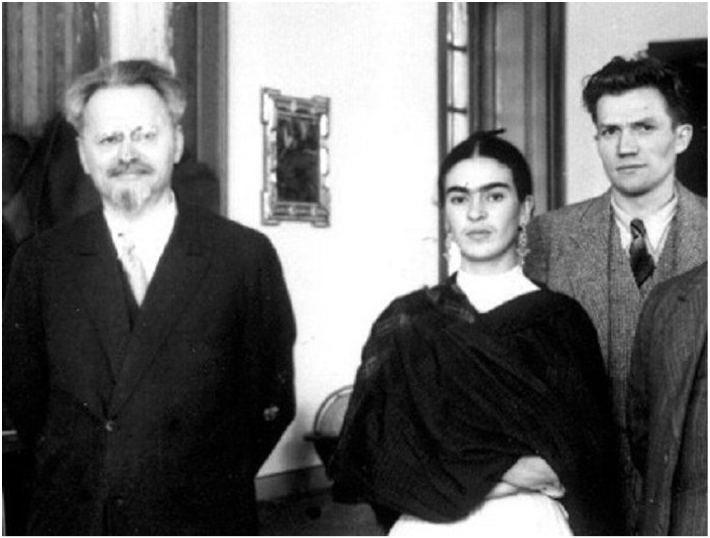
Trotsky, Frida Kahlo, and van Heijenoort
I suppose Schuringa might try to say that he omitted Van Heijenoort because he wasn’t really an analytic philosopher, but this isn’t any sort of credible claim, as van Heijenoort’s article on Frege (discussed above) shows. The papers in his Handbook were selected with the help of Quine, Burton Dreben, and Hao Wang. Although Van Heijenoort originally studied mathematics, he apparently got into the philosophy of math and logic via the influence of Wittgenstein’s student Georg Kreisel. He seems to have had connections with all of my grad school philosophy professors. Isaac Levi took a course from him at NYU. Sydney Morgenbesser befriended him and visited him in his home on Long Island. My advisor, Charles Parsons, wrote an introduction to a chapter in his collection on mathematical logic. van Heijenoort taught philosophy at Colombia, and then at Brandeis. What did he teach? We don’t know what he taught at Colombia, but we do have records of some of his courses at Colombia.From the 1971–72 Brandeis University Bulletin, Jean (listed there as John) van Heijenoort is explicitly named as instructor for:
PHILOSOPHY 15a – LogicPropositional calculus, quantification theory, satisfiability and validity, completeness, Löwenheim–Skolem theorem, many-sorted logic, theory of types.
Listed with: “See Linguistics Program and Mathematics 115a. Mr. van Heijenoort.”
PHILOSOPHY 171a – Frege“An intensive study of major themes in Frege’s philosophy. … Philosophy 15a or 115a not prerequisite but would be of great value in taking this course. Mr. van Heijenoort.”
Another strategy here would be to claim that van Heijenoort had abandoned the socialist cause by the time he took up philosophy in New York City.
This claim is typically based on two documents that he wrote. One is an essay in which he raked Engels over the coals for his bad take on non-Euclidean geometry, and the second, more important document, is an essay published in 1948, called “A Century’s Balance Sheet.” It was published under one of his many noms de plume – in this case, “Jean Vannier” – on the occasion of the 100th anniversary of the publication of Marx and Engels’ Communist Manifesto. It was also written in the wake of things going to shit in the Socialist Workers Party (SWP); his Morrow-Heijenoort-Goldman faction had lost to the faction led by James Cannon in 1946. Albert Goldman subsequently left the SWP in May 1946, and Felix Morrow was expelled in November 1946. At that point, van Heijenoort was done with the SWP, too.
van Heijenoort was done with the SWP, but was he done with radical socialism? Many argue that he was done with the SWP, with Marxism, with socialism, with all of it. This is certainly the view of the biographer, Anita Burdman Feferman. But a closer look at his own 1948 manifesto suggests that this is not what he said at all.
What van Heijenoort said is that “there is no necessary logical connection between Marx’s fundamental hypothesis and his economic doctrine,” where the fundamental hypothesis is something on the order of this: We can trust the proletariat to take us where we need to go.
Here is how van Heijenoort puts it:
Now this is a point that the commentators have never failed to emphasize; for most of them the Manifesto has in it all the certitude of natural science. Its fundamental hypothesis – that the proletariat can and must take the fate of society into its hands, snatch it from the catastrophe into which the bourgeoisie is leading it, and guide it toward communism – seems to them as solidly based, or nearly so, as the laws of motion governing the heavenly bodies. Without pausing to examine just what the modern physicist considers as truth in this domain, it is enough to observe that Neptune still follows the orbit marked out for it by Leverrier, whereas, unhappily, the course of the proletariat has, for more than a third of a century, been increasingly erratic. So much so that it is impossible today to shrug off the necessity of a systematic scrutiny of Marx’s fundamental hypothesis.
Two points here. First, van Heijenoort notes that it is an empirical hypothesis, and second, he claims it appears to be false. Why? Well, I suppose part of it has to do with the proletariat going in for Stalin, which was not the correct choice if you ask a Trotskyist (or anyone, honestly). But second, if the proletariat was all that it was cracked up to be, it would correct mistakes like this.
To seize and hold power the proletariat would have to demonstrate a minimum, a rather high minimum at that, of political capacity; more exactly, it would have to show a capacity to “secrete” a devoted and perspicacious leadership, to control that leadership, to change it with speed if the need arose – not thirty or forty years after a “betrayal." A capacity for handling such problems is precisely what being “fit for political power” means after all. Without that aptitude, the fundamental hypothesis cannot hold.
In other words, because the proletariat was not able to resolve mistakes like Stalin (a mistake of its own making at that), Marx’s fundamental hypothesis is refuted. Again, this is an empirical claim.
But all this leads us to the more important point, and the point that shows that van Heijenoort was not giving up on socialism. It is that “there is no necessary logical connection between Marx’s fundamental hypothesis and his economic doctrine.” Some people give up on socialism, others cling to the refuted hypothesis, but that is a false dichotomy. You can dump the fundamental hypothesis and continue the socialist project.
The problem of the fundamental hypothesis has provoked two opposed yet complementary attitudes. One attitude is to shun politics and to have no further aim than to forget as speedily and as completely as possible the years spent in the Marxist movement. The other is to take the fundamental hypothesis as an axiom and to refuse categorically to examine it. The two attitudes, one as false as the other, finally reinforce each other. It is the task of our reason, if this dilemma is ever to be resolved, to discover such possibilities of action as may exist, along with the most suitable means of realizing them.
In other words, it would be wrong to abandon socialism simply because the fundamental hypothesis is false; the task now is to discover alternative solutions. This leads to the following thought.
What is actually destroyed by the collapse of the fundamental hypothesis is the validity of an esoteric Marxist system standing in opposition to the totality of profane (read: bourgeois) knowledge. But that system was a construction of the Marxist epigoni rather than of Marx himself. Marx’s contribution should be considered in relation to our present body of scientific knowledge, and the value of any of its parts should then be determined by scientific criteria.
And that is a banger of a paragraph. For Marx, his project was scientific, and it was faithful to the science of his day. But that picture of science has ossified into an esoteric science that rejects anything that runs counter to it as “profane.” van Heijenoort’s point is that even socialism must be accountable to the realities of science. Marx himself saw it this way, even though his epigoni – a Marxist smack-talk reference, invoking the lesser sons of the Argive heroes of the first Theban war – could not see how conditions had changed.
Diego Rivera, Trotsky, Andre Breton, van Heijenoort.
This brings us to the most illuminating passage of van Heijenoort’s article:
The most to be hoped for by groups who claim to belong to the Marxist succession (I am not speaking of Stalinists, naturally) is for them to serve as a hyphen between past and future; to take in a way such a role as Buonarotti played between Babeuf and Marx.
This paragraph is the key to what van Heijenoort was thinking. It is a reference to Philippe (Filippo) Buonarroti’s book on Babeuf’s failed proto-communist uprising: Histoire de la Conjuration pour l’Égalité dite de Babeuf, suivie du procès auquel elle donna lieu (“History of the Conspiracy for Equality Called Babeuf, Followed by the Trial to Which It Gave Rise”), published in 1828. That book is a history or collection, documenting every ingredient of that revolutionary movement: the recruitment, its clandestine organization, the use of prints and songs, the infiltration by police spies, the arrests of Babeuf, Buonarroti and others, plus the long trial at Vendôme, plus Babeuf’s speech from the dock, and finally his execution. It also contained appendices with documents, manifestos, and letters from the conspirators. The book thus served as a resource for future revolutionaries like Marx.
The way van Heijenoort saw Buonarroti’s work is that it kept alive and systematized the memory and lessons of an earlier defeated revolution, so that it could feed into the theory and practice of a later, more developed socialist movement. And obviously, van Heijenoort is saying that his own revolution was defeated, and it was time for him to play the role of Buonarroti and preserve the record for future revolutionary movements. It was time to be an archivist, which is exactly what van Heijenoort became.
There is a famous passage in Archive Fever in which Derrida says that “there is no political power without control of the archive, if not of memory.” Van Heijenoort believed this as well, and he could hardly not have believed it based on his experience with Trotsky. They both knew that Stalin had plans to destroy Trotsky’s archive (and had already acted on it with some success), and they also knew that it was by virtue of having archival information that they were able to defend Trotsky against Stalin’s charges when the Dewey Commission met.
In the 1930s, when Trotsky was dealing with “the Moscow Trials,” he began speaking directly about his archives and the party’s archives as a terrain of political struggle. For example, in The Stalin School of Falsification, he explained that his book was built out of documents rescued from party archives, and pointedly said it is “not at all a volume for the archives; it is rather a weapon in the political struggle” on behalf of Marx and Lenin against the epigoni. When the NKVD (the forerunner of the KGB) broke into Trotsky’s Paris apartment and stole his papers, he explained why this mattered. In a 1940 letter, Trotsky wrote that no organization had a greater interest in destroying his archives than the NKVD, because those papers were proof of Stalin’s crimes and were crucial for the Dewey Commission’s exposure of the Moscow Trials as frauds. So, for Trotsky, the “archive of the movement” was not neutral storage; it was evidence in an ongoing civil war over the meaning of the revolution.
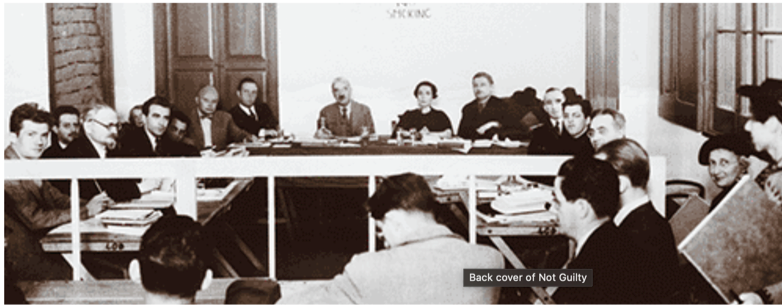
Dewey Commission hearings in Mexico. Van Heijenoort and Trotsky seated far left, Dewey seated center-left. Political joke not originally intended.
My concern here, and the reason I am banging on about it for so long, is because it seems very clear to me that while van Heijenoort believed he had been a participant in a defeated revolution, that did not mean he turned away from socialism. Like Buonarroti, he was serving as a bridge to the next revolution.
Just as importantly, it seems to me that whatever the nature of our revolutionary movement, even if it takes the form of philosophical revolution – whether successful or not – the critical thing is that we preserve the history of that movement. We cannot allow people like Schuringa to corrupt the historical record. If his plan actually is to flood the zone with shit, and if people get annoyed at our endless point-by-point responses, and even if they think it is excessive or mean or uncollegial, the record has to be preserved. In this respect, the greatest hero of the Vienna Circle may well turn out to be Rose Rand, who recorded numerous meetings and kept all the communications that came her way.
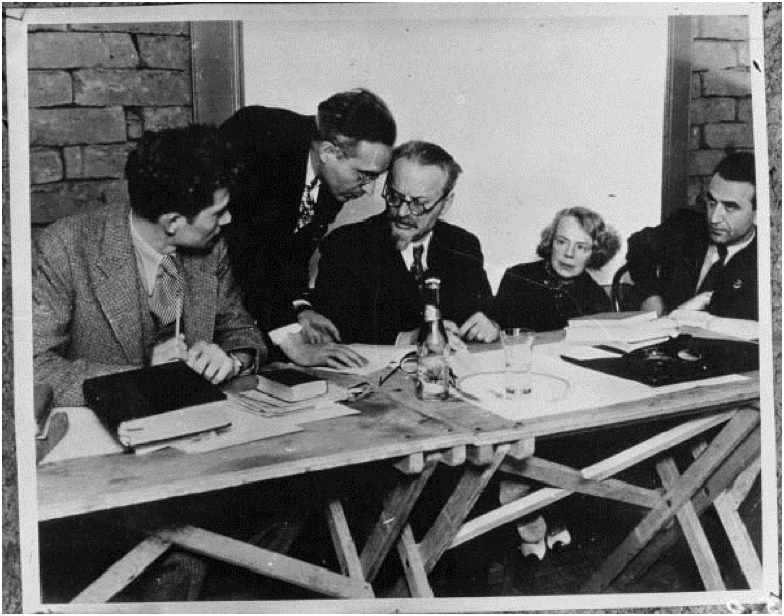
At the Dewey Commission hearings: van Heijenoort, Albert Goldman (acting as Trotsky’s lawyer), Trotsky, Natalia Sedova (Trotsky’s wife), Jan Frankel
Before we leave the topic of archives and their importance, I should take note of an article – a reminiscence of Trotsky – written by Pierre Broué, a French historian and Trotskyist who worked on the history of the Bolshevik Party, and wrote some biographies of Leon Trotsky. In 1977, he set up the Trotsky Institute to publish (in French) all of Trotsky's writings (27 volumes have been published). He also founded and edited the Cahiers Léon Trotsky, devoted to the history of Trotskyism. What is interesting is that in his essay written on van Heijenoort’s passing, he called van Heijenoort the eminence gris behind his archival projects.
Although he has always rejected being mentioned, he was, as I jokingly called him, “the gray eminence” or “the damned soul” of the Leon Trotsky Institute, the demanding inspirer and at the same time the irreplaceable advisor of the Works and the Cahiers Léon Trotsky. The work of the Institute, my personal works, owe him an enormity: unfortunately, he can no longer prevent us from saying so.
As Broué notes, van Heijenoort worked to suppress talk of his activities when he was alive. We don’t know everything that van Heijenoort was doing, apart from what he wanted the public and the state to see (for example, when he dimed out the Stalinists that had infiltrated the 4th International). The Mexican Trotskyists believed van Heijenoort was in contact with Molina. Was he? We may never know. Sometimes activism has to take place in the shadows, and van Heijenoort certainly had the opsec skills to work in the shadows.
But it has been 35 years since his passing. It is ok to talk about van Heijenoort’s project now – or at least what we know of it. So, the question is, why is Schuringa suppressing this story? It's troubling, really. We are supposed to have a social history of analytic philosophy but it is not really a history so much as an agenda, and when figures run counter to that agenda, their political activities are either underplayed, or the figures that don’t fit the agenda are written out of Schuringa’s history like Nikolai Yezhov, the “vanishing commissar” disappeared from the photo of him walking with Stalin along the Moscow–Volga canal.
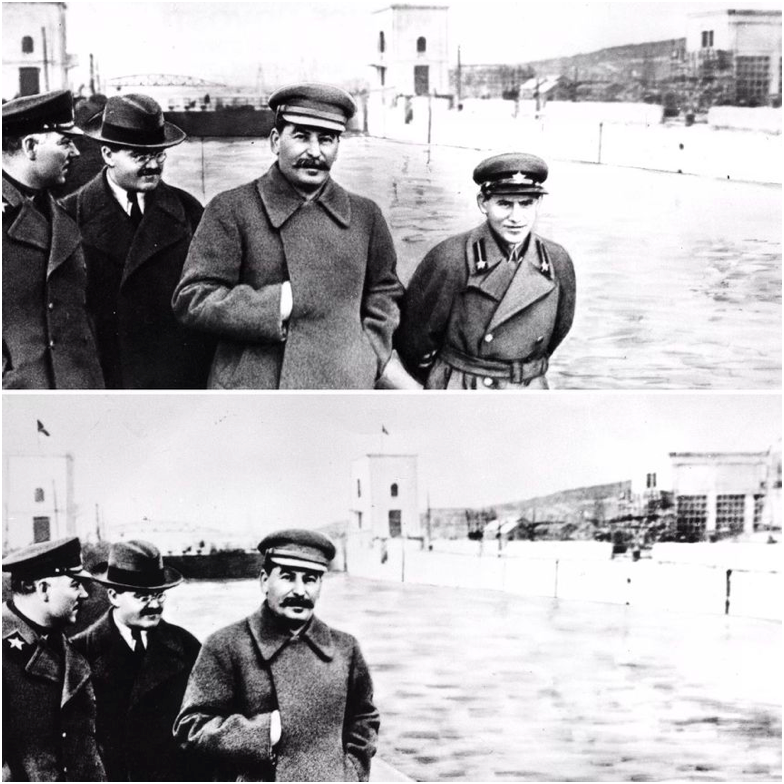
Comrade Yezhov disappears, like a lefty analytic philosopher written out of Schuringa’s book
One final note before we move on to another erased philosopher. For every star analytic philosopher we examine, there are less well-known but ones who are following in their footsteps. This is almost certainly the case with van Heijenoort, and I can give an example. In 1977, a van Heijenoort student named Irving Anellis earned a PhD at Brandeis, defending a thesis titled Ontological Commitment in Ideal Languages: Semantic Interpretations for Logical Positivism. Anellis went on to have a storied career, exploring many branches of logic and doing important historical work in logic. He discovered that Charles Sanders Pierce had discovered truth tables two decades before Wittgenstein wrote about them in the Tractatus, and he makes the case that Peirce, like Frege, had a logic-as-language approach to the foundations of logic. But there is another element to Anellis’s work that few know about. That unknown work appears in the journal Studies in Soviet Thought (where he published dozens of other articles/reviews), and in one article, he criticizes van Heijenoort for his 1948 publication. My point is that for every politically active analytic philosopher that we are allowed to see, there are others that we do not see, and behind those, even more that are unseen.
Noam Chomsky
While we are on the subject of analytic philosophers that get ignored by Schuringa, it is perhaps a good time to talk about Noam Chomsky, who is only mentioned in this book in the context of Chomsky’s review of Skinner’s Verbal Behavior. On what taxonomy is Chomsky not an analytic philosopher? He was trained in analytic philosophy and, using the tools and methods of analytic philosophy, he engaged critically with many of the leading figures of analytic philosophy, including Quine, Davidson, Kripke, Dummett, etc. He taught courses in philosophy at MIT. He was also a rabid critic of continental philosophy (more on that below).
A lot of philosophers I know would easily put him in the top 5 philosophers of the 20th Century. I can’t envision what the second half of 20th-century analytic philosophy would look like without Chomsky in the mix. The battles with Quine, Putnam, Searle, Burge, Dummett, Kripke were all classics, and his influence on analytic philosophy of mind and philosophy of language has been singular. None of which is to say I agree with him on everything or even most things philosophical.
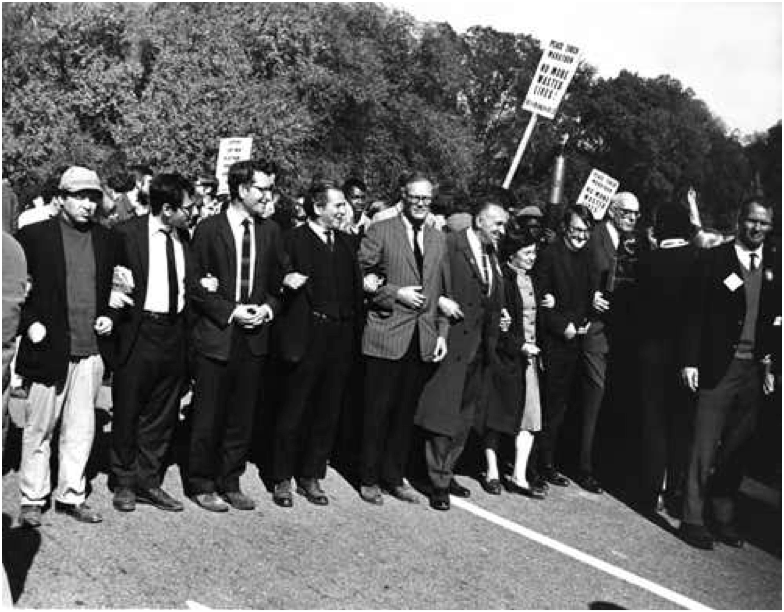
Chomsky(3rd from left) marching on the Pentagon.
This takes us to Chomsky’s politics. I don’t want to go into too much detail about Chomsky’s political views except to situate them, as best I can, based on a vast array of lectures and publications and online interviews, as well as a few private conversations. In short, Chomsky identifies as an anarcho-syndicalist. He thus advocates a strain of socialism that is identified with Emma Goldman, the aforementioned Anton Pannekoek, and Anarcho-syndicalist Spain (1936–39); it is bottom-up socialism, rather than top-down socialism of the type imposed by Lenin, Stalin, Mao, etc. In fact, Chomsky refuses to even call those efforts “socialism,” because workers did not control the means of production; some higher authority did. On the question of Trotsky, Chomsky believes that Trotsky was a good guy until 1917, and a bad guy thereafter. That is when, on Chomsky’s view, Trotsky switched from being a bottom-up socialist to a top-down “socialist.” There is a potted political bio for you!
This leads us to Chomsky’s take on continental philosophy post-1968; it is something like the inverse-Schuringa thesis. On Chomsky’s view, post-1968 continental philosophy has been counterrevolutionary. And this has been due to its tendency towards what he views as obfuscation, and the idea that it has taken its eye off what should still be a principal concern of the left – economic justice.
Chomsky’s Critique of post-1968 continental philosophy
The quotes that follow are reported to have originated in conversations in 1995 on an online bulletin board maintained by Z-Magazine. They are certainly consistent with what I have heard him say in public lectures and in conversation in the mid-1980s. These conversations are sometimes cited in the literature as (1995) “Noam Chomsky on post-modernism.” Post on LBBS, Z-Magazine’s Left On-Line Bulletin Board, and they are currently available on an active link here.
The first point of note is that Chomsky takes a dim view of what is popularly called “theory.”
As far as I do think I understand it, the debate was initiated by the charge that I, Mike, and maybe others don’t have “theories” and therefore fail to give any explanation of why things are proceeding as they do. We must turn to “theory” and “philosophy” and “theoretical constructs” and the like to remedy this deficiency in our efforts to understand and address what is happening in the world. I won't speak for Mike. My response so far has pretty much been to reiterate something I wrote 35 years ago, long before “postmodernism” had erupted in the literary intellectual culture: “if there is a body of theory, well tested and verified, that applies to the conduct of foreign affairs or the resolution of domestic or international conflict, its existence has been kept a well-guarded secret,” despite much “pseudo-scientific posturing.”
To my knowledge, the statement was accurate 35 years ago, and remains so; furthermore, it extends to the study of human affairs generally, and applies in spades to what has been produced since that time. What has changed in the interim, to my knowledge, is a huge explosion of self- and mutual-admiration among those who propound what they call “theory” and “philosophy,” but little that I can detect beyond “pseudo-scientific posturing.” That little is, as I wrote, sometimes quite interesting, but lacks consequences for the real world problems that occupy my time and energies.
Two observations here. The first is that Chomsky believes that moral and political action can and should flow from what is obviously the correct thing to do. You don’t need fancy theories to understand what must be done. Second, what is produced and labelled “theory” has nothing to do with theory as it is understood by scientists. The word “theory” suggests to Chomsky that there are testable empirical predictions that flow from the theory. So, the word “theory” has been borrowed (misappropriated, in his view) to lend gravitas and credibility to what is pseudo-scientific posturing.
The next part of his criticism stems from what he considers the unintelligibility of work by figures such as Derrida.
As for the “deconstruction” that is carried out (also mentioned in the debate), I can't comment, because most of it seems to me gibberish. But if this is just another sign of my incapacity to recognize profundities, the course to follow is clear: just restate the results to me in plain words that I can understand, and show why they are different from, or better than, what others had been doing long before and have continued to do since without three-syllable words, incoherent sentences, inflated rhetoric that (to me, at least) is largely meaningless, etc.
Then there is this, which I think is the part that really gnaws at Chomsky.
[T]here is no effort that I am aware of to make it intelligible to the great mass of the population (say, to the people I'm constantly speaking to, meeting with, and writing letters to, and have in mind when I write, and who seem to understand what I say without any particular difficulty, though they generally seem to have the same cognitive disability I do when facing the postmodern cults). And I'm also aware of no effort to show how it applies to anything in the world in the sense I mentioned earlier: grounding conclusions that weren't already obvious. Since I don't happen to be much interested in the ways that intellectuals inflate their reputations, gain privilege and prestige, and disengage themselves from actual participation in popular struggle, I don't spend any time on it.
This then leads to the claim that the listeners may not have the correct “frame of reference” to understand what is being said, but Chomsky’s response is that while this is true, the people who don’t have the “right frame of reference” are not ordinary people with their social and economic problems, but the intellectuals that have been hyper-indoctrinated to the point that they cannot understand plain language about the suffering of other people and the available political solutions to that suffering.
Johnb made the point that “plain language is not enough when the frame of reference is not available to the listener”; correct and important. But the right reaction is not to resort to obscure and needlessly complex verbiage and posturing about non-existent “theories.” Rather, it is to ask the listener to question the frame of reference that he/she is accepting, and to suggest alternatives that might be considered, all in plain language. I've never found that a problem when I speak to people lacking much or sometimes any formal education, though it's true that it tends to become harder as you move up the educational ladder, so that indoctrination is much deeper, and the self-selection for obedience that is a good part of elite education has taken its toll.
Finally, Chomsky makes a point that should bring us back to the projects of the members of the Vienna Circle, engaged in adult education in Red Vienna, or the public lectures given by Susan Stebbing. Why has the left abandoned projects like that? His concluding words, written 30 years ago, seem prophetic.
A final point, something I've written about elsewhere (e.g., in a discussion in Z papers, and the last chapter of Year 501). There has been a striking change in the behavior of the intellectual class in recent years. The left intellectuals who 60 years ago would have been teaching in working class schools, writing books like "mathematics for the millions" (which made mathematics intelligible to millions of people), participating in and speaking for popular organizations, etc., are now largely disengaged from such activities, and although quick to tell us that they are far more radical than thou, are not to be found, it seems, when there is such an obvious and growing need and even explicit request for the work they could do out there in the world of people with live problems and concerns. That's not a small problem. This country, right now, is in a very strange and ominous state. People are frightened, angry, disillusioned, skeptical, confused. That’s an organizer's dream, as I once heard Mike say. It’s also fertile ground for demagogues and fanatics, who can (and in fact already do) rally substantial popular support with messages that are not unfamiliar from their predecessors in somewhat similar circumstances. We know where it has led in the past; it could again. There's a huge gap that once was at least partially filled by left intellectuals willing to engage with the general public and their problems. It has ominous implications, in my opinion.
Just to connect the dots, Chomsky was saying, in 1995, conditions were fertile ground if we wished to engage people in social action, but it was also an opportunity for “demagogues and fanatics” if the left did not accept its responsibility to speak plainly to the people, their problems, and their concerns. 30 years on, it appears that this responsibility was not accepted, and we are witnessing the consequences today.
Of course, you can’t blame just continental philosophers here, as though they were the only ones that had this responsibility. Analytic philosophers have precisely the same level of responsibility. Everyone failed.
And let’s be clear. Chomsky isn’t criticizing continental philosophy tout court; he is criticizing a certain form of continental philosophy that we might call post-1968 continental philosophy, and it isn’t even the philosophy that he is criticizing – it is the lack of direct engagement.
What happened to continental philosophy? We think of the radical leaders of continental philosophy, and we think of figures like Sartre, Camus, Simone de Beauvoir, and the philosopher/mathematician Jean Cavaillès. They were all key figures, first in the French resistance during WWII, and then (the survivors) pushing progressive economic issues after the war. But that isn’t what much of continental philosophy looks like today. Forget about post-modern philosophy and its obscurity. The bigger problem is that the left has been swamped by the “nouveaux philosophes” – anti-Marxists like Bernard-Henri Lévy, André Glucksmann, Alain Finkielkraut , Guy Lardreau and Christian Jambet.
Not your father’s French Philosophers. Above, Simone de Beauvoir and Jean Paul Sartre protesting. Below: nouveaux philosophes Bernard-Henri Lévy and André Glucksmann chum it up with French Ministers Rama Yade and Bernard Kouchner after their meeting with President Sarkozy at the Élysée Palace in Paris on November 24, 2007.
So, how did this happen? Chomsky offers another way to think about that question. Why was post-modern philosophy allowed to happen, whereas other forms of philosophy might not have been allowed? Chomsky’s idea is that postmodernism, and its obsession with theory, has “worked as a way of insulating sectors of a kind of radical intelligentsia from popular movements rather than actual activism and it served as an instrument of power.” He then says he “suspect[s] that's the reason why it is so readily tolerated in the universities. It's all over the place. In the third world as well because of the function it serves.”
Chomsky is suggesting that centers of power hold the killswitch to silence certain forms of philosophical discourse, should they choose to do so (see the Cold War silencing of the Unity of Science Project). But in this case, they did not choose to use the killswitch. Why is the pomo stuff “tolerated?” In Chomsky’s view, it was “because of the function it serves.” And that function is to undermine the left’s pursuit of economic justice and its ability to organize popular movements in support of that goal.
Does this sound tinfoil-hat crazy to you? Well, get ready to have your hair catch on fire, because recent FOIA requests have yielded a document from the CIA dated Dec 2, 1985, showing that this is exactly what happened. The CIA was aware of what was going on and was just as pleased as punch with what they saw, and they recorded their glee in a document entitled “FRANCE: DEFECTION OF THE LEFTIST INTELLECTUALS."
The CIA likes what it sees!
The CIA document is available online in the CIA’s “reading room”, and there is also a summary of the document by the continental philosopher Gabriel Rockhill, (He teaches at Villanova University and Graterford Prison, and he directs the Critical Theory Workshop at the Sorbonne). His summary and analysis appears in The Philosophical Salon, and is entitled “The CIA Reads French Theory: On the Intellectual Labor of Dismantling the Cultural Left.”
Some passages from his summary:
Although the right had been massively discredited because of its direct contribution to the Nazi death camps, as well as its overall xenophobic, anti-egalitarian and fascist agenda (according to the CIA’s own description), the unnamed secret agents who drafted the study outline with palpable delight the return of the right since approximately the early 1970s.
It is in this context that the masked mandarins commend and support the relentless critique that a new generation of anti-Marxist thinkers like Bernard-Henri Levy, André Glucksmann and Jean-François Revel unleashed on “the last clique of Communist savants” (composed, according to the anonymous agents, of Sartre, Barthes, Lacan and Louis Althusser). Given the leftwing leanings of these anti-Marxists in their youth, they provide the perfect model for constructing deceptive narratives that amalgamate purported personal political growth with the progressive march of time, as if both individual life and history were simply a matter of “growing up” and recognizing that profound egalitarian social transformation is a thing of the—personal and historical—past. This patronizing, omniscient defeatism not only serves to discredit new movements, particularly those driven by the youth, but it also mischaracterizes the relative successes of counter-revolutionary repression as the natural progress of history.
As Rockhill notes, the CIA not only are fans of Bernard-Henri Levy, André Glucksmann and Jean-François Revel, but the Agency positively adores Foucault.
They cite in particular the profound contribution made by the Annales School of historiography and structuralism—particularly Claude Lévi-Strauss and Foucault—to the “critical demolition of Marxist influence in the social sciences.” Foucault, who is referred to as “France’s most profound and influential thinker,” is specifically applauded for his praise of the New Right intellectuals for reminding philosophers that “‘bloody’ consequences” have “flowed from the rationalist social theory of the 18th-century Enlightenment and the Revolutionary era.” Although it would be a mistake to collapse anyone’s politics or political effect into a single position or result, Foucault’s anti-revolutionary leftism and his perpetuation of the blackmail of the Gulag—i.e. the claim that expansive radical movements aiming at profound social and cultural transformation only resuscitate the most dangerous of traditions—are perfectly in line with the espionage agency’s overall strategies of psychological warfare.
The CIA absolutely loves Foucault. Screenshot from their “research paper.”.
Rockhill concludes by noting the uptake of French theorists in the anglophone world as coming with a “radical chic veneer” that is supposed to make it seem to “far surpass” to the crusty old socialism of Sartre and Marcuse.
The CIA’s reading of French theory should give us pause, then, to reconsider the radical chic veneer that has accompanied much of its Anglophone reception. According to a stagist conception of progressive history (which is usually blind to its implicit teleology), the work of figures like Foucault, Derrida and other cutting-edge French theorists is often intuitively affiliated with a form of profound and sophisticated critique that presumably far surpasses anything found in the socialist, Marxist or anarchist traditions.
The consequences of this are what you might expect: the left has sidelined itself, and imperial projects march on without resistance.
According to the spy agency itself, post-Marxist French theory directly contributed to the CIA’s cultural program of coaxing the left toward the right, while discrediting anti-imperialism and anti-capitalism, thereby creating an intellectual environment in which their imperial projects could be pursued unhindered by serious critical scrutiny from the intelligentsia.
At this point Rockhill shows that he’s not any sort of analytic philosopher because he says that this new French “theory,” total shit though it may be (on his view), at least “had important political implications as a pole of resistance to the false political neutrality, the safe technicalities of logic and language, or the direct ideological conformism operative in the McCarthy-supported traditions of Anglo-American philosophy,” thus buying into the line of McCumber and Schuringa about the politics of analytic philosophers.
But following the evidence presented in the essay/review, this “pole of resistance” would be an error and not a feature of French theory, for the charges against analytic philosophy are blatantly false, and because French Theory’s intentional obscurity and radical chic veneer pushed away natural allies in analytic philosophy – Chomsky being a case in point. In other words, the Theorists were optimal agents in the service of the CIA’s goals because they not only moved French intelligentsia away from economic critique and popular economic movements, but they also helped fracture what could have been a unified philosophical movement in the service of a shared political cause.
Now I’m not placing blame on continental philosophers here. Cooperation and communication require two willing parties and they also require effort. Chomsky, who just celebrated his 97th birthday, is past those sorts of efforts, and honestly, he was never that great at it in the first place. But others, I believe, are willing and able to cope with the idea that, in some hands, “theory” doesn’t mean what it means in Chomsky’s “theory of generative grammar.” Communication is possible.
Look, the two traditions are not that far apart. Chomsky, it must be noted, never said, in the Z-Magazine bulletin board posts quoted above, that Foucault said something false. He thought that, for the most part, Foucault was offering a lot of “truisms” (truisms that Chomsky felt he had been saying for 30 years). His objection is that Foucault was dressing it up in a whole bunch of bullshit about “theory,” and he objected to this because it was not speaking to the people that would benefit from the message and was not helping to organize anybody. In this, Chomsky was perhaps the last of the positivists, in the sense that he fervently believed in their efforts to bring the message to the people, like Neurath, Hahn, Rand and others had in Red Vienna.
A final note. There are, of course, Marxists that are having none of the continental philosophy stuff, even from the OG philosophers like Sartre, etc. In their view, pointy-headed intellectuals of any stripe are not a sound source for Marxist doctrine. So, for example, we have the following passage from Joshua Sykes, writing in Fight Back! News.
An important factor in the development of postmodernism, therefore, was the trend in philosophy known as “Western Marxism.” This group of philosophers, largely from western Europe, from Karl Korsch and György Lukács and Jean-Paul Sartre, all largely carried out, in one way or another, a reversal of Marx’s eleventh thesis on Feuerbach, which demanded that theory’s source and aim was revolutionary practice.
Instead, these Western Marxists worked to divorce Marxism from the practical struggles of the working class and retreated into the academic ivory tower. Furthermore, as the Western Marxist academic Perry Anderson notes in his book In the Tracks of Historical Materialism, they each attempted to merge Marxism with elements of non-Marxist (metaphysical and idealist) philosophy, such as with Martin Heidegger’s metaphysics or with Jacques Lacan’s psychoanalytic theories. The result was a muddle, and by the 1970s most of Western Marxism was engaged in self-obsessed navel-gazing or had become narrowly preoccupied with cultural criticism and aesthetics. No wonder this is the “Marxism” promoted in the universities of the imperialist countries.
Here is the most interesting thing about that quote. You will notice that in the middle of it, there is a reference to Perry Anderson’s 1983 book, In the Tracks of Historical Materialism.I’m pretty sure Sykes is reading things into Anderson that aren’t there, but certainly Anderson does have reservations about the new French intellectuals.
Actually “reservations” is a mild way to put it, as Anderson definitely drops the hammer and sickle on them:
Today, Lévi-Strauss speaks of Marxism as a totalitarian threat even to the animal kingdom; Foucault applauds the literature of gulagism; Sollers and Kristeva of Tel Quel have rediscovered the virtues of Christianity and capitalism. Conservative or collusive as these positions may be, they have little actual edge or weight. It is less their iniquity than their fatuity that is striking. Reflections of a political conjuncture in an essentially unpolitical thought, they can alter again when the conjuncture alters.
Cold. What is interesting for our purposes is that Perry Anderson does come up in Schuringa’s book, but in the context of an essay that Anderson wrote as a 19-year-old undergraduate student at Oxford University, which took issue with the ordinary language philosophy then being conducted at Cambridge (circa 1957). What Schuringa does not observe, or apparently did not want to report, is that mature Anderson did not have any particular love for postmodern continental philosophy either – particularly when fused with Marxism – and, as we saw, he dumps all over that unholy fusion in his book. But in the midst of this sea of philosophical despair, Anderson finds at least one bright light.
“[I]n philosophy G. A. Cohen’s Karl Marx’s Theory of History—A Defence, bringing for the first time the procedural standards of analytic philosophy to bear on the basic concepts of historical materialism, is clearly the landmark of the decade.”
That would be the analytic Marxist, G.A. Cohen that Schuringa dismisses without argument, but with a sneer.
Now my point here is not that analytic philosophy is somehow better than continental philosophy at understanding or shaping or executing Marxism, anarcho-syndicalism, or any other radical progressive movement. It is rather to reject the counter-thesis that analytic philosophy cannot do any such thing, whereas continental approaches more naturally can. Both traditions leave plenty of room for radical thought and action, should you choose to move in that direction. By the same token, both have the resources to allow you to cosplay as a radical even if the reality is that you are, in Anderson’s words, “conservative or collusive.”
Who is paying the piper now?
In the CIA “research paper” cited above, there is much applause for the new French intellectuals, but there is no evidence that, in 1985, the CIA was actively involved in funding the new intellectual movement. They mostly seem to be delighted that it fell into their lap for free. But that doesn’t mean that money wasn’t coming from somewhere in the empires of the West, whether governments or corporations, or from billionaires with skin in the game. And we have to ask this question because we know that in the past, the CIA has funded anti-left cultural movements. We have already looked at one such case: The Congress for Cultural Freedom, which sucked money away from the Unity of Science projects in the 1950s. But if we look at the CCF then we also need to take a closer look at funding that streams towards analytic philosophers, beginning with the aforementioned role of RAND funding research by Quine, Davidison, Reichenbach, and others.
We begin with a closer look at the case of the CCF. We already discussed a bit about the origins of the CCF when we discussed Sidney Hook urging Carnap to support a conference on World Peace. We also discussed the CCF in the context of the Rockefeller Foundation preferring to give money to the CCF instead of the “Vienna Boys,” but ultimately, it seems, not all the money was flowing from the Rockefeller Foundation, and quite a bit of it was coming from the CIA (although sometimes funneled through funding agencies like the Ford Foundation). And we know this because in 1967, the curtain was pulled back on the operations of the CCF, and honestly, even the people with tinfoil hats had not seen this one coming. The whole business is written up in a book by Frances Stonor Sauders called Who Paid the Piper?
The revelations began when Ramparts magazine published an exposé in March 1967 about the CIA’s secret funding of the National Student Association (NSA, but not that NSA). The article documented the CIA’s elaborate funding network through various foundations. That information came from an insider source – a former NSA (not that NSA) official named Michael Wood, who had records not just about the NSA, but other related fronts that the CIA had established. Wood had given the information to Ramparts despite pleas from other NSA officers who argued that exposing the story would hurt both the NSA and the “enlightened wing” of the CIA.
When Ramparts learned that the NSA was about to preempt their story by announcing it had severed CIA ties, its infamous eye-patch-wearing editor, Warren Hinckle, purchased a full-page ad in the New York Times that detailed most of the exposé before the March 1967 issue even came out.This was quickly followed by a massive investigation by corporate media, driven by Tom Wicker at the New York Times, who assembled a team of reporters to follow the money trail from the CIA-connected foundations named in the Ramparts article. The Washington Post jumped in with its own reporting team. Turning up new connections almost every day, the newspapers described how legitimate tax-exempt foundations laundered millions of dollars from the CIA.
Some of you who are old enough may remember a CNN show called Crossfire. Some of the early versions of that show featured a “liberal,” Tom Braden, squaring off against a conservative – alternatively Pat Buchanan or Bob Novack. What you may not have known was that Braden was an ex-CIA officer, and, adjust your tinfoil hats, people, he was the guy at the CIA running this whole CCF business. I shit you not. You don’t have to take my word for it. He said so himself!
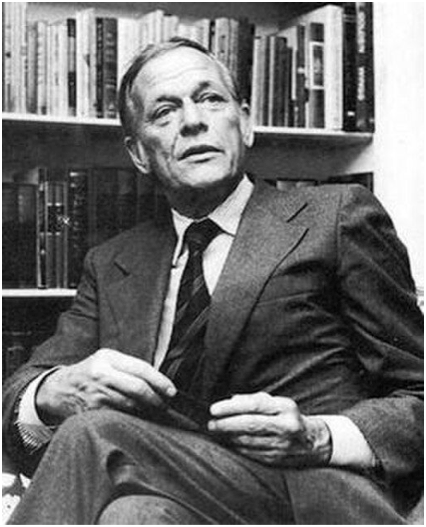
Tom Braden, the man behind the curtain.
In May 1967, Braden, the onetime head of the CIA's International Organizations Division, tried to respond to these revelations, writing an article published in the Saturday Evening Post, with the eye-grabbing title: “I'm Glad the CIA is 'Immoral'.” Braden admitted that for more than 10 years, the CIA had subsidized magazines like Encounter through the Congress for Cultural Freedom, and that one of its staff was a CIA agent, embedded within the CCF. His article was not an apology. He made it very clear that he was proud of his (“immoral”) accomplishment. His words:
I remember the enormous joy I got when the Boston Symphony Orchestra won more acclaim for the U.S. in Paris than John Foster Dulles or Dwight D. Eisenhower could have bought with a hundred speeches. And then there was Encounter, the magazine published in England and dedicated to the proposition that cultural achievement and political freedom were interdependent. Money for both the orchestra's tour and the magazine's publication came from the CIA, and few outside the CIA knew about it. We had placed one agent in a Europe-based organization of intellectuals called the Congress for Cultural Freedom. Another agent became an editor of Encounter. The agents could not only propose anti-Communist programs to the official leaders of the organizations but they could also suggest ways and means to solve the inevitable budgetary problems. Why not see if the needed money could be obtained from “American foundations”? As the agents knew, the CIA-financed foundations were quite generous when it came to the national interest. [my emphases]
The CIA has subsequently authored an internal document confirming all of this, entitled “Origins of the Congress for Cultural Freedom, 1949-1950.” Like Braden, they expressed pride in the operation (albeit addressing CIA operatives, not the public), noting that it was “widely considered one of the CIA’s most daring and effective Cold War covert operations.” Their document also showed the enormous role that Sidney Hook played in the birth of the CCF, and the key role that the Waldorff conference played in triggering this (again, recall the hostile Hook-to-Carnap letter).
CIA’s own history of how they started the CCF.
All of this leads to the question of what they were funding and why, and that is a long story in which there are plenty of both analytic and continental philosophers who were caught up in CCF activities. The central theme was to establish a “non-communist left.” They thus enlisted all sorts of academics who were left-wing, but who were not fans of the Soviet Union. Their founding meeting in Berlin in 1950 was attended by Karl Jaspers, John Dewey, Bertrand Russell, and Jacques Maritain. Benedetto Croce was an “honorary president.” Their money funded plenty of left-wing causes, including Isaiah Berlin’s Non-Communist Left (NCL), which was promoted through the CCF. This was certainly a dark period for Bertrand Russell who only broke off his ties with the organization in 1956, when he began campaigning for nuclear disarmament.
It is doubtful that many of the philosophers knew the source of their money, but everyone – continental and analytic alike – ended up looking dirty. Of course, some people knew exactly what was going on, including Sidney Hook, who the CIA featured by beginning their history of the CCF, using a quote from Hook as an epigraph. On the continental side, the Hook counterpart was the famous anti-Marxist and former Sartre college roommate (you cannot make this shit up!) Raymond Aron, who in turn appears to have acquired a tight relationship with Tom Braden’s embedded CIA agent Michael Josselson. Josselson, for his part, arranged funding (including CIA pass-throughs), recruited and networked intellectuals, and orchestrated journals, conferences, and exhibitions across 30 or more countries. Josselson was a kind of “fixer” and was credited with bringing in figures like Arthur Koestler, André Gide, Michael Polanyi, etc., to wage a “war of ideas” against communism under the banner of “cultural freedom.”
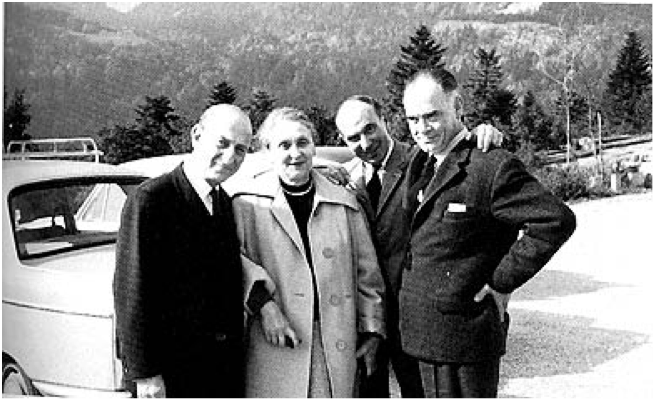
Anti-Marxist French philosopher (and former Sartre college roomie) Raymond Aron (left) and his wife Suzanne on vacation with CIA agent Michael Josselson and CCF executive Denis de Rougemont (right).
As I said, everyone looks bad here, and every type of philosopher was roped into the mess: existentialists, pragmatists, phenomenologists, idealists, religious philosophers, analytic philosophers, and on and on.
All of this raises the inevitable question: Could this be happening again? Is someone, right here, right now, funding philosophical research to some hidden political end? We may never know. But the most honest take is that all money is dirty money here. Even if your money is coming from your university’s general fund, that money is, to some degree, beholden to the interests of alumni donors and, if state funding is involved, the political interests of the state (a phenomenon that we witnessed in Trump’s recent campaign against elite universities).
It is pointless to get into disputes about whose money is dirtier. The correct strategy is to understand the source of your own money and to be reflective about the fundamental interests of that source of money and the ways in which it is coercive and deflecting your work from where it otherwise might have gone. Even if you are independently wealthy or somehow living in a communist paradise and have no need for remuneration, you are still beholden to the system that allows you to live as you do. It does not hurt to be mindful of how that steers your work.
This is also a good time to turn to the issue of the philosophers at RAND, and the question of whether the money they accepted was coercive or otherwise immoral. Into this bucket we can also place the funding that Chomsky received from the Office for Naval Research (ONR) and, later, from the defense department’s Advanced Research Projects Agency (ARPA, later to become DARPA, which, among other things, gave us the Internet). If you read Chomksy’s early linguistic work (e.g., Aspects of the Theory of Syntax), you will find footnotes acknowledging funding from the ONR.
Chomsky has, unsurprisingly, taken some heat for this funding and has responded in the following way. First, it was basic science research. In the 1950s – 60s, the Office of Naval Research was one of the few places in the U.S. government that would just give fairly open-ended grants to do foundational work in math, linguistics, psychology, and computation. MIT was of course full of that money. If you were at MIT, you were getting that money either directly or indirectly (still true today). Chomsky’s point was that the funding agencies weren’t asking him to build weapons or even develop strategies; they were funding theoretical work in basic science. Second, this was research that he could publish freely. I suppose one could also add that it was better for the money to go to his research than to developing new kinds of napalm.
Are these answers adequate? There is an article and a book about this by Chris Knight, and he argues that the answers from Chomsky and others are not adequate. But it seems to me that Knight’s thesis rests on the dubious premise that Chomsky’s linguistic work in the 1960s had direct military applications. It didn’t, even if people in the DoD might have said otherwise. This is a rare topic area in which I am somewhat qualified to speak, because I spent 1983-1985 at MIT as a visiting scholar in linguistics, and then worked as a contract engineer for a defense contractor (Honeywell) in 1985-1986. Honeywell sent me around the world to study existing natural language processing and machine translation technologies. Their interest was in enlisting machine translation to help with translating documents like service manuals for thermostats, not telling airplanes what to do. Even then, it was clear that theoretical linguistics was a long way from being useful for natural language processing, much less being useful for defense industry applications. Chomsky’s project wasn’t an engineering project; it was a basic science project. Some would say that Chomsky’s work was never going to be useful to that end, and now has been superseded by work on large language models, which are better equipped for any form of natural language processing applications. All this has been said, I have no issue with people raising this issue, and I have linked to Knight’s article above. It is always ok to question the source of your money. I’m just saying Knight is not correct about the applications of Chomsky’s linguistics work.
This takes us to the philosophers who worked for RAND during the Cold War. I’ll begin with the research that was classified at the time, and I suppose the work that has the bullseye on its back involves the two then-classified papers that Reichenbach produced in 1949 – “General Form of the Probability for War” (RAND D-515) and Rational Reconstruction of the Decision for War” (RAND D-539). Now, to be clear, I think it is entirely fair game to criticize this sort of work, in part because it was originally classified. But I also think that the criticism should be accurate, because hallucinated or otherwise invented pictures of what Reichenbach was up to are not going to be helpful.
When you read Schuringa, you get the idea that Reichenbach was a regular Doctor Strangelove. But it is surely not accurate to say, as Schuringa does, that “Reichenbach was, ostensibly, attempting to lay the groundwork for real-life calculations to be made in the supposedly always impending war with the Soviet Union.” A more accurate characterization of the work was that the Pentagon wanted to model Soviet doctrines in a kind of decision tree, assigning probabilities of them acting on each doctrine (or combination of doctrines), so that one might know what actions could unwittingly trigger World War III. That is, the paper had nothing to do with calculations to be made in a war, but calculations to be made so as to avoid a war. This is somewhat obvious from the titles of the papers themselves.
Hans Reichenbach and Dr. Strangelove. Not the same project.
Now, there are two ways to look at this. The positive way is to say that the work helped us to unwittingly trigger a nuclear holocaust. The negative way is to say that this work could be used to understand just how far we could push the Soviet Union before a nuclear response was triggered (e.g., would a blockade of Cuba trigger a nuclear response?). Thus, it could have enabled riskier actions by the US. What we don’t know is how decision-makers utilized this information or if they used it at all. What we do know is that it is consistent with the basic work that the philosophers were doing at RAND – reasons were causes, etc. In this case, if you give the Soviets the right reasons, you may be causing World War III. Again, it is a perfectly good topic on which to have an ethical debate. But please, for the sake of all that is holy, can Schuringa please stop inventing a bunch of bullshit about it?
All this being said, absolutely any scientific discovery and any new technology can be useful to the defense industry, even if it involves building superior toilets and refrigerators. And for that matter, absolutely any domain of human creativity can be deployed as a “weapon” in asymmetric warfare – even the Boston Symphony Orchestra, as Tom Braden observed. Everyone receiving funding through the CCF had been weaponized during the Cold War.
Right here, right now, I am not in the business of judging the ethics of where people get their funding. For now, I am just calling for mindfulness, noting again that almost all money is dirty at its source, and that any product of human ingenuity and human creativity can be weaponized.
With this happy thought in the background, let’s return to those RAND philosophers. Were they war-gaming for the Pentagon? It would be more accurate to say that they were engaged in basic science, but a form of basic science that was clearly of interest to the Pentagon. What Davidson Suppes, and McKinsey were doing was working within a new branch of science – modern choice theory and the beginnings of experimental decision theory. And it was not a science solely of interest to generals and admirals. Nor was it the creation of these philosophers alone. Sorry to say, but there were bigger contributors, such as von Neumann, Savage, Arrow, Nash, and Harsanyi. The work of the RAND philosophers became part of the background of choice theory.
Of course, although their work was of interest to the Pentagon, it was also of interest to everyone else, because everyone is interested in how to make better decisions, even Marxists! This is perhaps not shocking, given that Davidson himself was a Marxist, and I find it hard to believe that Reichenbach did not retain any socialist sympathies from his earlier days in Berlin. I don’t know the politics of McKinsey, but it is worth noting that he was fired from RAND for being gay, and then took his life a few years later. Whatever the political inclinations of the RAND philosophers, either directly or indirectly, they ultimately influenced rational-choice Marxism/analytic Marxism
Jon Elster, John Roemer, Adam Przeworski, Erik Wright, Jerry Cohen, and others used the tools of analytic philosophy along with choice theory and game theory to reconstruct Marxist themes like class, exploitation, collective action, and socialist strategy. Their primary hope was that once Marxist claims were given clear microfoundations, you could explain how individually rational behavior would generate the kind of class-wide political agency Marx predicted. However, much of the modeling revealed something else: it highlighted free-riding, coordination problems, reformist equilibria, and incentives that don’t reliably produce revolutionary proletarian action. Przeworski used the term “autophagia” to characterize what happened to the analytic Marxist project: Once you apply strict rational-choice, game-theoretic tools to classical Marxist claims, those very tools end up undermining the Marxist predictions they were meant to vindicate. The research program thus ended up dissolving Marx’s teleology rather than vindicating it, and the “analytic Marxism” project eventually fragmented as its practitioners moved into adjacent work.
Earlier in this review/essay, I spent a lot of time talking about van Heijenoort’s 1948 essay in which he expressed despair at the “increasingly erratic” behavior of the proletariat. That failure, in his view, refuted Marx’s fundamental hypothesis. If he was correct, we might say that the contribution of the analytic Marxists is that they showed why the fundamental hypothesis failed. They showed that what might be the rational outcome for a group may not be consistent with the rational behavior of individual members of the proletariat. There is no point in poo-poohing this result as methodologically defective, as Schuringa does, for there is no reason to reject the method other than the thought that it runs counter to what Marx predicted. But that is not a methodology. Or if it is a methodology, as van Heijenoort said, it is the methodology of the epigoni. Marx utilized the science of his day, just as any serious revolutionary movement must.
So here we are. As van Heijenoort observed, the central hypothesis had been refuted. We now know why it was wrong. That is progress. The question is, what comes next?
Part of the problem that the radical left faces is that there is a strain of technophobia that runs through it, with the result that it is forever “outgunned” by the technophiles of the right. There are paths forward, however, if the technophobia can be brought under control. One line of investigation would be to revisit the anarchism of figures like Bakunin, who foresaw the centralizing tendencies of Marxism. The challenge for any anarchist movement is the problem of coordination, but recent developments in blockchain technology have shown that technologies exist that enable decentralized yet coordinated activities. The technology isn’t just about cryptocurrencies. It is about coordinating human activities without top-down leadership. Whether such technologies are useful to anarcho-socialism is an open question, but such ideas are being pursued and even discussed online on platforms like Blockchain Socialist. My point here is not that this must be the future but that it is a possible path forward, and that progressives should not let technophobia rule out the exploration of technologies that enable decentralized yet cooperative action. (Full transparency, I have worked part-time for a blockchain technology company.)
There is a fascinating article by Nick French in Jacobin Magazine entitled “How Analytic Philosophers have Made Sense of Capitalism.” French makes the case that leftists/Marxists cannot afford to reject technological developments because they do not square with what Marx was saying in the 19th-century. Tools like rational choice theory, in the hands of analytic Marxists, have helped us to understand capitalism and why revolution is so difficult. Rational choice theory and technologies that enable decentralized action could be part of the toolkit of the next revolution.
French sums it up like this:
One of Marx’s most-quoted lines, from his Theses on Feuerbach, is: “Philosophers have hitherto only interpreted the world in various ways; the point is to change it.” We should not interpret this dictum as suggesting a wholesale abandonment of clear and systematic thinking about society. Rather, we should ask, what theoretical approach will help socialists today change the world?
The answer must be one that penetrates the mystifying appearances of capitalist society without depriving itself of the theoretical tools that this society has produced. Doing the latter, socialists must recognize, entails an intellectual regression rather than an advance.
Embracing the best of what “bourgeois” theory and philosophy has to offer can allow us to explain what we find morally objectionable with today’s society and to offer an appealing vision of a better world. In advancing this project, the insights of analytic philosophy and analytic Marxism will be essential to building the emancipatory theory we need.
On the origins of neoliberalism and Austrian economics
Schuringa’s book has a background premise, which I am accepting for purposes of this review, that neoliberalism and Austrian economics – as developed by Hayek, Menger, and Mises – are not good things. If you want to dispute that, that is a topic for another day. The problem, here, now, is that Schuringa wants to pin neoliberalism, including Austrian economics, on analytic philosophy, and in particular on the logical positivists. This leads to another case in which Schuringa must (and ultimately does) invert everything the positivists said and stood for, despite a massive historical record that runs counter to his narrative. Schuringa’s fetish for swimming against oceans of historical evidence is breathtaking.
Now it must be conceded that there was a friend of the Circle, a French philosopher named Louis Rougier, who actually was a kind of founding father of neoliberalism. It must also be admitted that Rougie did help organize a Unity of Science conference in Paris with Neurath in 1933, and for sure, the mathematicians in the Vienna Circle liked the ideas that Rougie had about mathematics – he was a conventionalist about mathematical truths, working on Poincaré. And I think it is pretty obvious that the Circle members were hoping to make inroads into the French philosophy scene (that went about as well as you would expect), or, at a minimum, they were looking for an excuse to go to Paris.
What catches Schuringa’s eye is that in 1938, Rougie organized a separate conference, now called the “Walter Lippmann Colloquium,” which is considered the foundational meeting for neoliberalism. The only problem with Schuringa’s thesis is that this conference had nothing to do with the Vienna Circle, nor its goals and philosophical ideas, and no members of the Vienna Circle attended. Indeed, no positivists of any stripe attended. Attendees did, however, include several European businessmen, plus Hayek, Mises, and some academics, including future CCF fans Michael Polanyi and the omnipresent Sartre ex-roomie Raymond Aron.
Schuringa does his best to link the Lippmann Colloquium to the Vienna Circle, but the effort is sad, even by Schuringian standards. The main incriminating link, besides the fact that Rougie was an organizer for both, is that both conferences were in Paris! And only four years apart! What are the chances? Schuringa shoves mentions of both conferences into a single paragraph and counts on us to connect the dots in this conspiracy.
The problem for Schuringa is that we know that the Vienna Circle was absolutely not on the same page as the Austrian economists. The Left Wing of the Circle was all about planned economies. Nor was this just some superficial disagreement. The two projects were at odds at their very philosophical core. Nowhere is this clearer than in the ongoing battle between Hayek and Neurath. The two were fundamentally at odds about everything,
There is a very interesting discussion about the conflict between Neurath and Hayek in a paper by John F. O’Neill, entitled “Pluralism and Economic Institutions.” Here is how he lays out the dispute.
Hayek’s epistemic arguments against planning and in defence of the market are deployed against the claims of ‘scientism’, ‘objectivism’ and ‘physicalism’ in the social sciences. [On Hayek’s view,] These assumptions [‘scientism’, ‘objectivism’ and ‘physicalism’] illustrate a pervasive version of the rationalist errors underlying socialist planning They foster a form of social engineering which promises to achieve an optimal technical outcome through planning in which monetary calculation in the market place is replaced by in natura calculation in kind. One of the main objects of criticism was Neurath in whom, for Hayek, all these errors are gathered in one person. [my emphases]
If Hayek and the Circle were swimming in different directions, the other members of the Austrian School in economics were not even in the same ocean as the members of the Circle. I don’t think a debate with Neurath would have even been possible.
Carl Menger, who founded the Austrian School, was doing something like Aristotle might do in economics. He argued that economics can discover “exact laws” that follow from the essential features of economic phenomena, not just from statistics. These laws weren’t mathematical laws but necessary relations grounded in the nature of human action and goods. So, we get a cocktail of essentialism and realism about abstracta; exactly the thing the logical positivists hated. On Menger’s view, economic categories (goods, value, capital) picked out real structures, not arbitrary conventions. There were explicitly Aristotelian strands all through his methodology (essences, a priori knowledge, realism about types, etc.).
Ludwig von Mises, on the other hand, offended the positivists in other ways. He reinterpreted economics in Kantian terms – defining economics as a part of praxeology, the a priori science of human action. From the axiom “humans act” (purposeful behavior), you can supposedly deduce necessary truths about exchange, prices, interest, etc. In Epistemological Problems of Economics and later work, Mises argued that praxeological propositions are synthetic a priori: they’re not derived from experience. Again, not logical-positivist-forward thinking.
The way the Vienna Circle saw it, Austrian Economics was not even science. There was no empirical support for it. It was all just bullshit spun from talk of essences and a priori this and that.
Obviously, the Austrian economists and the Vienna Circle were not philosophically aligned. This is not to say that they didn’t have personal ties with each other; Vienna wasn’t that big! Hayek was some sort of cousin of Wittgenstein. Carl Menger had a son (Karl with a K) who was a playwright, physicist, economist, mathematician, and a member of the Vienna Circle. Ludwig von Mises had a brother, Richard, who was a regular member of the Circle. Apparently, this led to some interesting brotherly conflicts; when Ludwig was asked what he thought of his brother Richard’s book, the economist reportedly said: “I disagree with that book, from the first sentence to the last.”
All of this raises the question of how a conventionalist like Rougie fell in with the essentialism-loving Austrian school. It seems counterintuitive. And the whole story gets sadder and sadder. Rougie had a well-documented falling out with Neurath, but the reasons for the falling out are not so well-documented (as far as I know). There are, however, plenty of candidate reasons. One reason could be that Rougie was playing footsie with Neurath’s archenemy, Hayek. Or it could be that the falling out could have come first, leading Rougie into a revenge relationship with the Austrian school.
Whatever the reasons, it initiated a downward spiral for Rougie, who ended up as an ally and collaborator with the Vichy government in France, and collaborating with Nazis was definitely not a way to win friends with the Circle members. In the 1960s, Rougie ultimately ended up in bed with Alain de Benoist’s neo-fascist political movement, the Nouvelle Droite. Trying to blame positivism for neoliberalism because of Rougie is like trying to blame Maoism for whatever it is that Bernard Henri-Levy and André Gluckman are today.
Neoliberalism is one thing, but Benoist’s new right is a whole different level of trouble. And if you have been paying attention to the news, extreme right-wing views – neo-fascist views, if we are being honest – have taken root in the United States, and metastasized in the form of the “Dark Enlightenment.” People like Curtis Yarvin, Nick Land, and others in the Dark Enlightenment movement have challenged the merits of democracy, advocating instead for something much more like absolute monarchy. Too many people laugh about these proclamations, not realizing that they are, even now, having widespread uptake in the political realm. Curtis Yarvin’s ideas are infused throughout the Trump administration, and wittingly or unwittingly, they are driving the US Supreme Court’s drift towards a theory of a unitary executive.
There are active voices that believe the American Revolution was not against the British Empire but against the British Parliament. The thesis is that the American revolutionaries were on the side of King George, and were against all that nonsense that emanated from the Magna Carta. That is where we are.
All that is disturbing, and I imagine that even now Schuringa is locked away somewhere, not seeking allies to fight this threat, but twisting the historical record so as to somehow implicate analytic philosophy in the rise of the Dark Enlightenment. But these ideas did not come from analytic philosophy; they came from the dark side of continental philosophy. In the next section, we will examine the sources of these ideas, and then, hopefully together, we can address this problem that we now all share.
On the Philosophical Roots of the “Dark Enlightenment”
Continental philosophy has taken a rightward turn since 1968, so it is hardly a bulwark against reactionary economic policies. But what people don’t seem to appreciate is that post-68 continental philosophy is larded throughout the so-called “Dark Enlightenment” in the United States, wherein extreme right-wing elements, often associated with the tech industry and Silicon Valley, have begun advocating authoritarian, anti-democratic policies. More concisely, we are witnessing the return of the monarchists.
Let’s start with Curtis Yarvin.
Curtis Yarvin (Mencius Moldbug) and two unidentified acolytes
Curtis Yarvin (writing as “Mencius Moldbug”), is a self-described “royalist.” He has been arguing that modern liberal democracy is structurally incapable of delivering good governance because real power is actually exercised by an informal, self-reinforcing complex of elite institutions – universities, legacy media, professional bureaucracy – institutions that comprise what he calls “the Cathedral.” To some extent, it is the inverted Chomsky thesis. For Chomsky, of course, all these institutions set boundaries for permissible discourse, but they set boundaries on the left.
For Yarvin, it sets the boundaries of permissible discourse on the right. If we are being honest, “the Cathedral,” if we want to call it that, sets boundaries on the left and the right. So, for example, when the CNN show Crossfire was hosted by Tom Haden and Patrick Buchanan, those two were supposed to set the extreme edge of acceptable discourse. The guests would theoretically be somewhere in the middle. So, the acceptable range of discourse, for CNN, lay between a former CIA officer and a former Nixon speechwriter.
Yarvin, of course, doesn’t see, or doesn’t care, about the left border, but it wouldn’t matter if he did. His goal is to wreck the Cathedral (a plan that is playing out in the Trump administration as I write this). Yarvin’s positive proposal is what he calls “neocameralism:” treat the state more like a tightly accountable corporation (“gov-corp”) led by a CEO/monarch with clear, concentrated authority, aiming for competence and order rather than participatory legitimacy. So, the idea is to get a competent version of Trump. You know, a good quality king like England’s George III, or France’s Charles VI, or, while Bavaria is fresh in our memory, Ludwig II of Bavaria (at least we got some good castles out of that one).
Our question now is, where do these ideas about kings come from? What are the philosophical influences behind this? Well, it sure as shit isn’t Locke and Hume, and I think even Schuringa would have to concede that (but who knows? <sigh>). And Schuringa might be advised to be careful what he wishes for, because if Liberalism collapses, you may not get a worker’s paradise. You just might get Mencius Moldbug’s CEO-run monarchy.
So, I ask again, where do these ideas come from? You may recall Schuringa talking about that brief moment of goodness in British philosophy – that period when British Idealism ruled Oxbridge, or at least Oxford. In discussing this, Schuringa gives a nod to Thomas Carlyle for helping to bring Idealism to England. And guess what? Carlyle is one of the key influences of Yarvin. Although perhaps “influence” is a bit weak. Here is how Yarvin puts it:
I have an alternative label [to “royalist’]. I am a Carlylean. I’m a Carlylean more or less the way a Marxist is a Marxist. My worship of Thomas Carlyle, the Victorian Jesus, is no adolescent passion—but the conscious choice of a mature adult. I will always be a Carlylean, just the way a Marxist will always be a Marxist. And it is not too late for you to join us yourself! It’s a big tent, this cult of Carlyle. The only problem is that since Carlyle is dead, you can’t sell your possessions and give them all to Carlyle. No—you’ll have to think of some other worthy recipient.
Yarvin spells this out in his book Moldbug on Carlyle, It’s all there – everything you would need to be a Trump supporter or a fan of having a CEO/monarch: heroic rule, fuck democracy, “great man governance” etc.
This isn’t Yarvin’s only philosophical influence, of course. To this, we can add Thomas Hobbes (sort of obvious). And, of course, Yarvin is a big fan of Austrian economics (previously discussed), and he presumes that that is what the monarch will use to run our economies. But in addition to Mises and Hayek, we now need to introduce Hans-Hermann Hoppe and Murray Rothbard, who are also are among Yarvin’s intellectual inspirations. Both are associated with Austrian economics and right-libertarian political economy as a route from libertarianism toward explicitly anti-democratic conclusions.
Hans-Hermann Hoppe is a German-American academic associated, as noted, with Austrian School economics, anarcho-capitalism, and right-wing libertarianism. He is perhaps most famous for his campaign against democracy, as in his 2001 book Democracy: The God That Failed – a book that famously proposed excluding democrats from society. From 1986 until 2008, he was a professor of economics at the University of Nevada, Las Vegas (UNLV). He is a senior fellow of the Mises Institute think tank.
The next question is: where do his ideas come from? Could this be the logical conclusion of Humean/Lockean liberalism? Logical positivism gone wild? Ordinary language philosophy when it travels to Las Vegas? None of the above. Hoppe was, in point of fact, a philosophy PhD, except that he got his PhD in Frankfurt…under…checking notes…one Jurgen Habermas. His dissertation, completed in 1974, was entitled Kritik der kausalwissenschaftlichen Sozialforschung: Untersuchung zur Grundlegung einer konstruktivistischen Sozialtheorie, which I guess we can translate as something like this: Critique of Causal-Scientific Social Research: An Inquiry into the Foundations of a Constructivist Social Theory. You can probably already guess who the targets are going to be: Yup, logical positivists.
Now, to be clear, I’m not blaming Habermas for where Hoppe ends up philosophically. The point that I am making is that this guy had zero contact with analytic philosophy, except in the form of a target of his critique. And to be sure, there were other important influences on Hoppe, including Karl-Otto Appel (ok, that isn’t so helpful to continental philosophy) and on Murray Rothbard, who Hoppe called his “principal teacher, mentor and master.”
OK, so who is Murray Rothbard? Murray Rothbard was the chief architect of so-called modern anarcho-capitalism, which has nothing to do with anarchism and has everything to do with ceding absolute power to corporations. There are some ideas from Locke in the mix – private property and voluntary association (which is misread as a justification for property confiscation) – but that is where the Locke part, such as it is, ends.
The rest is a kind of radical libertarianism, with a call for the abolition of the state. He proposed that all government functions – law, police, courts, defense – could and should be privatized and provided through voluntary market mechanisms. In 1982, following his split with the Cato Institute, Rothbard co-founded the Ludwig von Mises Institute in Auburn, Alabama (with Lew Rockwell and Burton Blumert).
Things get wild in the 1980s, when Rothbard married the traditional anarcho-capitalist desire to dismantle the state with the racial resentment of paleoconservatives such as the afore-mentioned Crossfire host, Pat Buchanan, creating an unholy synthesis of libertarianism with racism and xenophobia. In 1989, Rothbard left the Libertarian Party (not enough hate there) and began building bridges to the post-Cold War right. He was the founding president of the conservative-libertarian John Randolph Club and supported the presidential campaign of Pat Buchanan.
What does libertarianism have to do with paleoconservativism? God only knows, but the end result is the stuff of nightmares. Noam Chomsky (Understanding Power: The Indispensable Chomsky) critiqued Rothbard’s ideal society as “a world so full of hate that no human being would want to live in it ... First of all, it couldn't function for a second—and if it could, all you'd want to do is get out, or commit suicide or something.” Full of hate or not, it was also a precursor to Trumpism.
The question we are really interested in is where do these ideas come from, and the answer, of course, is that they come first and foremost from Austrian economics and the idea that there are no empirical handles on economic and social theory. It is all a priori.
Here is a hint of how that reasoning proceeds, from Rothbard’s (1957) paper “In Defense of ‘Extreme A Priorism’”
Now the crucial question arises: how have we obtained the truth of [Mise’s fundamental] axiom? Is our knowledge a priori or empirical, “synthetic” or “analytic”? In a sense, such questions are a waste of time, because the all-important fact is that the axiom is self-evidently true, self-evident to a far greater and broader extent than the other postulates. For this Axiom is true for all human beings, everywhere, at any time, and could not even conceivably be violated. … Postivists of all shades boggle at self-evident propositions. And yet, what is the vaunted “evidence” of the empiricists but the bringing of a hitherto obscure proposition into evident view? But some propositions need only to be stated to become at once evident to the self, and the action axiom is just such a proposition.
And yes, the mind boggles. Or perhaps wobbles. Whether you buy this line of thinking or not, I think we can agree that it is not empiricism, and it is not positivism. It is Austrian economic apriorism. It is ideology, wrapped in dogma, wrapped in dogshit.
The dystopian vision that emerges from Rothbard and others is nothing compared to the dystopian future envisioned by Nick Land -- the guy who coined the term Dark Enlightenment.
Land’s influences are a bit more post-modern than the Carlyle-loving Mencius Moldbug.
In his early work, Nick Land views capitalism as a self-propelling techno-cultural evolution, a positive feedback loop where technology and markets feed each other in exponential growth – yielding a runaway process escaping human control. In Land's vision, technological growth will expand to such a degree that humankind’s welfare is just a speedbump on capitalism’s destination of brutality, culminating in what he calls the “Techno-Capital Singularity” – a point where artificial intelligence surpasses human intelligence and capitalism fully automates itself, rendering humanity obsolete in a post-human future of pure machinic becoming. That’s bad, right? Wrong!
According to Land’s neo-reactionary “Dark Enlightenment” thesis, your feeble democratic and egalitarian politics merely delay acceleration. Capitalist monarchies would better pursue long-term technological progress toward this inevitable, though anti-humanist, destiny.
OK, so where the hell does that shit come from? I promise you it is not coming from Locke or Hume, or from anywhere in analytic philosophy, which he quite likely knows nothing about.
His key influences are Deleuze & Guattari and wider post-structuralism, which, through the filter of Land’s mind, yields a cocktail of “deterritorialization” plus accelerationism, plus an understanding of Nietzsche / Schopenhauer / Bataille as being anti-humanist, nihilist, etc. Transgressive “limit” traditions are central to Land’s thinking. I guess the rest must include cyberpunk fiction. Don’t believe me? Here is what the editor of his collected papers says.
Land seized upon Deleuze-Guattari’s transcendental materialism – years before its predictable institutional neutering – and subjected it to ruthless cybernetic streamlining, excising all vestiges of Bergsonian vitalism to reveal a deviant and explicitly thanatropic machinism. The results of this reconstructive surgery provide the most illuminating but perhaps also the most disturbing distillation of what Deleuze called ‘transcendental empiricism’. In Land’s work, this becomes the watchword for an experimental praxis oriented entirely towards contact with the unknown.
And then in the very next paragraph we get this.
At the core of Land’s thought are the works of Immanuel Kant.
What? Look, obviously this is all just incoherent babbling and has nothing to do with Kant, but isn’t this precisely the sort of thing that analytic philosophers have warned us about since the days of Susan Stebbing? If you tolerate incoherent discourse, you are bound to secrete a political horror show. In Schuringa’s discourse, the incoherent babbling about Hume etc. yields an implausible thesis about analytic philosophy being cut off from human concerns and political activism. In Curtis Yarvin’s discourse, the incoherent babbling yields royalism, or Carlylism, or whatever we want to call it. In Land’s discourse, the incoherent rambling yields the conclusion that we should accelerate towards our imminent destiny with the end of humanity itself, and perhaps the best way to do that is to replace our liberal democracy with technocratic monarchs – people who are better positioned to accelerate us to this doom.
And of course in the background of all this, we have the Austrian economists, rejecting any empirical justification for their claims, suggesting that it all flows from Kant’s a priori, or Aristotle’s essences, or whatever, but the thing they want you to get through your thick skull is that you can ignore the calls for evidence and science from those silly logical positivists because the claims being made are “self-evident.” End of story.
It would be one thing if Dark Enlightenment philosophy were confined to academics and essayists, but as we already noted, these ideas have metastasized within the American political discourse and have now have uptake at the highest level of American government, certainly in the Trump administration, which could hardly be expected to spurn the idea of an all-powerful unitary executive. But so too these ideas, born from nonsense, have seeped into the judicial branch of the US Government, making it seem that the US Supreme Court cannot wait to install Mencius Moldbug’s Dear CEO and bring about the dystopias envisioned by Land and Rothbard, Yarvin and Hoppe.
If it only stopped there. These same ideas, born of incoherence, post-modern word salad, and anti-empiricism, have found their way into the thought processes of the true authorities in today’s world – the Silicon Valley tech titans. Yup, they have been drinking the Kool-Aid too, and it isn’t Lockean-Humean Kool-Aid.
Let’s look at a couple of examples. We could start with Alex Karp, CEO of Palantir, a corporation that advertises itself as using artificial intelligence and big data to build software platforms that enable governments, intelligence agencies, militaries, corporations, and critical-infrastructure operators to combine massive, fragmented datasets into a unified operational picture for decision-making. Its core products ingest and fuse data from thousands of sources (databases, sensors, logs, images, communications, supply chains), apply access controls, audit trails, and governance rules, and then allow users to model scenarios, detect patterns, run simulations, and coordinate real-world operations (e.g. asymmetric warfare attacks). It is, as of this writing, the 10th largest tech company in the US, just behind Tesla and Oracle.
We can almost imagine Schuringa hopping up and down and insisting that here, finally, we must be getting the evidence of Lockean-Humean liberalism, distilled into big data. But of course, I doubt that Karp knows the first thing about any kind of liberalism. He is, however, a PhD in philosophy, earned in Frankfurt, under the direction of … checking notes again… Jurgen Habermas. I don’t want to sound like a broken record, but I am not blaming Habermas for this. But can we at least stop trying to blame analytic philosophy?
This is a clear case in which Karp is using knowledge he acquired while studying under Habermas and weaponizing it! He learned that social order is produced by communicative action, not brute force alone. He seems to internalize the idea that populations, institutions, and states are fundamentally communication networks that can be modeled, mapped, and influenced.
Palantir weaponizes this by graphing communication, relations, coordination, and contagion of ideas at scale.He seems to have leaned that contemporary discourse is corrupted by strategic actors, media manipulation, and institutional powers that override rational consensus. His takeaway from this is that if the public sphere can be distorted, it can also be stabilized and optimized through better sensing and computation. Palantir then uses this idea to justify engineering information environments and institutional dashboards for governments and large organizations, rather than empowering citizens. Habermas’s philosophy, flipped on its head, gives him a roadmap for products that are instruments of social control. And very profitable ones at that.
Palantir isn’t the largest or most influential tech company, it is more like it is building the central nervous system for the system of social control. If we are interested in which tech titans are the most influential in American Politics, you might think that Elon Musk is important, but he is more of a stooge for Trump and does not seem to have any particular intellectual grounding other than to cut regulation on his companies. The real power behind the throne is Paypal founder and start-up investor Peter Thiel.
Peter Thiel
Thiel is, of course, well-known as the principal mentor of US Vice President JD Vance, and some would say that he is still JD’s puppet master. But what is Thiel’s ideological background? You will be happy to know that it isn’t Habermas. It isn’t Hume either. It is something else altogether.
The number one intellectual influence on Thiel is René Girard (Thiel was Girard’s student at Stanford). As Thiel put it: “Girard has shaped how I see the world.” What Thiel got from Girard was, first of all, the idea of mimetic desire – the idea that people imitate what others desire. Add to this, mimetic rivalry – the idea that competition becomes self-destructive. Then, there is the idea of scapegoat dynamics – the idea that crowds punish outliers. Finally, we can point to anti-mimetic strategy – the idea that you should avoid competition by doing what others aren’t
These ideas directly informed PayPal’s early strategy, his investment thesis (“avoid competition”) and his critique of higher education, media, and mass democracy. But Thiel has also cited Nietzsche – In fact, his book Zero to One, Thiel opens with a Nietzsche quote: “Madness is rare in individuals, but in groups, parties, nations, and ages it is the rule.” Nietzsche may be the source of Thiel’s suspicion of the “herd,” his valorization of exceptional individuals, his critique of equality as resentment and his skepticism toward democracy. From this, Thiel reframes will-to-power as entrepreneurial will-to-creation and his idea that tech founders are “exceptional individuals.”
Thiel, according to his own reports, is also a big fan of Leo Strauss and the Straussian idea thatmodern liberalism is philosophically unstable, and that societies need elites who understand deeper truths. Would it surprise you to hear that Thiel is also a big fan of Nazi political theorist Carl Schmitt? Thiel has cited or alluded to Schmitt’s ideas repeatedly (especially in political talks). From Schmitt he takes the idea of politics as friend vs. enemy, sovereignty as the power to decide the exception, Schmitt’s critique of parliamentary democracy, his admiration for decisive, centralized authority (not gonna name names but you know who Schmitt loved), strong executives, and emergency powers. It is basically the philosophical foundation for Trumpism, as understood by the sitting US Vice President, if not Trump himself. Of course, Thiel also loves Ayn Rand, from whom he absorbed the hero-founder narrative, the distinction between creative vs. parasitic classes, etc.
You can find all of these ideas folded into a single online essay by Thiel, titled “The Straussian Moment.” In it, you will also find out who Thiel thinks the bad guys are: The enlightenment thinkers – the guys who got us into this big mess! And the guy that Thiel really hates is Locke.
If it sounds like Yarvin and Thiel are converging on a fusion of Carlyle/Schmitt/Nietzsche/Ayn Randian antidemocratic adoration for a singular great heroic and creative leader, well, that is because their views have converged. And that point of convergence is the direction that American civil and political life is pointed. Trump is just a freakish failed prototype – a place-holder for the Dear Leader we deserve and will someday be blessed to have.
Again, Humean liberalism is not the engine driving American capitalism. It is not driving analytic philosophy. It is not driving anything except for the aimless spinning gears in Schuringa’s mind.
Of course, this isn’t the whole story about American ideology, because underlying it all is the ideology of Trump’s anti-elite base, and that is its protestant evangelical ideology.
Evangelical Ideology
Evangelical Christian ideology runs through American culture and has wound its way into every nook and cranny of American government and American civil society. But what is that ideology? I can tell you it has absolutely nothing to do with Locke or Hume or Empiricism or Liberalism or the enlightenment, or Catholic theology any intellectual development of the past 2000 years. And the key thing you have to understand is that the central thesis is this: Western culture took a wrong turn with St. Thomas Aquinas, because he established a natural realm independent of a religious realm. And what you must understand is that every attempt to engage in any activity outside the context of (evangelical) Christian religion yields nonsense. Let’s dig a little deeper. In what follows, I borrow from my widely unread essay “The Calvinist Roots of American Anti-Intellectualism.”
Many years ago, Senator Ted Cruz and his father caught some criticism for attending a conference hosted by the author and pastor Kevin Swanson. What caught the media’s attention was Swanson’s anti-gay rhetoric and his calls for the death penalty for gays. What did not receive the attention of the media, nor so far as I know, any academics, was the philosophical writing of Swanson. In his book Apostate: The Men Who Killed the Christian West, Swanson lays out the problems in the West, and he sees those problems emanating from a time when we attempted to unhook human reason from Biblical religious teachings.
Chapter by chapter, Swanson walks through the history of thinkers and writers that have supposedly led to the death of the Christian West: Descartes, Locke, Rousseau, Bentham, Darwin, Marx, Nietzsche, Dewey, and Sartre, each receives a chapter cataloging their contribution to this failure. But the first such chapter is about Aquinas, who supposedly started the whole mess by introducing the possibility of natural revelation, and more generally the possibility that humans might know anything at all independently of church teaching. Why is Aquinas problematic? Swanson’s answer is this: “the natural man’s reason has been clouded by layers upon layers of demonic deception (2 Cor. 4:4), and he is incapable of providing a solid basis for truth and ethics by his own reasoning capabilities.” Swanson concludes that, “in a fundamental sense [the unbeliever] will think wrongly about everything.”
You might think that this line of thinking would have to subsume the entirety of the history of university education and the quest for knowledge. But in case you needed a reminder that one person’s modus ponens is another person’s modus tollens, Swanson is there with the reminder.
As we consider the causes and processes that brought about the slow and steady 800-year erosion of the Christian faith in Italy, German, France, England, Scotland, and America, we must start with the first universities — where the great humanist incursion began. The University of Bologna commenced its work in 1088. By the 1270s, there were universities at Paris, Orleans, Toulouse, Montpellier, Cambridge, Oxford, Padua, Bologna, Nables, Salerno, Salamanca, Comra, and Lisbon. These academic institutions were established on humanist ideas that served as the foundation for the humanist renaissance.
This was the point at which Aquinas became the great culprit and earned his place as the first philosopher discussed by Swanson.
Thomas Aquinas really believed that natural man in his fallen state could build a reliable system of philosophical knowledge on “human reason.” He did not believe that man’s reason was seriously tainted by the fall into sin. …Contrary to what Aquinas taught, the bible does not represent two different kinds of thinking or knowledge (Provers 2:1–6, Col. 2:1–3). There is only one source and one fountain of learning, and this is the Lord Jesus Christ.
I suspect that the preceding will sound absurd to many readers, but I can assure you that this is not an outlying position in the Evangelical movement – even within Evangelical colleges and Universities. If you have attended a Christian college in the past fifty years (as I have), chances are you are assigned a book called Escape from Reason, and it made precisely the same point that Swanson is making, beginning with a critique of Aquinas. The book was written by a figure who was, without question, the most important intellectual figure in evangelical Christian thinking. His name was Francis Schaeffer.
Throughout the 1970s, Schaeffer published a number of books and, by 1980, he had become a tour de force in Christendom. His 1977 film — Whatever Happened to the Human Race — energized the conservative movement in the United States, and several people in American conservative politics have spoken of its influence on them. In 1981, he published a book called A Christian Manifesto, which called the evangelical movement to reject abortion. It sold 250,000 copies and ignited the evangelical anti-abortion movement.
Schaefer (like Swanson and many other evangelical intellectuals) believed that the great intellectual failure of the West could all be traced to St. Thomas Aquinas. This is how he laid the blame on Aquinas in Escape from Reason.
In Aquinas’s view the will of man was fallen, but the intellect was not. From this incomplete view of the biblical Fall flowed all the subsequent difficulties. Man’s intellect became autonomous…. From the basis of this autonomous principle, philosophy began to take wings, as it were, and fly off wherever it wished, without relationship to the Scriptures.
Aquinas’s error was thinking that human reason could function independently of God. In Chapter 2 of Escape from Reason, Schaeffer contextualized the key issue — the independence of human reason — in the context of the Reformation and the Renaissance.
We come therefore to an overlapping of the Renaissance with the Reformation. To this problem of unity the Reformation gave an entirely opposite answer from that of the Renaissance. It repudiated both the Aristotelian and the Neo-platonic presentation. What was the Reformation answer? It said that the root of the trouble sprang from the old and growing Humanism in the Roman Catholic Church, and the incomplete Fall in Aquinas’s theology which set loose an autonomous man. The Reformation accepted the biblical picture of a total Fall. The whole man had been made by God, but now the whole man is fallen, including his intellect and will. In contrast to Aquinas, only God was autonomous.
The core philosophical position underlying evangelical Christianity is not about the US Constitution or guns or abortion or states rights or taxation or the teaching of evolution or any of the other dog whistles of the religious right in the United States. No, at its core, evangelical Christianity is a rejection of 600 years of Renaissance and Enlightenment thinking. It is a call to reject all thinking that is not grounded in Biblical thought. Persons that don’t ground all of their thought in Biblical teaching are “irrational,” and “in error.” Evolution and climate change? Well, they are not merely in error because they get some facts wrong; they are in error because they are not grounded in the scriptures, and there is no other source of truth.
Naturally, quite a lot follows from this philosophical perspective, including the idea that democracy is a bad idea. This is articulated in a number of places, but typically not openly. One person who has made the point in the open is Rousas John Rushdoony in his very influential book The Institutes of Biblical Law (1972) – the title riffing on Calvin’s Institutes of the Christian Religion. In this 890-page tome, Rushdoony argued that not only should we reinstate Mosaic Law, but we should also reinstate its penal sanctions. Homosexuality, adultery, incest, lying about your virginity, striking your parents, witchcraft, idolatry, apostacy, and public blasphemy all required the death penalty. As for democracy, in The Institutes he wrote that “the heresy of democracy has since then worked havoc in church and state … Christianity and democracy are inevitably enemies.”
This is what underpins the philosophy of Trump’s base (although obviously not Trump himself). It would also certainly be the driving philosophy behind US-based business owners. And also has nothing to do with Hume. Or Lock. Or liberalism. Or Empiricism. Or analytic philosophy.
So this is where we are.
All Hands on Deck!
It is my thesis that whatever history there is regarding the conflict between analytic and continental schools of thought, enough is enough. It is time to stop with the nonsense. There is too much at stake and greater sins to confront than the excessive or insufficient clarity of a philosophical opponent. It is time for continental and analytic philosophers to unite in a fight against dangerous philosophies of all stripes – whether it be the Carlyle-inspired royalism of Curtis Yarvin, the apocalyptic acceleration to doom of Nick Land, or the deep Evangelical roots of Trumpism.
Of course, philosophy has faced these critical moments before – moments in which a unified approach was called for against the rise of fascism in Europe in the 1930s. There were even attempts at collaboration between the Vienna Circle and the Frankfurt School, but those efforts failed, unfortunately. But perhaps we can learn something from those failures.
The Horkheimer-Neurath Reconciliation Attempt
Earlier in this review, I observed that the Left Wing of the Vienna Circle and the Frankfurt School were not so very far apart. Why couldn’t they find common ground during the rise of fascism? Personality conflicts? Professional jealousy? Misinformation? All of the above? Hans-Joachim Dahms addresses this issue in his not-so-snappily titled article, “Positivismusstreit, Die Auseinandersetzung der Frankfurter Schule mit dem logischen Positivismus, dem amerikanischen Pragmatismus und dem kritischen Rationalismus,” interestingly, in the resurrected journal Erkenntnis (1997). The original Erkenntnis journal had been the house journal for the positivists before it was shut down by the Nazis.
As Dahms reconstructs the events, there were attempts to communicate, initiated (unsurprisingly) by Otto Neurath, who loved to talk to people, but who also had the subtlety of an elephant in a China shop. No matter, at least he tried. That was in 1936.
Weirdly, while Neurath’s overture was still fresh, Horkheimer was in communication with Adorno, who was then at Oxford, apparently learning about analytic philosophy from Gilbert Ryle, which predictably did not make analytic philosophy seem like a barrel of fun.
As Schuringa notes, Horkheimer had already made up his mind spurn the overture and was planning an attack on logical positivism. From a letter to Adorno on 22 October 1936: “Basically, the whole thing is only a miserable rearguard action of the formalistic epistemology of liberalism, which also in this area turns into open servility to fascism.”[my emphasis]
What a wild thing to say. Moritz Schlick had been assassinated exactly 4 months earlier. Horkheimer had to have known that the positivists were natural allies in that moment, but Horkheimer was saying that the positivists were in “open servility to fascism.” One supposes that Neurath had no idea about this private communication, but he picked up on the negative vibes soon enough.
While Neurath was looking forward to an open channel of communication with Horkheimer, he was blindsided in 1937 when Horkheimer published “The Latest Attack on Metaphysics” (“Der neueste Angriff auf die Metaphysik.” It was a brutal attack, claiming, among other things, that the positivists were conflating “calculating thought” with “reason as such.”
Neurath, understandably, was taken aback by this. Here is how Schuringa lays out these events.
Horkheimer’s piece appeared in the Institute’s Zeitschrift für Sozialforschung in the spring of 1937. When Neurath got sight of it in June, he was taken aback by the severity of the polemic, writing to Horkheimer: ‘At first the shock rendered me speechless.’ Neurath’s shock is unsurprising, given that Horkheimer had continued to maintain a friendly façade in correspondence. On 24 November 1936, Horkheimer wrote to Neurath: ‘I can assure you that both discussion evenings you granted us were extraordinarily stimulating for me personally. You have intensified not only my desire but also the desire of the other participants to continue our engagement with logical empiricism.’ Friendly letters continued to pass between Horkheimer and Neurath in May and June 1937, even after Horkheimer’s piece had gone to press.
That is pretty cold. Neurath wrote an article in reply, but Horkheimer refused to accept it in his journal. Again, from Schuringa:
Horkheimer point-blank refused to publish Neurath’s response in the Zeitschrift, claiming there to have been a misunderstanding: ‘Neither Pollock nor I wanted to guarantee an extension of the debate on logical empiricism in the journal through extensive discussion. Rather, we declared in the journal at the very beginning that it wasn’t to provide a platform for contradictory views.’ He suggested Neurath publish his response in Erkenntnis instead, unaware that the positivists’ journal had been discontinued under pressure from the Nazis.
I mean, maybe he was unaware? It’s possible, I guess. I mean how would a Jewish intellectual know that his correspondent just had his house journal shut down by Nazis? Parenthetically, by the way, Schuringa doesn’t supply potted bios for continental philosophers, but had he done so, we would learn that Horkheimer’s father owned several textile factories.
Schuringa, thinks that this exchange was probably the end for attempts to establish dialogue between the Frankfurt School and the Vienna Circle. As he puts it, “Thus ended the sorry saga between Horkheimer and Neurath. Any prospect of significant contact or collaboration between Institute and Circle was over.”
There were, in fact, other attempts, albeit not very successful. When Carnap was invited to attend a meeting he asked, “who is Horkheimer?” He later bowed out because of a “bad back.” And well, yes, we know from his FBI files that he had a bad back, but we also saw that he was able to fly to Mexico City if he thought it was for something important.
Horkheimer continued to argue against logical positivism for the next two decades, often saying things about positivism and analytic philosophy that sound just zany to my ears, and some of the zany claims seem to have found their way into Schuringa’s understanding of analytic philosophy. I’m quite sure that the misunderstandings flow both ways. This is what happens if you don’t hash things out. But hey, why would people from the Frankfurt School or the Vienna Circle think that communication was somehow important?
Josephson-Storm, in The Myth of Disenchantment, argues that the two camps were never that far apart. He had his own sad way of summarizing the whole sad story.
[W]hat later generations have been brought up thinking was an epochal conflict between diametrically opposed positivism and critical theory looks more like one of the left’s endless internal conflicts.
Yup.
The Punch Bowl Revisited
Back when I was a junior professor at Stony Brook, a member of my department – a Jesuit priest with a dislike for analytic philosophy – was promoted to Dean of the Humanities. This was not good news for me, as the new dean had (I would learn) a history of attempting to fire analytic philosophers in my department. Some of those attempts had made their way to APA’s Committee on the Professional Rights of Philosophers. History was about to repeat itself.
The dean declared, without consulting the department (an issue that would have legal repercussions), that he was going to “downsize the analytic wing” of the philosophy department, and since I was the most junior member of that “wing,” I just had to go. And just to make sure the President of Stony Brook understood why I had to go, the new dean explained in a letter that my work was “mechanistic, realistic, monistic, reductionistic, empiricistic, and methodologically behavioristic, etc.” It could have been written by Schuringa.
But the Continental philosophers in the department decided that enough was enough; the nonsense was going to stop now. Ed Casey, a phenomenologist who had been a victim of the Continental purges at Yale, came to my defense, as did Don Ihde (Science and Technology Studies), Donn Welton (a Husserl scholar), Shayla Ben-Habib (Frankfurt School), Dick Howard (a Ricoeur and Hartmann student), Mary Rawlinson (continental bioethics) all came to my defense as did the analytic philosophers in the department. The President of the university reversed the decision and put me back on tenure track.
After that, I had mad respect for the continental philosophers in my department, and I started paying more attention to what they were saying. And sometimes I also paid attention to what they weren’t saying. I recall that once, we interviewed a Straussian for a job. Before the interview, I asked what a Straussian was, and they said, “You’ll see.” After the interview, they all turned to me and one said, “Now you know what a Straussian is.”
The point of that story is that they knew enough about me to know that we were going to be aligned on this matter. That person was not going to get hired. But there were many more moments of common cause, and I am quite sure that if we could be reassembled today, we would find common cause on the philosophical nonsense driving the thinking of Curtis Yarvin, Nick Land, and Peter Thiel. They would just know that I was not buying into the shit about Carlyle, Strauss, René Girard, Ayn Rand, Austrian Economics, Carl Schmitt, the distorted takes on Nietzsche, Habermas, etc. If we could all be assembled again, we might even have more than common cause; we might have common missions.
The open question is why Schuringa is trying to open old wounds and divide philosophy now, during this moment of crisis in our culture; this moment when fascism (or “royalism” or whatever you want to call it) is activated and rising to power, just as it rose to power in Vienna and elsewhere in the 1930s. I don’t know if collaboration between the Frankfurt School and the Vienna Circle would have helped, but they could have tried. And we can try too.
(Photo: Steve Pyke)
About the Author
Peter Ludlow is a permanent resident of Playa del Carmen, Mexico, and sometimes a resident of Miami and Medellin, Colombia. He works in and writes about various topics in philosophy, linguistics, cognitive science, artificial intelligence, virtual worlds, cyber rights, hacktivism, and blockchain technologies. He has also written on the topics of bullshit, why we should dissolve the American Philosophical Association, and why the latest book by former APA President Philip Kitcher is so terrible. MTV.com once described him as one of the 10 most influential video game players of all time (ALL time – going back to Aristotle!). He owns Bored Ape #1866.
His 3:16 interview is here.
His new book is here