Maybe What Patrick Cosgrove Does To Hopper’s Stillness, Lynch’s Dislocation, Fine’s Modality, and Perniola’s Impersonal Affect
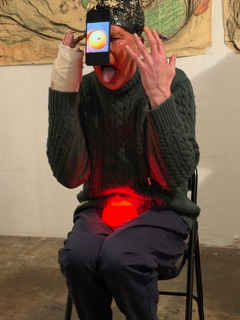
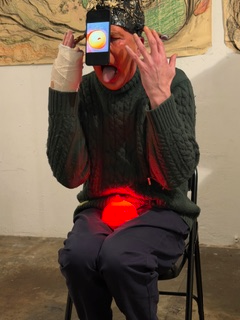
What we see is a seated figure, recognisably human, but immediately fractured by a set of substitutions. The face is not a face but a mask, exaggerated, theatrical, already a kind of prosthesis. In front of that mask, held where a face would ordinarily present itself to the world, is a smartphone screen displaying a bright circular image. Below, between the legs, a red light glows, unnatural in colour and placement, irradiating the body from an interior zone that is neither clearly sexual nor clearly mechanical. The hands are raised to the head in a gesture that could signal distress, concentration, possession, or calibration. The body is still, but the image hums with incompatible functions.
A Finean reading begins by noticing how aggressively the work destabilises essence. Ordinarily, the face is the site of identity, expression, and address. Here, that role is split across three layers: the biological head beneath the mask, the mask itself, and the phone screen which now performs the work of facing. None of these layers fully inherits the essence of a face. The phone cannot feel. The mask cannot see. The body cannot speak directly. As a result, the modal profile of the figure collapses into uncertainty.
What can this figure do as a figure? Can it speak? Can it be recognised? Can it be encountered as a person? The work does not merely make those questions difficult. It constructs a situation in which no stable answer is permitted. Because the essence of the figure is fractured, the space of possibility around it is damaged. The unease does not come from not knowing what the performer intends. It comes from not knowing what kind of thing this is such that intentions would even apply. The performance blocks the ordinary modal continuations of personhood. We cannot move smoothly from seeing to engaging.
Perniola’s philosophy sharpens this further. The affect here is not expressive. The performer does not communicate fear, pain, or ecstasy in a conventional sense. Instead, the affect seems to be located in the assemblage itself. The red glow, the phone screen, the rigid posture, the mask, together form what Perniola would call an already felt configuration. The viewer does not empathise with a subject. The viewer is exposed to an affective field that precedes subjectivity. The discomfort is impersonal. It does not ask what the performer feels. It imposes a feeling.
David Lynch repeatedly stages figures whose faces are unreliable, doubled, masked, replaced by screens, voices, or other media. The horror there is that mediation replaces essence. The face is no longer what anchors identity. In this image, the smartphone is not a prop but a rival ontological centre. It claims the role of interface, of presentation, of visibility. The human face is displaced sideways, literally and metaphysically. At the same time, the seated posture and chair quietly invoke Edward Hopper. A solitary figure, isolated, framed, inactive. But where Hopper’s figures are paralysed within intact identities, this figure is paralysed by identity breakdown. Hopper thins the space of action while preserving the person. Cosgrove fractures the person while preserving the stillness. The overlap is exact but inverted. In Hopper, the world will not move. Here, the self will not cohere.
The red light is crucial. It is not merely theatrical lighting. It functions as a false interior, a simulated core. It suggests energy, life, desire, or danger, but none of these interpretations can settle. It is too bright, too artificial, too placed. It does not belong to the body in the way organs do, nor to the environment in the way light normally does. It is an implanted signal. This introduces a pseudo essence, something that behaves as if it were constitutive but is in fact intrusive. The body now carries an internal feature whose modal implications are unclear. Is this power? Is it exposure? Is it damage? The work refuses to decide. This refusal is a disciplined suspension of modal grammar. The performance constructs a being for whom the usual distinctions between inner and outer, organic and technical, expressive and instrumental no longer govern what can happen.
The hands on the head intensify this. That gesture normally expresses distress or overload. Here it could equally be maintenance, calibration, containment. Again, the work withholds a stable role. Perniola helps us see why this does not collapse into mere spectacle. The feeling is not theatrical excess. It is neutrality under strain. The figure does not emote. It endures. The affect circulates in the system formed by body, object, light, and posture. The viewer encounters a state rather than a message. That state feels oppressive rather than open. Because the state is tightly constrained. Very little can happen here without breaking the assemblage. The world of the performance is rigid.
This rigidity is what aligns the image with trauma, but not trauma as memory or confession. It is trauma as a deformation of possibility. The figure is stuck not because it remembers something unbearable, but because it inhabits an arrangement that no longer supports ordinary transformations. It cannot simply stand up and become a person again. That option is not available within the work’s modal economy.
In this sense, the image completes the arc linking Cosgrovia to Hopper and Lynch. Hopper shows us people who could move but do not. Lynch shows us people who move but are no longer what they were. Cosgrove shows us a person whose category is so compromised that movement itself loses meaning. The uncanny force of the image lies exactly there. We are not frightened of what will happen next. We are disturbed because we cannot see how anything could happen next at all. The work does not tell us that the world is broken. It places us inside a world whose essences no longer guarantee possibilities, and whose affects no longer belong to anyone in particular. We do not observe the disturbance. We inhabit it, briefly, as viewers.
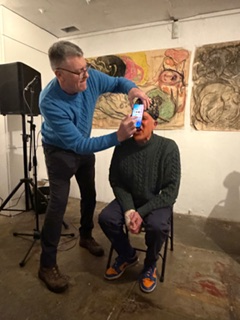
In this second still, the force of the work shifts, but it does not weaken. It sharpens. What was previously encountered as a closed, uncanny assemblage is here shown in the process of being made, and that revelation does not dissolve the disturbance. It deepens it.
The crucial change is the introduction of a second figure, the Assembler Man, standing, leaning in, carefully positioning the phone in front of the seated performer’s masked face. The act is deliberate, technical, almost gentle. This is an act of calibration. The uncanny now arises not from concealment but from exposure. We see how the effect is produced, and yet seeing this does not restore normality. This moment exposes the construction of essence itself. In the previous still, the fractured face assemblage appeared as a completed being. Here we see that being assembled through ordinary actions.
A man holds a phone. Another sits on a chair. A device is placed at a particular angle. None of these actions is strange in isolation. What is strange is that together they generate an entity whose modal profile exceeds that of its parts. Once assembled, the figure is no longer merely a seated man with a phone near his face. It becomes something whose possibilities are altered. The essence of the assemblage is not reducible to the intentions or identities of either participant. The work shows us essence coming into being through arrangement. Before the phone is placed, the seated figure is a person waiting. After placement, the figure is no longer simply a person. The modal shift is immediate. What can happen to this figure, how it can be encountered, what responses are appropriate, all change. That change is not psychological. It is ontological, produced by the configuration.
Perniola’s influence becomes especially legible here. The affect becomes colder, more impersonal. The standing figure does not appear cruel or invasive. He appears practical, almost caring. This neutrality is unsettling. Perniola’s claim that feeling can be detached from intention finds a concrete instantiation. No one here needs to feel disturbed for the disturbance to exist. The affect belongs to the configuration, not to the people.
The phone, in this still, is unmistakably a tool. It is being positioned like a medical instrument, a measuring device, a prosthetic. This gives the scene a clinical undertone. The face is treated as a site to be serviced rather than expressed. In Lynch’s work, similar moments occur when violence or transformation is carried out with bureaucratic calm. The horror lies not in sadism but in procedural normality. Something essential is being altered without drama.
Hopper rarely shows the making of his scenes. His figures are always already placed, already stilled. Cosgrove shows the placement itself. But rather than demystifying the scene, this act of placement reveals how fragile the boundary is between an ordinary social interaction and an ontologically disturbing situation. A man helping another man becomes the mechanism by which personhood is partially withdrawn. The seated figure’s posture is also important. Hands folded, body compliant, gaze obscured. This is not resistance. It is submission without explanation. The body offers itself to reconfiguration. That willingness intensifies the trauma, understood not as violence inflicted but as possibility surrendered. The figure allows its face to be replaced by an interface. That replacement is neither coerced nor celebrated. It is simply done.
This is devastating. Ordinarily, showing the process of construction restores a sense of contingency. One can say, this could have been otherwise. But here, the process feels necessary. The calmness of the act gives the impression that this configuration is what the situation is for. The possibility of refusal or alternative arrangement recedes. We witness not an option being chosen, but a role being fulfilled. This is where the two images together achieve something that neither Hopper nor Lynch quite does alone. Hopper freezes the aftermath. Lynch plunges us into the transformation. Cosgrove gives us both, and in doing so shows that the uncanny does not depend on secrecy. It can survive full visibility. Knowing how the assemblage is made does not restore agency or meaning. It confirms that the disturbance is structural.
The unsettling possibilities we feel in the completed image are not imaginative excesses. They are licensed by the work’s essence, which we now see being constituted. Once the phone is placed, once the face is displaced, the space of what can happen is genuinely altered. The work does not ask us to imagine a broken world. It constructs one in front of us, step by step, with ordinary gestures. Perniola would say that this is the triumph of the already felt over the already known. Even as we understand what is happening, even as we see the hands, the phone, the chair, the gallery space, the affect does not retreat. It settles. The feeling is no longer suspense but resignation. This is how things are arranged now. The uncanny does not arise from symbolism, shock, or transgression. It arises from a quiet reengineering of essence. A face becomes an interface. A person becomes a platform. A social interaction becomes a device. Hopper’s stillness, Lynch’s dislocation, Fine’s modality, and Perniola’s impersonal affect converge here in a single, disturbingly ordinary act.
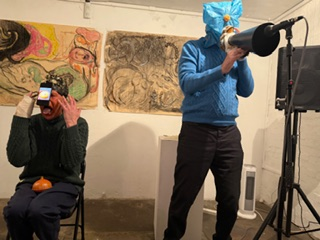
In this third still, the logic of the performance reaches a kind of cold clarity. The assemblage that previously appeared self contained is now revealed as part of a larger apparatus. The seated figure remains fixed, masked, phone still interposed where a face should be, hands pressed to the head as if holding the configuration in place. But now the Assembling Man has been transformed as well. His head is wrapped in a bright blue plastic covering, and he operates a large microphone aimed directly at the seated body. The scene has become explicitly infrastructural.
What matters is that this is no longer just about vision. Sound has entered as a parallel channel of capture. The seated figure is not only being faced by a screen but listened to, extracted from, processed. The microphone is oversized, almost grotesque, relative to the human scale. It reads less as a tool for recording speech and more as an instrument for harvesting presence. In Finean terms, this is another shift in essence. The seated figure is no longer simply someone whose face has been displaced. He has become a source, a node in a system whose function is unclear but whose constraints are unmistakable. The introduction of the microphone dramatically narrows the modal field. Ordinarily, a microphone implies speaking, performing, communicating. Here, however, the face has already been replaced. The mouth is masked. The phone screen offers an image rather than a voice. The microphone’s ordinary purpose is therefore suspended. What can it be recording? Breath. Noise. Silence. The work does not decide, and that undecidability is a genuine absence of authorised roles. The object no longer knows what it is for, and so neither do we. The unease does not arise because we are unsure what the artist means. It arises because the configuration deprives the objects involved of their ordinary modal profiles. A face no longer enables address. A microphone no longer guarantees speech. A phone no longer mediates communication. Each element retains its physical properties but loses its normative function. The world is misaligned.
Perniola’s affect without expression applies. No one here appears to be emoting. The Assembling Man operates equipment with focus and efficiency. The seated figure remains compliant and contained. The disturbance is not enacted through dramatic gesture. It is generated by the impersonal choreography of devices and bodies. Perniola’s claim that feeling can be objectified, detached from subjects and lodged in arrangements, is no longer abstract. The feeling here belongs to the system, not to the people.
The blue plastic covering on the Assembling Man's head intensifies this impersonal quality. It suggests protection, anonymity, sterility. The Assembling Man is no longer fully present as a person. He has partially joined the apparatus. Just as the seated figure’s face has been replaced by a screen, the Assembling Man’s head has been replaced by packaging. Both bodies are being reorganised around functions rather than identities. This is not theatrical disguise. It is a stripping away of personal address.
Lynch repeatedly stages scenes in which technical processes, recording, amplification, surveillance, are performed with ritual seriousness and emotional blankness. The dread arises not from threat but from the sense that human presence has been subordinated to procedures whose logic is opaque. This image produces the same effect without narrative. We are witnessing a world in which being seen and being heard have been decoupled from being recognised.
At the same time, the seated stillness continues to echo Edward Hopper. The figure remains inert, isolated, framed, unable to intervene in the scene that surrounds him. But Hopper’s figures are trapped within social and architectural stillness. Here the trap is technological and ontological. The figure is immobilised not by loneliness but by incorporation into a system.
What is crucial is that nothing in the image looks violent in a conventional sense. No force is being applied. No struggle is visible. The work achieves its traumatic effect by showing how easily a human body can be repositioned as a functional component. Trauma, here, is not remembered pain but the loss of modal latitude. The seated figure can no longer simply speak, look, or withdraw. Those options are no longer available within the assembled world.
Once the essence of the figure has shifted, once it has become a platform for interfaces, the possibilities that depend on personhood do not merely recede. They cease to apply. Perniola gives us the courage to let that condition stand without attributing it to cruelty, intention, or ideology. It is enough that the arrangement exists. Seen as part of the sequence, this image shows Cosgrove’s practice at its most uncompromising. The work does not rely on shock or symbolism. It relies on the cumulative deformation of what things are for. A face becomes an image. A voice becomes a signal. A helper becomes an operator. A performance becomes a system. The uncanny emerges not because something monstrous appears, but because nothing restores the ordinary grammar of possibility.
At this point in the sequence, the world of the performance has fully detached from everyday modal expectations. We are confronted with the deep unease of not knowing what could happen next, given what this world now allows. That is the deepest point of contact between Cosgrove, Hopper, Lynch, Fine, and Perniola, and it is here, in this image, that their shared terrain becomes unmistakable.
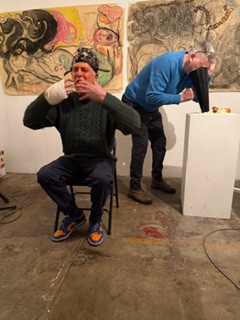
As the sequence moves into this moment, something decisive happens. The apparatus recedes. The phone, the microphone, the blue plastic, all disappear. What remains is a seated figure again recognisably human, hands raised to the mouth, fingers pressed together as if shaping breath, speech, or something pre linguistic. Behind him, the Assembling Man bends over a plinth, handling an object with the same careful attentiveness we have already seen, but now the focus has shifted away from capture and mediation toward handling, adjustment, preparation.
At first glance, this looks like a return to normality. The face is no longer occluded. The hands are no longer holding a device in place. The scene appears calmer, almost relieved. But the relief does not come. The earlier stages of the performance have altered the modal ground so thoroughly that the restoration of ordinary gestures does not restore ordinary possibility.
Essence, once disturbed, is not automatically repaired by removing a prop. The seated figure may look like a person again, but the space of what he can now do has already been transformed by what we have witnessed. His gesture toward his mouth is ambiguous in a new way. Is he about to speak? Is he testing whether speech is still available? Is he holding something invisible? The work does not allow us to treat this as a simple expressive moment because the earlier sequence has taught us that functions can be withdrawn without warning.
There is no catharsis. The removal of the device does not return the world to its previous state. Instead, it exposes the fragility of that state. We now see that speech, expression, and self presentation were never guaranteed. They were provisional all along. The affect here is not shock but neutrality. The figure’s gesture is restrained, almost careful. There is no outcry, no visible distress. Feeling has not returned to the subject. It remains suspended in the situation. The affective charge lingers in the space, detached from the devices that initially produced it. This is precisely Perniola’s already felt. The configuration has imprinted a sensation that does not require its original cause to remain active.The Assembling Man’s behaviour reinforces this. He does not attend to the seated figure’s apparent recovery. He is absorbed in his task at the plinth. This indifference is structural. The performance has shifted from manipulating the person to manipulating the environment, as if the person were no longer the primary site of interest. That displacement echoes a recurring move in Lynch, where the human figure ceases to be the centre of the scene and becomes just one element among others, no longer privileged by narrative or sympathy.
Hopper’s figures are intact but trapped. This figure is potentially free but ontologically unsettled. He sits not because the world has immobilised him, but because he no longer knows, and we no longer know, what counts as a meaningful action. The object on the plinth, small, orange, ambiguous, quietly inherits the role previously played by the phone and microphone. Attention migrates. The performance suggests that mediation was never the point. The point was substitution. Whatever occupies the focal role reorganises the field of possibility. The human face is only one candidate among others.
Once the performance has demonstrated that essence can be reassigned so easily, once it has shown that a face can cease to function as a face, the category of person becomes unstable. The seated figure’s hands near his mouth do not reassure us because the work has already severed the necessary connection between gesture and function. The possibility that he can simply resume speaking is no longer licensed by the world the performance has built.
Trauma here is not the memory of an event but the persistence of a constraint. The event is over, but the space of possibility remains narrowed. The work does not need to keep violating the body. It has already altered what the body can be.
Seen in sequence, this image completes a trajectory that neither Hopper nor Lynch could achieve alone. Hopper freezes the world before rupture. Lynch immerses us in rupture without repair. Cosgrove shows us rupture, construction, and apparent repair, and then demonstrates that repair does not restore the original modal order. The uncanny resides not in what we see now, but in what we can no longer assume.
The seated figure, hands near his mouth, is no longer simply about to speak. He is testing a capacity whose guarantee has been withdrawn. The performance is a question posed at the level of being itself. What, after all this, is still possible for a human figure to do?
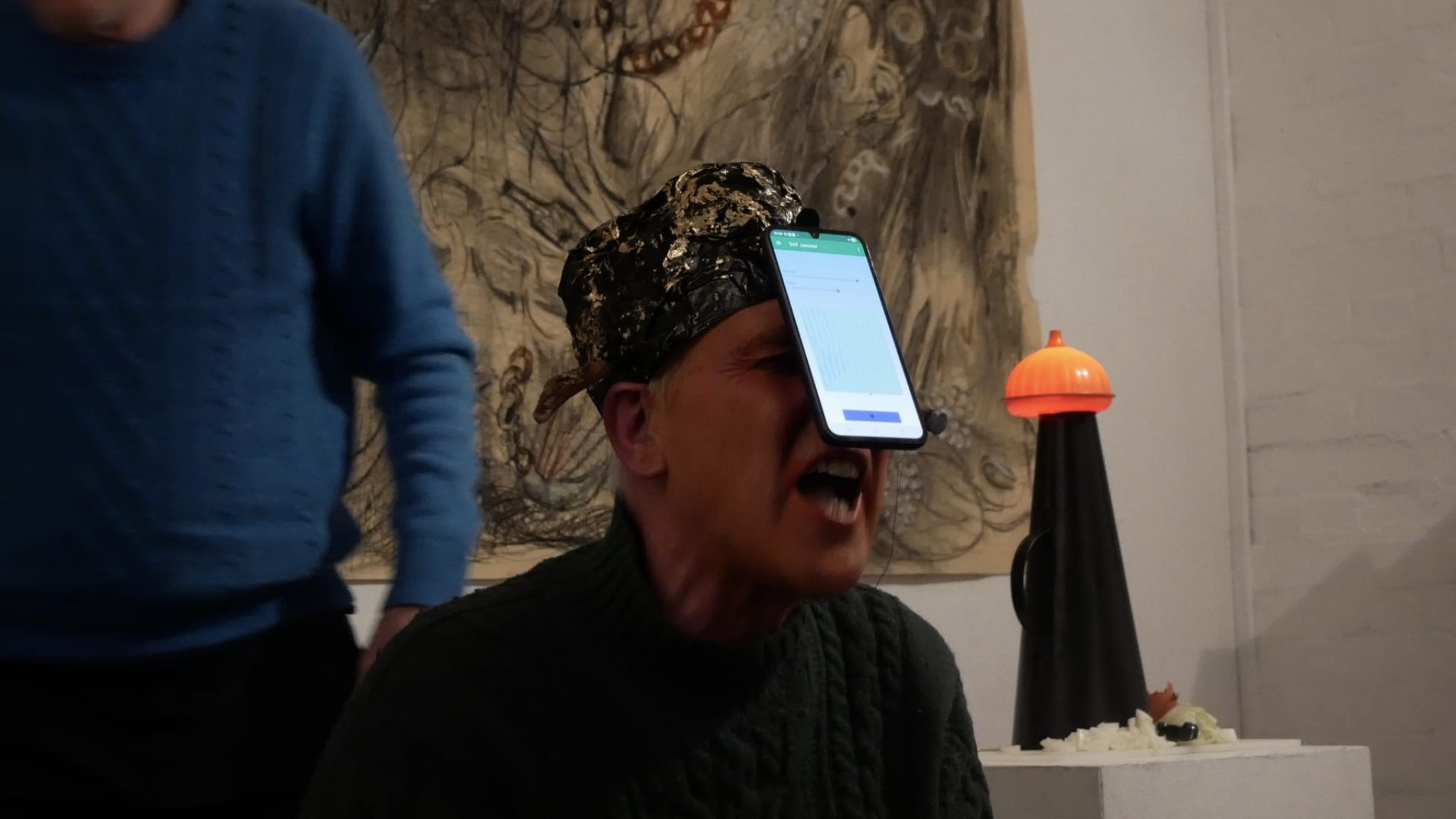
If we stay with this frame, the sequence turns sharply, but again without releasing the pressure it has built. The phone has returned to the face, now clamped more aggressively, vertically, dominating the facial plane rather than hovering in front of it. The mouth is open in what looks like a cry, a laugh, a vocalisation pushed to the edge of strain. Yet the phone screen displays something resolutely administrative, a form, a graph, a calibration interface. Expression and procedure collide at the same site.
The face is no longer merely displaced or supplemented. It is overridden. The phone does not just stand in for a face, it occupies the role of face while remaining stubbornly what it is. The scream cannot be read by it. The interface does not respond to it. Two incompatible essences are forced into coincidence without synthesis. The resulting entity is radically impoverished. Almost none of the ordinary possibilities associated with either a human face or a device now apply cleanly. Speaking does not communicate. Display does not address. The conjunction blocks rather than expands possibility.
This is why the moment feels so violent without depicting violence. The violence is modal. The scream suggests urgency, pain, or excess, but the world has been reorganised so that none of those states can do their usual work. The scream cannot count as a call. It cannot count as expression. It cannot even count as breakdown, because breakdown presupposes a functioning system that has failed. Here there is no unified system left to fail. This is affect stripped of subjectivity. The scream is there, but it does not belong to anyone in the way screams normally do. It does not solicit empathy or response. The feeling is not inside the person. It is suspended between incompatible layers of the assemblage. The already felt now appears as a kind of surplus that has nowhere to go. The work does not allow the affect to be discharged through recognition, care, or narrative.The presence of the orange, lamp-like object on the plinth intensifies this. It glows softly, indifferently, as if performing the role of an interior light without being interior to anything. In the earlier still, a red glow sat beneath the body. Now a glow stands beside it. Illumination migrates from the human to the object. It suggests that vitality, signal, or significance no longer has any privileged attachment to the human figure. The world is still lit, but the light no longer answers to the body.
The Assembling Man standing behind, partially out of frame, reinforces this redistribution. He is present but disengaged, neither restraining nor responding. The scream does not reorganise the situation. In Lynch, screams often fail to summon help. They echo inside worlds whose structures no longer recognise them as meaningful events. The terror lies in that non response. The world continues according to rules that do not include rescue.
At the same time, the seated posture persists, echoing Hopper yet again. But here the stillness is no longer quiet. It is strained, vocal, exposed. Hopper’s figures are silent because nothing can happen. This figure is loud because nothing will happen. Silence and scream converge at the same modal endpoint, the collapse of effective action.
Once essence has been scrambled to this degree, the distinction between expressive and inexpressive behaviour loses its grip. A scream and a still gaze can be equally inert. The work gives us a world in which vocal intensity does not widen possibility but confirms its closure.
What is striking is how ordinary the components remain. A phone. A chair. A lamp. A person. Nothing fantastical appears. This is where Cosgrove’s work differs from overt dystopian imagery. The disturbance does not come from unfamiliar objects but from familiar ones misfunctioning together. Fine would say that the work alters the grounding of modal truths without altering the inventory of things. Perniola would say that this is precisely how contemporary affect operates, through neutral surfaces that absorb intensity without reflecting it back.
By this point in the sequence, the performance has achieved a bleak coherence. The earlier stages showed how essence could be displaced. This stage shows what happens when that displacement meets excess. The excess does not break the system. It reveals that the system has no place for it. Trauma, here, is no longer an event or a memory. It is the experience of being in a world where even the most extreme gesture cannot re open the space of the possible.
In this image, then, the performance reaches its most Lynchean and most Finean moment at once. The scream is real. The interface is real. Their collision is real. What disappears is not the body but the guarantee that bodily acts still matter. The uncanny force comes from recognising that this disappearance has been engineered calmly, visibly, and without concealment.
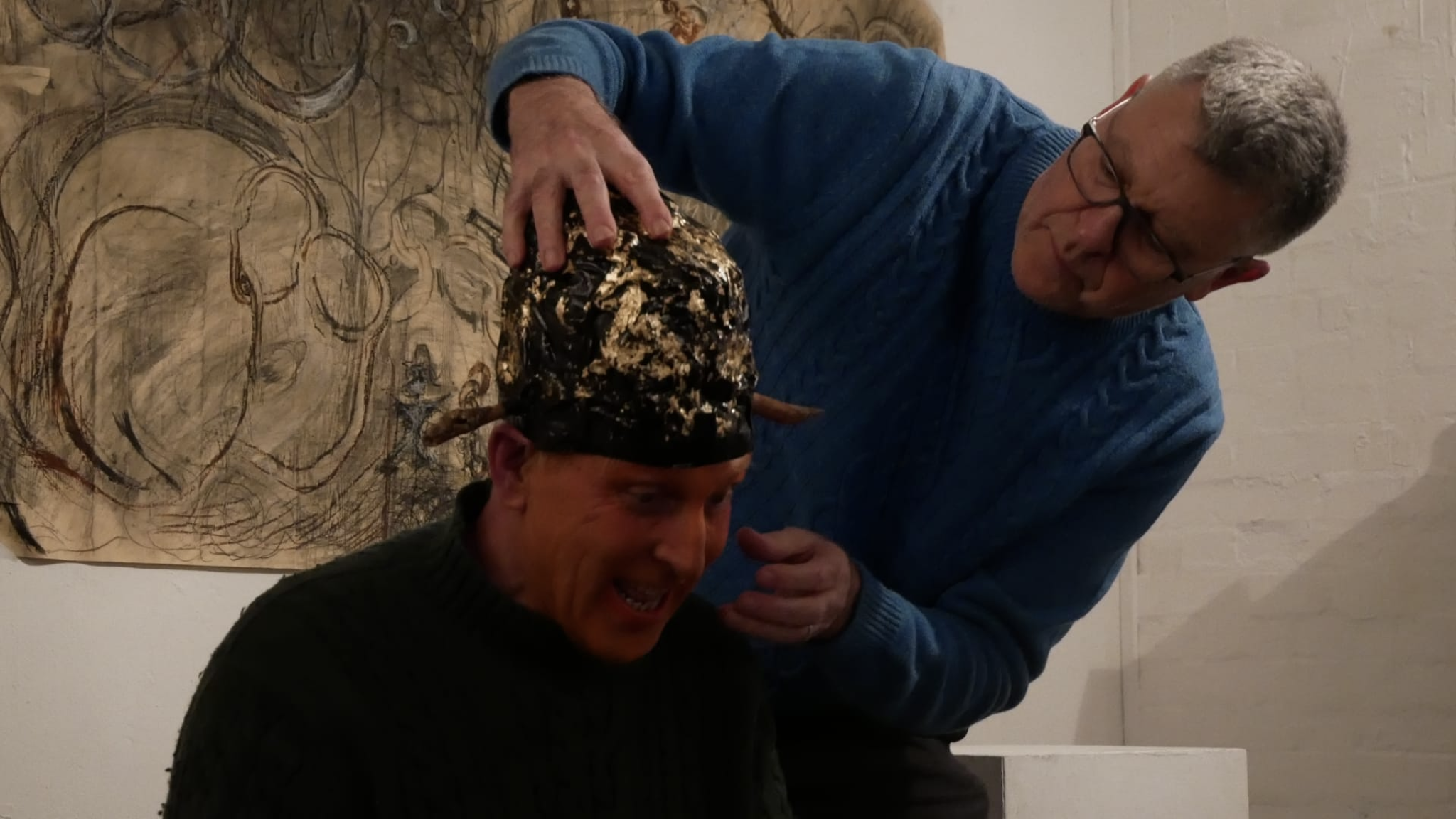
If we now fold this earlier moment back into the sequence, the whole performance snaps into a clearer structural arc. What initially looked like a progressive escalation toward breakdown can now be seen as a carefully staged reengineering of essence from the outset, not a sudden violation but a gradual recalibration of what the figure is allowed to be.
In this image, the phone and microphone have not yet appeared. Instead, we see the first decisive intervention: the placing of the black, tar like, gold flecked headpiece onto the seated figure. The gesture is intimate, almost parental. A hand rests on the crown of the head, adjusting, steadying, securing. The seated figure’s expression is ambiguous, caught between tension and a strained grin. Nothing overtly violent is happening. Yet everything that follows is already latent here.
Headwear ordinarily decorates, protects, or signifies status. This object does none of those things cleanly. Its texture is heavy, occlusive, almost geological. It does not express identity so much as overwrite it. By covering the head, it interferes with the site where perception, thought, and self orientation are culturally anchored. This is not a costume in the theatrical sense. It is a reclassification device. Once it is placed, the seated figure is no longer simply a person wearing something. He has become a bearer of an object that partially governs what he can now do.
The work is not symbolising domination or control. It is literally constructing a new kind of entity whose modal profile is narrower than that of an ordinary person. With the headpiece in place, certain possibilities quietly disappear. The figure can no longer simply turn his head freely. He can no longer present his face unmediated. He can no longer be encountered as fully transparent to others. The space of possible actions begins to thin before any technological mediation appears.
The affect does not belong to the seated figure’s expression. It belongs to the configuration itself. The headpiece carries a charge independent of intention. The Assembling Man’s calm concentration intensifies this. There is no sadism, no drama, no display of power. The feeling is neutral, procedural. This is the already felt taking form. A state is being installed, not an emotion expressed.
Seen retrospectively, this moment also reframes the later reintroduction of the phone and microphone. Those devices exploit a condition that has already been prepared. The headpiece is the first infrastructural element. It marks the body as available for further reassignment. Once the head is treated as a site to be worked on rather than a centre of agency, the later substitutions follow with unsettling inevitability.
Lynch often begins his most disturbing sequences with gestures that seem minor or caring, a hand on a shoulder, a calm instruction, a small ritual. The horror grows not from sudden brutality but from the slow realisation that these gestures are reconfiguring the terms of personhood. This image does exactly that. The hand on the head is not a threat. It is an initiation.
Hopper’s figures are already trapped when we meet them. Cosgrove shows us the trapping process itself, but renders it so ordinary that it feels almost reversible. That is the trap. The viewer senses that nothing dramatic has occurred, and yet something essential has shifted. Once this image is placed at the beginning of the sequence, the later scream, the phone face, the microphone capture, and the post apparatus gestures all acquire a different weight. They are not violations layered on top of an intact subject. They are developments within a world whose modal grammar was altered at the very first touch.
This is why the performance feels coherent rather than episodic. Each step respects the altered essence established earlier. Once the head is no longer fully the person’s own, once it has become a site of intervention, the later replacement of face by interface, voice by signal, expression by data does not feel excessive. It feels like the unfolding of what was already permitted.
The seated figure does not need to feel fear for fear to be present. Perniola allows us to say this without moralising the Assembling Man. He does not need to intend harm for harm to occur. The work operates at a level where affect and possibility are engineered into the situation itself.
Folded into the sequence, this image reveals the true centre of gravity of the performance. The most disturbing moment is not the scream or the phone face. It is this quiet, early adjustment, the moment when a human head is treated as something to be fitted, aligned, and prepared. From that point on, the space of the possible has already been compromised. Everything that follows merely makes that compromise visible.
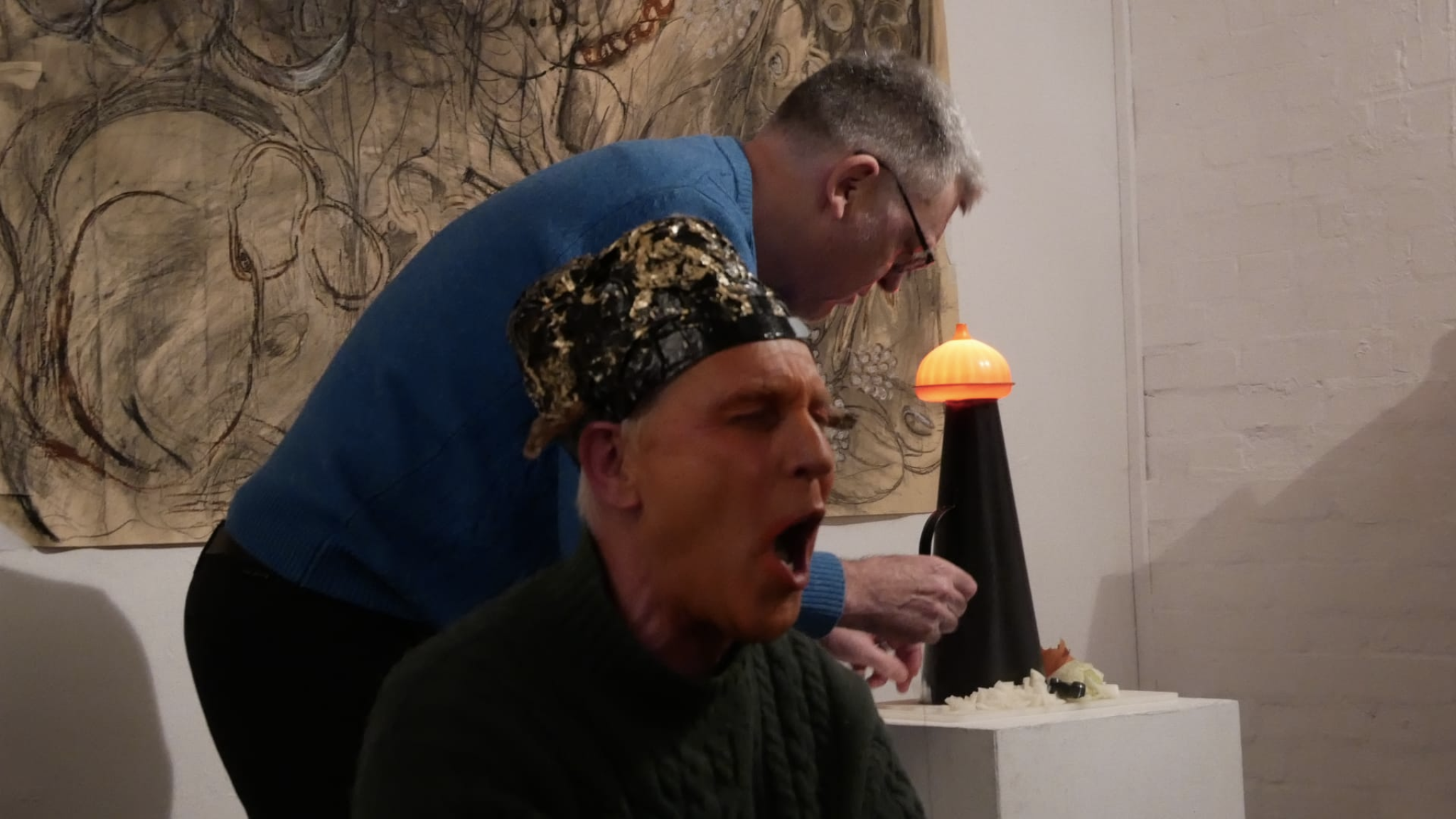
In the beginning , the word. The seated figure is actually telling a story about three rings, Christmas, a cat being pushed violently into the mouth of a child by a father and black blood dripping down, and then a woman called Vinegar who was very eeerily thin, who did a strip tease for pennies and was pushed into a cupboard for the Christmas holidays. The voice, streaming these grotesque Christmas stories almost casually, without framing, without moral punctuation, is not an accompaniment to the images. It is the first deformation of the world’s modal grammar, arriving before any apparatus is attached, before any interface replaces the face. What matters is not only the content of the story, though that content is unmistakably violent and obscene in its banality, but the manner of its delivery. The story is told without explanation, without signalling whether it is remembered, invented, confessed, or performed. It does not ask to be believed or disbelieved. It simply occupies the space. Then it stops. Then it resumes later. All the while, a low growling sound continues, a non linguistic pressure beneath speech. From the start, language is already split against itself.
Speech normally carries a modal promise. To speak is to address, to narrate, to make something available for uptake. Here that promise is withdrawn immediately. The voice does not aim at understanding. It does not even aim at shock. It behaves more like an environmental condition than a communicative act. As a result, the listener cannot locate what kind of thing this speech is. Is it testimony? Is it fiction? Is it incantation? Is it noise? None of these classifications holds, and because none holds, the space of possible responses collapses. One cannot respond appropriately because there is no appropriate response available.
This is why the later visual interventions feel inevitable rather than excessive. The voice has already demonstrated that expressive acts can lose their ordinary force while remaining intact as physical events. Words are still spoken. Sounds are still made. But their modal role has been altered. They no longer open a space of shared meaning. They thicken the atmosphere. This is affect detached from subjectivity.
The horror of the story does not reside in the psychology of the speaker or the listener. It is not empathy driven. It is lodged in the situation itself. The voice becomes an object among objects, a material flow that circulates violence without asking to be interpreted or resolved. The already felt appears here as a kind of residue that accumulates rather than discharges.
Seen alongside the image, this early still becomes newly legible. The seated figure’s mouth is open, but this is not yet the scream of later stages. It is speech already edging toward noise. The Assembling Man attends to the glowing object on the plinth with quiet focus, as if the voice belongs to the room rather than to the person producing it. The glow does not react to the story. Nothing reacts. That non reaction is crucial. It establishes from the outset a world in which atrocity does not reorganise attention or priority.
In Hopper, when violence is absent, the stillness feels tragic. In Lynch, when violence occurs, it often feels strangely unanchored, as if it does not command the narrative gravity it should. This moment aligns more closely with Lynch. The story is unbearable, yet it does not take control of the scene. It flows alongside other actions, as if it were one more signal in a system already overloaded.
The performance is not representing a world in which violence is normalised. It is constructing a world in which the modal consequences of violence have been suspended. Ordinarily, such a story would demand response, outrage, grief, explanation. Here it does not. The world does not permit those responses. The violence is real in content but inert in effect. That inertness is the deepest disturbance. The low growling sound reinforces this. It is not expressive either. It does not rise and fall with the story. It does not comment on it. It persists. This persistence gives the impression that menace is not event based but structural. The menace is not what happens. It is what the world sounds like when nothing that happens can change it.
When this is recognised, the later replacement of face by phone, voice by signal, scream by unreadable interface appears not as a thematic turn toward technology, but as a continuation of the same logic. Speech had already ceased to function as speech. The phone merely makes that failure visible. The scream later in the sequence is not more extreme than this early narration. It is more explicit. Both are equally ineffective in reopening the space of the possible.
In Finean language, the essence of expressive acts has been compromised from the beginning. Once that happens, modality follows. Possibilities that depend on being heard, understood, or responded to no longer apply. Perniola allows us to hold this without insisting on a moral centre. The work does not ask us to judge the story or the speaker. It asks us to endure a situation in which even the most shocking content cannot restore meaning.
Placed at the start, this image and this voice make the entire performance intelligible as a single, coherent deformation. The later apparatus does not silence the voice. The voice was already silenced in a deeper sense. What the performance shows, step by step, is how a world can continue to function, speak, glow, record, and scream after the conditions that make those acts meaningful have quietly withdrawn.
We can now perhaps understand some things. The performance unfolds as a slow and deliberate undoing of the ordinary guarantees that organise human action, speech, and recognition. It does not proceed by shock, confrontation, or transgression in the usual sense, but by a series of calm adjustments that gradually alter what kinds of things the participants are, and therefore what kinds of things can happen in the space they occupy. The effect is not one of narrative escalation but of ontological drift. By the time the most extreme gestures occur, screaming, facial occlusion, technological substitution, the ground that would allow those gestures to function as expressions has already been withdrawn.
From the very beginning, the performance refuses the theatrical logic of before and after. There is no clear baseline of normality against which later violations can be measured. Instead, the work begins already slightly askew. A seated figure occupies a chair in a gallery space. Another figure stands nearby. Objects are present but not yet activated. This arrangement is familiar enough to disarm suspicion. It resembles preparation, setup, rehearsal. Yet almost immediately, a crucial shift occurs. An object is placed on the seated figure’s head. The gesture is gentle, careful, and unhurried. There is no force, no resistance. This matters. The work does not begin with violence. It begins with fitting.
The headpiece itself is difficult to classify. It is not a costume in any conventional sense. It does not signal role, character, or identity. Its texture is heavy, dark, irregular, flecked with gold. It appears closer to a geological or industrial substance than to clothing. By covering the head, it interferes with the site that in ordinary social life anchors perception, orientation, and personhood. Yet it does so without theatrics. Nothing dramatic happens. The seated figure remains seated. The standing figure adjusts the object with care. Already, something essential has changed.
If one approaches this moment through the lens of Kit Fine’s metaphysics, what is striking is not what is represented but what is restructured. Fine’s central insistence is that modality depends on essence, not the other way around. What a thing can do depends on what it is. Possibility is not projected by imagination or convention but grounded in real structure. The performance makes this abstract claim tangible. By altering the seated figure’s head in a way that neither decorates nor protects it, the work subtly changes what kind of thing this figure is. Certain possibilities quietly disappear. The figure can no longer be encountered simply as a face oriented toward the world. Turning the head, addressing others, being immediately recognisable as a subject of speech, these are no longer straightforwardly available. The work does not announce this loss. It simply installs it.
At the same time, the voice begins. The seated figure speaks, but the speech does not behave as speech ordinarily does. The story that emerges is grotesque and disturbing in its content, a Christmas narrative populated by violence, sexual degradation, cruelty, and bodily intrusion. A cat is pushed violently into the mouth of a child by a father. Black blood drips. A woman called Vinegar, eerily thin, performs a striptease for pennies and is pushed into a cupboard. These images are extreme, but what is most unsettling is not their extremity. It is their delivery. The story is not framed. It is not contextualised. It is not introduced as fiction, memory, or confession. It is spoken without explanation, then stops, then resumes later. Beneath it runs a low growling sound, continuous, non linguistic, indifferent to the narrative.
From the outset, then, language has been stripped of its ordinary modal role. Ordinarily, speech opens a space of shared action. It invites response, belief, disbelief, outrage, sympathy. Here it does none of those things. The audience is not positioned as listener in any stable sense. The story does not demand interpretation or reaction. It does not reorganise the scene. It simply occupies the space. This is not because the audience is morally numb or confused. It is because the performance has already begun to withdraw the conditions under which response would make sense.
Fine’s framework allows us to articulate why this matters. The failure here is not epistemic. It is not that we do not know how to interpret the speech. It is that interpretation itself has lost its foothold. The essence of speech has been altered. It still produces sounds and words, but it no longer carries the modal promise that speech usually carries. The possibilities that normally follow from speech, answering, reacting, intervening, no longer apply. The violence of the story does not force the world to change course. It is inert in effect.
This inertness is reinforced by the growling sound beneath the voice. The growl does not respond to the narrative. It does not intensify or recede. It persists. Menace becomes atmospheric rather than event based. The performance establishes, very early, a world in which what happens does not determine what is possible. This is a crucial inversion of ordinary moral and narrative logic. In most contexts, extreme events expand the space of response. Here they do not. The space of response has already been narrowed.
At this stage, the performance is already deeply aligned with the philosophical orientation of Mario Perniola. Perniola’s work repeatedly insists that affect need not be grounded in a subject who feels. Feeling can be objective, impersonal, sedimented in arrangements, rituals, and forms. In this performance, the horror of the story does not belong to the psychology of the speaker or the audience. It belongs to the situation. The affect circulates without anchoring itself to anyone. The audience endures. The already felt appears not as a climax but as a background condition.
A phone is brought into the scene. It is strapped directly onto the face, vertically, dominating the facial plane. The screen displays something administrative, a graph, a form, an interface that belongs unmistakably to bureaucratic or technical systems rather than expressive ones. The face becomes a surface for data.
At the same time, a microphone enters the scene. It is large, almost grotesquely so, relative to the human body. It is aimed at the seated figure with care and precision. The standing figure wraps his own head in blue plastic, partially anonymising himself, becoming less a person than an operator. The phone and microphone make explicit a logic that has already been operating since the first spoken words.
Speech had already ceased to function as speech in the modal sense. The microphone does not capture a voice that would otherwise have communicated. It captures something whose communicative role has already been withdrawn. Fine’s insistence that modal truths are grounded in real structure rather than in conventions or expectations helps here. The work does not frustrate our expectations about technology. It alters the essence of the human figure such that the usual expectations no longer apply.
The resonance with the cinema of David Lynch is unmistakable at this point, though it is important not to overstate it. Lynch’s films often depict worlds in which screams fail to summon help, in which violence does not reorganise narrative priority, in which bureaucratic or procedural systems continue unaffected by human suffering. Both construct worlds in which expressive acts have lost their usual power to alter what happens next.
At the same time, the seated stillness of the central figure continues to recall the paintings of Edward Hopper. Hopper’s figures are often alone, seated, immobilised within spaces that seem to deny action. Yet Hopper’s figures remain intact as persons. They are trapped by circumstance, not ontologically reconfigured. In Cosgrove’s performance, stillness has a different source. The seated figure is not merely prevented from acting. The grammar of action itself is being dismantled. The chair becomes not a site of rest but a platform for reclassification.
The most extreme moment of the performance occurs when the seated figure screams. His mouth opens wide. The scream is bodily, strained, unmistakably real. Yet the phone screen remains indifferent. The interface does not register the scream. The scream does not reorganise the scene. This is perhaps the clearest illustration of the work’s central operation. The scream does not fail because it is insufficient. It fails because the world no longer contains the possibility for a scream to function as a scream.
From a Finean perspective, this is not metaphorical. Once the essence of expressive acts has been compromised, intensity does not restore efficacy. A scream and silence converge at the same modal endpoint when the world no longer recognises either as meaningful interventions. This is why the moment feels so violent without depicting violence. The violence is modal. The scream collides with a world that has no place for it.
The performance does not present a cruel operator silencing a victim. The standing figure does not appear sadistic. He appears focused, procedural, almost gentle. The affect does not belong to intention. It belongs to arrangement. Feeling has become objective. The already felt is now overwhelming precisely because it has nowhere to go.
The seated figure brings his hands to his mouth as if testing whether speech is still available. This gesture is devastating in its restraint. It is not expressive but diagnostic. Can I still speak? Does speech still do anything?
Essence, once altered, is not restored by subtracting an object. The removal of the phone does not restore the face’s former role. The possibilities that depended on that role do not automatically return. The performance makes this palpable. The audience does not feel relief. It feels uncertainty. What kind of thing is this figure now such that speech would apply?
Meanwhile, the standing figure’s attention shifts to an object on a plinth, a small glowing form. He attends to it with the same care previously devoted to the phone and microphone. Attention migrates away from the human body. This redistribution of significance is structural. The human has lost its privileged status as the centre of affect and meaning. Perniola’s account of impersonal affect finds one of its clearest artistic instantiations here. The glow no longer belongs to the body. It belongs to the object. The situation remains charged even as the apparatus disappears.
Seen as a whole, the performance is not primarily about technology, surveillance, or digital mediation, though those themes are present. It is about the fragility of the modal guarantees that underpin everyday life. Speech, face, voice, expression, these are not metaphysical givens. They are roles sustained by a world that recognises them. The performance shows how easily that recognition can be withdrawn, not through catastrophe, but through ordinary gestures carried out calmly and visibly.
This is why the work feels traumatic without representing trauma in the usual sense. Trauma here is not the memory of an event. It is the persistence of a constraint. By the end of the performance, the audience does not feel that something terrible has happened and is now over. They feel that the conditions under which things happen at all have been altered. Fine allows us to describe this alteration without psychologising it. Perniola allows us to endure it without demanding resolution.
In this respect, the performance occupies a precise position adjacent to Hopper and Lynch. Hopper presents worlds where action has thinned but meaning remains. Lynch presents worlds where action proliferates but meaning fractures. Cosgrove presents the process by which meaning and action can be quietly decoupled, step by step, until both persist only as hollow forms.
The performance does not conclude. It simply stops. There is no catharsis, no restoration, no moral frame. The audience is left with a sense that the world they briefly inhabited continues beyond the performance, that the narrowing of possibility has not been reversed. This is the deepest disturbance the work produces. It does not tell us that expression is impossible. It shows us how easily expression can become ineffective while remaining intact as behaviour. It does not tell us that meaning has died. It shows us how meaning can persist as form while losing its force.
What lingers after the performance is not an image or a story but a condition. A sense that speech may no longer guarantee response, that intensity may no longer widen possibility, that human presence may no longer command attention. The performance constructs this condition. And in doing so, it achieves a rare philosophical precision, making metaphysical claims not by assertion but by arrangement, leaving the audience not with something to interpret, but with something to reckon with.