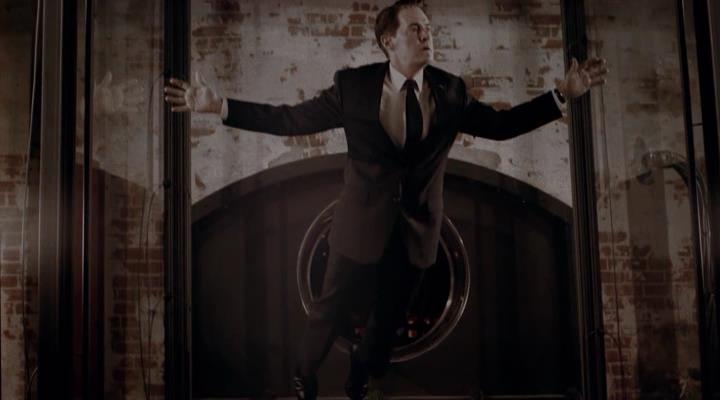
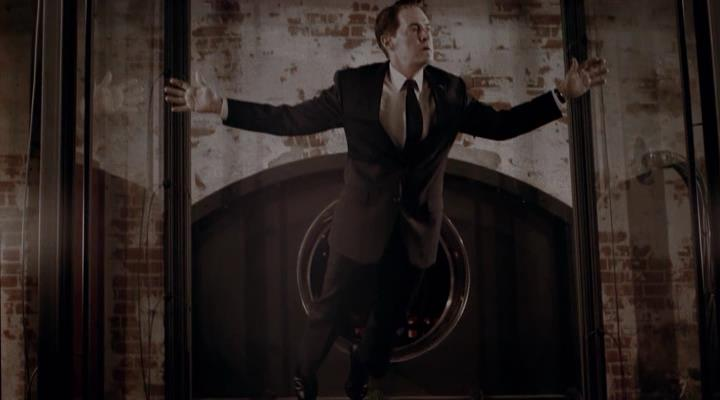
The third series of Twin Peaks begins as a metaphysical catastrophe whereby the structures which normally make identity, time, causation, and knowledge intelligible are still operating, but no longer line up with one another. The first episode presents a world whose joints no longer match the categories by which anyone inside it is trying to understand it. The most striking feature is its slowness. Time stretches, stalls, loops. Scenes unfold with an almost punitive patience. This is an ontological statement. Time is no longer functioning as a reliable grounding structure. Events occur, but they do not explain one another. Duration replaces sequence. Waiting replaces anticipation. Everything is suspension. Cooper’s presence in the Black Lodge is the clearest case. He is there, but not there in a way that supports agency. He can speak, but speech does not do what speech normally does. He can move, but movement does not lead anywhere. He is addressed, but not as a stable interlocutor. The Lodge is a space in which the relations that normally ground identity and action have been severed. Cooper has an identity. He remembers who he is. He recognises Laura Palmer. He knows, in some sense, that he is an FBI agent. But this knowledge has lost its grip. It does not enable action. It does not allow planning. It does not generate responsibility. Identity persists as memory, but not as a basis for agency. This is crucial. The episode is showing identity without efficacy. What has failed is grounding. Cooper’s being an agent is no longer grounded in the institutional, causal, and normative structures that make agency possible. There is no case to solve. No law to enforce. No future to move towards. The Lodge suspends Cooper in a state where who he is does not determine what he can do. Cooper is immobilised. The figure of Laura Palmer appears as a kind of epistemic trauma. She knows something Cooper does not. She whispers, but the whisper is withheld from us. This is a demonstration of knowledge that cannot be shared because the conditions for shared knowledge have collapsed. The whisper is knowledge that cannot be integrated into any cognitive economy that would allow it to function. The Giant’s appearance intensifies this. He speaks in riddles, because his statements have the form of explanation without the grounding of explanation. “Listen to the sounds.” “It is in our house now.” These utterances generate belief without specifying what would count as understanding them. They are directives that cannot be followed in any ordinary sense. They presuppose a form of agency and attention that the world no longer supports. This is the systematic collapse of epistemic normativity. The episode shows a world where statements are made, but assertion no longer binds speaker or listener to truth conditions that could guide action. Language persists, but its role in coordinating belief and behaviour has degraded. Speech becomes atmospheric rather than communicative. The glass box sequence in New York makes this explicit. A structure has been built, at great expense and secrecy, to observe something. No one knows what. The box is not a window into another world. It is a machine for producing expectation without content. The young man watching it does not know what he is watching for. He is paid to attend, not to understand. Surveillance has been detached from purpose. The box produces data, or at least the promise of data. It is an apparatus of observation without an explanatory framework. When the entity appears and kills the observers, it is the eruption of something ungrounded into a space designed to capture patterns without understanding. The violence is a structural consequence of building epistemic machinery without metaphysical anchoring. Notice that the entity does not break the glass. It appears inside. This matters. There is no boundary violation because the boundary was never grounded. The box did not separate worlds. It merely staged observation as an end in itself. When observation is no longer governed by knowledge norms, anything can appear. Back in the Lodge, Cooper encounters his doppelgänger. This is the splitting of identity along axes that no longer correspond to agency. The doppelgänger is an actuality that occupies the same ontological space without the same constraints. The two Coopers are not distinguished by essence or history in a way that could ground their difference. They are distinguished by role, by function, by alignment with forces the episode refuses to systematise. This is why the doppelgänger feels like a bureaucratic error in reality. Identity has been duplicated without the conditions that would allow that duplication to make sense. The show does not ask us to decide which Cooper is real. It shows us that the criteria by which such a decision would be made no longer apply. The transition of Cooper through the electrical socket into the world is displacement. Cooper arrives as a residue. His consciousness inhabits Dougie Jones, but without the grounding that would allow consciousness to count as selfhood. Dougie’s life is a masterpiece of Lynchian horror precisely because it continues smoothly. He has a job. A family. Obligations. He functions in systems. But Cooper’s presence within Dougie reveals how little agency those systems require. Dougie can work, earn money, be praised, without understanding, intention, or knowledge. The systems around him absorb his dysfunction and reinterpret it as idiosyncrasy or inspiration. Dougie succeeds not because he knows what he is doing, but because pattern recognition systems, financial algorithms, and bureaucratic expectations do not require understanding, just outputs that fall within acceptable ranges. Cooper’s vacant repetitions are interpreted as profundity. His lack of intention is read as creative insight.The horror is that the world does not notice. The systems of work, finance, and family life depend on surface compliance and statistical fit. Agency has become optional. Time behaves strangely around Dougie as well. He does not anticipate. He does not remember in a way that informs action. He reacts. And yet consequences unfold in his favour. This is a demonstration that the causal structure of this world no longer aligns with the normative structure of agency. Doing well no longer tracks knowing what one is doing. This is why the episode is so unsettling even when nothing overtly horrific is happening. The threat is structural. The world no longer requires the capacities that once defined personhood. Identity persists as a label. Knowledge persists as data. Action persists as movement. But the relations that once bound these together have loosened. The episode’s sound design reinforces this. Electrical hums, distorted frequencies, long silences. Sound becomes an environment rather than a signal. It no longer carries meaning. It is something one inhabits. This mirrors the collapse of language into atmosphere, so familiar to anyone reading contemporary on-line influencers, self-identifying continental philosophers, post structuralist literary critics and gurus of all kinds. Meaning is no longer transmitted. It is absorbed. Even nostalgia, which had once grounded Twin Peaks in shared memory and communal identity, is stripped of its anchoring role. Familiar locations appear, but they do not reassure. The town is recognisable, but recognition no longer does any work. Memory has become aesthetic rather than epistemic. It does not guide action or understanding. It merely persists. What the first episode of season three ultimately shows is Lynch at his most austere. There is no dream to wake from, no truth to uncover, no villain to defeat. There is only the experience of living in a world where the structures that once made sense of agents and selves have quietly slipped out of alignment, leaving everything intact on the surface and hollow underneath. If episode one shows a world in which grounding has failed but is still recognisable, episode two shows what it is like to live inside that failure once it has become ordinary. The tone is entrenchment. The metaphysical damage is being administered slowly, methodically, almost tenderly. The episode opens by staying with Cooper in the Lodge, but the Lodge is beginning to function as a sorting mechanism. Cooper is told where to go, when to wait, when to listen. These are procedural constraints without intelligible purpose. Action is compliance with opaque rules. This is an important shift. In episode one, language had already thinned into atmosphere. In episode two, it becomes algorithmic. Commands aim at correct execution. “Listen to the sounds” is a rule whose success conditions are undefined. Cooper follows it because there is nothing else to do. Agency has become procedural rather than deliberative. Time seems more like recursive delay. Cooper waits. Waiting is pure endurance. It is strangely detached from expectation. It is pure temporal occupation. Time continues, but it does not lead. The appearance of Naido intensifies this condition. She cannot speak. She communicates through gesture, urgency, and proximity. Her presence creates obligation without articulation. Cooper knows he must help her, but he does not know what helping consists in. The ought is felt, but it is not specified. Moral life has thinned into compulsion without content. This is a world where the structures that normally allow duties to be articulated and weighed have collapsed. One can feel responsibility without being able to discharge it. Naido is the embodiment of obligation in a world that can no longer say what obligations are for. The transition through the electrical socket is staged as an administrative error. Cooper is processed, misrouted, delayed, then ejected. The imagery is industrial rather than spiritual. Electricity replaces causation. Systems move him, not reasons. This is crucial. The episode is not interested in metaphysical transcendence of any kind. What I notice whilst thinking about Lynch through the philosophical tools of modality and knowledge first epistemology is how much of Lynch seems to be testing out what his own personal dedication to transcendental meditation is claiming - or perhaps not claiming - to do. The whole of Twin Peaks seems interested in bureaucratic metaphysics, the movement of entities through systems that no longer track meaning. When Cooper emerges into the world through Dougie Jones, the horror becomes quiet and domestic. Cooper inside Dougie does not know where he is, who anyone is, or what anything is for. And yet nothing stops working. The world does not collapse in the presence of epistemic vacancy. Instead, it interprets vacancy as eccentricity, delay as contemplation, silence as depth. Meaning is not required. Pattern suffices. Agency has been replaced by behavioural fit. Cooper’s responses are minimal. He repeats words. He points. He stares. And yet these behaviours fall within acceptable ranges. Systems designed to manage variability do not distinguish between rational action and its absence. They optimise for outputs, not reasons. The casino sequence makes this explicit. Cooper’s jackpots are the result of alignment with a pattern he does not understand. He follows impulses, guided by a vague sense of rightness. This is responsiveness without comprehension. The casino only cares that he wins. This is the complete inversion of rational agency. Success tracks coincidence between behaviour and system parameters. Cooper is rewarded precisely because he does not think. The more emptied he is of intention, the more perfectly he fits the system. This is a diagnosis of a world in which understanding has become noise. This is a familiar complaint about our current situation. I just read Werner Herzog's "The Future of Truth" which is his own take on this. Herzog is a strange one, because although I find his films astonishing and beautiful his books are often working in a very different register. He writes as a hilarious self parody, pumping up banalities and half digested thoughts into pompous conceits, and you can't read him without hearing it all in lurid Bavarian but yet his notion of 'ecstatic truth' manages to tag something essential about his genius nevertheless. Lynch's diagnosis of our troubles strikes me as equally prescient. The doppelgänger moves through the world with terrifying efficiency. He knows what he is doing in the narrow instrumental sense. He issues commands. He eliminates obstacles. He manages networks. But his agency is pure instrumental control. He is not a counterexample to Cooper’s vacancy. He is its complement. Together, Cooper and his doppelgänger show the two modes of agency available in this world. Vacant compliance and ruthless optimisation. Neither involves deliberation, justification, or shared understanding. Both function perfectly well within systems that no longer care about meaning. The episode crosscuts these modes without comment. It shows that the middle ground, the space of ordinary rational agency, has vanished. One can either be absorbed or dominate. Understanding is irrelevant to both. The town of Twin Peaks itself begins to appear, but it no longer functions as a grounding space of shared memory. Familiar faces appear, but they are isolated. Conversations do not cohere into a social world. People speak, but nothing accumulates. Community has thinned into adjacency. The town exists, but not as a site of collective understanding. Even the sheriff’s station, once a locus of rational order and moral seriousness, feels hollow. Procedures are followed. Coffee is drunk. But the sense that these actions serve a shared project is gone. Law persists as form without purpose. Investigation continues, but without the confidence that truth will matter when found. Good and evil are no longer opposed within a shared framework. They operate in parallel, each fully compatible with the systems that sustain them. Sound design again reinforces this. Mechanical noises, electrical crackles, long silences punctuated by banal dialogue. Sound no longer marks events. It merely fills space. Like language, it has become environmental rather than communicative. One does not listen to sounds to learn anything. One listens because the sounds are there.
Episode three does not interrupt the condition established by the first two episodes so much as deepen it by stripping away any remaining illusion that agency, identity, or explanation will reassert themselves. If episode one shows dislocation and episode two shows accommodation, episode three shows drift. It is the episode in which the world settles into its new operating mode, one where things happen, people respond, systems adjust, and yet nothing adds up to a life that could be owned, narrated, or justified. The episode opens by remaining with Cooper inside Dougie’s body, but now the novelty of his vacancy has worn off for those around him. Janey E’s initial panic has given way to a kind of forced pragmatism. She does not understand what has happened to her husband, but she recognises that understanding is no longer required in order to continue. Bills must be paid. Breakfast must be made. Sonny Jim must be taken to school. The domestic world absorbs epistemic catastrophe without comment. This is systemic indifference. The family structure only requires routines to be maintained within tolerable bounds. Cooper’s repetitive utterances, his pointing, his staring, all fall within those bounds. His failure to recognise people is reinterpreted as stress, illness, or eccentricity. The category of explanation expands to absorb anything that does not fit, rather than resisting it. This expansion is one of the most unsettling features of the episode. There is no moment when Janey E demands truth. She demands functionality. Does he go to work? Does he come home? Does he respond when spoken to? The deeper questions of identity and responsibility are deferred indefinitely. This is not denial. It is adaptation to a world in which those questions no longer yield answers that can be acted upon. At work, this adaptation becomes grotesquely productive. Cooper wanders the insurance office as if it were the Black Lodge, following flashes of attention rather than goals. He fixates on papers, symbols, coffee cups. His gestures are slow, his expressions blank. And yet the office treats his behaviour as insight. His markings on case files are interpreted as brilliant forensic interventions. Entire fraud networks collapse as a leading consequence of his randomness. This is a structural claim. The systems that govern finance and bureaucracy do not require understanding. They require outputs that match certain patterns. Cooper’s lack of intentionality frees him from the biases and blind spots that ordinarily accompany expertise. He does not know what he is doing, and that is precisely why the system reads his actions as pure signal. Rational agency has become a liability. The more emptied Cooper is of selfhood, the more effective he becomes within algorithmic systems that no longer distinguish insight from coincidence. The office does not ask why his interventions work. It asks only whether they do. Meanwhile, the criminal underworld responds with equal efficiency. The men who attempt to kill Dougie are thwarted by his vacancy. Cooper survives because danger cannot attach to him in the usual way. Bullets miss. Cars crash. Events slide off him. This is the effect of a world whose causal structure no longer aligns with intention. Violence still exists, but it has lost its narrative economy. Attempts at murder no longer function as climactic events. They dissipate into absurdity. The would be assassins die because the system misfires. Cause and effect still operate, but without purpose. Violence merely occurs. The doppelgänger’s storyline continues in parallel, sharpening the contrast. He moves through networks of crime, power, and control with precision. He knows names, locations, leverage points. He issues commands and expects obedience. But his knowledge is not epistemic in the sense of understanding. It is purely instrumental. He does not ask why things are the way they are. He exploits the fact that systems respond to force and alignment, not to meaning. This instrumental agency is shown to be just as compatible with the hollowed out world as Cooper’s vacancy. Both modes thrive. Neither restores sense. The show refuses to privilege one over the other. It does not suggest that evil is the price of agency or that goodness survives in emptiness. It shows that both are structurally equivalent within a world that no longer requires grounded selves. The town of Twin Peaks itself continues to appear in fragments. We see Ed and Norma. We see Lucy and Andy. Their conversations are gentle, awkward, stalled. Long pauses stretch between lines. Characters repeat themselves. Information does not accumulate. The town exists as a collection of habits without a shared temporal arc. It feels preserved rather than alive. This preservation is not comforting. It is museum like. Memory has become aesthetic rather than functional. The characters remember who they are in relation to one another, but those relations no longer organise action toward a future. Waiting dominates. Ed waits. Norma waits. The sheriff’s department waits. Waiting has become a way of being. The episode’s pacing reinforces this relentlessly. Scenes linger beyond their informational content. The camera holds on faces that do not emote. Actions unfold in real time without compression. This is ontological insistence. The show forces the viewer to inhabit time without narrative payoff, mirroring the characters’ own condition. Time passes, but nothing develops. Even the supernatural elements participate in this flattening. The Lodge figures appear, but they do not explain. They observe. They deliver fragments. Their authority is no longer anchored in revelation. They have become part of the environment, like the hum of electricity or the flicker of lights. The mystical has been absorbed into the banal. This is perhaps the most radical move and where we see Lynch's metaphysics operatingvery differently from Herzog's . Earlier seasons treated the supernatural as a source of hidden depth and in doing so we might have understood it as a different staging of the sort of sensibility Herzog mobilises in his films. But here, it is just another layer of surface. The question is no longer what the Lodge means, but how one lives in a world where meaning itself no longer organises experience. By the end of the episode, it is clear that no rescue is imminent. Cooper is not on a path toward awakening. The doppelgänger is not on a path toward defeat. The town is not on a path toward restoration. Everything continues, but nothing converges. The show offers only persistence. The collapse seen in earlier works has now become a stable condition. This is not a temporary disorder. It is the new normal. Identity can be vacant or instrumental. Knowledge can be simulated or ignored. Time can pass without direction. And life can go on. The terror of this episode lies precisely there. Nothing forces a reckoning. No catastrophe compels grounding to return. The systems work. The families function. The town endures. And the structures that once made sense of selves, reasons, and futures quietly fade into irrelevance. Episode four does not change the world established by the first three episodes. It demonstrates how completely that world has settled. What had still felt provisional in episode three now acquires a grim stability. The episode’s achievement is not escalation but confirmation. It shows that the erosion of grounding, agency, and intelligibility is not a transitional phase on the way to revelation, but a condition capable of sustaining long term social, emotional, and institutional life. The episode opens by lingering on the aftermath of violence that, tellingly, no longer functions as a narrative rupture. The aftermath of the failed assassination attempt on Dougie is not treated as a crisis. It is processed, smoothed over, and absorbed. Police appear, procedures are followed, explanations are offered that do not explain very much, and life resumes. The world demonstrates again that it does not require truth in order to move forward. It requires only enough coherence to keep processes running. Dougie’s survival continues to be read as success. He is rewarded at work. His superiors praise him. He is spoken of as a genius. None of this praise attaches to understanding, intention, or even awareness. It attaches to outcomes. The insurance firm does not ask how Dougie discovered the fraud. It asks how much money was saved. This is a depiction of a world in which evaluative criteria have detached completely from epistemic ones. This detachment is what allows Dougie to thrive. At home, Janey E’s transformation becomes clearer. Her initial confusion has hardened into a kind of brittle accommodation. She oscillates between anger, fear, and forced normalcy, but she never quite demands an explanation that would require a stable account of identity. She cannot. Such an account is no longer available. Instead, she negotiates behaviour. Does he eat? Does he respond? Does he function? The questions of who he is and what has happened to him are pushed into the background, not because she does not care, but because they no longer have practical traction. This is one of the episode’s quietest but most devastating moves. Love persists, but it persists without understanding. Care becomes management. Intimacy becomes logistical. Janey E’s emotional labour consists not in knowing her husband, but in maintaining a livable equilibrium around his absence. The episode does not judge her. It shows how this adaptation is demanded by the world itself. Sonny Jim’s presence sharpens this further. The child accepts Duggie and his behaviour. He adapts to it. The episode suggests, without sentimentality, that the next generation will not experience this world as broken. It will experience it as normal. This is perhaps the most chilling implication. The loss of grounding is not traumatic for those who never knew it. Herzog demands an ecstatic response to devastation. Lynch sees something else. Meanwhile, the criminal networks continue to operate with grim efficiency. Mr C exerts control through intimidation, surveillance, and calculated violence. His power depends on leverage. The episode emphasises that this form of agency is not exceptional ibut exemplary. It is what agency looks like when justification and understanding have become optional. Mr C’s interactions are stripped of excess. He does not explain himself. He does not persuade. He issues commands and enforces compliance. This is not because he has access to deeper truths. It is because the systems he operates within respond to force and alignment, not to reasons. His agency is effective precisely because it is indifferent to meaning. The episode crosscuts this instrumental agency with scenes of near total passivity elsewhere. In Twin Peaks, characters continue to wait. Conversations circle familiar topics without progress. Ed remains suspended between past and future. Norma continues to run her diner, but the sense of a shared communal rhythm has thinned. The town is static. It exists without development. The sheriff’s department exemplifies this stasis. Procedures are followed. Files are kept. But investigation has become ritual rather than inquiry. The assumption that truth will organise action no longer holds. Information does not converge. The department persists as a form without a function that could restore order. Hawk’s investigations into the Log Lady’s messages and the ancient history of Twin Peaks do not lead toward revelation. They generate more fragments. Clues proliferate, but none acquire explanatory priority. The metaphysical depth that once distinguished the Lodge mythology has been replaced by an endless lateral expansion of reference. Everything connects to everything else, but nothing grounds anything. This lateralisation is key. Meaning no longer flows downward toward foundations. It spreads sideways across associations. This is why the episode feels dense but unilluminating. There is a great deal happening, but none of it settles. The show refuses to provide a hierarchy of significance. All elements occupy the same ontological plane. The episode’s soundscape reinforces this. Ambient noise, humming, distant machinery, and long silences dominate. Sound blankets events. The effect is that nothing feels discrete. Everything blends into an undifferentiated present. Time loses its edges. By the end of episode four, it is unmistakable that the series is not moving toward a conventional confrontation or resolution. The structures that once promised such outcomes no longer operate. There will be no final synthesis where identity is restored, truth revealed, and order reestablished. Instead, the show is documenting how a world continues after those promises have quietly expired.
Episode five does not rupture the world that has been established so far, it perfects it. Where episode four confirmed that the loss of grounding could be socially stabilised, episode five shows that it can become aesthetically normalised. This is the episode in which the new ontology of Twin Peaks acquires texture, rhythm, and place. The town, the workplaces, the criminal networks, and the domestic interiors are no longer merely enduring the collapse of meaning, they are inhabiting it fluently. The episode is saturated with detail, sound, and location, but none of these details accumulate into explanation. Instead, they produce a world that feels complete while remaining fundamentally ungrounded. The episode opens not with plot but with atmosphere. Long establishing shots linger over roads, trees, interiors. The camera does not guide attention toward significance. It allows space to persist. This is crucial. Space has replaced narrative as the organising principle. Places exist, but they do not orient action toward goals. They are containers rather than trajectories. Dougie’s Las Vegas continues to function as a model of a world that rewards behavioural fit rather than understanding. At work, Dougie is celebrated again. His superiors praise his “vision” and “instincts”. The language is revealing. Instinct here tracks pattern alignment without comprehension. The office does not require Dougie to articulate reasons. It does not require justification. It requires results. The episode shows in granular detail how meetings proceed, how praise is distributed, how decisions are made, all without anyone noticing that the central agent has no idea what is happening. The sound design in these scenes is telling. Keyboards clack, printers hum, phones ring softly in the background. These sounds are not foregrounded, but they are constant. They form a sonic bed of activity that does not respond to meaning. The office sounds the same whether insight is present or absent. Work continues as an acoustic routine where sound is the signature of procedural life. At home, Janey E’s exhaustion becomes more palpable. Her voice tightens. Her patience thins. But still she adapts. She speaks to Dougie slowly, carefully, as one speaks to someone who cannot meet one halfway. The episode gives time to these domestic scenes, not to sentimentalise them, but to show the labour involved in sustaining a household without reciprocal agency. Love persists, but it is asymmetrical. Care flows in one direction only. Sonny Jim’s presence deepens the unease. He is affectionate, trusting, untroubled. He accepts Dougie’s vacancy as a fact of life. The episode shows them watching television together, sitting quietly. The television itself becomes another object of significance. Images flicker. Sounds play. Content flows without demanding attention or interpretation. The family watches, not to understand, but to occupy time. The television mirrors the world itself, a stream of stimuli without epistemic demand. It is fair to say that Lynch's social satire is done in this metaphysical key and as a model for understanding many of our contemporary ailments it's a powerful and fruitful model. Many of us feel that ours has become an ungrounded world where de dicto patterns of attention demand and interpretation without understanding have become norms. We live to occupy time within streams of stimuli that offer no understanding and are ungrounded. There are no epistemic grounds. There is little reciprocal agency, indeed agency itself seems to be thin. Contrast this with Werner Herzog's attempt to analyse our contemporary predicament. Herzog recognises that something is happening but his ecstatic truth seems to misfire in this environment. It is a notion that requires a stable ontological ground for it to function. If this is now at best badly damaged and thin then ecstatic truth seems just another symptom rather rather than a solution to the predicament. Ecstatic truth rehearses and, worse, sentimentalises the issues Lynch stages in terms of metaphysical dread. The Roadhouse appears as a site of repetition. People enter, drink, speak in fragments, listen to music. Conversations begin and end without consequence. Arguments flare briefly, then dissipate. The Roadhouse band plays with precision and feeling, yet the music does not unify the space into a shared emotional arc. It fills the room without gathering it. The sound here matters deeply. The Roadhouse music is loud, present, enveloping but it does not carry narrative meaning nor underscore revelation or transformation. It exists alongside the characters rather than for them or emanating from within them. This is music as environment, not expression. It marks a world in which aesthetic experience has been detached from understanding. Where Herzog would insist that the music necessarily expresses meaning, Lynch denies this by decoupling it from the grounding essences that would enable that necessity. The criminal storyline advances in this episode, but again without moral framing. The Cooper doppelganger Mr C continues to exert control through fear and efficiency. He interrogates, threatens, kills. The episode dwells on the mechanics of this violence, the rooms it happens in, the sounds it produces, the reactions it provokes but there is no attempt to psychologise him. His actions are not explained by motive or ideology. They are simply effective. The sound of violence is particularly stark. Gunshots echo sharply. Bodies fall heavily. There is no musical cue to heighten drama. The sounds are clean, unadorned, almost bureaucratic. Violence is not theatrical but operational. This reinforces the sense that violence, like everything else, has become a process rather than a rupture. The sheriff’s department scenes further illustrate this. Hawk, Andy, Lucy, and the others continue to work, but their work has lost its orienting telos. They gather information. They discuss clues. They reference ancient lore. But nothing converges. The episode carefully shows the rhythms of the station, the pauses in conversation, the glances exchanged. These are people performing roles whose original purpose has faded. Lucy’s confusion about technology becomes emblematic. She struggles with cell phones, with new equipment, with changes that seem minor but feel overwhelming. Her confusion is often played for gentle humour, but within the broader context it carries enormous, terrifying weight. The tools that mediate communication no longer support understanding. They multiply signals without clarifying meaning. Lucy’s resistance is not ignorance. It is a refusal, however unarticulated, to inhabit a world where mediation has replaced connection. Hawk’s quiet seriousness contrasts with this. He senses that something is wrong at a deep level. He searches through history, symbols, old stories but the episode shows that even this search is compromised. The lore no longer grounds explanation. It accumulates alongside everything else, one more layer of reference without foundation. The Log Lady’s absence is felt here as well. Her earlier messages hinted at a structure of meaning that might still exist beneath the surface, but by now messages arrive, but they do not organise experience. They merely add texture, not direction. Visually, the episode is meticulous. Lighting is controlled. Compositions are balanced. Lynch gives us clear images, not distorted ones. This clarity is deceptive. It suggests order where none exists. The world looks legible, but it is not. This is one of the episode’s most unsettling achievements. There is no visual chaos to signal metaphysical collapse. Everything looks right. The episode’s pacing reinforces this. Scenes are allowed to run longer than expected. Actions unfold in real time. This slowness is numbing. It habituates the viewer to waiting without expectation. Time becomes something to endure rather than to use. It is clear that the series by this stage has fully committed to its new mode. There will be no sudden reassertion of meaning, no return to a world where clues know where they are going. Lynch has staged a demonstration in exhaustive detail what this world sounds like, looks like, and feels like when it is no longer surprised by its own emptiness. Its terror has become ambient. The next episode opens by returning us to Dougie’s Las Vegas world, but now the tone has shifted from uncanny success to something more brittle. Dougie continues to function without comprehension, but the consequences of that functioning are beginning to register emotionally for those around him. Janey E’s anxiety sharpens. Her fear is no longer abstract. She is worried about money, safety, and the strange men who keep appearing around her husband. The episode spends time in their home, lingering on ordinary domestic gestures, coffee being poured, voices raised, then lowered. The camera holds steady, often at a distance, as if refusing to enter the emotional space it is depicting. Lynch favours static shots, neutral framing, and unembellished lighting. There is no softening, no visual cue that these are intimate or emotionally privileged moments. Domestic life is presented with the same clinical detachment as violence or bureaucracy. This reinforces the sense that the distinctions that once structured experience, private versus public, meaningful versus incidental, have lost their organising power. Dougie himself remains almost entirely vacant. He repeats words he hears, points at objects, stares at lights and patterns. Yet the episode makes clear that this vacancy is not experienced as absence by the systems around him. At work, his presence continues to generate success. He is given praise, rewards, even admiration. His boss speaks about him with reverence. The language used to describe Dougie is revealing. He is intuitive. He is visionary. He sees what others miss. These attributions are not ironic within the world of the show. They are sincere. The system needs a story to explain its own success, and Dougie is providing one, despite not being a subject of understanding himself. The filming of the office scenes emphasises repetition and enclosure. Rows of desks, muted colours, consistent lighting. The camera often frames Dougie centrally, with others orbiting him. He is treated as a point of gravity, even though he exerts no intentional force. This visual centring mirrors the institutional centring of a subject who does not know he is a subject. Agency has become positional rather than cognitive. The episode also advances the storyline involving Ike the Spike, whose arrival introduces a particular kind of violence. Ike is not charismatic, not expressive, not psychologically rich. He is small, silent, precise. He carries an ice pick. His violence is quick, unceremonious, and filmed without flourish. The murders he commits are not staged as climactic moments. They happen abruptly, almost casually, in rooms that look no different before or after. The sound design remains stark. There is little music. The sounds of footsteps, doors opening, bodies falling are clear and unadorned. Violence does not interrupt the world. It is absorbed into it. The episode shows that even death no longer reorganises space or time. A man is killed in his office. The camera lingers briefly. Then the scene ends. There is no aftermath that carries emotional or narrative weight. Violence has lost its function as a narrative signal. It no longer tells us that something important has happened. It is simply another event. This aligns with the broader logic of the season. When grounding fails, nothing can serve as a marker of significance. Everything is equally real and equally inert. The criminal world continues to intersect with Dougie’s life in ways that expose the fragility of the structures around him. Assassins are hired. Plans are made. But again, these plans fail not because Dougie resists or outsmarts them, but because the world misaligns around him. Cars crash. Guns misfire. People trip. The episode films these mishaps with a strange neutrality. There is no comic timing, no emphasis on irony. The accidents simply occur.This neutrality is unsettling because it removes any sense that the universe is intervening on Dougie’s behalf. There is no cosmic justice, no protective force. There is only a world whose causal pathways no longer respond predictably to intention. Plans do not fail because they are wrong. They fail because the environment does not reliably support purposive action. In Twin Peaks itself, the episode returns to familiar locations, but with a changed affect. The Great Northern appears, but it is quieter, more subdued. Ben Horne is present, but his energy is muted. He speaks of his past, of failures and regrets, but these reflections do not motivate change. They hang in the air, unintegrated. Memory persists, but it does not guide action. The sheriff’s department scenes continue to emphasise procedural inertia. Andy, Lucy, Hawk, and the others talk, joke, and work through tasks, but the sense of a shared investigative project is gone. They are physically together but epistemically isolated. Each character inhabits their own rhythm. Dialogue overlaps without converging. Information is exchanged without synthesis. Lucy’s ongoing difficulty with technology becomes more pronounced. She expresses confusion and resistance to new devices. The episode gives her space to articulate this, not as ignorance, but as discomfort. As we saw earlier, she feels overwhelmed by systems that mediate interaction without offering understanding. Her confusion mirrors the broader condition of the world. Tools have multiplied, but meaning has not. Exterior shots linger on empty streets, quiet intersections, familiar buildings devoid of activity. The town looks preserved, almost frozen. It is recognisable but inert. The camera often frames spaces without people, or with people who do not interact meaningfully with their surroundings. Place exists without narrative momentum. Scenes take as long as they take. Characters walk slowly. Conversations pause. Silence stretches. This pacing is not designed to build suspense. It is designed to normalise waiting. The viewer is invited to experience time the way the characters do, as something that passes without progress. By the end of the episode, nothing has been resolved, but several things have been made unmistakably clear. First, that the world of Twin Peaks can fully incorporate violence, vacancy, and misalignment without breaking down. Second, that characters can continue to live, work, and relate within this world without understanding it. And third, that the aesthetic surface of the world, its places, sounds, and rhythms, can remain intact even as the structures that once made those surfaces meaningful have eroded. This is Lynchean clarification. It shows, in detail, how a life is lived when intention no longer organises action, when knowledge no longer grounds belief, and when place no longer anchors identity. It is filmed with such care, such restraint, that the absence of grounding becomes almost invisible. And that invisibility is the episode’s deepest unease.
Episode seven does not alter the world that has been patiently assembled, it presses on its most fragile joints. Where episode six showed how vacancy, violence, and procedural life can coexist without friction, episode seven introduces moments where that coexistence starts to creak, not into revelation, but into a more intimate unease. The episode is structured around encounters rather than events, conversations rather than discoveries, places revisited rather than transformed. It is an episode about proximity, about people being close to one another without sharing a world in any robust sense. The episode opens in Las Vegas, returning again to Dougie’s domestic space. Morning routines unfold with painful slowness. Janey E watches Dougie closely now, not with hope, but with vigilance. Her tone is sharper. She asks questions he cannot answer. She waits for responses that do not come. The camera often frames them in the same shot but at opposite ends of the space, emphasising distance without separation. They are still married, still cohabiting, still functioning as a household, but the mutual recognition that once underwrote those roles has thinned to almost nothing. Janey E speaks in complete sentences, expressing fear, frustration, and anger. Dougie replies by repeating fragments of what she says, or by fixating on irrelevant details. The episode allows these exchanges to run longer than is comfortable. There is no cutaway to relieve the tension. The sound of Janey E’s voice fills the room, while Dougie’s responses echo emptily. Language persists, but it no longer coordinates understanding. Sonny Jim remains largely unaffected. He accepts Dougie’s repetitions and silences without question. There is a brief, tender moment where Dougie responds instinctively to Sonny Jim’s presence, a fleeting gesture of care that suggests something of Cooper still operates beneath the vacancy. But the episode does not allow this moment to develop into hope. It passes, leaving no structural change behind. The system absorbs it as it absorbs everything else. At the insurance office, the tone shifts slightly. Dougie’s coworkers now speak about him with a mix of admiration and mild fear. He is no longer just a genius, he is unpredictable. His presence has destabilised the office’s internal hierarchies. The episode shows meetings where people glance at Dougie nervously, waiting for him to gesture, point, or speak. Decisions are delayed until he does. Authority has migrated to a subject who cannot exercise it intentionally. This inversion of authority is quietly horrifying. Power no longer belongs to those who understand the system or even to those who manipulate it knowingly. It belongs to whoever happens to be positioned at the centre of its feedback loops. If ever we needed a clarity about the new metaphysics of contemporary power being developed in the USA, this is as good as we've seen so far. Lynch's pure Americana gives us intimate precision engineering to capture what the Trump administration actualises. The criminal plotline intersects with this again through Ike the Spike. His presence is brief but intense. He moves through spaces with purpose, but that purpose feels increasingly disconnected from outcome. He kills again, quickly and efficiently, but the episode refuses to frame these acts as turning points. The murders neither escalate tension nor do they alter trajectories. They are simply absorbed into the ongoing texture of the world. At the sheriff’s department, Hawk and Frank Truman talk through fragments of information, old stories, half remembered warnings. They refer to the past, to Cooper, to the Lodge. But these references do not organise their activity. They are gestures toward meaning rather than acts of understanding. The episode gives us the rhythm of their speech, the pauses, the sighs, the weight of things unsaid, without offering any synthesis. Lucy and Andy continue their gentle, slightly absurd conversations about technology and daily life. Lucy’s discomfort with cell phones resurfaces. She expresses anxiety about how devices transmit voices and images invisibly. Andy tries to reassure her, but his reassurance is vague, procedural. Neither of them reaches clarity. Their dialogue circles rather than progresses. It is affectionate, but it does not resolve anything. The town itself is filmed with a strange tenderness. Exterior shots of streets, storefronts, and wooded edges linger longer than necessary. The light is soft, often overcast. There is very little movement. Cars pass occasionally, but the town feels paused. It exists as a place of memory without momentum. The episode does not contrast this with the past. It simply presents it as the present. One of the episode’s most unsettling scenes takes place at the Roadhouse. Characters enter, drink, argue briefly, and leave. A couple has a tense exchange that seems on the verge of becoming violent, then dissipates. The music plays. The lights remain low. Nothing climactic happens. The Roadhouse no longer functions as a crucible for revelation or danger. It is a holding space, a place where people go to feel something without knowing what. By the end of the episode the sense that something must happen has almost entirely evaporated because the expectation of resolution itself has been worn down. It is about exhausting the desire for advancement. It shows, in careful detail, how a world can sustain conversation, violence, work, family, and memory without ever allowing them to add up to understanding or agency. The unease it produces is dull, persistent, and deeply unsettling, the feeling of living inside a story that no longer knows where it is going and no longer cares that it does not. Then we get a rupture in the very idea of continuation. Everything the previous episodes have been patiently normalising, the erosion of agency, the flattening of meaning, the replacement of grounding with pattern and procedure, is suddenly exposed at its deepest geological level. This episode shows what has always already happened. It is not an origin story in a narrative sense. but an excavation of the conditions under which any of the previous episodes could occur at all. The episode opens with violence, but the violence immediately loses its familiar shape. Mr C shoots the men in the warehouse with mechanical efficiency, but this is not the focus. The focus is what follows, when his body is torn open and something else emerges. The figure that vomits from him is not another character, not a symbolic double, not an embodiment of evil in the moral sense. It is an ontological remainder. Something that does not belong to the category of person at all. We are no longer in the world of Twin Peaks as a town, or even as a broken system. We are in a void. A black and white space, stripped of texture, stripped of reference points. Sound becomes dominant. Low frequency hums, electrical crackles, distant rumbles. This is the sound of structure without content, the acoustic trace of a world before meaning has been sorted into objects, agents, and causes.The appearance of the Giant, now more explicitly framed as a figure of oversight rather than intervention, makes clear that what we are seeing is not a battle between forces but a reconfiguration of levels. He watches. He observes. He does not act to prevent or correct. He operates at a level where prevention and correction no longer apply. His concern is not with events, but with balance, with distribution, with what can exist at all. The atomic bomb sequence is not a historical flashback. It is not about the Cold War or human violence in any conventional sense. It is the visualisation of a metaphysical catastrophe. The bomb is significant because it obliterates grounding. The explosion is filmed as an assault on differentiation itself. Forms dissolve. Boundaries melt. Particles scatter. The camera plunges into the blast to show the birth of indeterminacy. This is the moment where pattern overwhelms essence. Matter is no longer organised into stable kinds. Time is no longer linear. Causation no longer runs in intelligible directions. What we are seeing is raw possibility without constraint. This is what happens when the conditions that normally stabilise identity and explanation are annihilated. Out of this annihilation comes the figure called the Experiment or Judy. It is not introduced. It is not named. It simply is. It floats, emits, disgorges. It produces matter, images, faces, eggs. This production is generation without purpose. The episode shows us, with terrifying clarity, what ungrounded productivity looks like. Things come into being without reason, without function, without placement in a wider order. Among what is produced is the image of BOB, but this is crucially not presented as the origin of evil in any moral narrative. BOB is emitted, a by-product of ontological breakdown. This reframes everything that has come before. The violence, the cruelty, the instrumental domination seen in earlier episodes can now be seen as are emergent properties of a world whose grounding has been destroyed. The episode then cuts again, this time to the Giant’s response. He levitates, observes the devastation, and produces something of his own. A golden orb, containing the image of Laura Palmer. This is an attempt at counterbalancing. Laura here is a stabilising possibility. A concentration of identity, suffering, and meaning that might, under certain conditions, re introduce structure into a broken world. Laura is sent to anchor something. She represents the possibility that pain, identity, and responsibility can coincide in a way that allows a story to form at all. The episode shows us that without such anchors, nothing else can make sense. From here, the episode moves into the sequence set in the 1950s. This is the installation of damage into the everyday. The young couple walking, the radio DJ, the diners and cars, all are filmed with a deceptive calm. The world looks ordered. Social roles are intact. Language functions. Music plays. The metaphysical collapse installs something within it. The Woodsmen appear, not as invaders from another realm, but as figures that belong nowhere and therefore everywhere. They are agents of de grounding. They move through spaces without being integrated into them. Their repeated phrase, “This is the water and this is the well”, is an instruction that bypasses understanding. It enforces. The radio station scene is one of the most chilling in the entire series. The Woodsman speaks, and people fall unconscious. Language has become pure force. It produces effects. This is speech after epistemic normativity has collapsed entirely. Words no longer bind speaker and listener to truth. They bind bodies to outcomes. The girl the frog moth enters is being colonised by possibility. The creature enters her as a carrier of something that will unfold over time. This is how the episode depicts the long term consequences of metaphysical collapse. Damage embeds itself in ordinary lives and waits. Sound is relentless. The droning, the crackling, the industrial noise, the silence. Music overwhelms emotion. Sound erases the boundary between inside and outside, between perception and environment. One does not listen to this episode. One is subjected to it. Visually, the episode alternates between abstraction and stark realism, but without hierarchy. The atomic blast and the diner are treated with the same ontological weight. This tells us that the metaphysical catastrophe is here. and it has always been here. It is a condition of history. By the end of all this, the question of plot has been rendered almost irrelevant. We are not meant to ask how this connects to Cooper’s return or the fate of Twin Peaks as a town. We are meant to understand that the world in which Cooper wanders vacant, in which Dougie succeeds without knowing, in which violence occurs without consequence, is a world that has been living with this rupture for decades. The episode withdraws reassurance. It shows that the erosion of grounding, agency, and meaning is not a recent anomaly or a temporary crisis. It is the deep background condition of the series. Everything else, the doppelgängers, the Lodges, the vacant successes, the procedural violence, is downstream of this. What makes episode eight so overwhelming is that it refuses to offer even the minimal consolation of explanation. It does not tell us why this happened in a way that would restore understanding. It shows us that asking why may no longer be the right kind of question. The structures that once made such questions meaningful have been burned away. It is the moment where pattern erupts without grounding, where regularity precedes explanation, where force replaces meaning. It is Lynch’s most explicit statement that the horror is not hidden beneath the surface but rather that our horror is that the surface can continue to function long after the foundations have been destroyed. In the first two series', the show kept offering you a familiar contract, there is a town, there is a murder, there is a detective, there are clues, and then it quietly violated that contract scene by scene. Episode eight in season three does not violate the contract, it burns it. It shows you the contract itself as something contingent, something that only ever held because a deeper, stranger structure allowed it to hold at all. In series one, the town of Twin Peaks works because there is still a shared sense that facts will settle questions. The corpse on the riverbank is a fact. It rearranges attention, triggers obligations, motivates inquiry. Even when the supernatural begins to seep in, dreams, visions, the Red Room, the Log Lady’s messages, it still behaves like evidence in a broadened but recognisable sense. People treat the weird as a clue. The original run constantly plays with this. A dream is not just a dream, it is a lead. A symbol is not just a symbol, it is a key. The show is already pushing you toward a world where intensional material, dreams, signs, prophecies, begins to do the work that extensional facts usually do, but it is still tethered to the detective grammar. Episode eight of The Return shows you what happens when that tether is cut. The atomic sequence is not a flashback that gives you background, it is a depiction of a world in which the possibility of background, the idea that things have a stable past that grounds their present, has been ruptured. It is not merely that something terrible happened in 1945. It is that a certain relation between events and explanations is broken. The bomb is filmed as if it is pulverising not only bodies and buildings but the very conditions that let causes lead to effects in a way that can be owned by agents and understood by investigators. That is why the episode’s abstraction matters. It is the visual form of de grounding, the dissolution of joints. Seen in that light, the original Laura Palmer mystery takes on a different complexion. The earliest episodes set up Laura as a secret, and secrets presuppose stable identity and stable time. A person has a life, and the life contains hidden chapters. You can discover them. You can reveal them. But even in series one, Laura is already more like an ontological wound than a secret. She is everywhere. She saturates the town. She contaminates speech, fantasy, desire, violence. Her diary, her tapes, her photographs, her homecoming queen image, these are modes of presence. Laura is intensely present as an absence that structures everything. Episode eight reframes that presence. When the Giant produces the golden orb containing Laura, it is tempting to read it as mythology, Laura as the chosen one, sent to battle evil. But the episode’s logic is colder and more structural. Laura appears not as a hero but as a stabilising anchor. She is an attempt to re introduce a kind of personal identity that can bear the weight of suffering and thus make responsibility and meaning possible again. In series one and two, Laura’s tragedy is that she is both a person and a symbol. Everyone tries to use her, to turn her into what they need, an object of desire, a victim, a saint, a secret. Episode eight suggests that this symbolic over determination is not accidental. It is what happens when grounding is damaged. A person becomes a carrier of structure for a whole world that has lost structure. This is where episode eight speaks back to the most controversial part of series two, the revelation of Leland as Laura’s killer and the way BOB is handled. For many viewers, BOB is either a brilliant externalisation of abuse or an evasion, a way of displacing responsibility onto a demon. Episode eight does something unnerving to that debate. It refuses the moral framing that would settle it. BOB is not introduced as an intentional adversary with motives. He is emitted. He is produced as a by product of rupture. That does not absolve Leland but makes the problem larger. It says that a world can generate forms of violence that do not need motives in the ordinary sense, because the deeper conditions that ordinarily tether violence to agency have been compromised. The horror is not that a demon made him do it. The horror is that violence can become a kind of ontological sediment that lives inside human life, and that human beings then enact it as if it were theirs, because there is no clean separation left between personal agency and structural contamination. This is also why the Woodsmen feel so different from earlier Lodge entities. The Man From Another Place, the Giant, even BOB in the original run, are presented through the grammar of character. They have mannerisms and a signature. They can be approached as beings with intentions, however alien. The Woodsmen in episode eight are closer to processes than persons. They behave like the enforcement arm of a broken metaphysics. Their speech is not communication, it is compulsion. When one of them repeats “This is the water and this is the well”, what matters is that language has become force. It acts directly on bodies. People collapse. Agency is switched off. In series one and two, the supernatural is strange but still legible as part of a widened investigative field. In episode eight, the supernatural is the point at which investigation itself stops making sense. That shift makes episode eight a pivot for season three, because season three is obsessed with the persistence of systems after meaning has drained out of them. Dougie’s success without understanding, Cooper’s vacancy, the glass box surveillance project, Mr C’s instrumental control, the bureaucratic continuation of the sheriff’s station, all of these are depictions of a world where the norms that used to link knowledge, agency, and responsibility have loosened. Episode eight supplies the deep background for that looseness. It suggests that the world has been living in a post rupture condition for decades, and that what we are seeing in season three is not a new crisis but the maturation of an old one. The 1950s segment is crucial here. It is filmed with a deceptive normality, diners, couples, cars, radio, night streets. This shows how rupture installs itself. Metaphysical damage looks like continuity. The radio station scene is one of the clearest statements Lynch has ever made about the relation between media and agency. The Woodsman’s broadcast is not persuasion, ideology or propaganda. It is an interruption of the very capacity to stay awake, to be an epistemic subject. People simply lose the ability to be agents at all. In the original run, television and radio are part of the town’s texture, Nadine’s drape runners and soap operas, news reports, announcements. In season three, media becomes infrastructure, an ambient field in which agency can be modulated. Episode eight makes that infrastructure mythic by showing its metaphysical stakes. This is where episode eight also speaks to Lynch’s whole body of work. Lynch has always been fascinated by the way surfaces can remain intact while something foundational rots underneath. Blue Velvet is the suburban lawn and the ear in the grass, the assertion that normality is a veneer over violence, desire, and power. Lost Highway is identity splitting under the pressure of guilt and surveillance, where the self cannot own its actions and so becomes narratively displaced. Mulholland Drive is a dream that temporarily replaces grounding with affective coherence until the deferred facts return as unbearable necessity. Inland Empire is the most extreme, where roles, scenes, and selves lose their anchoring relations altogether. Episode eight gathers all of this and pushes it one level deeper. Instead of showing a character who cannot maintain identity, it shows a world that cannot maintain the conditions under which identity would be maintainable. It shows surveillance as the symptom of a world in which watching has replaced knowing. Instead of showing media as a source of fantasy, it shows media as a mechanism that can interrupt the very structure of wakefulness and agency. It is Lynch’s recurring preoccupation with the difference between appearance and ground, but here the ground is not personal history or hidden crime. The ground is the metaphysical and epistemic order that makes personal history and crime intelligible in the first place. Lynch’s sound design across his career comes into focus here. He has always used low frequency hums, industrial drones, and electrical crackles as a kind of metaphysical weather. In earlier works, the hum suggests a hidden machinery behind ordinary life. In episode eight, the hum becomes the world. It is the primary register. The bomb sequence is essentially a sonic experience. You are not watching an event. You are being immersed in a vibration that threatens to dissolve distinctions. That is exactly what the episode is doing conceptually, immersing you in the felt form of de grounding. The episode also reinterprets the original show’s treatment of the Lodge. In series one and two, the Lodge is a place you can enter, a realm with rules, a mythic space. Episode eight suggests that the Lodge and its entities are not simply elsewhere. They are the residue of the rupture, forms that arise when the ordinary constraints on possibility and necessity have been damaged. That is why the Giant appears less like a character and more like a curator. He is managing the distribution of the sensible, to borrow a phrase that fits here, deciding what can appear in a world where appearance itself has been compromised. As a pivot for season three, episode eight therefore does something more daring than giving lore. It changes the viewer’s stance. Up to episode seven, you might still be watching season three as a slow mystery, waiting for Cooper to return, waiting for the pieces to converge. Episode eight makes that waiting feel naïve. It says, the problem is not that you lack information, the problem is that the world does not reliably support the kind of convergence you are waiting for. The story will not resolve in the old way because the old way depended on a metaphysical order that is no longer intact. That is why episode eight is both the most radical and the most clarifying hour of Twin Peaks. It is radical because it abandons character centred narrative for cosmic montage, abstraction, and mythic violence. It is clarifying because it reveals that Twin Peaks has always been about the same thing, the fragile conditions under which a town can have a secret, a detective can solve a case, a person can be a person, a memory can be a memory, a warning can function as knowledge rather than as mere noise. In series one and two, those conditions were strained but still partly functional. That is why the show could oscillate between soap opera, crime procedural, and supernatural horror. In season three, the conditions are no longer functional, but the world continues anyway, through routines, offices, families, surveillance, broadcast, violence. Episode eight is the hinge that makes this continuation intelligible. It tells you why the new world feels so cold, why it can reward vacancy, why it can sustain domination, why it can keep talking without communicating, why it can keep watching without knowing. It is the point at which Lynch stops hinting that the surface hides something and shows that the surface is what remains after the foundations have been burned away.