Saints of The Atlas 5


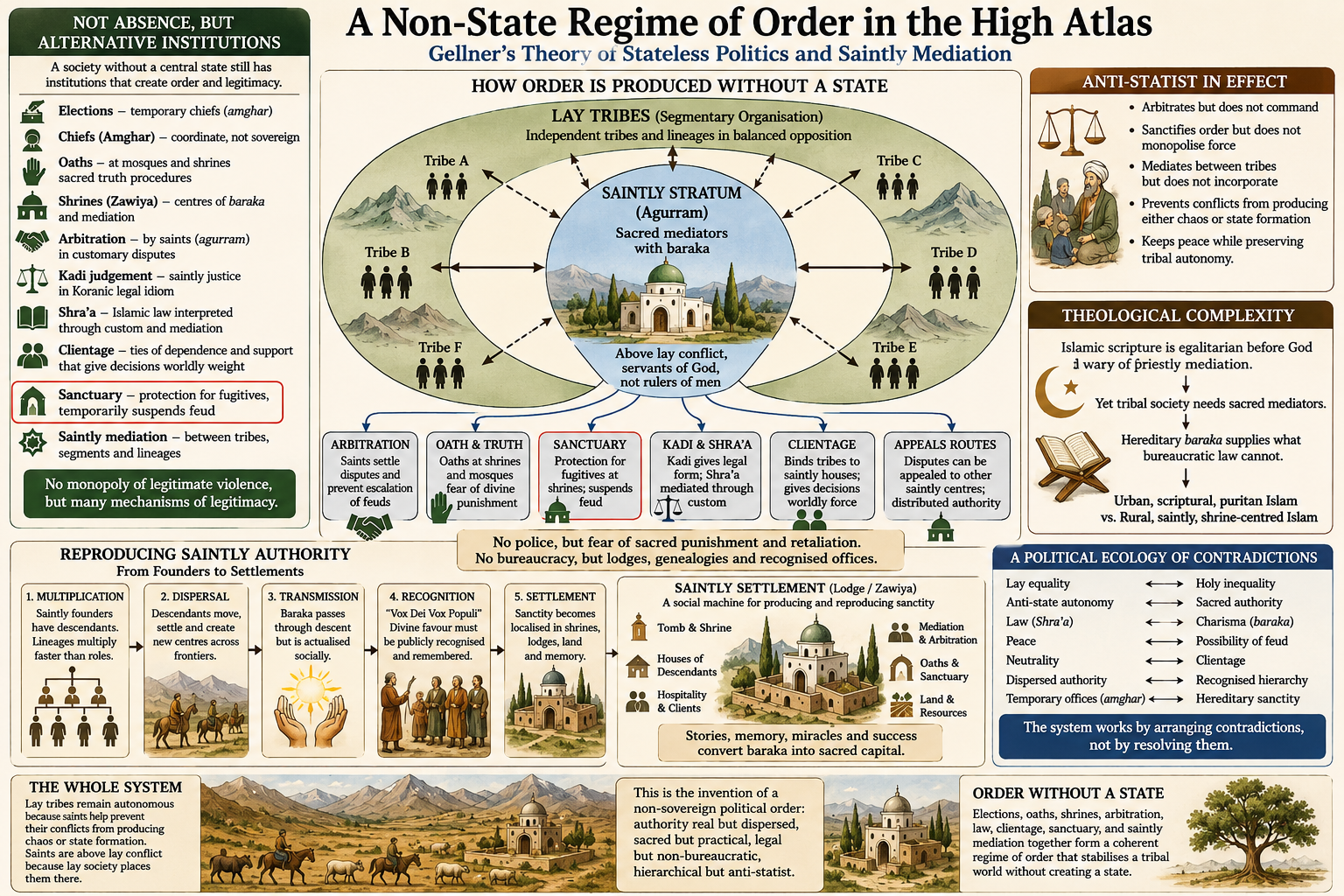
Gellner also has a wider theory of stateless politics. Gellner is not describing absence. He is describing alternative political institutions. Elections, chiefs, oaths, shrines, arbitration, clientage, sanctuary, Kadi judgement, Shra’a, and saintly mediation together form a non state regime of order. There is no monopoly of legitimate violence, but there are mechanisms of legitimacy. There is no court hierarchy, but there are appeal routes among saintly centres. There is no police, but there is fear of sacred punishment and retaliation. There is no bureaucracy, but there are lodges, genealogies, and recognised offices.
The saints keep peace but do not become rulers. They solve problems that might otherwise invite state formation, but they do so in a way that prevents the emergence of an indigenous state. The saint is therefore anti statist in effect, even though he performs some state like functions. He arbitrates but does not command. He sanctifies order but does not monopolise force. He mediates between tribes but does not incorporate them.
There is also a theological complexity here. Islam, at least in its scriptural and legal form, can be understood as egalitarian before God and suspicious of priestly mediation. Yet here saintly lineages mediate divine blessing and social order. Gellner’s broader theory of Islam often turns on this tension between scriptural, urban, puritan Islam and rural, saintly, shrine centred Islam. He gives the political reason for the rural saintly form. A tribal world without central government needs sacred mediators. Hereditary baraka supplies what bureaucratic law cannot.
Gellner’s approach refuses to confuse the absence of the state with the absence of order. It shows that the High Atlas has political institutions, but they are not state institutions. It shows that religious figures perform political work, but not as priests of a church or bureaucrats of a state. It shows that law exists, but in hybrid form, as Shra’a mediated by saints and Kadis. It shows that truth procedures exist, but through oaths and shrines. It shows that offices exist, but lay offices are temporary while saintly status is hereditary. It shows that social control exists, but through moral authority, clientage, sacred fear, and reputational pressure rather than centralised enforcement.
The internal divisions of his account form a single argument. The lay tribes elect temporary chiefs because they need coordination without sovereignty. The saints supervise or legitimate these processes because the lay segments distrust one another. Oaths at mosques and shrines provide sacred truth procedures. Arbitration by saints substitutes for courts, though without full coercive enforcement. Appeals among saintly centres show distributed authority. The Kadi gives saintly judgement a Koranic and legal idiom. Clientage gives sacred verdicts worldly weight. Sanctuary interrupts feud. The whole system creates order without government.
The holy and the lay are not two separate domains. They are mutually constituted positions inside one political ecology. The lay world produces the need for the holy because segmentary balance generates disputes that cannot always be solved internally. The holy world depends on the lay because saintly authority is recognised, funded, visited, feared, and needed by lay tribes. The saints are above lay conflict only because lay society places them there. The lay tribes remain autonomous only because saints help prevent their conflicts from producing either chaos or state formation.
Gellner’s theory is about the invention of a non sovereign political order. Its key concepts, amghar, agurram, baraka, Shra’a, Kadi, oath, shrine, sanctuary, clientage, arbitration, balanced opposition, rotation, and segmentary organisation, all name pieces of a system in which authority is real but dispersed, sacred but practical, legal but non bureaucratic, hierarchical but anti statist. Gellner’s brilliance lies in showing that the system works not by resolving its contradictions, but by arranging them. Lay equality requires holy inequality. Anti state autonomy requires sacred authority. Law requires charisma. Peace requires the possibility of feud. Neutrality requires clients. The chapter is powerful because it lets those contradictions remain visible.
Gellner also answers the question of how that authority is actually reproduced through people, stories, descent, charisma, settlement, memory, and success. After establishing the model of a stateless or weakly governed tribal world, a segmentary lay order built around balanced opposition, and a sacred stratum of hereditary saints who mediate, arbitrate, bless, protect, and stabilize he then asks what happens when one looks at the saints themselves, not merely as an abstract social category, but as lives, lineages, careers, reputations, and multiplying descendants. Gellner is not interested in saints as private personalities, inward spiritual heroes, or psychological cases. Nor is he writing hagiography, that is, a devotional account of holy lives meant to edify believers. He is instead analysing what one might call the sociology of hagiography. A “life of a saint” in this context is not just a life story. It is a mechanism for distributing legitimacy. It explains why one lineage possesses baraka, why one settlement is treated as sacred, why one shrine has standing, why one descendant may mediate, why one holy house can attract clients, and why one man rather than another may be believed to carry grace.
To do this Gellner begins with multiplication, then dispersal, then transmission of sanctity, then popular recognition, then spatial and institutional form. Saintly descent creates a problem of proliferation. A saintly founder has descendants. Those descendants have descendants. If sanctity is hereditary, then saintly persons multiply. The number of people who can claim descent from the saintly ancestor expands across generations. Yet the number of available saintly roles, mediation positions, shrine centres, recognised patronage niches, and viable holy settlements does not expand indefinitely at the same rate. Here Gellner identifies a basic structural tension: hereditary charisma multiplies biological claimants faster than the social system can generate recognised offices for them.
The anthropological point is that a purely personal charisma dies with the charismatic individual unless it is routinised. Max Weber argued that charismatic authority, originally attached to an extraordinary person, must be stabilised after that person’s death if it is to endure. It can be routinised through office, doctrine, property, discipleship, or heredity. In the High Atlas case, charisma is routinised mainly through descent. The saint’s baraka, his sacred blessing or divine potency, is believed to pass through a lineage. But this creates what might be called the demographic problem of charisma. If many descendants exist, which ones really count? Which ones carry effective baraka? Which ones become mediators? Which ones remain merely genealogically saintly but practically marginal?
Gellner does not treat baraka as a simple substance that everyone in the line possesses equally. Local belief may speak as though grace flows by divine favour, but social reality imposes selection. Some saintly descendants become powerful. Others remain obscure. Some lineages become attached to successful shrines. Others fade. Some holy settlements become recognised centres of arbitration. Others become little more than villages with a prestige claim. So the question is not merely whether sacred grace is hereditary, but how hereditary grace is socially validated.
When he discusses the saintly diaspora “diaspora” means dispersal from an original centre. The descendants of Sidi Said Ahansal and related saintly lines do not remain confined to one place. They spread, hive off, settle elsewhere, form new centres, attach themselves to new tribal environments, and claim or reactivate sanctity in different ecological and political circumstances such as Amzrai, Tighanimin, Tidrit, Troilest, Temga, Sidi Aziz, Asker, Sidi Ali u Hussein, and Bernat.
Sanctity must be portable and localisable at the same time. It must be portable because descendants move. A saintly man may leave the main lodge, establish himself elsewhere, marry, attract clients, or be called upon by tribes needing mediation. But sanctity must also become localised, because a saintly settlement requires a shrine, a name, a recognised genealogy, a history of interventions, a network of clients, perhaps land, perhaps a tomb, perhaps a reputation for miraculous protection. The saintly diaspora is therefore not random migration. It is the expansion of sacred legitimacy into new political spaces.
The saints expand into frontiers, tribal borderlands, zones of conflict, transhumant routes, and places where lay tribes need mediators. A holy man is most useful where ordinary political order is fragile. In a peaceful, centrally governed region, the saint’s arbitration role might diminish. In a turbulent tribal zone, his value increases. This means that sanctity thrives not despite conflict but partly because of conflict. Holy men need a world in which holy mediation matters. The saintly diaspora follows the fault lines of tribal society.
So the saints are not simply religious specialists. They are political specialists in a society that cannot openly tolerate ordinary political domination. Their success depends on occupying a niche between feuding lay groups. “Niche” here should be understood almost ecologically. A saintly centre survives where there is a demand for its services, where conflict needs mediation, where pasture routes need guarantees, where oaths need sanctified witnesses, where sanctuary is valued, where a sacred outsider can be trusted more than a rival insider.
Baraka flows. It is imagined as divine blessing, but it also behaves sociologically like a scarce and unevenly distributed resource. It flows through descent, but not mechanically. It may be intensified by proximity to a powerful ancestor, by possession of a shrine, by public recognition, by success in mediation, by miracle stories, by moral reputation, by marriage, by hospitality, by the ability to attract followers, and by the cumulative force of local memory. Grace is therefore not simply inherited biological substance. It is socially actualised sacred capital.
Sacred capital means recognised holiness that can be converted into practical authority. A saintly descendant with no recognition, no clients, no shrine, no successful interventions, and no public reputation may possess a genealogical claim, but his baraka remains weak in social effect. By contrast, a saintly house that repeatedly mediates disputes, protects fugitives, receives offerings, hosts visitors, and is remembered in stories of divine favour accumulates sacred capital. The grace is believed to come from God, but its social visibility depends on public validation.
Gellner’s subsection “Vox Dei Vox Populi” - the Latin phrase means “the voice of God, the voice of the people” - points to a paradox. If baraka is divine favour, it should be determined by God, not by popular opinion. Yet in practice, a saint is known to be effective because people recognise him as effective. His grace is validated by reputation. If the tribes believe that a holy man carries blessing, bring disputes to him, respect his sanctuary, fear false oaths before his shrine, and tell stories of his miracles, then his sanctity becomes socially real. Divine election and popular recognition become inseparable.
Gellner is saying that in social life, divine favour must be publicly legible. A purely invisible baraka with no social recognition could not perform the functions required of saintly authority. The saint must be believed in. The belief must circulate. It must be repeated in stories, enacted in ritual, confirmed by successful arbitration, embodied in visits to shrines, and protected by genealogy. Vox Dei Vox Populi names this social theology of recognition: God chooses, but the people recognise, and without that recognition the choice cannot operate politically.
Weber’s charisma is recognised by followers. It does not exist socially unless followers accept the charismatic claim. In Gellner’s High Atlas, however, charisma is not a revolutionary personal force that breaks tradition. It is hereditary, routinised, embedded, shrine based, and mediated through a local Islamic idiom. The saint is charismatic, but not in the modern celebrity sense, nor even in the purely prophetic sense. He is a bearer of inherited, locally ratified, ritually embodied charisma. This is why his phrase “tribally routinised charisma” is so apt.
The saints do not govern as bureaucrats, magistrates, police, or sovereign rulers. They govern in the broader anthropological sense of helping to regulate conduct. They produce order by mediation, oath, sanctuary, blessing, arbitration, hospitality, moral pressure, and the public fear of sacred punishment. Their authority is not sovereign authority. It is not the authority of command backed by a monopoly of violence. It is regulatory authority distributed through sanctity.
This produces a deep tension. Saintly authority depends on the saints not being ordinary political rulers, yet they must perform many functions that ordinary political rulers might otherwise perform. They must be powerful enough to settle disputes, but not so powerful that they appear to be chiefs. They must be wealthy enough to maintain hospitality and prestige, but not so obviously exploitative that their sanctity becomes suspect. They must be genealogically superior enough to be set apart, but not so alien that local tribes reject them. They must be peaceful, yet politically consequential. They must be outside the feud, yet useful within a feuding world.
Gellner gives this problem a spatial and institutional form. A holy settlement is not merely a village inhabited by descendants of a saint. It is a social machine for producing recognised sanctity. Different settlements embody different degrees and forms of saintly effectiveness. Some are major lodges with shrines, genealogical depth, political influence, and wide patronage networks. Others are offshoots, marginal claims, new foundations, reactivations, rival centres, or settlements whose saintly identity is ambiguous.
A “lodge” in this context is not simply a building. It is a zawiya, a religious centre, shrine settlement, and institutional base of a holy lineage. The zawiya may contain a tomb, houses of saintly descendants, spaces of hospitality, ritual focal points, and a reputation for mediation. It is a place where sanctity is stored, displayed, inherited, contested, and made available to the surrounding lay world. The settlement is therefore a political and religious institution fused into one.
The holy settlement also reveals the importance of place in Gellner’s argument. Earlier we thought of baraka as flowing through descent alone. But it also settles in places. Tombs, shrines, lodges, villages, land deeds, and sacred geography make grace durable. A saintly lineage without a recognised place may struggle to sustain its authority. A shrine gives memory a location. It allows people to swear oaths, seek sanctuary, visit, give, receive blessing, and locate the saintly past in material space.
Gellner is studying the social materialisation of belief. Sanctity requires bodies, descendants, tombs, land, buildings, routes, clients, animals, crops, marriages, and stories. Grace flows, but it flows through institutions. A saint lives, dies, leaves descendants, becomes remembered, becomes localised, becomes invoked, becomes a source of claims. The life of the saint becomes the life of a settlement.
Previous Parts here