Saints of the Atlas 4


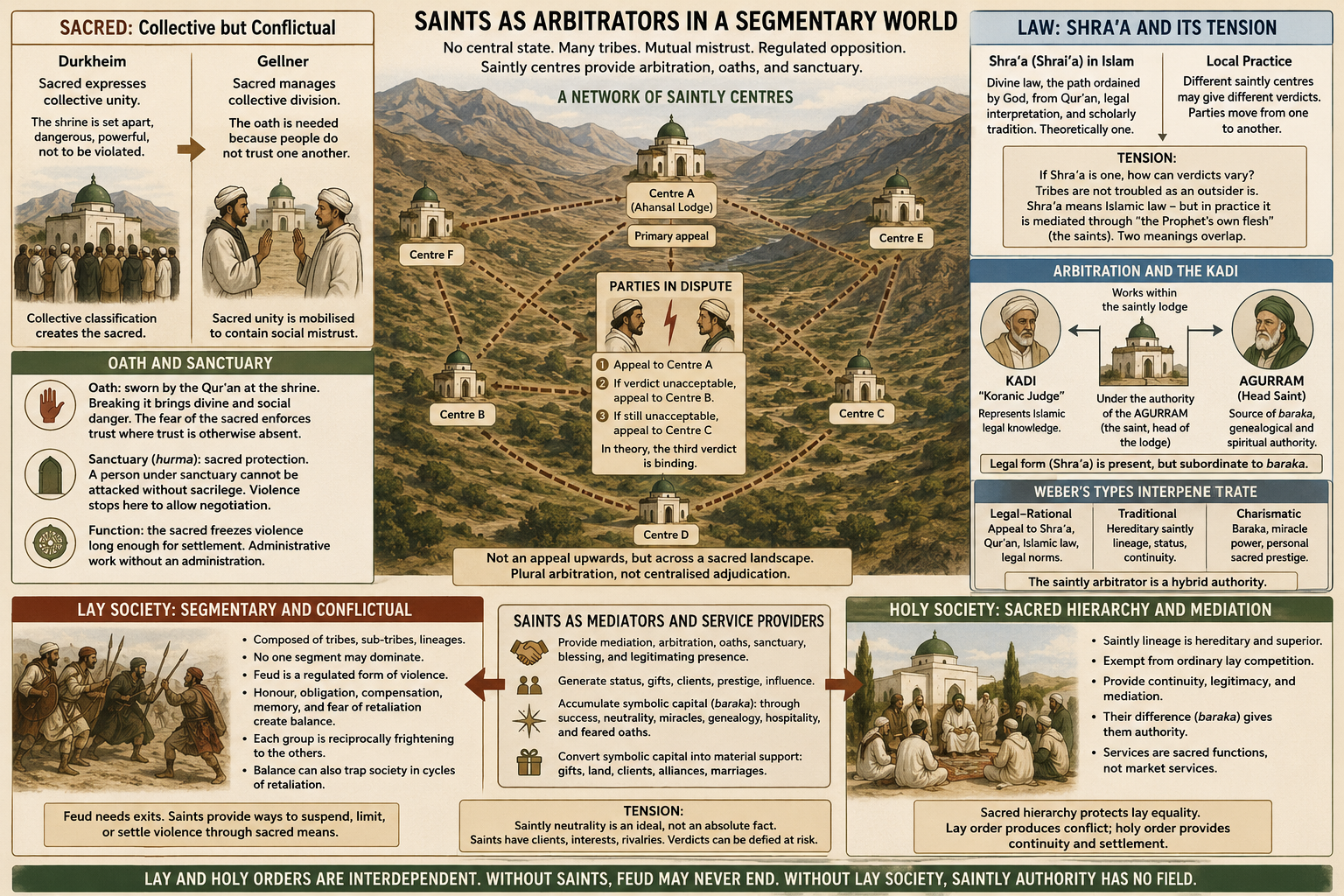
Durkheim argued that the sacred is not just private belief but a collective classification that organises social life. The shrine is sacred because people collectively treat it as set apart, dangerous, powerful, and not to be violated. But Gellner’s use of the sacred is more conflictual than Durkheim’s. The sacred here does not simply express collective unity. It manages collective division. The oath is needed because people do not trust one another. Sacred unity is mobilised to contain social mistrust.
Gellner then turns to arbitration. The saints are ultimately arbitrators rather than judges. A judge, in the full state sense, issues a binding decision backed by coercive institutions. An arbitrator depends on the willingness of the parties to accept the decision. Gellner gives the example of Ait Abdi practice near the main Ahansal lodge: if a dispute cannot be settled locally by appeal to the chief, it is taken to saints to be arbitrated according to the Shra’a, or Islamic law. If one saintly centre’s verdict is unacceptable, the parties may move to another, then another, with the third verdict treated in theory as binding. This shows both the sophistication and the contradiction of the system. There is no single sovereign court. There is a chain of possible saintly centres. Authority is distributed. The parties move through a sacred landscape of arbitration. They do not appeal upwards through a state hierarchy, but across a network of holy centres. This is plural arbitration, not centralised adjudication.
The term Shra’a, or Shari‘a, needs careful explanation. In Islamic terms, Shari‘a means divine law, the path or law ordained by God, elaborated through scripture, legal interpretation, and scholarly tradition. But in the local context Gellner analyses, there is a tension. Tribes appeal to saints for “Koranic” judgement, yet different saintly centres may give different verdicts. If Shra’a is theoretically one, how can repeated appeals to different centres produce different answers? Gellner explicitly notices this contradiction: the saints are supposed to adjudicate according to theoretically unique Koranic law, yet the practice of moving from one saintly centre to another implies variable decisions. The contradiction is obvious to an outside observer, but Gellner says it does not trouble the tribesmen in the same way. One might say, he suggests, that for them Shra’a has come to mean whatever the saints, “the Prophet’s own flesh”, decree, though he immediately qualifies this, because the proper meaning of Shra’a is not wholly ignored.
That qualification is very important. Gellner is not saying the tribes are simply confused or that Islamic law is merely a mask for saintly whim. Rather, he is showing that two meanings overlap. On the one hand, Shra’a refers to universal Islamic law. On the other, locally effective legal judgement is mediated through saintly authority. The saintly verdict is respected because it is supposed to be Koranic, but its practical force also depends on who gives it. Law and charisma interpenetrate.
Max Weber distinguishes legal rational authority, traditional authority, and charismatic authority. In Gellner’s case, these types are not neatly separated. The appeal to Shra’a invokes legal and textual authority. The saint’s hereditary status invokes traditional authority. His baraka invokes charismatic authority. The saintly arbitrator is a hybrid. He gives what appears as legal judgement, but the judgement is embedded in inherited sanctity and local prestige.
The figure of the Kadi makes this hybridity clearer. Gellner notes that the saintly lodges, especially the main lodge, had a rudimentary internal judicial organisation, including one or more persons known as the Kadi, or Koranic judge. The Kadi’s role was to pass the supposedly Koranic verdict under the general authority of the saint, the agurram. This is a striking institutional arrangement. The Kadi represents Islamic legal knowledge, but he operates inside a saintly lodge. He is not an autonomous state judge. He is subordinate to the sacred authority of the saintly lineage. Thus Gellner is not describing a fully developed court system. He is describing a partial legal apparatus embedded in a non state sacred institution. The Kadi gives the saintly lodge a legal face. He allows the lodge to claim that its arbitration is not merely charismatic persuasion but judgement according to Islamic norms. Yet because the Kadi works under the saint’s authority, legal form remains subordinate to baraka.
This gives us a much more complex political theory than the simple statement “saints mediate tribes”. The saints do not merely calm quarrels. They operate at the intersection of customary tribal politics, Islamic law, sacred charisma, shrine ritual, and public recognition. Their authority is neither purely religious nor purely political, neither purely legal nor purely magical, neither purely genealogical nor purely institutional. It is the combination that matters.
Another internal division concerns the feud and the logic of lay politics. Gellner understands feuding not as an absence of order but as a regulated form of violence. A feud is a system of retaliatory relations between groups. It is dangerous and destructive, but it is not random. It is governed by honour, obligation, compensation, memory, kinship, and fear of counter retaliation. In such a system, each group is, as Gellner’s language suggests, reciprocally frightening to the others. The possibility of retaliation deters excessive aggression. This is balanced opposition at the level of violence. No group can attack without anticipating response. No group can dominate easily because other groups can combine. Yet this balance can also trap society in cycles of retaliation.
That is why the saints are needed. They do not abolish feud. They provide ways of suspending, limiting, or settling it. Their shrines, oaths, sanctuaries, and arbitration procedures create exits from retaliation. The institution of sanctuary belongs here. A shrine or saintly place may possess hurma, inviolability. Hurma means sacred protection, the condition of being forbidden to violate. A person under sanctuary cannot be attacked without sacrilege. This creates a protected space within a violent landscape. Sanctuary is an institution that makes negotiation possible. It freezes violence long enough for settlement. The political sophistication of this is considerable. Where the state would create safe spaces through police and courts, the saintly system creates them through sacred fear. The shrine says: here violence stops, not because an official guard will arrest you, but because violation of the sacred brings shame, danger, and divine punishment.
Again, the sacred performs administrative work without becoming an administration. Saints are service providers, but not in a modern market sense. They provide mediation, arbitration, oath administration, sanctuary, blessing, and legitimating presence. Their “services” are sacred functions. Yet these functions also generate status, gifts, clients, prestige, and influence. A saint who successfully arbitrates becomes more respected. A shrine where oaths are feared becomes more powerful. A lodge that settles disputes attracts clients. Sacred service reproduces sacred authority. The saints possess symbolic capital: prestige recognised as legitimate. Their baraka is sacred symbolic capital.
But symbolic capital must be enacted. It is accumulated by successful interventions, recognised neutrality, miracle stories, genealogical prestige, hospitality, and the fear attached to oaths. It can also be converted into material support, gifts, land, clients, and marriage advantages. Sacred prestige becomes socially productive. At the same time, Gellner makes clear that saintly neutrality is an ideal, not an absolute fact. Saints can have clients. They can be offended. Their verdicts can be defied at risk. Their clients may become part of the pressure exerted on reluctant parties.
Gellner notes that refusing arbitration risks antagonising the saint and indirectly his clients; the more saintly he is, the greater the impiety, but also the more numerous the clients and the more dangerous the offence. Sanctity and clientage reinforce each other. Spiritual danger and social danger are intertwined. A client is a dependent, follower, protected person, or affiliated group attached to a patron. In the saintly context, clients may look to a saint for mediation, protection, blessing, or status. The saint gains influence through them, but they also gain security through him.
Patronage here is not bureaucracy. It is relational, moral, and sacredly charged. But it can still be politically forceful. A saint with many clients is harder to ignore. This introduces a tension in saintly arbitration. The saint is supposed to be neutral, but the saint is not socially empty. He has a lodge, descent group, clients, reputation, interests, rivalries, and material base. His neutrality is therefore a socially produced fiction, not necessarily a lie, but an ideal that must be maintained. He is neutral enough to mediate because he is not an ordinary lay segment. But he is not neutral in the abstract sense of having no interests. Mediation requires difference, not purity. The saint can mediate because he is differently placed. He is not simply impartial in a modern bureaucratic sense. He is sacredly distinct. His difference gives him authority. His baraka creates the distance necessary for arbitration. But that same difference creates hierarchy, clients, and material advantage. Thus the solution to lay conflict introduces another form of inequality.
In this way Gellner modifies the classic segmentary model. Evans Pritchard’s segmentary lineage theory could suggest that order arises from balanced opposition alone. Gellner shows that balanced opposition is not enough. The lay tribes may balance one another, but they also require an external or quasi external sacred stratum to handle elections, oaths, arbitration, sanctuary, and major disputes. The saints are not a decorative addition to segmentary order. They are one of its enabling conditions. The political logic is paradoxical. Lay society is egalitarian among its armed male segments and hostile to permanent chieftaincy. Yet it depends on hereditary saintly hierarchy. The saints are superior by birth, but their superiority is acceptable because it is not lay sovereignty. The tribes resist being ruled by one of their own, but they accept mediation by those who are not quite “one of their own” in ordinary terms.
Sacred hierarchy protects lay equality. The lay order produces conflict and mistrust because no segment can be allowed to dominate. The holy order provides continuity, legitimacy, and mediation because it is exempted from ordinary competition. Lay society is transient, rotating, balanced, armed, honour bound, and segmentary. Holy society is enduring, genealogical, pacific, blessed, and mediating. Each needs the other. Lay order without saints risks endless feud. Saintly authority without lay society lacks the conflict field that gives it function.
Coming Next Part 5 - Stateless Politics