Lori Ringhand, We the Voters: The Constitutional Choices That Shape America’s Elections
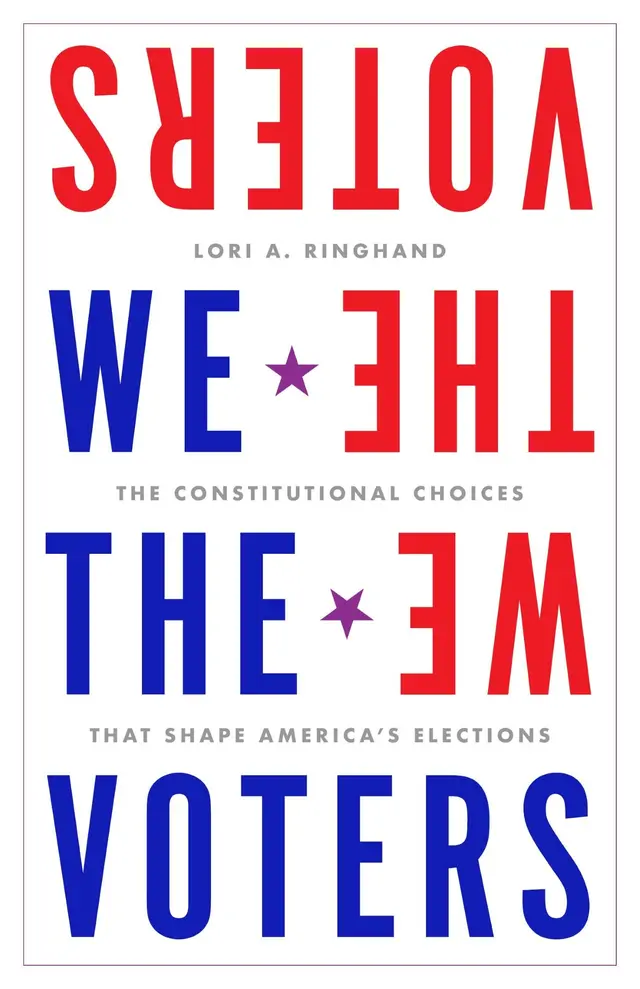
Lori Ringhand, We the Voters: The Constitutional Choices That Shape America’s Elections (Stanford University Press, 2026)
There are many discouraging aspects about the deterioration of voting rights in the U.S. since the 1970s. But what should cause the most pain is likely to come from considering the Dixie Confederacy’s regular reassertions of its continuing desire to ensure that only certain citizens should be allowed to vote. Along with the Emancipation Proclamation, the enactments of the 13th, 14th, and 15th amendments to the U.S. Constitution after the Civil War were the crowning features of that horrific conflict, the reason for all that death and destruction. But while the North got bored with Reconstruction, the South never gave up their attacks on it. Lori Ringhand’s We the Voters is a painful reminder of the fact that the resolute attempts to keep Whites in charge, however Congress might have tried to keep things fair, have been just as obsessive as the “super hardcore” reenactors depicted in Horwitz’s Confederates in the Attic.
When one sees as many books on American democracy and voting as I do, one may make the mistake of incorrectly pigeonholing a new work based on the title, contents, and introduction. I certainly did that with Lori Ringhand’s We the Voters. I jumped to an early conclusion that this would be one more correct but surely unnecessary addition to the huge pile of recent books indicating the dangers of the Electoral College, gerrymandering, and similar assorted failures of the U.S. system. But, while this book is indeed a kind of primer of such shortcomings, it is likely not the best book of that sort for the general reader. Rather, because of its intense focus on recent (and not so recent) court decisions that, in conjunction with (i) Constitutional provisions/mistakes of “the Founders,” and (ii) the perseverance and success of post-bellum lawyers and judges with particular (racist?) axes to grind, this work seems to me better suited as a text for law students or those considering embarking on careers in law or advocacy.
Ringhand’s grasp of the history is quite sharp, and her discussion of the arguments in such cases as Harper v. Virginia (1966) and Bush v. Gore (2000) is both expert and compelling. But I think a casual interest in American democracy and a limited competence for legal argument may not prove sufficient to keep readers engaged. In spite–or perhaps because–of the author’s expertise and willingness to include a dozen citations per page, it is often dense and…well...textbooky.#
There is no doubt, however, that We the Voters will be found useful by all those who want to be up on the central legal and legislative fights involving voting rights since the Civil War. A bit of name-checking will be illustrative. In addition to Plessy, there are discussions of all of these depressing post-Reconstruction proceedings: The Slaughterhouse Cases (1873), U.S. v. Cruikshank (1875), The Civil Rights Cases (1883), and Giles v. Harris (1903). And, of course, the Amendments and statutes that led to them are also explained. The moments of relief that one may enjoy when such laws as the Voting Rights Act make it into the books are, like Trumpian contradictions, regularly followed by SCOTUS overturns or repeals. The research here is entirely up to date, so we hear about the most relevant disputes around the country, whether emanating from Fulton County, Georgia or Arizona Tribal Councils, the Electoral Count Act of 1887, or the Electoral College Reform Act of 2022. There is even a discussion (and to me at least, another somewhat saddening one) of why Ringhand doubts the National Popular Vote Compact would survive the current Supreme Court, even if it somehow got all the states it needed to sign on to it.
There should be no doubt about the steepness of the backsliding to which Ringhand points. Before Shelby County v. Holder (2013), the DOJ blocked hundreds of discriminatory voting changes. Since that decision, at least 29 states have passed new restrictive voting laws. As we watch our two main parties race toward the most disgusting (and silliest-looking) districts that anybody has ever imagined, it should be remembered that way back in 2022, it was already the case that fewer than 10% of U.S. House seats were truly competitive due to intentional packing or cracking of districts. And if passage of the Voting Rights Act gave one hope for a while, the recent removal of polling places in various minority-rich areas has sharply decreased Black voting percentages–just as intended.
In the end, Ringhand proposes two items as remedies. Thing 1 is somehow getting Rick Hasen’s Right to Vote Amendment🗡into the Constitution. Thing 2 is for the American citizenry to become more passionately involved in voting and pestering state legislators to oppose gerrymanders and enact such regional improvements as multimember state legislative districts. Unfortunately, her concluding chapter is much less incisive and compelling than her earlier legal ruminations, though they are likely to leave readers just as morose.
It is interesting that Ringhand begins and ends her book with Madison, for in spite of opening her final chapter with a quotation from Federalist 14 in which that “Founder” exhorts us not to glorify “a blind veneration for antiquity, custom, or names,” it is just that sort of adulation for Madison that is responsible for the limited horsepower here. Madison, of course, was a firm believer in the idea that to save democracy we must ensure that our systems have lots of “glit hes” in the form of multiple legislative branches, vetoes, overrides, cross-cutting interests, supermajority requirements, and the like. All of them are called upon to take their place in saving us from too much “people power.” In the end, however, they have failed, perhaps by keeping us from sufficient people power.
I note that another recently reviewed book, Stephen Legomsky’s Reimagining the American Union, boldly argues that we have to somehow get states entirely out of the way in order to realize any sort of true democracy.$ Here, Ringhand has proposed what many will surely take to be a much saner, Madisonian path: try to fix what we have now by working really hard to add a couple more gears or cogs. You know, get a new Amendment or two in the Constitution. File more lawsuits. Perhaps get a few new Justices appointed with whom we are more comfortable. She thus takes the lawyerly tack of focusing on the Judiciary and the fixing of Article V. This can be seen to be an acceptance of the principle that the Madisonian engine can still run if we simply swap out a few broken parts. Legomsky instead aims at dismantling Federalism itself, suggesting that the "engine" (the states' role in federal elections) is fundamentally incompatible with authentic democracy in the 21st-century. I leave readers to form their own conclusions regarding what sort of approach is more rational in these dark days. I myself would be content with Recall and Referendum.
Note
#I was at least glad to find that there is no extended explanation here of the “intermediate” level of judicial review that is applied to gender-based statutory distinctions pursuant to the Equal Protection Clause, as compared with the “lower tiered” and “strict scrutiny” standards applied to other sorts of classifications. The lengthy discussion of Anderson-Burdick tests that have stemmed from Justice Stevens’ Crawford decision may be found a bit too granular even for old analytic philosophers.
🗡My 3:16 AM review of Hasen’s book is here.
$My 3:16 AM review of that book is here.

About the Author
Walter Horn is a philosopher of politics and epistemology.
His 3:16 interview is here.
Other Hornbook of Democracy Book Reviews
His blog is here