Saints of the Atlas 1, 2 & 3


. Siba
European anarchy remains the rebel wet dream. But on the Mediterranean coast of North Africa it was a genuine and rich social reality before the coming of industrialisation, puritanism and nationalism tried more or less successfully to bury it. Ernest Gellner’s book ‘Saints of The Atlas’ describes it. What follows is my attempt to remind readers of this social formation. Why bother? Well, anti-Muslim racism is rearing its ugly head across the world. The rise of English, Welsh and Scottish Nationalism in the recent local elections and the racist US President and his regime’s illegal and murderous actions in the Middle East are symptoms. We need to prosecute the racists in the courts but we also need to talk about Muslim society in a much more intelligent, informed and thoughtful way. Just as we refuse to think about Jewish culture solely via the prism of Israel’s current genocidal regime, we need to extend our vision of Islam so as to see its richness, variety and beauty. I admire Gellner’s work and think it gives us a slice of that richness and beauty so I thought the time was right to share.
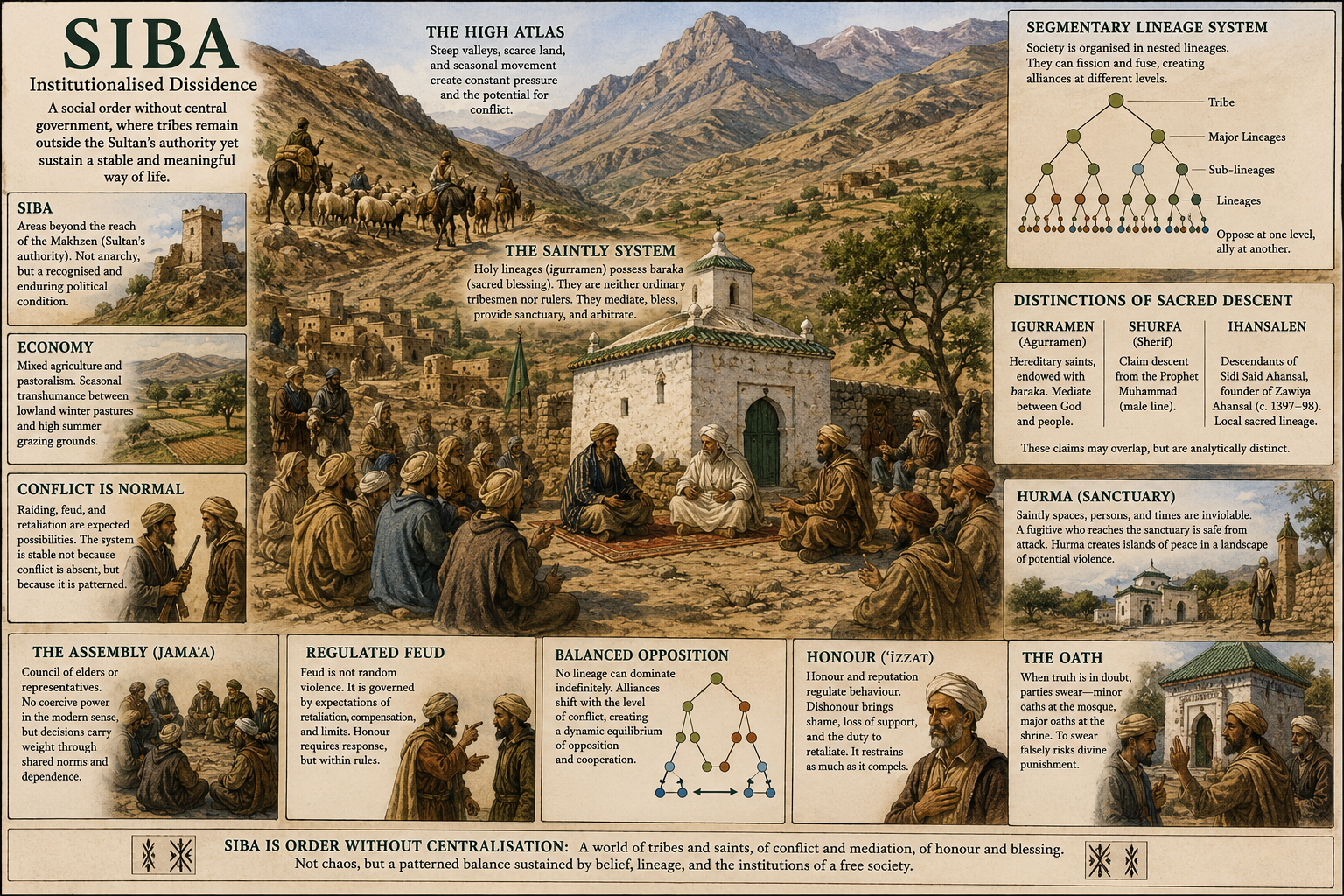
The setting is the Berber population of the central High Atlas of Morocco, especially the groups often referred to as the Shluh. These are not a homogeneous people but a mosaic of tribes and sub tribes, organised through what Gellner repeatedly calls a segmentary lineage system. This term refers to a specific form of social organisation in which descent groups are nested within one another in a genealogical hierarchy. A lineage splits into sub lineages, which split again, producing a branching structure that is at once genealogical and political. These segments are not fixed administrative units. They are activated situationally. In one dispute, a small lineage may act as a unit. In another, several lineages may fuse into a larger segment against a common opponent. This capacity for fusion and fission is one of the central mechanisms of order in the absence of a central authority.
The High Atlas is a region of steep valleys, difficult communications, and sharply limited agricultural land. Much of the population practises a mixed economy of agriculture and pastoral transhumance. Herds are moved seasonally between lowland winter pastures and high summer grazing grounds. This movement is not incidental. It creates constant points of friction over access to land, water, and routes. The scarcity and distribution of resources generate what Gellner treats as a structurally permanent condition of potential conflict. Raiding, feud, and retaliation are not aberrations but expected possibilities within the system.
Siba is often translated as “dissidence” or “anarchy,” but Gellner insists that such translations are misleading if they suggest mere disorder. Siba names a recognised political condition in which tribes are effectively outside the control of the central government, historically the Sultan’s authority. These areas are not lawless in the sense of lacking norms. Rather, they lack a monopoly of legitimate coercion. The distinction Gellner draws is between makhzen areas, where the Sultan’s administration operates, and siba areas, where it does not. The High Atlas tribes he studies largely fall into the latter category prior to the consolidation of French colonial rule in the early twentieth century.
The sociological problem is how a society functions when it lacks a centralised apparatus capable of enforcing decisions across the whole population. Gellner’s answer is not that it approximates a state in miniature, nor that it collapses into chaos, but that it operates through a combination of segmentary structure and a set of normative institutions that regulate conflict. One such institution is the feud, which, paradoxically, is itself regulated. Feuding is not random violence. It is governed by expectations about retaliation, compensation, and the limits of escalation. The existence of these expectations allows actors to anticipate responses and therefore constrains behaviour.
Another key institution is the assembly, often referred to in Berber contexts as the jama‘a. This is a council of male elders or representatives that deliberates on matters affecting the group, such as disputes, resource allocation, and collective action. The assembly does not have coercive power in the modern sense, but its decisions carry weight because they are embedded in shared norms and because individuals depend on the group for protection and cooperation. The authority here is diffuse and moral rather than centralised and coercive.
Gellner introduces the notion of balanced opposition, a term closely associated with segmentary lineage theory. The idea is that opposition between groups is structured in such a way that no single group can dominate indefinitely. Alliances shift depending on the level of conflict. Two lineages may oppose one another in a local dispute, but unite against a third lineage at a higher level. This produces a kind of equilibrium, not in the sense of peace, but in the sense of a dynamic balance in which forces counteract one another. The system is stable not because conflict is absent but because it is patterned.
Within this framework, Gellner begins to signal the importance of religious figures, the “saints” of the book’s title, though he does not yet analyse them in full detail. These are individuals or lineages believed to possess baraka, a form of sacred power or blessing. Baraka is not merely symbolic. It has practical consequences. Saints and their descendants are often treated as neutral or quasi neutral actors in a field otherwise structured by segmentary opposition. Because they are associated with holiness, they can act as mediators in disputes, arbitrate conflicts, and provide sanctuary. Their authority does not derive from force but from a widely recognised belief in their special status.
The presence of saints introduces a second axis into the social structure, one that cuts across the segmentary organisation of tribes. Whereas the lineage system is based on descent and produces a pattern of opposition, the saintly system is based on charisma and produces a pattern of mediation. Gellner is preparing the reader to see that the coexistence of these two principles is central to the functioning of the society. The segmentary system alone would risk endless fragmentation. The saintly system introduces nodes of relative neutrality that can dampen and redirect conflict.
The concept of hurma refers to a kind of sacred inviolability. Certain persons, places, or times are treated as protected from violence. Sanctuaries associated with saints often enjoy this status. A fugitive who reaches such a sanctuary may be temporarily safe from retaliation. This creates spaces within the otherwise conflict prone landscape where negotiation can occur. Again, belief is not a superficial layer. It structures practical possibilities for action.
Gellner also pays attention to the role of honour, often tied to concepts of masculinity, lineage reputation, and the defence of group integrity. Honour is not an abstract value but a regulating principle. It shapes when retaliation is required, when it can be foregone, and how disputes are interpreted. The fear of dishonour can be as powerful a constraint as the fear of physical punishment in a state system.
Historically, Gellner situates these institutions within a long period in which the Moroccan state’s reach was limited. The Sultan’s authority, while symbolically acknowledged, did not translate into effective administration in the High Atlas. Taxation, conscription, and legal enforcement were sporadic or absent. It is only with the French colonial pacification, completed in the early 1930s, that sustained external control is established. Even then, indirect rule often preserved local structures, meaning that the segmentary and saintly systems continued to operate, though increasingly transformed. Gellner is explicit that he is not offering a purely ecological or economic explanation, even though he takes those factors seriously. His focus is on what might be called the political anthropology of the region, the forms of authority, legitimacy, and conflict regulation that allow the society to persist.
The triad he invokes, power, belief, wealth, signals this, but he privileges the first two because they are where the distinctive features of the system lie. What emerges is a picture of a society that is neither chaotic nor centrally governed but organised through a set of interlocking mechanisms.
Segmentary lineage structure provides a grammar of opposition and alliance. Institutions such as the assembly and the regulated feud provide procedures for managing disputes. Concepts like honour and inviolability supply normative constraints. The figure of the saint, endowed with baraka, introduces a cross cutting principle of mediation and sanctuary.
Order is not here the product of a sovereign power imposing rules from above. It is the emergent effect of a system in which conflict is expected, structured, and partially neutralised by institutions that do not resemble those of the modern state. The background is therefore an argument about the plurality of forms of social organisation and about the possibility of stability without centralisation.
We’re so used to thinking that order has to be centralised, that there has to be a strong state and so on. What this social structure reminds us is that you can have order through non-centralised, weak or even absent state anarchy. Siba, segmentary lineage, baraka, hurma, assembly, and balanced opposition are the elements of a system that, taken together, demonstrate how a society can sustain itself through a complex interplay of structure, belief, and practice in the absence of centralised power.
Next: 2 How is this even possible?
When Gellner turns from description to problematisation the tone shifts accordingly. The language becomes more overtly sociological, and the stakes become clearer. The issue is no longer simply what this society looks like, but how it is even possible. The problem can be stated in a way that resonates with a long tradition in social theory, but Gellner deliberately avoids framing it in purely classical terms. It is not just a version of the Hobbesian question of how order emerges from a war of all against all, though that question is in the background. Nor is it simply a Durkheimian question about how solidarity is maintained. Instead, it is a problem specific to what anthropologists, especially following figures such as E. E. Evans Pritchard and Robert Montagne, had called segmentary societies. These are societies in which there is no centralised sovereign authority, yet there is no collapse into chaos. Gellner’s question is therefore about how a system without a monopoly of legitimate coercion sustain a stable pattern of social relations over time?
To articulate this, he sharpens several technical distinctions . One of the most important is between order and government. Government refers to the presence of a centralised apparatus capable of enforcing rules across a territory. Order, by contrast, refers to the regularity and predictability of social behaviour. The key insight is that these two do not coincide. A society can lack government yet still possess order. The High Atlas tribes are precisely such a case. This separation is conceptually important because it prevents the analysis from smuggling in the conclusion that order must be imposed from above.
Gellner then reintroduces the notion of segmentary lineage organisation, but now in a more explicitly theoretical role. The system of nested lineages is not merely a classificatory scheme. It functions as a ‘political algebra’, a set of rules governing how alliances form and dissolve. The principle of complementary opposition becomes central. This term refers to the way in which segments oppose one another at one level while uniting at another. For example, two sub lineages may be in conflict, but when confronted by an external threat, they combine into a larger lineage. This produces a self balancing system in which no single segment can easily dominate, because any attempt at domination triggers counter alliances at a higher level.
However, this mechanism, taken on its own, is not sufficient. This is where the problem deepens. If the system consisted only of segmentary opposition, it would risk endless oscillation without resolution. Conflict would be regulated in the sense of being patterned, but it would not be effectively contained. You’d end up with an endless bloodbath with every new conflict requiring a further feud. What is needed is something that can interrupt or transcend the logic of lineage opposition. This is where Gellner introduces, in a more explicit theoretical way, the role of ‘saints’ and ‘holy lineages’.
The key sociological concept here is that of structural mediation. Saints, or more precisely the lineages associated with them, occupy a position that is not reducible to the segmentary structure. They are not simply another lineage among others. Their claim to baraka, sacred power, places them in a category that is recognised as distinct. Because of this, they can act as mediators in disputes between ordinary lineages. Their authority is not based on coercion or on genealogical seniority, but on a shared belief in their sanctity. In sociological terms, this is a form of charismatic authority. The important point is that this authority cuts across the segmentary system and provides a mechanism for resolving conflicts that the system itself cannot resolve.
Gellner introduces a second layer to the analysis, one that can be described as the coexistence of two principles of organisation. The first is egalitarian segmentation, in which lineages are formally equal and relations are structured through opposition and alliance. The second is hierarchical sanctity, in which certain lineages are set apart by their religious status. The problem, as Gellner formulates it, is how these two principles can coexist without one destroying the other. An egalitarian system resists hierarchy, yet the saintly system is a form of hierarchy. The puzzle is therefore not just how order is possible, but how these two incompatible principles are combined in a stable way.
At this point, Gellner’s argument begins to take on a more explicitly theoretical character, and it becomes useful to connect it to broader sociological traditions. There is a clear affinity with Durkheim’s idea that social order depends on shared beliefs, but Gellner is more attentive to conflict and division than Durkheim’s emphasis on solidarity would suggest. There is also an implicit dialogue with Weber, particularly in the distinction between different types of authority, though Gellner is less interested in typology than in the structural interplay between them. The closest anthropological antecedents are Evans Pritchard’s analysis of the Nuer and Montagne’s work on North African tribes, both of which had identified segmentary lineage systems as a key to understanding stateless societies.
Yet Gellner’s formulation goes beyond these predecessors by insisting on the necessity of a second, non segmentary element. The problem is not simply how segmentation produces balance, but why that balance does not collapse into permanent instability, what might be called the bloodbath or permanent war problem. The answer, foreshadowed here and developed later, is that the saintly system provides what might be called a transcendental reference point within the society. It introduces values and authorities that are not reducible to the immediate logic of lineage competition.
Another important concept that emerges is that of normative order. This refers to the set of shared expectations that guide behaviour, including rules about feud, compensation, honour, and sanctuary. These norms are not enforced by a central authority, but they are nonetheless effective because they are internalised and because deviation carries social consequences. The existence of such a normative order complicates any simple opposition between law and anarchy. The High Atlas tribes lack formal law in the sense of codified, centrally enforced rules, but they possess a dense network of customary norms that function as law in practice.
Gellner also sharpens the historical dimension of the problem. The tribes are not isolated from the idea of the state. They are aware of the possibility of incorporation into a centralised political order, one associated with the Sultan and sanctioned by Islam. Indeed, they may have resisted this incorporation. This awareness introduces what might be called a counterfactual horizon into the system. The tribes are not simply stateless because they have never known a state. They are stateless in a more reflexive sense, having rejected or avoided incorporation into one. This makes their condition more complex, because it is defined in relation to an alternative that is both recognised and resisted.
The problem, then, can be restated now in a more refined way. How can a society that lacks centralised coercion, that is structured by segmentary opposition, and that is aware of but resists incorporation into a state, nonetheless maintain a stable and intelligible social order? And how can it do so while accommodating a form of religious hierarchy that seems, at least on the surface, to contradict its egalitarian structure?
What makes Gellner particularly powerful is that he does not rush to resolve the problem. Instead, he clarifies its terms and sharpens its contours. The reader is left with a sense that something theoretically significant is at stake. The High Atlas is no longer just an ethnographic case. It becomes a kind of conceptual laboratory in which fundamental questions about power, belief, and social organisation can be explored.
At the same time, the way Gellner frames the problem already hints at potential tensions. By casting the system in terms of a balance between segmentation and sanctity, he risks presenting it as more coherent and functionally integrated than it may have been in practice. Real societies are rarely so neatly organised, and the emphasis on structural principles can obscure variation, conflict, and historical change. Yet this is part of the ambition of the project. Gellner is not simply describing a society. He is attempting to extract from it a general model of how certain kinds of social order are possible.
Gellners next issue is not merely who the saints are, but what sort of distinctions a society must make in order for saintly authority to operate. This is a deceptively technical question. In a world organised by tribes, lineages, honour, feud, pastoral movement, and resistance to central government, what does it mean for one category of people to be marked off as sacred? What is the difference between ordinary tribesmen and holy lineages? Is sanctity a matter of descent, of moral conduct, of miracle working, of ritual knowledge, of political neutrality, of genealogical prestige, or of economic power? The answer is that it is all of these, but not in a simple additive way.
Gellner begins from the broadest contrast, that between the ordinary or lay population and those who are regarded as saintly. The lay population are the ordinary Berber tribesmen, the men of the segmentary tribal order, the people whose social lives are governed by kinship, land, pasture, retaliation, honour, collective defence, and the duties of agnatic solidarity. “Agnatic” here means organised through the male line. In such a system, men trace descent from male ancestors, and political obligation is imagined, remembered, or claimed through lines of father to son. This does not mean that every genealogy is historically exact. It means that descent through males provides the idiom through which political belonging is understood. The lay tribesman belongs to a lineage, the lineage belongs to a larger segment, that larger segment belongs to a tribe, and the tribe stands in relation to other tribes through alliance, hostility, exchange, and rivalry.
Against this lay order Gellner sets the igurramen, singular agurram. These are hereditary saints, or saintly people, though the English word “saint” is slightly misleading if one hears it in a Christian sense. An agurram is not a morally perfect person, nor a dead holy man canonised by an ecclesiastical institution. He belongs to a category of persons endowed with special religious status, ideally by birth. He is thought to possess, inherit, or transmit baraka, sacred blessing or sacred force. Baraka is one of the key terms in the whole book. It is not simply “goodness”, nor is it just magical power. It is a quality of divine favour, blessing, potency, and beneficent charisma. It may be attached to persons, lineages, shrines, places, relics, memories, and ritual acts. In Gellner’s sociology, baraka matters because it gives certain persons authority without making them chiefs. It gives them leverage in social life without making them rulers in the usual tribal sense.
The sacred and the political are not identical, but they are not separate either. A saintly lineage has a political function because it can mediate, arbitrate, provide sanctuary, receive gifts, redistribute resources, host visitors, and stand outside some of the ordinary rules of conflict. Yet it must not become a state. It must not become an ordinary government. It must not simply seize the apparatus of coercion. Its power depends on being marked as different from lay power. Gellner’s problem is therefore one of classification and social function. The saintly must be inside society enough to act upon it, but outside ordinary tribal antagonism enough to mediate it.
Gellner then complicates the category of the sacred by distinguishing three terms that can easily be confused: igurramen, shurfa, and Ihansalen. These are conceptually distinct, even though in practice they may overlap. The igurramen are hereditary saints, persons with saintly status. The shurfa, singular sherif, are those who claim descent from the Prophet Muhammad through the male line. The Ihansalen are descendants of Sidi Said Ahansal, the founding saint of Zawiya Ahansal, who is locally believed to have descended from the Prophet through Idris, associated with the first Muslim dynasty in Morocco. Gellner notes that Sidi Said Ahansal is believed locally to have arrived in the region in 800 AH, that is 1397 to 1398 CE, founded Zawiya Ahansal, and fathered the lineages associated with it. The key point is that these terms do not mean exactly the same thing. One may be saintly in local status, sherifian in prophetic descent, and Ihansal by descent from Sidi Said Ahansal, but the three claims are analytically separable. Gellner explicitly frames them as distinct but not always socially distinguishable notions.
This is a very Gellnerian move. He does not allow local categories to remain in a haze of romantic sacredness. He asks what is being claimed, by whom, and with what social effect. A claim to be sherifian is a claim to descend from the Prophet. That gives status in the wider Moroccan and Islamic world. It connects a local Berber religious elite to the great symbolic capital of Islam. “Symbolic capital” here means recognised prestige that can be converted into influence, authority, and deference. A claim to be Ihansal is more specific. It ties one to the local saintly founder, Sidi Said Ahansal, and therefore to the sacred geography and social history of Zawiya Ahansal. A claim to be igurramen concerns the capacity to mediate between humanity and God, or between ordinary social conflict and sacred legitimacy. These are different routes by which authority is constituted.
A zawiya is a religious lodge, shrine centre, saintly settlement, or institutional focus of a holy lineage. In Moroccan Islam it may be associated with a Sufi order, a saintly tomb, teaching, hospitality, mediation, and the management of sacred prestige. In Gellner’s case, Zawiya Ahansal is not just a place on the map. It is a social and symbolic centre. It anchors the saintly lineages in space, genealogy, memory, and ritual. It provides a location where sanctity becomes institutional. This matters because hereditary sanctity needs material supports: shrines, houses, genealogies, followers, clients, gifts, agricultural resources, stories of miracles, marriage rules, and public acts of mediation.
The distinction between sacred and profane, then, is not a clean separation of religion from politics. It is a differentiation within society that makes possible a special kind of political work. The ordinary tribes are internally egalitarian in the sense that no lineage is supposed to become a permanent sovereign authority over the others. This is what Gellner means by a segmentary tribal system. “Segmentary” means that society is composed of parallel, repeating, nested segments. Each segment resembles the others and can oppose or ally with them depending on the level of conflict. “Balanced opposition” means that these segments check each other. No one segment permanently absorbs the others because opposition reorganises itself against any excessive concentration of power.
But the saints disturb this picture. They are not ordinary segments. Their genealogies may be denser, richer, more elaborated, and more prestigious than those of lay tribes. Their settlements may be geographically discontinuous, scattered rather than forming a compact tribal block. They may claim rights that are not reciprocal, such as the right to marry the daughters of ordinary tribes while not necessarily giving their own daughters back in equal exchange. Their settlements are centred on shrines housing their ancestors. All of this means that the saintly lineages are socially differentiated from the ordinary tribal structure. Gellner’s point is not merely that they are “higher” in a vague sense. It is that they operate according to a different principle of organisation.
If the whole society were simply segmentary, then saintly authority would be hard to explain. If the whole society were hierarchical, then tribal egalitarianism would be hard to explain. The High Atlas order combines a lay segmentary principle with a sacred differentiating principle. The lay tribes reproduce balance through opposition. The saints reproduce authority through difference. The lay order says, in effect, no one lineage should rule the others. The saintly order says, some lineages are not like the others, because they carry blessing, descent, sanctity, mediation, and ritual prestige. The problem is how these two principles can coexist.
Gellner’s answer begins with the idea that saints are both inside and outside the ordinary kinship order. They are inside it because they too have descent, ancestors, genealogies, marriages, property, settlements, and interests. They are not disembodied religious functions. They are social groups. But they are outside it because their descent is not merely one descent among others. It is charged with sacred value. Their genealogical claims are not only political claims, they are religious claims. Their ancestors are not just forefathers, they are holy founders. Their houses are not just households, they are attached to shrines and sanctuaries. Their status is not simply defended by force, it is recognised through belief.
This gives Gellner a way to refine the concept of “mediator”. A mediator is in this context a structural position. The mediator must be sufficiently external to the conflict that both parties can accept him, but sufficiently internal to the society that his intervention has meaning. The saint’s sacred status supplies precisely this position. He can intervene because he is not merely the armed representative of one faction. He stands, ideally, above feud, even if in practice saintly lineages have interests, rivalries, and resources of their own.
Gellner is not presenting them as pure spiritual beings and recognizes that their role is built on the tension between ideology and practice. “Ideology” here means the socially accepted representation of how things are supposed to work, not necessarily a false consciousness in a crude sense. The ideology of saintliness says that the saint is holy, peaceful, mediating, generous, blessed, detached from ordinary violence. The practice may involve wealth, political bargaining, lineage strategy, marriage manipulation, and local competition. But the ideology is not therefore irrelevant. It is exactly what makes the practice possible. People accept mediation partly because the mediator is classified as holy. The classification has social force.
3: The Morphology of Social Categories.
Gellner is also interested in what might be called the morphology of social categories. “Morphology” means the shape or form of a social structure. Lay tribes have one morphology, saintly lineages another. Lay tribes tend towards territorial compactness, mutual defence, and political segmentation. Saintly groups may be dispersed, shrine centred, genealogically prestigious, and connected through descent from a founder rather than through the ordinary balance of tribal opposition. Their social shape does not simply mirror that of the tribes. That difference in shape is itself sociologically meaningful. It allows them to stand across or between tribal units. So what we’re getting here is a theory of social differentiation.
In a state society, differentiation may take the form of offices, bureaucracies, courts, police, tax collectors, clergy, and administrative territories. In the High Atlas, where the state is absent or resisted, differentiation is carried by descent categories and sacred status. Instead of an official judge, there is a saintly mediator. Instead of a police force, there are sanctions of honour, feud, oath, sanctuary, and collective pressure. Instead of a central administration, there are assemblies and negotiated settlements. Instead of formal sovereignty, there is a field of balanced tribal opposition crossed by sacred centres. This also helps explain why the saints must not be reduced to economic parasites or religious mystifications. They may receive gifts, hospitality, labour, respect, and marriage advantages, but these are tied to a function. The society grants them privileges because they help solve a problem that the segmentary order itself produces. A system based on honourable opposition needs someone who can stop opposition becoming ruinous. A system without a central court needs figures whose decisions can be accepted without appearing as submission to a rival tribe. A society suspicious of chiefs needs authority in a form that does not look like chieftaincy.
Sanctity becomes a political technology precisely because it is not straightforwardly political. The distinction between saint and chief is therefore one of the deepest political distinctions. A chief commands, or aspires to command, through coercive or quasi coercive authority. He stands at the head of a political unit and may threaten to become a ruler. A saint mediates through sanctity, blessing, prestige, and recognised neutrality. He may have followers and resources, but his legitimacy depends on not appearing as an ordinary power seeker. This is why saintly authority can flourish in a society hostile to state formation. The tribes may reject government, but they do not reject all authority. They reject domination by one segment over others. The saint provides authority without, in principle, domination.
This distinction also clarifies Gellner’s wider political anthropology. The Berber tribes are not anarchists in the modern European ideological sense. They are not opposed to all norms, all hierarchy, or all sacred authority. They are opposed to incorporation into a central coercive apparatus, especially one associated with taxation, military imposition, and loss of autonomy. Their “anarchy” is structured. Their egalitarianism is selective. Their independence depends on institutions that are not themselves egalitarian in a simple way. This is the paradox. A stateless egalitarian order seems to require sacred inequality.
Gellner’s discussion of shurfa further broadens the frame beyond local ethnography. In Morocco, descent from the Prophet is not confined to one tiny elite. Many people, in town and countryside, may claim sherifian origin. In towns, shurfa may form something like a corporation, a recognised status group with collective prestige. In the countryside, they may form lineages among Berbers as well as Arabs. This connects the local saintly system to the wider Moroccan political theology of descent. The Moroccan monarchy itself has historically drawn legitimacy from sherifian descent. So the local categories of saintliness echo wider structures of Islamic and Moroccan authority, even where tribes resist the effective power of the Sultan.
This produces a fascinating ambiguity. The same symbolic material that legitimates the Sultan can also legitimate local holy men who help sustain tribal autonomy from the Sultan. Prophetic descent can support monarchy, but it can also support anti state or non state mediation. Religious legitimacy does not have a single political destiny. It can be centralising or decentralising, monarchical or local, state forming or state avoiding. What matters is how it is inserted into a particular social structure.
Here one sees Gellner’s difference from a purely interpretive anthropology that might dwell mainly on symbols and meanings. He certainly cares about meanings. He takes baraka, genealogy, and sanctity seriously. But he asks what these meanings do in a social system. He wants to know how they distribute authority, regulate conflict, sustain autonomy, and prevent the emergence of chiefs. His anthropology is therefore structural and functional, though not crudely so. He is interested in the relations between positions, lay tribesman, saint, sherif, mediator, chief, client, founder, descendant. And he does ask what work a category performs in maintaining a social order. But he is too sharp a thinker to imagine that function eliminates contradiction.
The saints both stabilise the egalitarian system and introduce inequalities into it. The term “client” also belongs here, even when only implicit. Saintly lineages often have dependent relations with lay groups. A client is someone attached to a patron, receiving protection, mediation, or status in exchange for services, loyalty, gifts, labour, or recognition. Patronage is not the same as state rule. It is personal, relational, and often morally coded. The saint can be a patron because he commands religious prestige and access to sacred resources. But patronage again risks sliding into domination. Gellner’s interest lies in the way saintly patronage remains politically acceptable where ordinary political domination might not.
Gellner also forces us to think carefully about genealogy. Genealogy is not just family history. It is a political and religious instrument. To claim descent from Sidi Said Ahansal is to claim a place in a sacred descent structure. To claim descent from the Prophet is to claim inclusion in the wider Islamic hierarchy of honour. To be a lay tribesman is also to claim descent, but of a different kind, one rooted in tribal segmentation rather than prophetic sacredness. Genealogy therefore has different modes. There is ordinary agnatic genealogy, which organises opposition and solidarity. There is saintly genealogy, which organises sanctity and mediation. There is sherifian genealogy, which links local persons to the Prophet and to the prestige of Islam as a civilisation. These distinctions affect marriage. They affect claims to honour. They affect ritual precedence. They affect who may mediate disputes. They affect who can receive gifts without humiliation. They affect who can refuse reciprocity and still remain legitimate.
Marriage is especially important because it is one of the ways hierarchy becomes socially real. If saintly men can marry lay women while lay men cannot marry saintly women, then sanctity is reproduced as asymmetrical status in that the relation does not work equally in both directions. Ordinary tribal relations often depend on reciprocity, balanced exchange, and mutual obligation. Saintly status may involve unreciprocated claims. That is a profound distinction. It means the sacred line is not merely different but ranked. Yet this ranking must be carefully managed. If the saints become too openly dominant, they may lose their mediating legitimacy. If they become too ordinary, they lose the sacred difference that enables mediation. Their social power rests on a controlled ambiguity. They must be human enough to act, marry, own, negotiate, and speak. They must be sacred enough to stand apart from ordinary feud. They must be genealogical enough to be a lineage, but exceptional enough not to be merely another lineage.
One can now see why Gellner places “Distinctions” before the more direct analysis of “Holy and Lay”. He needs the reader to understand that the terms of the system cannot be collapsed. If we say simply “the saints are religious leaders”, we miss the descent structure. If we say “they are descendants of the Prophet”, we miss the local specificity of the Ihansalen. If we say “they are mediators”, we miss the sacred ideology that makes mediation acceptable. If we say “they are an elite”, we miss the peculiarity of elite formation in a society that resists ordinary political hierarchy. If we say “they are holy men”, we miss the fact that the holiness is hereditary and institutional, not just individual and devotional.
There is also a subtle theory of categories . Gellner is showing that social categories can be analytically distinct even when they are empirically fused. A person may be at once agurram, sherif, and Ihansal. In local discourse, these may reinforce each other so strongly that people do not always separate them. But for analysis, one must separate them, because each has a different logic. Agurram concerns saintly capacity and sacred status. Sherif concerns descent from the Prophet. Ihansal concerns descent from Sidi Said Ahansal and membership in the local saintly complex. Without the distinction, one cannot see how local and universal, sacred and genealogical, political and religious, are being fitted together.
This has wider implications for understanding Islam in North Africa. Gellner is not describing Islam simply as a doctrine or creed. He is analysing Islam as a social field in which different kinds of religious authority are distributed. There is scriptural Islam, associated with learning, law, the wider community of believers, and the authority of scholars. There is saintly Islam, associated with baraka, shrines, mediation, miracle, genealogy, and local sacred centres. There is political Islam in the sense of the Sultan’s religious legitimacy. These are not wholly separate Islams, but they are different emphases within one religious civilisation.
Already we can see how coarse grained and frankly ignorant much discussion about Islam is at the moment. The heartbreaking and terrible consequences of this ignorance dominate our contemporary geopolitical disasters. Politically, Gellner is radical because he shows that authority does not need to be sovereign. Modern political theory often begins with sovereignty, the final authority that decides, commands, judges, and enforces. Gellner’s High Atlas begins with dispersal, opposition, sacred prestige, lineage memory, and negotiated order. The saint does not possess sovereignty. He does not monopolise legitimate violence. He does not make law in the modern sense. But he helps make order possible. This forces a distinction between power as command and power as mediation.
Command says, obey because I can compel you. Mediation says, accept this settlement because the mediator occupies a recognised position outside your immediate opposition. The saint’s power is not weaker simply because it is not command. It is different. This difference also changes how one thinks about the state. The state is not absent. It is present as a rejected possibility, a neighbouring form, a threat, a sacred monarchy, a tax collector, an army, an Islamic centre, a historical pressure. The saints inhabit the space between tribal autonomy and state religion. Their prophetic or saintly descent gives them access to the symbolic language that also underwrites state authority, but their local function helps the tribes avoid incorporation into state power. In that sense, they are mediators not only between tribes but between political forms. They help sustain a world that recognises Islam and sacred hierarchy without accepting direct government. A society can preserve its anti state character only by producing internal distinctions that do some of the state’s work without becoming the state.
This is the whole subtlety of the saintly system. It gives judgment without courts, peace without police, hierarchy without bureaucracy, sacred authority without central administration, prestige without sovereignty. But this is also its danger. Every one of these substitutions is unstable. Judgment can become domination. Prestige can become power. Mediation can become rule. Sanctuary can become strategic leverage. Gifts can become tribute. A holy lineage can begin to look like an aristocracy. Gellner is alert to these slippages, and provides the conceptual tools for tracing them.
We can see that Gellner is building a highly disciplined sociology of sanctity. Sanctity is not treated as private piety. It is an institutional form. It is carried by descent, settlement, shrine, marriage, honour, miracle stories, mediation, and public recognition. It is sacred, but it is also political. It is political, but not in the same way as chieftaincy or state power. It is genealogical, but not merely kinship. It is Islamic, but not simply the universal Islam of doctrine and law. It is local, but linked to the Prophet and to Moroccan religious history. Its force lies in the fact that it condenses all these dimensions without allowing any one of them to exhaust the others.
Gellner now asks how, practically, the igurramen, or hereditary saints, the lay Berber tribesmen, the shurfa, the descendants of the Prophet, the Ihansalen, the descendants of Sidi Said Ahansal, the segmentary tribes, the chiefs, the assemblies, the oaths, the sanctuaries, the feud, and the ideology of siba, that is, dissidence from the Moroccan state actually operate together. Gellner shows that the Berber tribes have an extremely active political life, but it is organised through forms that are deliberately anti sovereign.
The lay tribes elect chiefs, known as imgharen, singular amghar. An amghar is not a king, not a permanent ruler, not a bureaucratic officer, and not a sovereign. He is a temporary chief or executive figure within a tribal group. His authority is limited by custom, lineage balance, collective opinion, and the danger that any excessive concentration of power will provoke opposition. Gellner presents lay political office as transient. Chiefs are selected for limited periods, and office tends to circulate rather than crystallise into dynastic rule. Rotation is a mechanism for preventing domination. In a segmentary society, where lineages are suspicious of one another and where no lineage wishes another to become permanently superior, political office must be kept temporary. It must be useful without becoming dangerous. The amghar is needed, but the chief must not become a ruler.
A segmentary society is composed of nested groups, lineages within larger lineages, tribal fractions within larger tribal groupings, each capable of opposing or combining with others according to the level of conflict. The classic formulation comes from British social anthropology, especially Evans Pritchard’s work on the Nuer and Fortes’s work on African lineage systems. Gellner applies and modifies this apparatus in Morocco. The political principle is often called “balanced opposition” or “complementary opposition”. A smaller group may oppose a neighbouring smaller group, but both may unite against a more distant group. Opposition is therefore not random. It is structured by the relative level at which conflict occurs. In the lay order, this means that authority must remain embedded in the balance of segments. The chief cannot detach himself from that balance and rise above it as a sovereign. If he did, the entire anti state logic of the system would be threatened. This is why lay election is so important.
So lay tribes are not primitive democrats in a modern liberal sense, but they possess a strong institutional suspicion of permanent domination. Their politics is egalitarian in a very specific sense: not egalitarian between all persons, not egalitarian between men and women, not egalitarian between saints and laymen, not egalitarian between free and dependent people, but egalitarian among the politically relevant male lineage segments that compose the tribal order. This is the first major contrast with the saints. Lay office is temporary, while saintly status is permanent. The chief rotates, the saint endures. The lay office is generated by election, consensus, or customary procedure; saintly status is generated by descent, baraka, shrine, and recognition. The lay chief belongs to the field of balanced opposition. The saint stands partly outside it. The chief coordinates tribal action. The saint legitimates, blesses, arbitrates, and mediates.
That contrast is the political engine. The lay system needs leadership but fears sovereignty. The saintly system offers authority without ordinary chieftaincy. It gives the society a way of producing durable legitimacy without allowing a lay lineage to monopolise force. The saints are politically useful precisely because they are not supposed to be political in the ordinary lay sense. Gellner looks at the way saints supervise or legitimise lay procedures, especially elections. Why should holy men be involved in tribal elections? Because where no lineage trusts another lineage fully, an external or quasi external guarantor is needed. The saintly figure, the agurram, possesses baraka, sacred blessing, and is treated as standing outside the immediate factional contest. His presence can make an election acceptable. He does not impose the result by force. He makes the result legitimate. This gives us the political concept of legitimation without coercion.
In modern state theory, legitimacy and coercion are often bound together. A state claims the right to make binding decisions and possesses institutions that can enforce them. In the High Atlas world Gellner analyses, enforcement is much more fragile. The saint’s role is not to compel obedience but to make refusal morally and socially costly. A decision blessed or witnessed by saints is harder to reject because rejection is no longer merely political disagreement. It risks appearing as impiety, disrespect towards baraka, and an insult to a sacred person whose clients and followers may also be offended.
Here one must be careful. The saints do not stand outside power altogether. Their sacred authority has worldly consequences. They may not command soldiers like rulers, but their prestige can mobilise shame, fear, divine sanction, client pressure, and the threat of social isolation. Gellner’s point is not that saintly authority is weak because it lacks force. It is that it is a different form of force, morally charged and socially diffused rather than administratively concentrated.
The oath is one of the most important institutions in the system. In disputes where evidence is unclear, parties may be required to swear. Minor oaths can be associated with local mosques, while major collective oaths go to the shrine. The mosque represents formal Islamic worship, prayer, and textual religion. The shrine represents saintly baraka, local sacred force, and the fear of supernatural punishment mediated by a holy place. Consequently, minor oaths go to the local mosque, while major oaths go to the shrine. An oath in this setting is a ritualised truth procedure.
In a modern court, truth is ideally established through evidence, testimony, investigation, cross examination, written record, and official judgement. In the world Gellner describes, truth may be produced through sacred risk. To swear falsely at a shrine is to expose oneself to divine punishment, misfortune, sickness, infertility, death, or some other manifestation of violated sacred power. The oath works because people believe that sacred places and saintly baraka can punish falsehood.
This gives the shrine a political function. It becomes an institution of truth production. It does not discover truth scientifically, but it structures the social consequences of lying. The person who refuses an oath may appear guilty. The person who swears falsely risks supernatural sanction. The group that accepts the oath accepts a way of ending dispute without endless retaliation. Oath, shrine, fear, and settlement are therefore joined.
Next: Sharia Law