The Beast and the Constitution: Carl Schmitt in Trump's America
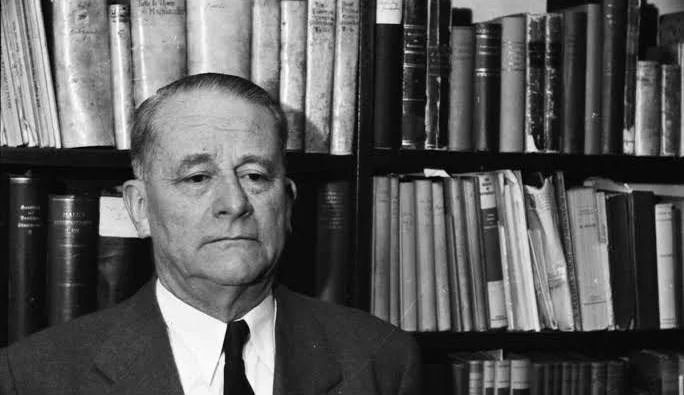
There is something almost reassuring about discovering that the political obscenities of Donald Trump's America have a philosophical pedigree. Not reassuring in the sense that anything is going to be all right, obviously. Rather the opposite. But reassuring in the way that finding the architectural drawings of a collapsing building might be reassuring. At least we can see what is holding the thing up, what has been removed, and why the people responsible for the demolition keep insisting that they're actually restoring it.
The architect in question is Carl Schmitt, the German constitutional theorist who became one of Hitler's most energetic legal apologists. He was clever, unpleasant, sometimes brilliantly perceptive, and disastrously wrong about some of the most important things a political philosopher can be wrong about. He also understood something about the possibilities of democratic self destruction that ought to make contemporary Americans rather uncomfortable. A democracy need not be overthrown by people announcing that they hate democracy. It may be transformed by people announcing that they alone represent it. Indeed, that may be the most effective way of doing the job.
Schmitt joined the Nazi Party in 1933, helped provide legal justification for Hitler's consolidation of power, defended the extrajudicial killings of political opponents, and participated in the campaign to remove Jewish influence from German jurisprudence. His intellectual reputation never recovered morally from these commitments, though his philosophical influence survived them remarkably well. Lars Vinx's excellent account in the Stanford Encyclopedia of Philosophy makes clear why. Schmitt wasn't merely a propagandist. His account of sovereignty, democracy and political belonging exposed genuine problems in liberal constitutional thought. His solutions, however, were sufficiently monstrous to make the problems look almost attractive.
And here is the alarming thing. Once we understand Schmitt's argument, the apparently disconnected beastliness of the Trump administration begins to look less disconnected. The military strikes against suspected drug traffickers, the hostility towards independent journalism, the treatment of immigrants, the rhetoric of racial entitlement, the attempt to subordinate legal judgment to presidential necessity, even the strange insistence that an electoral defeat cannot really be a defeat if the authentic people have spoken otherwise: all these begin to reveal a recognisable political structure.
This doesn't mean Trump has read Schmitt. Nor does it mean that America in 2026 is Nazi Germany in 1933. Historical analogies become useless when they erase the very differences that might explain what is happening. The more disturbing possibility is that Schmitt identified a set of political temptations that can survive without Nazism, without German nationalism, and without anyone involved knowing much political philosophy at all. A philosophy can describe a political formation without having caused it. The beast needn't have read its own anatomy.
Schmitt begins with a question that sounds harmless. What makes law possible? We tend to imagine that laws are rules and that governments are institutions authorised to apply them. If there is a dispute, a court decides. If circumstances change, a legislature amends the law. If the government acts unlawfully, another institution corrects it. This is roughly the liberal picture, and it has the considerable advantage of allowing people to get on with their lives without constantly wondering who possesses the ultimate authority to kill them. Schmitt thinks this picture is hopelessly complacent.
Rules, he argues, work only where the conditions for applying them already exist. A legal order presupposes a relatively normal social world. But what happens when that world breaks down? What happens when the state itself is threatened? Who decides whether the circumstances are sufficiently extraordinary to justify setting ordinary rules aside? His famous answer, from Political Theology in 1922, is that the sovereign is whoever decides on the exception.
Schmitt is saying that the authority to determine when ordinary legality no longer applies cannot itself be completely contained within ordinary legality. The sovereign's decision reveals something more fundamental than the rules. It reveals the power upon which the rules ultimately depend. Now consider Trump's declaration in February 2025 that whoever saves his country does not violate any law. It is difficult to imagine a more economical expression of the temptation Schmitt identifies. The decisive question is whether the person performing it can plausibly claim to be saving the political community. If he can, legality appears to follow from the saving rather than the other way round. The person claiming exceptional authority also claims a privileged understanding of the danger that makes the authority necessary. He identifies the emergency, judges its seriousness, determines the response, and presents legal objections as evidence that his opponents have failed to appreciate the threat. The argument has a wonderful circularity. Necessity justifies the decision, and the decision demonstrates what necessity required.
The recent controversies surrounding Defence Secretary Pete Hegseth offer a particularly sharp illustration. In November 2026, Republican congressman Thomas Massie introduced eight articles of impeachment concerning military operations against Iran, Yemen, Venezuela and suspected drug-trafficking vessels. The allegations include unauthorised hostilities, civilian casualties and unlawful killings at sea. These are allegations in an impeachment resolution, not judicial findings. But the constitutional issue they identify is real enough: how far may the executive determine for itself when lethal force is justified?
The maritime strikes are especially disturbing. A person suspected of trafficking drugs is ordinarily someone whose guilt must be established through legal procedures. He may be investigated, arrested, charged and tried. But when a government treats suspected traffickers aboard vessels as military targets, the legal world changes around them. The suspect becomes an enemy. The procedures through which his conduct might have been judged are replaced by an executive decision about whether he may be killed. What matters isn't only the decision to use force. It is the prior decision about what sort of situation exists. Is this law enforcement? Armed conflict? National defence? An emergency? The answer determines which protections remain available.
Schmitt's sovereign is dangerous because he claims the authority to answer such questions from a position that ordinary legal scrutiny cannot fully reach. Of course, the government may advance legal arguments for its operations, and those arguments must be examined rather than simply dismissed. Schmittian analysis explains why the executive's claim to determine the applicable legal framework deserves particular suspicion. The more completely the government controls the description of the emergency, the more easily it can make the people affected disappear from the ordinary world of legal protection.
Schmitt's theory becomes even more revealing when we turn from sovereignty to political identity. In The Concept of the Political, published first in 1927, he argues that the defining distinction of politics is between friend and enemy. This sounds as if parliamentary debate were a pub fight. But Schmitt means something much stronger. The enemy isn't somebody whose opinions we dislike. Nor is he necessarily morally wicked. He is a member of a group whose existence is understood as threatening our collective way of life. The distinction becomes political when people are prepared to fight and die for their own group and kill members of the opposing one. Politics, on this account, is about establishing who belongs to the community and who threatens it.
And here's the clever, nasty twist. Schmitt doesn't think the political community exists first and then discovers its enemies. The distinction between friend and enemy helps constitute the community itself. We discover who we are by discovering who they are. This is a helpful way of understanding MAGA's political imagination. The movement is organised through recurring representations of enemies: undocumented immigrants, supposedly corrupt elites, disloyal officials, hostile journalists, foreign powers, internal conspirators. These groups are not interchangeable, and they are not all treated in the same way. But their recurring political function is to identify forces against which the authentic nation must defend itself.
The nation becomes visible through the threat. Think of the strange moral economy involved. If the country is always being stolen, invaded, betrayed or destroyed, then those who claim to be rescuing it need never explain what a condition of successful rescue would actually look like. The enemy must remain available because the political identity depends upon the enemy's continued existence. Victory threatens to become a conceptual embarrassment. What would the movement be without the people it hates? Schmitt would have understood this perfectly. Indeed, he might have considered it evidence that MAGA possesses something liberal politics has supposedly forgotten: a sufficiently intense conception of collective belonging.
The problem, of course, is what happens to the people who find themselves on the wrong side of the distinction. In November 2026, Paul Dans, a former director of Project 2025, argued on television that young white men should regain control of the American economy and described America as their birthright. Matt Gaetz, interviewing him, challenged the racial formulation. The disagreement is worth remembering because MAGA isn't a single undifferentiated racial ideology. Nevertheless, Dans's remarks expose a conception of national entitlement in which membership isn't simply a matter of citizenship, participation or shared constitutional commitment. It is something inherited by a particular racial group. Schmitt's theory helps explain the philosophical movement involved. A constitutional community of formally equal citizens is being displaced rhetorically by a supposedly more authentic community defined through substantive identity. Some people belong more fundamentally than others. Some possess a prior claim upon the nation. Others may live within its borders, obey its laws and even possess its citizenship while remaining, in this deeper political sense, outsiders.
This was one of the most sinister possibilities within Schmitt's own theory. His conception of democratic equality was equality among those who shared the identity constituting the political people. The implications are obvious enough. Once membership is determined by an identity that precedes the constitution, the constitution can no longer guarantee membership. Its promises become conditional upon a prior judgment about who really belongs.
And this brings us to Schmitt's daftest contribution to the theory of democracy. He thinks democracy can exist without liberalism, without parliamentary government, and potentially without the ordinary mechanisms through which citizens choose their rulers. What matters is the identity between rulers and ruled. The ruler must express the authentic will of the people. But the authentic people need not be identical to the numerical majority, and their will need not be established by counting votes.
Elections are meant to tell us who the people want to govern them. Schmitt turns the relationship around. We first identify the genuine people, then determine which political authority expresses their will. If the election produces the wrong answer, perhaps the election has failed to discover what the people really wanted. Trump's persistent allegations of electoral fraud become particularly interesting in this light. Of course, elections can be improperly conducted, and allegations of irregularity must be judged on evidence. But there is a difference between saying that an election was defective and suggesting that the authentic people cannot possibly have rejected their rightful representative. The latter makes the leader's authority independent of the very procedures through which democratic legitimacy is supposed to be established.
This is democracy converted into a kind of political ventriloquism. The people speak, but the leader tells us what they were really saying. Schmitt's theory makes this manoeuvre philosophically intelligible. It also exposes its central absurdity. How do we know who the authentic people are? Apparently because the leader represents them. And how do we know that the leader represents them? Because it's the authentic people who support him. The argument moves in a circle, but a circle can be politically effective if enough people are willing to inhabit it.
This is why the hostility towards courts, legislatures and independent scrutiny matters. These institutions provide alternative means of establishing what is legally permissible, politically authorised and factually true. They interrupt the imagined identity between the leader and the people. Schmitt had a particular dislike of the idea that constitutional courts should possess final authority over fundamental political questions. In his dispute with Hans Kelsen, he preferred the president as the guardian of the constitution. Kelsen, by contrast, defended constitutional review as a means of subjecting political power to legal standards that political leaders could not simply determine for themselves.
The difference becomes vivid in the recent American case concerning journalists' LinkedIn records. Federal investigators sought extensive communications information during a classified-leak investigation. The Fourth Circuit required the disclosure demands to be narrowed because they extended too broadly into journalists' confidential contacts. Here the court did exactly what constitutional adjudication is supposed to do. It recognised a legitimate government interest while refusing to allow that interest to determine its own limits. The administration's investigative purpose did not automatically justify every means employed to pursue it. The existence of the judgment is important because it prevents us from imagining that the American constitutional order has simply disappeared. Courts still decide cases. Government lawyers still argue about legal authority. Officials can be compelled to narrow their demands. A Schmittian ambition is not the same thing as a successfully established Schmittian sovereignty.
Nevertheless, the case reveals what is at stake. The government seeks information in the name of security. Journalists and their sources possess interests that may conflict with the investigation. An independent institution must decide whether the government's demand is lawful. Remove that independent judgment, and security becomes whatever the executive says security requires.The same problem appears in allegations that records concerning Trump's Washington construction projects were being destroyed. The Interior Department denies the allegations. But the constitutional significance of the dispute is plain. A government that controls the evidence of its own conduct can make accountability depend upon its willingness to be accountable. The problem is that the means of discovering whether they have done something wrong may themselves be placed under executive control.
Schmitt's account of sovereignty directs attention to the authority to determine the conditions under which judgment takes place. Who decides what evidence may be seen? Who decides which institution has jurisdiction? Who decides whether an emergency permits ordinary requirements to be disregarded? These are questions about the architecture of political authority, not merely about the personal wickedness of particular officeholders.
In his book Dictatorship, Schmitt distinguishes between a dictator temporarily exercising extraordinary powers to preserve an existing constitution and one who claims authority to establish a fundamentally new constitutional order. The first is what he calls a commissarial dictator. The second is a sovereign dictator. Political movements frequently present constitutional transformation as constitutional restoration. They announce that they are returning the country to its authentic foundations while dismantling institutions that have long formed part of its political life. They insist that extraordinary measures are necessary to recover normality, though the normality they propose may bear little resemblance to the constitutional order they inherited.
There is something revealing about the word again in Make America Great Again. It presupposes a lost condition of national authenticity. The present is an aberration, a period of corruption or decline. Restoration becomes the supreme political objective. But because the authentic past is never specified with much precision, almost any transformation can be represented as its recovery. The result is a peculiar political magic trick. A government can claim to defend the constitution while attacking the institutions through which the constitution operates. It can claim to restore democracy while denying the legitimacy of electoral outcomes. It can claim to protect freedom while treating dissenting institutions as enemies of the people.
Schmitt's theory allows the authentic political community to possess an authority prior to the constitutional arrangements that supposedly express it. If those arrangements no longer correspond to the community's genuine identity, they can be presented as obstacles to democracy rather than its conditions.This is the point at which his constitutional theory becomes most dangerous. The sovereign dictator doesn't merely break the rules. He claims to represent a political authority more fundamental than the rules.
And then there is the question of food. Which might seem an odd place to look for Hitler's constitutional philosopher, but perhaps we shouldn't be surprised. In November 2026, Trump's Department of Agriculture proposed changes to food assistance that, by its own estimates, would remove some 6.3 million people from the programme by 2029. Children, elderly people and households already negotiating the precarious arithmetic of poverty would be among those affected. The department presents the measure as a correction to eligibility rules, intended to direct assistance towards those who satisfy the programme's requirements. But what interests us here is the possibility that an apparently technical distinction between eligible and ineligible people might also participate in a much larger political distinction between those regarded as belonging to the nation and those whose claims upon it are treated with suspicion.
I had thought that his theory might be less useful when we moved away from the spectacular world of military strikes and presidential emergencies into the duller business of welfare administration. But why should it be? Hitler's regime didn't confine its conception of political enemies to speeches, police operations and military adventures. It organised social provision around the Volksgemeinschaft, the racially constituted national community. Those considered racially or socially undesirable could be excluded from its protections. The poor, the homeless and people designated unwilling to work could find themselves classified as asocial, outside the community of the deserving. Welfare wasn't simply something the Nazi state administered. It was one of the means through which the boundaries of its political community were made real.
Now, it would be historically careless to equate a proposed American food-assistance restriction with the Nazi system of racial persecution. The legal structures, criteria and consequences are profoundly different. Nor do we yet know that the Trump proposal was designed specifically to injure political enemies. But Schmitt helps us ask a question that an exclusively economic analysis might miss. What conception of the people is presupposed when a government decides whose dependency deserves public recognition and whose does not? And what happens when political rhetoric has already divided the nation into the hardworking and the parasitic, the authentic citizen and the alien intruder, the people who belong and the people who supposedly take from them?Perhaps the mistake is to think that political enmity must always appear as hatred. Sometimes it appears as a distinction between deserving and undeserving. The people who lose their benefits need not be explicitly named as enemies for their exclusion to reinforce a political story about who the nation exists to serve.
There is a complication, of course, and it's a revealing one. Food assistance is received by Americans across racial, geographic and political divisions, including people in communities that support Trump. So we cannot simply assume that the proposal harms only MAGA's imagined outsiders. The evidence would have to show who is actually affected, how the government describes those people, and whether its choices reflect the boundaries of the political community it claims to represent.
This is where Schmitt and Foucault might turn out to be more complementary than opposed. Schmitt explains how the political community can be imagined through distinctions of belonging and exclusion. Foucault explains how those distinctions can become ordinary administrative practice. The sovereign identifies the people; the bureaucracy sorts them. One provides the political imagination, the other the techniques through which it acquires consequences. And what makes the arrangement disturbing is precisely that nothing need look particularly exceptional. The exclusion can happen during office hours, under the authority of regulations, with every form correctly completed.
And then there is foreign policy, where the comparison with Hitler's constitutional thinker becomes rather more uncomfortable than it first appears. Schmitt supposedly defended the sovereignty of distinct political communities against interference from outside. So what are we to make of Trump's military interventions in places such as Venezuela? Doesn't this contradict the theory? Well, no. Or rather, only if we overlook what Schmitt was actually doing while Hitler was conquering Europe. In 1939 he developed his theory of Grossraum, the great geopolitical space organised around a dominant power. Germany, on this account, possessed a special authority over its European neighbourhood, just as the United States claimed a special position in the Americas through the Monroe Doctrine. And here's the trick. Non-intervention meant that outsiders mustn't interfere with the dominant power's regional arrangements. It didn't mean that the smaller countries within the region were entitled to resist the dominant power itself. Hitler could invade and dominate neighbouring states while presenting Germany as the defender of a legitimate European order against external interference. Schmitt wasn't embarrassed by this. He helped furnish the legal vocabulary for it. Indeed, Hitler himself invoked the Monroe Doctrine in April 1939, after occupying the Czech lands. So the interesting question about Trump is whether sovereignty is being distributed according to political power, with America claiming privileges over its neighbours that it would deny to outsiders. Sovereignty turns out not to be a universal entitlement but something organised hierarchically around the power that decides whose independence counts. And suddenly the supposed contradiction between national sovereignty and imperial aggression looks less like a contradiction than one of the organising principles of the whole arrangement.
There is a further irony. Schmitt believed that liberal humanitarianism could make war more destructive by representing enemies as enemies of humanity itself. Once an opponent is no longer recognised as a legitimate adversary, he may be treated as someone whose elimination requires no further political justification. But the transformation of suspected criminals into military targets seems to display a related danger without requiring any liberal humanitarian ideology at all. The enemy becomes someone against whom extraordinary force appears permissible because the sovereign has already decided what sort of enemy he is.
This suggests that Schmitt understood a genuine danger while failing to appreciate how deeply it implicated his own philosophy. If political identity is constituted through enmity, and if sovereign authority is revealed through the power to determine exceptional circumstances, then the temptation to enlarge the category of the enemy is built into the theory. The more enemies there are, the more occasions there are for exceptional decisions. And the more exceptional decisions there are, the more indispensable the sovereign appears.The enemy becomes politically productive. Perhaps this is the most disturbing feature of the comparison. The apparent chaos of MAGA politics may not be chaotic. Its shifting antagonisms, recurring emergencies, extravagant claims to popular legitimacy and impatience with institutional restraints can be understood as different expressions of a common political tendency. The movement continually seeks to establish the authority of the authentic people against the institutions, populations and constraints said to obstruct them. Schmitt would have recognised the structure. He might even have admired its energy. It's rather different from the disciplined political unity his theory imagined: a movement entangled with corporate capitalism, celebrity culture, personal loyalty, media spectacle and competing factions, whose leaders do not always agree about who belongs or what victory would mean. Trump's America is not simply Schmitt's Germany in different clothes. It is a contemporary constitutional democracy experiencing conflicts over executive authority, political identity and institutional legitimacy, while many of its ordinary legal mechanisms continue to function.
So the analogy with Hitler must be handled carefully. Schmitt's participation in National Socialism is an established historical fact. His defence of Hitler's extrajudicial killings and his antisemitic jurisprudence belong to the moral history of his thought. But to say that Schmitt's theory illuminates Trump's politics is useful, and alarming, when it is precise. Schmitt shows how a political movement can make the authentic people prior to their constitutional representation, how it can identify collective enemies as the condition of political unity, how it can claim extraordinary authority through the language of emergency, and how it can present the subordination of independent institutions as the restoration of democratic legitimacy. These all concern the underlying logic through which political authority is justified.
Schmitt's greatest philosophical weakness is that he never supplies a satisfactory independent criterion for identifying the authentic people whose authority the sovereign supposedly expresses. The people are invoked to justify the decision, while the decision determines who counts as the people. What looks like democracy becomes an assertion of authority insulated from the ordinary means of democratic correction. Perhaps, then, the most useful way to understand the beastliness of the Trump world is not to imagine a single dictator standing outside the law, but to examine a political movement attempting to make the distinction between legality and legitimacy increasingly unstable. The leader claims to speak for the people more directly than their institutions do. The emergency justifies the departure from ordinary constraints. The enemy explains why the emergency continues. The restoration of normality remains forever just out of reach. The whole arrangement has a horrible elegance. Schmitt's political philosophy helps us see why. It takes the features of liberal constitutionalism that make political life bearable - compromise, institutional restraint, legal equality, independent judgment, the possibility that one's opponents may be legitimate - and redescribes them as weaknesses that prevent the political community from asserting itself.
The beastliness is not an accidental excess of an otherwise respectable constitutional theory. It emerges from the willingness to make political belonging dependent upon enmity and to place the ultimate judgment of necessity beyond ordinary legal control. What Schmitt never adequately explains is why a community willing to live with disagreement, to recognise the rights of people it dislikes, and to accept the possibility of losing an election should be regarded as deficient. Why isn't that willingness itself an extraordinary political achievement? Why should the capacity to kill for one's community count for more than the capacity to share it with people whose conception of the good one rejects? I think that's the great ambition and flawed achievement of modern liberalism.
Schmitt has very little to say in answer, beyond the insistence that political existence requires the possibility of enmity. But the existence of conflict doesn't establish the desirability of organising political life around it. Still less does it establish that the sovereign should be authorised to determine when the ordinary restraints on power no longer apply.
The institutions Schmitt regarded with suspicion aren't merely technical devices for processing disagreement. They are ways of preventing any political faction from identifying its own survival with the survival of the community as a whole. They make it possible for a government to lose without the nation being destroyed, for a critic to disagree without becoming an enemy, and for a person accused of wrongdoing to remain a person to whom reasons and protections are owed. Trump's politics repeatedly puts pressure on precisely these distinctions. Schmitt explains the pressure with uncomfortable clarity. So there is something both illuminating and profoundly unsettling about finding Hitler's constitutional thinker waiting at the end of an inquiry into the contemporary American right. We don't discover that he secretly wrote the MAGA programme. We discover that he understood how political power might present its appetite for domination as the defence of democracy itself. And perhaps the worst thing is that he understood how attractive this could become. The promise that someone will finally decide, finally identify the enemy, finally restore the nation, finally put an end to all this tedious argument about what the law permits are promises of political clarity in a world that refuses to be clear. Schmitt makes the promise intelligible. His own history demonstrates its danger. And let's be clear, if Schmitt counts as a fascist - and he surely does - then there's enough here to call Trump and his enabling cult fascists too.
The tragedy is that what appears to the sovereign as an escape from the weakness of constitutional democracy may be the destruction of its greatest strength: the possibility that nobody, however powerful, gets to decide on their own who the people really are.