Why Ruth Marcus Barcan's Modal Logic Is Really Really Good for Arts, Humanities and Sports Education
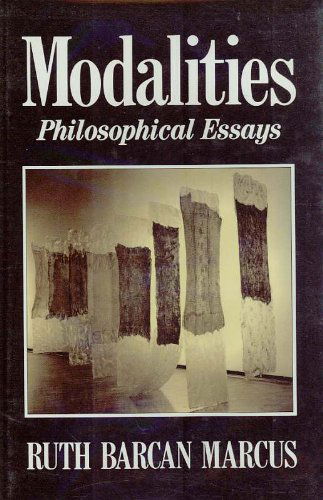
Ruth Barcan Marcus is not usually discussed in philosophy of education. Her name is more familiar in logic and metaphysics, where she is known for early work on quantified modal logic, identity, essentialism and moral dilemmas. Yet if we step back from the technical details and look at the picture of rationality that emerges from her essays, we find a conception that cuts across many of the assumptions that now shape educational theory and policy. Where much current thinking, often implicitly, treats rationality as either a mathematical ideal in the style of Quine or as a language centred practice in the style of Davidson, Brandom or certain continental and Wittgensteinian approaches, Marcus offers a more naturalistic, object centred and conflict tolerant account. It is a view of rationality as the management of modal, moral and doxastic commitments by embodied agents in an actual world, not the maintenance of a tidy web of propositions or the mastery of a single discourse.
In what follows I will argue that if we took Marcus’s conception of rationality seriously, educational practice and policy would look very different, and that the humanities and arts including sport would emerge not as soft extras but as central sites where rational capacities are refined. To set this up, I will first sketch the core of Marcus’s view as it appears in her collected essays Modalities (Barcan Marcus 1998). I will then contrast it with three broad families of approach that have strongly influenced educational thinking: Quinean extensionalism and its mathematical image of rationality, language based accounts associated with Davidson and Brandom, and more continental or Wittgensteinian styles that emphasise language games and interpretive frameworks. Using examples from the teaching of literature, I will show how a Marcus inspired model leads us to value complex, non convergent, revisable understanding rather than penalising it, and how this gives us a deeper defence of the arts and humanities in education.
Marcus’s early technical work looks, at first sight, far removed from questions of schooling. In “Modalities and Intensional Languages” she constructs a family of systems for quantified modal logic, that is, logics that combine talk of necessity and possibility with quantifiers like “for all” and “there exists” (Barcan Marcus 1998). A central theme is the difference between extensional and intensional contexts. An extensional context is one where you can freely replace one expression with another that refers to the same thing and never change the truth value of the sentence. Simple predications like “The morning star is bright” are extensional in this sense. If “the morning star” and “Venus” pick out the same planet, then “Venus is bright” will be true whenever “The morning star is bright” is true.
In an intensional context, this sort of substitution can fail. Belief reports are the standard example. Someone might believe that the morning star is bright while not believing that Venus is bright, even though the two expressions refer to the same object. The clause “believes that …” introduces an intensional context where both reference and the way the object is described matter. Marcus insists that necessity and possibility operators create intensional contexts of this sort as well. Once one acknowledges this, one can see why Quine’s extensional hostility to modality was misplaced. Quine had argued that quantified modal logic was “conceived in sin” because it seemed to confuse use and mention and allowed substitution failures he found intolerable (Quine 1951). Marcus shows that once intensionality is recognised as a fundamental feature of certain operators, there is no confusion. One simply needs, in addition to an extensional calculus, a well defined intensional one, with its own substitution rules. Rationality cannot be modelled solely on the extensional pattern; it must live comfortably inside intensional structures too.
Alongside this technical point, Marcus develops a distinctive view of how we think about objects across possible situations. She argues that proper names function as “tags” that directly refer to their bearers, rather than as disguised descriptions (Barcan Marcus 1998). Once we discover that two names pick out the same object, any true identity statement between them is not only true but necessarily true. If “Hesperus” and “Phosphorus” both name Venus, then “Hesperus is Phosphorus” is not a fragile discovery that could have failed. It records the necessary fact that a single object has two tags. This is the famous necessity of identity, a result Marcus proved in modal systems long before Kripke popularised it.
Why does this matter for rationality and, eventually, for education. Because it reveals that much of our thinking is de re, that is, directed at particular things in the world, rather than de dicto, that is, directed only at how we describe those things. A de re belief concerns an actual object under a range of possible ways it might have been. When a pupil learns that Kent is necessarily the county in which Canterbury stands, given the actual geography of England, they are adjusting a de re commitment about a region of space, not merely reshuffling words. Rationality, on Marcus’s view, involves managing such object anchored commitments in a space of possibility, not just arranging sentences in a consistent pattern.
This object centred picture becomes even more explicit in Marcus’s later work on belief. In “Rationality and Believing the Impossible” she examines cases where someone seems to believe something that is not just false but impossible, such as “there is a largest prime number” (Barcan Marcus 1998). A naive, language centred account would say that the person’s belief set contains an impossible proposition and is therefore in tension with rational norms that prohibit impossible contents. Marcus suggests instead that we rethink how we ascribe belief. The pupil who confidently says “I know there is a largest prime, you just have to search long enough” is in a confused state, but it does not follow that they have a cleanly identifiable impossible proposition as the object of their belief. Once they learn Euclid’s proof, the right description of their earlier state is that they thought they knew there was a largest prime, but they did not; their dispositions and expectations were misreported by the sentence we used to summarise them. Their rationality is better judged by how they respond to the proof than by the static properties of the sentence we once attributed. In “Some Revisionary Proposals about Belief and Believing” Marcus generalises this thought. She criticises accounts that treat belief as essentially the holding true of sentences and that demand that a rational agent’s set of beliefs be closed under all logical consequences (Barcan Marcus 1990).
Real believers are finite, temporally extended, embodied creatures. They cannot survey all consequences of their commitments, nor can they keep their web of beliefs in perfect order. Rationality for such creatures must therefore be understood in more dynamic terms: as a capacity to recognise salient conflicts when they arise, to respond appropriately to counter evidence, and to reorganise their network of commitments. Closure under consequence remains a regulative ideal in certain domains, such as mathematics, but cannot be the basic definition of what it is to be rational.
A similar pattern appears in her ethics. In “Moral Dilemmas and Consistency” Marcus challenges the widely held view that a coherent moral code can never yield conflicting obligations in a single case (Barcan Marcus 1980). She argues that this demand for global consistency conflates the structure of principles with the contingent constraints of the world. There can be situations in which an agent really does owe incompatible things to different people. A doctor in a disaster may have a duty to treat each of several patients first; a friend may owe conflicting obligations of loyalty and honesty. In such cases, a rational agent can correctly judge both that they ought to do A and that they ought to do B, even though they cannot do both. The conflict does not show that the underlying principles are inconsistent; it shows that the world has forced a tragic choice. Rationality here is expressed in the agent’s recognition of the conflict, their attempt to decide as well as they can, and their readiness to accept regret for the duty they could not discharge.
These strands give us, in outline, a Marcus style picture of rationality. It is object centred, because beliefs and obligations are directed at actual things and persons. It is modal, because rational thinking involves tracking what could and could not have been the case for those things. It is intensional, because the way objects are described matters in contexts of belief and duty, and one cannot collapse all such contexts into extensional ones. It is dynamic and revisable, because rational agents are finite beings who adjust their commitments in time rather than maintaining a perfect static web. And it is conflict tolerant, because moral and cognitive tensions are treated as normal features of a serious life, not as anomalies to be ironed out by redefining concepts or principles.
If we now contrast this with Quine’s picture, the difference is striking. Quine’s famous “Two Dogmas of Empiricism” attacks the analytic synthetic distinction and encourages us to think of our total system of beliefs as a single web tested at the edges by experience (Quine 1951). Logical truths and mathematics sit near the centre, more stable and less revisable, empirical claims nearer the periphery. There is no deep modal structure, only what our current theory treats as impossible or necessary. In Word and Object Quine proposes an austere first order language as our best formal model of rational scientific discourse (Quine 1960). Extensionality is the reigning norm. Quine is suspicious of intensional idioms and famously dislikes de re modalities and essential properties. A Quinean image of rationality is therefore one in which the ideal rational agent holds a large, coherent set of sentences in a suitably neat inferential pattern and revises that set in the light of new sensory input. Mathematics then appears as the neatest and most self consciously structured part of our web, and Quine often writes as if the clarity of extensional set theory and predicate calculus gives us a paradigm of good reasoning. If you transcribe this picture into education, rationality becomes a matter of acquiring, organising and updating a propositional system. Students are initiated into forms of knowledge by learning key sentences, their relations of implication and their empirical support. Mathematics and science become the obvious models. Assessment focuses on whether pupils can reproduce and apply the right propositions and maintain local consistency.
Marcus exposes the limitations of this model in at least three ways. First, by making intensionality a central feature of rational thought, she shows that not all good reasoning fits extensional patterns. A pupil who believes that “the narrator is telling the truth” while reading a novel and then later revises that stance when evidence of unreliability appears is not someone failing to tidy up their web of belief quickly enough; they are someone whose description sensitive attitudes are gradually adjusting to the object, the narrator, as more is learned. To treat this as irrational until full consistency is reached is to mislocate rationality. Second, by insisting on de re commitments, she shows that rationality is exercised in tracking individual people, places and things across time and possibility. A historian who wrestles with their judgement of a political leader, pulled between admiration for reforms and horror at atrocities, is not best understood as someone failing to assign a single stable propositional attitude. They are managing a complex object centred judgement under conflicting descriptions. Third, by legitimising moral dilemmas, Marcus undermines the Quinean hope that a rational system must always be brought to global coherence. Sometimes the world does not let our duties converge, and rationality lies in the way we inhabit that non convergence.
Language centred accounts of rationality, such as Davidson’s and Brandom’s, look very different from Quine’s at first sight, but Marcus challenges them too. Davidson writes that “believing that p is roughly holding true a sentence that means that p” and he suggests that genuine belief requires participation in a public language where sentences can be interpreted and corrected by others (Davidson 1973). Brandom goes further and defines the content of a belief in terms of its inferential role within a practice of giving and asking for reasons (Brandom 1994). On this inferentialist view, to be rational is to be a scorekeeper in a discursive game, tracking one’s own and others’ commitments and entitlements and adjusting them in accordance with socially instituted norms. Marcus objects that such accounts are “anti naturalistic” because they make belief and rationality depend essentially on linguistic practices and normative statuses (Barcan Marcus 1995). This threatens to exclude non linguistic animals and pre linguistic children from the space of rational evaluation. Yet, she notes, our everyday explanatory practices do treat animals and infants as having states we naturally describe as expectations, fears or simple beliefs. A dog that persistently returns to the place where its ball usually lands when thrown appears to act on a rudimentary belief about a pattern in the world. A toddler who searches for a toy hidden behind a screen shows an expectation that objects persist. On Marcus’s object centred view, these are early forms of belief. They involve dispositional commitments to possible states of affairs, even though no sentences are held true and no explicit inferences are drawn.
Educationally, language based conceptions of rationality have a strong attraction. They fit easily with classroom practices that centre on talk, writing and explicit justification. To initiate a pupil into a discipline is then to induct them into a certain discourse, with its vocabularies, norms of argument and ways of giving reasons. There is real insight in this. It captures the important fact that much of our higher level rationality is articulated in words and that the humanities especially are concerned with learning to read and write within particular language games. However, if one makes propositional articulation the definition of rationality, one tends to undervalue the many non discursive ways in which learners engage rationally with the world. Practical exploration in science, drawing and making in art, embodied performance in drama and sports, and even silent, absorbed reading of a novel are then in danger of being treated as mere preparation for the real business of stating and defending claims. Marcus gives us a way to resist that narrowing. If beliefs are about objects and possible states of affairs, and if rationality involves adjusting those beliefs in the light of how things actually are, then many pre linguistic or non linguistically articulated activities are already rationally structured. A pupil exploring how different materials behave in water, noticing which sink and which float, and revising their expectations in the light of surprising cases, is exercising rationality even before they can state Archimedes’ principle. A child experimenting with how different voices or gestures change the audience’s reaction to a line in a play is learning about possibilities and constraints in human interaction in a way that is rationally responsive to feedback, even if they cannot yet conceptualise this as “reading the room” or “varying tone”.
A Marcus style educational theory will therefore locate rational induction in these object and practice centred engagements, not only in the acquisition of explicit concepts and sentences. When we turn to Wittgensteinian and McDowellian approaches, Marcus’s challenge has another inflection. The later Wittgenstein invites us to see understanding as mastery of a language game embedded in a form of life. To follow a rule is to participate in a shared practice, not to consult a mental blueprint (Wittgenstein 1953). McDowell extends this by arguing that rational animals live in a “space of reasons” where experience itself is already conceptually structured and where to be a thinker is to be able to take up and give reasons (McDowell 1994). These views have encouraged educational theorists to stress induction into discourses and practices, and to treat the rational mind as essentially normative and conceptual. Marcus would agree that practices and norms matter, but she would resist the thought that rationality has to be conceptually articulated all the way down. Her naturalism about belief insists that there are doxastic states that are not yet located in the space of reasons, but that nevertheless respond systematically to how things are. A young child’s expectation that unsupported objects fall does not require a grasp of the concept of gravity or a place in a justificatory practice. It is a disposition that can be correct or mistaken relative to the world and that can be revised under the pressure of failed expectations. The educational task is to refine and extend such dispositions through structured experience and only later to wrap them in the vocabulary of reasons. If we take McDowell’s idea that all rational responsiveness is conceptual too literally, we risk undervaluing the early, non conceptual work that goes on in laboratories, studios and rehearsal spaces.
How does all this bear on the humanities and the arts, and on literature teaching in particular. Current policy in England, and in many other systems, has shifted strongly towards STEM subjects and towards conceptions of rigour that sit comfortably with a Quinean or Brandomian image of rationality. Department for Education data on GCSE and A level entries show a steady rise in mathematics and sciences and a relative decline in English, modern languages and some arts subjects; this has been widely discussed as evidence of a system that rewards quantitatively measurable outcomes and prioritises subjects that fit easily with economic narratives (DfE 2019). In such a climate it is common to justify humanities in one of two ways. Either they are defended as offering “transferable skills” in argument and communication, which can be made to look faintly Brandomian, or they are sold as identity and wellbeing projects, whose connection to rationality is left vague. A Marcus inspired view lets us tell a different story.
Consider a class studying Macbeth. On a simplistic model of rationality, perhaps one silently influenced by Quine, the task might be seen as getting pupils to adopt a correct set of propositions about the play: that Macbeth is a tragic hero, that ambition is his fatal flaw, that Shakespeare’s language creates a mood of foreboding, and so on. Assessment would reward essays that display internal consistency and that apply the right concepts in the right places. Pupils who vacillate between calling Macbeth heroic and calling him monstrous, who express sympathy in one paragraph and condemnation in the next, might be marked down for lack of a clear line. From a Marcus perspective, those vacillations look different. The pupil is grappling with a particular object, Macbeth, as he appears under conflicting descriptions and in different possible evaluative frames. Their belief state is not yet neatly arranged, but that is not a defect. It is a sign that they are encountering a genuine moral conflict, not unlike the dilemmas Marcus describes, in which reasons do not converge. To call Macbeth simply heroic or simply villainous is to force a resolution that the material itself does not warrant. A rational reader may end up with a stance that contains tension, for example, “I continue to see how he is tempted and trapped, yet I cannot excuse what he does.” Rationality here consists in the capacity to hold that tension steadily, not in eliminating it. Classroom tasks can be designed to reveal and cultivate this kind of rationality. Instead of setting a question like “Is Macbeth a tragic hero or a mere villain, argue one side,” which pushes towards convergence, a teacher might ask “Write about moments where you admire Macbeth and moments where you condemn him; do not try to make them fit. Then reflect on whether you can live with that conflict.” A pupil who traces their own shifts of judgement as the play unfolds, noting, for example, that early sympathy is eroded as the murders multiply, is displaying exactly the sort of dynamic revision of belief that Marcus takes to be central to rational agency. If a mark scheme penalises such complexity for lacking a single thesis, it is the scheme, not the pupil, that embodies a poor conception of rationality.
Similarly, when pupils encounter an unreliable narrator in a novel, their reading often moves through stages. They may begin by taking the narrator at face value, later notice discrepancies between what the narrator says and what other characters or events reveal, and eventually settle on a more guarded stance. If we describe their early state as “believing that everything the narrator says is true,” we may then be tempted to call that state irrational once contradictions appear. Marcus would instead remind us that our sentence was a rough label for a messy cluster of expectations and that it is our ascription, not the pupil’s basic rationality, that needs adjusting. What matters educationally is that the pupil be able to say, “At first I trusted this voice, but now that I have seen X and Y I am less sure, and I am rethinking.” That self report is a clear expression of rational revision under pressure of evidence, even though the underlying belief state cannot be crisply expressed in one proposition.
Literature also offers rich opportunities to explore modal thinking in Marcus’s actualist sense. When students discuss what might have happened had Romeo received the message in time, or had Antigone chosen differently, they are not populating a metaphysical space of fully real possible worlds. They are imaginatively projecting actual characters into slightly different circumstances and tracing what follows, under constraints imposed by the text and by their understanding of human psychology. Marcus’s insistence that modal discourse is best understood as talk about actual objects in counterfactual situations, not about “possibilia” in non actual worlds, makes sense of this practice (Barcan Marcus 1998). Rationality here involves being appropriately constrained in one’s imaginings, respecting what is essential to a character and what might reasonably vary. A reading that says “If Macbeth had not met the witches, he would still have murdered Duncan” is arguably less rational than one that sees the witches as genuinely opening a new possibility to him, because it fails to track the modal structure of the play.
If we frame the humanities and arts as places where such modal, intensional and conflict responsive rationality is systematically exercised, we have a stronger answer to those who regard them as less rigorous than STEM subjects. Mathematical and scientific practices exemplify, and rightly celebrate, forms of rationality that fit the Quinean image: extensional consequence, deductive closure within a theory, the pursuit of global coherence. Humanities and arts subjects exemplify other, equally important forms: attention to description, tolerance of unresolved tensions, revision of object centred commitments under interpretive pressure, and a refined sense of possibility grounded in actual human capacities and histories. Marcus’s philosophy helps us see these not as rival or lower forms of reason, but as different articulations of the same underlying rational agency.
Educational policy built on a Marcus model of rationality would therefore shift in two ways. First, it would move away from treating rationality as essentially mathematical or purely discursive, and would instead design curricula and assessments that look for how students reorganise their thinking when something does not fit. In literature, that means valuing essays and discussions that reveal movement and reconsideration, not only those that present a polished final position. In science, it means rewarding the capacity to redesign an experiment when results are unexpected, not just the capacity to apply known formulae. In art and music, it means recognising that critical reflection on one’s own work, in the light of what one discovers one cannot do, is a form of rational revision, not a merely expressive activity. Second, it would resist the downgrading of the humanities and arts as sites of rational education. If policy makers implicitly hold a Quinean or Brandomian picture in which rationality is identified either with extensional theory or with explicit inferential scorekeeping, then subjects that do not lend themselves easily to those images will seem second class. If, instead, they adopt Marcus’s more subtle, naturalistic and conflict aware conception, they will see that the arts and humanities are precisely where many of the rational capacities we most need are honed: the ability to confront genuine dilemmas, to manage commitments that cannot be fully harmonised, to understand persons as persisting objects with complicated histories, and to think seriously about what might and might not have been possible. Marcus herself did not write about schools. But the picture of rationality that emerges from her work has clear implications for what it means to induct someone into reason. It suggests that education should be less about installing a preset web of propositions and more about enabling learners to build and rebuild their own networks of object centred, modal and moral commitments in a responsive way. It suggests that we should not be surprised when serious engagement with texts and practices leads to states of partial understanding and non convergence, and that we should treat those states as sites of rational labour rather than as failures. And it suggests that any educational policy that systematically privileges those subjects that best match an extensional, propositional image of rationality will be impoverished.
If we want a system that cultivates the full range of rational capacities human beings can exercise, we should let Marcus, rather than Quine, be our guide, and we should recognise that the humanities and arts, and literature in particular, are central to that project rather than dispensable.