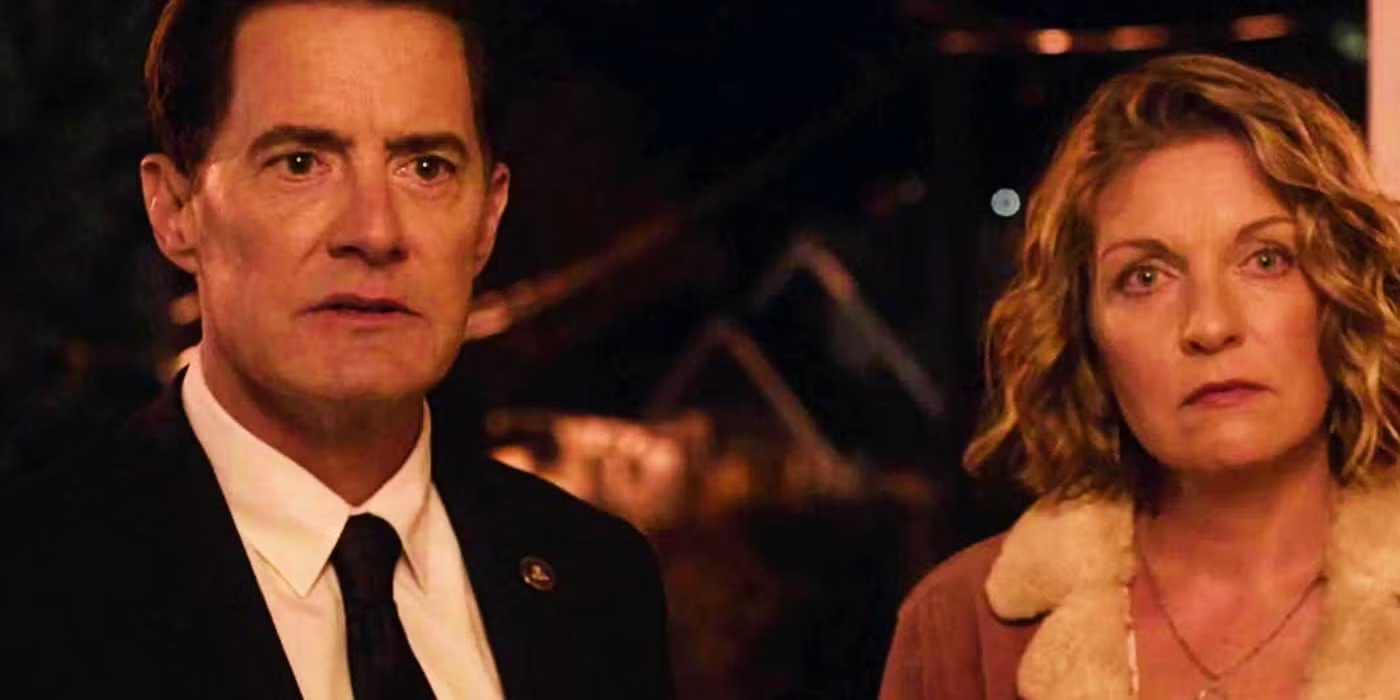
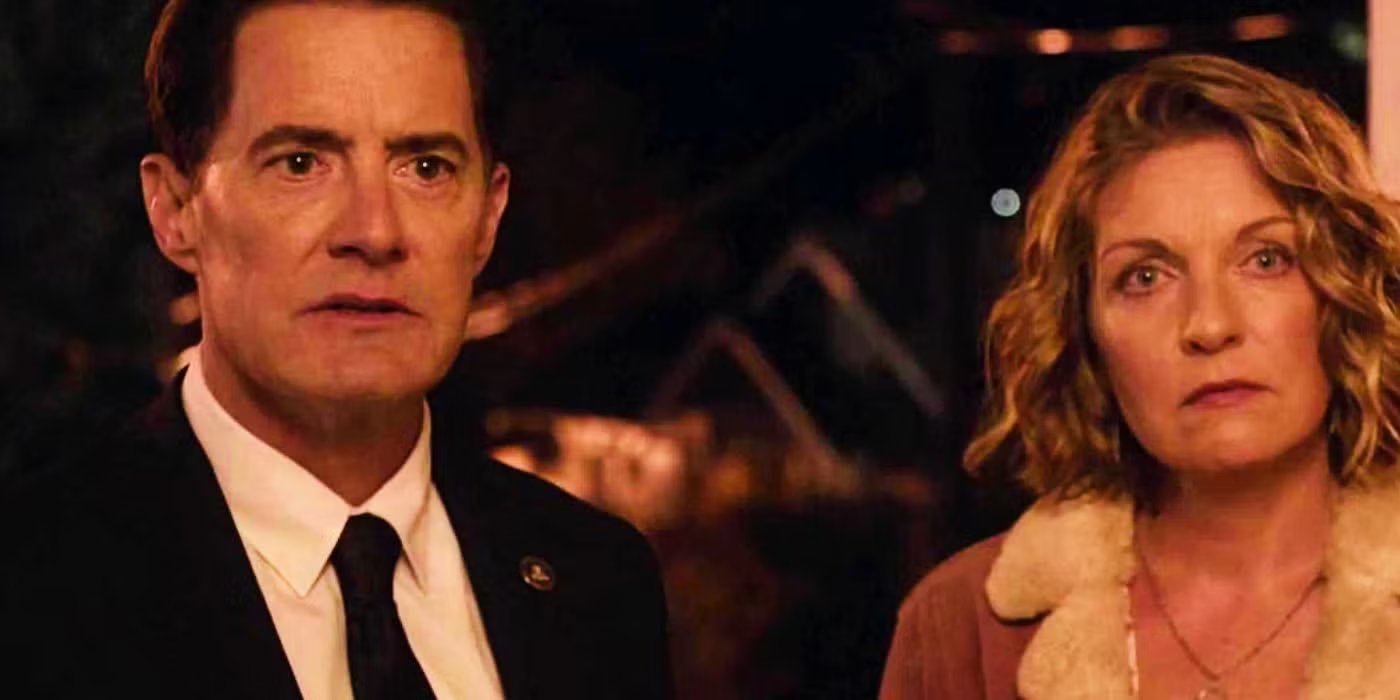
Episode nine marks a subtle but decisive shift. After the ontological violence of episode eight, which stripped the series down to its deepest conditions of possibility, episode nine returns us to the everyday world, but that return is now charged with a new clarity. Nothing has been repaired. Nothing has been explained. What has changed is that the series now begins to show, in more recognisable narrative terms, how life proceeds once the damage exposed in episode eight has already been absorbed. If episode eight was the rupture made visible, episode nine is the world learning how to move on inside it. The episode opens not with abstraction but with aftermath. Mr C survives the attack that should have ended him. His body is damaged, leaking, unstable, yet he persists. He is no longer framed as a villain whose defeat would restore order. He is a structural feature of the world. His continued existence demonstrates that survival is no longer tied to integrity. One can be broken, internally incoherent, and still operational. This is the same logic that allows Dougie to succeed at work without understanding. Mr C is the violent counterpart to that vacancy, a being who functions without the constraints that once made agency accountable. The scenes involving Mr C are filmed with a stark, almost clinical precision. Interiors are bare, lighting is harsh, dialogue is minimal. He interrogates people not to learn but to enforce alignment. Information is extracted, but not in order to understand a situation in its fullness. It is extracted to maintain control of a network. Knowledge here is not something one has. It is something one uses. It does not ground belief or action. It lubricates domination. This instrumentalisation of knowledge contrasts sharply with the sheriff’s department in Twin Peaks, which episode nine revisits at length. Sheriff Frank Truman, Hawk, Andy, and Lucy gather information about Cooper’s disappearance and the strange events surrounding it. They talk about dates, names, old cases. They handle files. They attempt, sincerely, to reconstruct a narrative that would make sense of what has happened. But the episode makes clear that this effort is operating on borrowed time. The methods they are using belong to a world where facts could be assembled into explanations that would guide action. Here, facts accumulate without converging. Hawk senses this. His seriousness is tinged with restraint. He knows that something deeper is wrong, but he does not know how to articulate it within the language of investigation. The episode gives space to his quiet attentiveness, his pauses, his listening, without rewarding it with insight. The way these scenes are filmed reinforces their fragility. The sheriff’s station is warmly lit, familiar, almost comforting. But that comfort is deceptive. The camera often lingers just a bit too long, holding shots after dialogue has ended, allowing silence to stretch. These pauses are empty. They signal that the investigative form is still being enacted, but the conditions that once made it efficacious are gone. At the Great Northern, Ben Horne continues his efforts at moral self reform. He speaks earnestly about environmental responsibility, about doing good. His transformation is sincere, but sincerity no longer carries the weight it once did. Moral intention does not translate into structural change. The world does not respond to goodness with restoration. It absorbs it as another local pattern. Ethical agency has not been abolished. People still care. They still try. But the link between caring and shaping the world has weakened. Ben can be a better person, but that improvement does not propagate outward. It remains contained. Morality has become personal rather than world organising. The episode also spends time with Norma and Ed, whose long delayed relationship has become emblematic of waiting in Twin Peaks. Their scenes are tender, restrained, heavy with unspoken history. Yet even here, episode nine refuses catharsis. Their longing does not resolve. It simply persists. Love, like investigation and morality, survives as a feeling without an effective horizon. It does not reorganise the future. Sound design continues to play a crucial role. Ambient noises, soft hums, distant traffic, wind through trees, fill the spaces between dialogue. Music is sparse. When it appears, it sits alongside the images rather than instructing the viewer how to feel. This reinforces the sense that emotional cues no longer align neatly with narrative structure. Dougie’s storyline remains in abeyance during much of the episode, but his absence is felt. The systems he inhabits continue to function. His successes ripple outward. Janey E enjoys financial relief. The office celebrates. Yet the episode subtly shifts tone. The earlier comedy of Dougie’s vacancy begins to sour. There is a growing awareness, especially in Janey E, that something fundamental is missing. Comfort has been purchased at the cost of recognition. This shift is mirrored in the episode’s pacing. Scenes involving Dougie’s world are shorter, more fragmented. The episode does not linger on his routines with the same indulgence as before. This suggests that the series is preparing for a change, not a restoration, but a reconfiguration of how vacancy and agency will coexist. Episode nine also begins to reintroduce Cooper as a question rather than a solution. Characters speak his name. Old cases are recalled. His absence becomes an object of attention rather than a background condition. But this attention merely marks a pressure point. The memory of Cooper functions as a reminder that another mode of being once existed, one where understanding, responsibility, and action could align. Crucially, the episode does not frame this memory nostalgically. It does not suggest that the past can be recovered. It suggests that the loss of that alignment is now perceptible as a loss. This is an important distinction. Earlier episodes showed a world that functioned without caring about what it had lost. Episode nine shows the first signs that something is missing, even if no one knows how to name it. In this sense, episode nine is the beginning of a new phase. Episode eight exposed the rupture. Episode nine shows its consequences being lived with consciously, if inarticulately. The series moves toward recognition. Recognition, however, does not guarantee agency. It merely opens a space where the absence of grounding can be felt as absence rather than as normality. This makes episode nine one of the most quietly painful episodes of the season. There is no spectacle. No revelation. No metaphysical fireworks. Instead, there is the slow emergence of a mood, a collective sense that something essential is gone, that routines continue, that people care, that investigations proceed, but that the old confidence in sense making has evaporated. Episode nine shows how a world continues after its foundations have been exposed as fragile, contingent, and already compromised. It prepares the ground for what follows by allowing the loss of grounding to register as a loss, rather than as a condition that no one notices anymore.
Episode ten deepens the movement episode nine began by tightening the emotional and spatial proximity between characters who are increasingly aware that something is wrong without knowing what would count as making it right. If episode nine allowed loss to register, episode ten shows what it feels like to live while holding that recognition in suspension. The episode is dense with scenes, conversations, and locations, but the density produces a claustrophobic sense of near connection without convergence. The episode opens in Twin Peaks itself, returning us again to the sheriff’s department. Frank Truman, Hawk, Andy, and Lucy continue their slow work of assembling fragments. Names are mentioned. Dates are checked. Cooper’s disappearance is discussed with renewed seriousness. What is striking is not what they learn, but how they behave while learning it. Their conversations are careful, measured, almost hesitant. They do not rush to conclusions. They do not express confidence. The tone is one of custodial responsibility rather than investigative drive. They are tending to facts rather than pursuing truth. The sheriff’s station is brightly lit, orderly, familiar, but the camera often frames characters slightly off centre or holds shots a moment too long after dialogue ends. These micro delays give the sense that the form of investigation is still being enacted, but the animating confidence that once drove it is gone. Inquiry persists as ritual. Hawk’s role becomes more pronounced. He is attentive, grounded, quietly alert to the town’s deeper history. Yet even his attentiveness does not produce insight. He senses that the old stories, the maps, the legends, still matter, but he cannot integrate them into a framework that would guide action. His knowledge is intact, but its efficacy has been diminished. This is the failure of the world to respond to intelligence in the way it once did. Elsewhere in Twin Peaks, the episode lingers on Ed and Norma. Their scenes are restrained, heavy with mutual awareness and long deferred desire. Episode ten gives them more time together, but again refuses resolution. Ed looks at Norma with a mixture of longing and resignation. Norma responds with warmth tinged by weariness. They are close, but not together. The episode makes clear that this is structural. The future no longer presents itself as something that can be chosen into existence. The diner is warmly lit, but the space feels enclosed. The camera often frames them through counters or doorways, partial obstructions that suggest intimacy constrained by circumstance. Sound is soft, clinking dishes, low voices, ambient hum. Nothing intrudes, but nothing opens up either. Love exists, but it does not reorganise time. The Roadhouse sequence in this episode reinforces the theme of proximity without convergence. Characters argue, reconcile, flirt, and threaten. A fight nearly breaks out, then subsides. Music plays. The crowd responds. Yet none of these interactions produce lasting change. The Roadhouse functions as a pressure valve rather than a crucible. Feelings are expressed, but they do not transform relationships or futures. The episode films these scenes with a patient neutrality, refusing to signal which moments matter more than others. Sound again plays a crucial role. The music at the Roadhouse is immersive but not directive. It fills the space without steering emotion toward catharsis. Dialogue overlaps slightly. Laughter and anger coexist. The effect is a flattening of affect. Everything is present, nothing dominates. In Las Vegas, Dougie’s storyline continues, but with a noticeable shift in tone. His success has stabilised materially. Janey E enjoys financial relief. The threat of immediate danger recedes. Yet the episode makes clear that this stability is fragile and unsatisfying. Janey E watches Dougie with a mixture of relief and grief. She is mourning someone who is present but unreachable. Their conversations are especially painful. Janey E speaks directly, sometimes sharply, sometimes pleadingly. Dougie responds with repetition, smiles, vacant gestures. The episode allows these exchanges to linger, showing the emotional cost of living with a person who cannot reciprocate recognition. Care has become one sided. The world has made space for Dougie’s vacancy. Janey E must live with the consequences. The filming of these domestic scenes mirrors those in Twin Peaks. Neutral lighting. Static shots. No visual cues to elevate them into melodrama. The show refuses to aestheticise suffering. It presents it as an ongoing condition, woven into ordinary life. Mr C’s storyline continues in parallel, and episode ten makes explicit how different his mode of agency is from Dougie’s, while showing that both are equally accommodated by the world. Mr C interrogates, threatens, and manipulates. He extracts information not to understand but to secure advantage. His body continues to deteriorate, but his operational capacity remains intact. This dissociation between integrity and efficacy is one of the episode’s most unsettling features.The spaces Mr C inhabits are stark and functional. Motels, cars, warehouses. The camera frames him with precision, often isolating him within the shot. He dominates space without warmth. Sound is minimal. Dialogue is sparse. His world is one of pure instrumentality. Unlike the sheriff’s department, which clings to procedure out of loyalty to a vanished order, Mr C inhabits a world where procedure has already been stripped of justification and reduced to leverage. Episode ten crosscuts these worlds without privileging one over the other. The domestic, the communal, the bureaucratic, and the criminal all persist side by side. None of them resolves into a larger structure. The episode does not suggest that one will triumph or restore order. It shows that they are all sustainable within the same hollowed out reality. The episode maintains a restrained palette. Nothing is stylised as dream or nightmare. Even moments of threat are filmed plainly. This restraint reinforces the sense that the series is no longer interested in signalling importance. Everything is equally real and equally ungrounded. By the end of episode ten, the season has reached a strange equilibrium. The rupture exposed in episode eight has been domesticated. Characters feel its effects, but they continue to live, work, love, and harm one another within it. Recognition of loss has increased, but the capacity to act on that recognition has not. Episode ten shows what it looks like when a world learns to carry its damage quietly. The horror is intimate, procedural, and persistent. The episode leaves us with the sense that whatever change is coming, it will arrive, if at all, as another reconfiguration of how people inhabit a world that no longer guarantees that understanding, agency, and meaning will line up.
Episode eleven is where the season’s long suspended tensions begin to move toward collision. If episode ten showed a world that had learned to carry its damage quietly, episode eleven shows what happens when that quiet becomes unsustainable. The episode is unusually active by the standards of the season. Things happen. People move. Plans advance. Yet this activity exposes how action itself has become detached from understanding, how motion no longer guarantees direction. The episode opens in Las Vegas, and from the first moments there is a sense that Dougie’s bubble of protected vacancy is thinning. Janey E’s vigilance sharpens further. She is no longer merely adapting. She is watching for danger. Her tone toward Dougie is protective but edged with fear. The domestic space, once a zone of uneasy stability, begins to feel porous. Threats from the outside world are pressing in, and Dougie’s inability to recognise them becomes newly alarming. The scenes in the house are filmed with tighter framing than before. The camera lingers less indulgently, cuts come slightly faster. The sense of temporal slack that characterised earlier domestic scenes has narrowed. This signals that the season is entering a phase where the consequences of vacancy can no longer be indefinitely deferred. At the insurance office, Dougie’s position is scrutinised. His coworkers and superiors still praise him, but the tone has changed. Admiration is mixed with caution. The system that once absorbed his randomness effortlessly is beginning to notice strain. His presence has produced too much disruption. Too many frauds uncovered. Too many ripples. The system does not question his methods, but it does respond to instability. Systems tolerate vacancy only as long as it remains productive. Once it begins to threaten equilibrium, it becomes a liability. Dougie’s success has made him visible, and visibility brings risk. The episode makes clear that this is not a moral judgement. It is an operational one. The system is rebalancing. Violence intrudes more directly into Dougie’s world in this episode. Assassins close in again. The episode stages these moments with greater immediacy than before. Cars are followed. Rooms are entered. Guns are raised. The sense of danger is sharper, but it is still not organised as suspense in the conventional sense. There is no confidence that intention will lead to outcome. Plans are made, but the episode continues to show how plans exist in a world that no longer reliably supports purposive action. When violence occurs, it is abrupt and oddly flat. The camera does not linger on aftermath. There is no moral punctuation. Death is treated as another event that must be managed rather than a rupture that demands meaning. This continues the season’s insistence that violence has lost its narrative authority. In Twin Peaks Frank Truman, Hawk, Andy, and Lucy are more active now. Information is shared more urgently. Names are connected. The sense that Cooper’s absence matters is now operational. Something is wrong, and it is interfering with the town’s ability to function. Yet even here, the episode resists the language of solution. The department’s work is earnest and careful, but it does not build toward mastery. They gather fragments, but the fragments do not snap together. The show lingers on their faces, their pauses, their mutual respect. These are people committed to a form of life that presupposes meaning, even as that presupposition is failing them. Hawk’s role deepens again. He listens. He notices. He speaks sparingly. His attention to the land, to old stories, to what lies beneath the town’s surface, feels increasingly like a form of mourning rather than investigation. He senses that what has been lost cannot be recovered by more careful inquiry. The episode allows this intuition to remain unspoken. It does not give Hawk the words to articulate it, because such words may no longer exist. The Roadhouse scenes are more volatile than before. Arguments escalate further. Emotions flare more intensely. Yet, as in earlier episodes, these eruptions do not produce lasting transformation. The Roadhouse continues to function as a place where feeling can be discharged without consequence. The music is loud, enveloping, but again it does not guide interpretation. It absorbs emotion rather than amplifying it. The filming of these scenes emphasises proximity and compression. Bodies are close. Voices overlap. The space feels crowded. Yet despite this closeness, there is no convergence. People collide without connecting. The episode uses spatial density to underline emotional isolation. Mr C’s storyline becomes more ominous. His body continues to degrade, but his control remains intact. He issues orders, extracts compliance, and navigates obstacles with ruthless efficiency. The contrast between his physical decay and his operational effectiveness sharpens the season’s central unease. Integrity, whether bodily or moral, no longer grounds power. Power persists without it. The spaces Mr C inhabits feel increasingly sterile. Motels, cars, corridors. These are non places, transit zones rather than homes. The episode films them with harsh lighting and minimal decoration. They feel interchangeable. This reinforces the sense that Mr C is not rooted anywhere. He moves through the world as an instrument of its hollowed out logic rather than as a participant in its social fabric. Characters almost realise something. Conversations skirt the edge of insight. Janey E nearly articulates what she has lost. The sheriff’s department nearly names what is wrong. These moments hover, then dissipate. The episode is full of almosts. Almost understanding. Almost action. Almost confrontation. This pattern is not accidental. It reflects a world where the capacity for recognition exists, but the conditions for acting on recognition do not. Awareness does not translate into agency. Knowing that something is wrong does not supply the means to make it right. Visually and sonically, the episode continues the season’s restrained aesthetic, but with slightly heightened tension. Cuts are marginally quicker. Silences feel heavier. Ambient sounds are more pronounced. The hum beneath the scenes feels closer to the surface. The world feels less settled, more brittle. By the end it is clear that the season has entered a new phase. The long equilibrium of vacancy and accommodation is breaking down. Movement has increased. Pressure has built. But this movement does not restore narrative confidence. It intensifies uncertainty. It promises contact. Forces that have been running in parallel are beginning to intersect more directly. The episode prepares the ground for consequences. It shows that a world can only tolerate the loss of grounding for so long before the strain begins to show as collision, misalignment, and the quiet violence of systems pushed beyond their capacity to absorb incoherence.
If episode eleven was about pressure building, episode twelve is about exposure. Characters are being placed in situations where that loss of enclosure has direct, personal consequences. The episode is rich in plot detail, but what matters is not what happens so much as how what happens fails to cohere into reassurance, explanation, or restored agency. The episode opens by returning us to Twin Peaks itself, and specifically to the sheriff’s department. There is a renewed seriousness in the air. Frank Truman and Hawk speak more directly now. Names are connected with less hesitation. Cooper’s absence is treated as a structural problem. The department’s work has an urgency it lacked earlier, but the urgency does not come with confidence. They are acting because they must, not because they believe action will resolve anything. The camera stays close to faces, catching small shifts in expression, moments of doubt, quiet resolve. The lighting is steady, almost flat. There is no dramatic contrast, no visual signal that insight has arrived. Instead, the department feels like a group of people doing their duty in a world that no longer guarantees that duty will make sense. Hawk’s conversation with Sheriff Truman about the history of Twin Peaks is especially telling. Hawk speaks of ancient forces, of things that have always been present beneath the town’s surface. But the episode does not frame this as a revelation that clarifies events. It frames it as an acknowledgment that the town has always existed on unstable ground. The implication is that the conditions that once kept that instability contained have weakened. This reframing subtly alters how we see series one and two. What once felt like the intrusion of the supernatural into a normal town now appears as the surfacing of something that was always there, held at bay by structures that have since eroded. Episode twelve makes this explicit without spelling it out. The town is not corrupted. It is exposed. Elsewhere in Twin Peaks, the episode returns to Ed and Norma. Their relationship finally shifts, but the shift is not triumphant. When Norma confronts the limits of her current life, it is framed as exhaustion. She is tired of waiting, tired of deferral, tired of living in a future that never arrives. Her decision is a refusal to continue suspending herself indefinitely.The scene is filmed with restraint. The diner is quiet. The camera holds steady. Dialogue is measured. There is no swelling music. The emotional weight comes not from drama but from duration. We feel how long Norma has been living this way. The episode allows this feeling to stand without converting it into hope. Even as something changes, the future remains uncertain. Change merely interrupts stasis. Ed’s response mirrors this. He is moved, grateful, overwhelmed. But he does not suddenly become decisive or transformed. The episode resists turning this long delayed connection into a symbol of redemption. It is a human moment in a world that no longer guarantees that human moments will reorganise everything else. In Las Vegas, Dougie’s situation becomes more precarious. The episode shows Janey E confronting the reality that danger has not passed. The men who want Dougie dead are not gone. They are regrouping. Her fear is now explicit. She speaks about it. She names it. This naming matters, because earlier episodes showed fear being absorbed into routine. Here, fear demands response. Yet Dougie cannot provide that response. His vacancy is dangerous. The episode shows Janey E oscillating between anger, tenderness, and desperation. Her love is still present, but it is now openly burdened by loss. She is caring for someone who cannot care back in the way that matters most, by recognising risk and acting on it. Shots are tighter. Cuts come more quickly. Ambient sound is more pronounced. The house feels less safe. Doors, hallways, and windows take on a new significance as points of vulnerability. Space itself becomes charged. The criminal storyline continues to advance with a sense of inevitability rather than suspense. Mr C remains active, calculating, and ruthless. His body continues to deteriorate, but this deterioration reads as confirmation that the usual link between wholeness and efficacy has been severed. He is proof that power can persist without integrity. One of the episode’s most disturbing implications is that Mr C’s mode of being is better adapted to the current world than Cooper’s or Dougie’s. He understands, at least implicitly, that explanation and justification no longer matter. He operates directly on leverage, threat, and control. The world responds to this. It does not resist it. The episode crosscuts between Mr C’s movements and the sheriff’s department’s efforts, making the contrast stark. On one side, a form of agency stripped of moral and epistemic grounding but operationally effective. On the other, a form of agency committed to truth, responsibility, and care, but increasingly unable to shape outcomes. Episode twelve does not tell us which will prevail. Silence stretches. Mechanical hums intrude. Music is sparse and understated. The episode uses sound not to guide emotion but to maintain unease. There is no sonic relief, no cue that a moment has resolved. By the end several lines have moved closer together. Ed and Norma have crossed a threshold. Janey E has named her fear. The sheriff’s department has acknowledged the depth of the town’s instability. Mr C has continued to advance his plans. But none of these movements produce synthesis. They produce exposure. Episode twelve is therefore about the cost of recognition. It shows that becoming aware of loss, danger, or instability does not automatically restore agency. In some cases, it intensifies vulnerability. The episode refuses the comforting idea that seeing clearly is the first step toward fixing things. It suggests instead that clarity can arrive too late, in a world that no longer supports the actions clarity would require. This is the deepening of consequence.
Episode twelve is dense with movement across locations, institutions, and emotional registers, yet the movement never feels liberating. It feels binding. It opens by returning us to Las Vegas, and specifically to the insurance office, which now reads as a machine that has extracted everything it can from Dougie’s vacancy. His interventions have reshaped the organisation. Fraud networks have collapsed. Money has been saved. Careers have been advanced. The system has profited. And now it begins to disengage. Dougie’s value has been realised. His superiors speak to him with a new tone, still polite, still admiring, but edged with closure. Praise now sounds like farewell. The system is efficient. Once usefulness has peaked, there is no reason to sustain the anomaly that produced it. Office lights remain bright. Smiles are exchanged. No one articulates what is happening, but everyone behaves as if it is inevitable. Systems do not need to understand anomalies in order to exploit them, and when they are done they simply move on. Dougie’s vacancy is revealed as something the system can metabolise completely. At home, Janey E’s fear reaches a breaking point. She has been patient, adaptive, resilient. But now she is forced to confront the reality that the world surrounding her husband is lethal. The episode gives her extended scenes of confrontation, not with the men threatening Dougie, but with Dougie himself. She speaks plainly. She names danger. She asks for recognition. Dougie cannot provide it. His responses remain fragmentary, delayed, misaligned. The episode lingers on Janey E’s face as this becomes undeniable. What she has lost is the possibility of sharing a world with him in which danger can be jointly apprehended and addressed. Care has reached its limit. Love persists, but it has nowhere to go. The camera stays close. Spaces feel smaller. Doors, windows, hallways are framed as potential points of intrusion. Sound design heightens this sense of enclosure. The hum beneath the dialogue feels louder. Silence presses harder between lines. Home feels like exposure. The episode’s violence is sharper and more explicit than in earlier instalments, but it remains stripped of narrative glamour. The attack on Dougie’s home is sudden, brutal, and messy. It unfolds as chaos. Janey E acts. Neighbours intervene. Guns fire. Bodies fall. The episode films this with an almost documentary bluntness. Violence is not meaningful. It is disruptive. Crucially, Dougie survives because others act around him. Agency is distributed, contingent, improvised. There is no heroic centre. This reinforces the season’s insistence that individual understanding is no longer the organising principle of survival. In Twin Peaks Hawk and Frank Truman are more resolved now. They speak with clarity about Cooper’s importance because his absence has left a structural gap. Cooper represented a mode of being in which understanding, responsibility, and action could still align. The department recognises that without him, their own practices feel increasingly hollow. This recognition shifts the tone of their work. They are preparing. For what, they cannot say. The episode shows them gathering information with a new seriousness, as if aware that whatever comes next will not allow for hesitation. Yet this preparation lacks the confidence of mastery. It is closer to bracing oneself for impact. Ed and Norma’s storyline advances again, but without romantic triumph. Their newfound openness does not dissolve the weight of the past. Instead, it brings that weight into sharper focus. They are together, but the world around them has not become more welcoming. The episode treats their connection as fragile, provisional, something that exists despite the surrounding instability rather than because of any restored order. Light is soft, but shadows remain. Sound is muted. Their closeness does not radiate outward. It remains contained, personal, vulnerable. Mr C’s trajectory continues with grim momentum. His plans advance. His body decays further. The contrast between these two movements becomes more pronounced. The episode frames decay as the cost of operating without grounding. He is functional, but hollowing out. Power persists, but it corrodes its bearer. This is structural exhaustion. The episode crosscuts between Mr C’s instrumental efficiency and Dougie’s radical vulnerability, drawing an implicit comparison. Both are products of a world that no longer supports ordinary agency. One exploits that world. The other is carried by it. Neither represents a viable model for living well. Episode thirteen refuses to present an alternative. Sound is mechanical hums, distant sirens, muffled voices. Music is sparse and restrained. When it appears, it underscores persistence. The world keeps going. By the end several things are irrevocably clear. Dougie’s protection by vacancy has ended. The systems that once absorbed him are done. Janey E’s capacity to adapt has been pushed to its limit. The sheriff’s department has committed to action without knowing what action will achieve. Mr C’s momentum continues unchecked. The season has moved from endurance to consequence. Whatever comes next will not restore the old alignments between knowledge, agency, and meaning. It will test what remains when those alignments can no longer be assumed.
Episode fourteen is notable for its emotional clarity, its surprising warmth, and its apparent narrative progress. But this progress reveals its limits.The episode opens by shifting tone almost immediately. We are back in Twin Peaks, and the focus turns decisively toward Ed and Norma. Their story, long suspended across decades, finally resolves. Norma confronts the constraints that have defined her life, not through revelation or discovery, but through exhaustion. She sees clearly that the life she has been living is a form of prolonged deferral, a waiting that has ceased to be justified by anything other than habit and fear. The scene is striking for its directness. Norma speaks plainly. There is no riddle, no hesitation, no mystification. The diner, so often a space of routine and containment, becomes a place where a decision is articulated without ambiguity. The camera holds steady. The lighting is warm. The music, when it arrives, is gentle rather than ironic. This is not mocking hope. It is allowing it, briefly, to exist. Ed’s response is immediate and emotional. His reaction is to be overwhelmed. The years of waiting collapse into a moment of recognition that something has finally moved. Their embrace, their kiss, is one of the most straightforwardly affective moments in the entire season. It feels earned. It feels real. And it feels almost out of place.That sense of being out of place is crucial. The episode does not present Ed and Norma’s union as a restoration of order. It presents it as a local coherence, a small region where alignment between desire, decision, and action is briefly restored. This does not radiate outward. It does not fix the town. It does not undo the damage revealed in earlier episodes. It simply exists. The music swells, but it does not overwhelm. The camera lingers, but it does not sentimentalise. The scene is allowed to be meaningful without being universal. This is the season’s most important ethical gesture. It acknowledges that even in a broken world, some things can still come together, but only contingently and without guarantee. The Roadhouse scenes reinforce this contrast. On the same night that Ed and Norma find resolution, violence and chaos erupt elsewhere. A series of confrontations unfolds. Arguments escalate. Fights break out. One man assaults another without clear provocation. A woman is struck. The space becomes volatile. The episode intercuts between intimacy and brutality without hierarchy. The Roadhouse is filmed differently here. The camera is more mobile. Cuts are quicker. Sound is harsher. Music pounds. The space feels unstable. This is the Roadhouse as pressure cooker. The episode makes clear that emotional release in one corner of the town does not stabilise the whole. The town contains incompatible affective registers simultaneously. This simultaneity is one of the episode’s most important structural claims. Meaning can appear locally without becoming systemic. Resolution can occur without restoring grounding. Ed and Norma’s happiness does not negate the violence at the Roadhouse. Both are equally real. Neither explains the other. Elsewhere, the episode shifts to the FBI storyline, bringing Gordon Cole, Albert Rosenfield, and Tammy Preston back into focus. Their scenes are marked by a different kind of seriousness. The tone is less playful than earlier episodes. Gordon’s humour persists, but it is edged with fatigue and concern. The investigation has reached a point where facts alone are no longer sufficient. Something more fundamental is at stake. In Gordon’s dream of Monica Bellucci she asks him, simply and devastatingly, “Who is the dreamer?” This question is a challenge to the entire epistemic posture of the series. Who is grounding whom? Who is watching? Who is acting? Who is responsible? The setting is elegant, unreal. The dialogue is sparse. The question hangs in the air. Gordon wakes, shaken. This is an interrogation of the investigative stance itself. The episode suggests that the FBI, like the sheriff’s department, may be operating with tools that no longer reach the level where the real problem resides. Albert’s presence sharpens this. His scepticism, his insistence on evidence, his sharp tongue, once functioned as a corrective to mysticism. Here, it feels insufficient. He is not wrong. He is simply limited. The episode shows rationality its boundary. Tammy, too, is positioned as attentive and capable, but not empowered. She listens. She learns. She follows. The hierarchy remains intact, but its purpose is unclear. The investigation continues, but without confidence that investigation itself can reach the ground of what is happening. The episode also continues Mr C’s trajectory. His movements are deliberate. His control persists. But there is a sense that he is approaching a convergence point. His body continues to degrade. The cost of his mode of agency is becoming harder to ignore. The episode frames it as entropy. For once, music is allowed to guide emotion, but only in isolated moments. The Norma and Ed scene is the clearest example. Elsewhere, ambient hums and environmental noise reassert themselves. The episode alternates between sonic openness and sonic compression, mirroring its thematic alternation between coherence and collapse. By the end the season has achieved something delicate. It has shown that meaning is not entirely extinct. People can still choose. Love can still be affirmed. Decisions can still be made that align with desire. But it has also shown that these moments do not restore the world. They do not undo the deeper rupture. The episode is a refinement of the season's bleak ontology. It says that a broken world is one in which what matters cannot reliably scale up, cannot become lawlike, cannot ground a shared future. This is why the episode feels both relieving and unsettling. It gives the audience emotional resolution. But it does so in a way that makes clear that such resolution is fragile, local, and contingent.
Running beneath the town of Twin Peaks, beneath Las Vegas, beneath the Lodges and the violence and the vacancy, the FBI storyline provides a second spine to the series, one that is often mistaken for comic relief or procedural ballast. In fact, across the original run and especially in season three, Gordon Cole, Albert Rosenfield, and Tammy Preston form a moving diagram of the fate of rational investigation in a world where grounding has progressively eroded. Their story is about discovering, slowly and painfully, that the form of life which made “solving mysteries” intelligible is itself under threat. In the original series, the FBI enters Twin Peaks as a stabilising force. Dale Cooper arrives carrying the authority of method, professionalism, and curiosity. Dreams, intuitions, and visions are folded into this authority rather than set against it. Cooper’s famous openness to the unconscious works because it is anchored in a broader epistemic discipline. He records observations. He follows leads. He respects procedure. Even when the Red Room appears, it does so as information, strange information, but information nonetheless. The FBI, in this phase of the show, represents a world where intensional material can still be integrated into extensional inquiry. Meaning is stretched, but not broken. Albert Rosenfield’s role in that earlier configuration is abrasive, sceptical, emotionally guarded, but deeply committed to forensic truth. His clashes with the town are often read as culture war jokes, but structurally they do something more important. Albert marks the boundary conditions of rational inquiry. He insists that evidence matters. He insists that sentiment cannot substitute for explanation. And yet, even he eventually affirms a moral core, his famous declaration about love and death, which signals that rationality, at its best, is not opposed to value but requires it. In series one and two, this balance still holds. Gordon Cole, in those seasons, appears almost as a distortion of authority, loud, eccentric, larger than life. But his function is stabilising. He authorises Cooper’s methods. He legitimises intuition as part of investigation. His presence signals that the institution can flex without breaking. The FBI, as embodied by Cole, can absorb anomaly without losing its centre. What season three reveals is that this centre no longer holds. When Gordon Cole reappears in The Return, he is recognisably the same figure, but his role has subtly changed. He is no longer the anchor of an epistemic order. He is a witness to its disintegration. His loudness now feels compensatory rather than authoritative. His humour persists, but it is edged with anxiety. He is still in charge, but the meaning of being in charge has thinned. These new FBI scenes are marked by an almost painful seriousness beneath the banter. Cole, Albert, and Tammy move through spaces that look like the old world of investigation, offices, files, interviews, surveillance, but these spaces no longer promise mastery. They collect information, but information does not converge. Leads proliferate without resolution. Knowledge accumulates without grounding. Albert’s scepticism, once the cutting edge of rationality, now reads differently. He is still sharp, still committed to evidence, still intolerant of nonsense. But the world no longer rewards that stance with traction. His objections are no longer decisive. His intelligence is no longer sufficient. He can tell when something is wrong, but he cannot say what would count as making it right. Rational critique has become a form of ethical posture rather than an effective tool. Tammy Preston’s introduction into this trio is one of the most understated but significant moves of the season. She is competent, observant, attentive. She listens carefully. She learns. She asks the right questions. She represents the future of the institution, a younger agent trained in contemporary methods. But she enters a world where those methods are already misaligned with the phenomena they are meant to address. Her presence highlights generational continuity without epistemic inheritance. She can inherit the role, but not the confidence that the role makes sense. Tammy’s position is especially telling because she is neither cynical nor naïve. She takes the work seriously. She respects her superiors. She does not mock the strange material she encounters. Yet she is never given the moment of insight that would ground her agency. She remains, throughout, a careful observer in a system that no longer knows what observation is for. This is not her failure. It is the system’s. The Monica Bellucci dream crystallises this crisis. When Gordon dreams of her asking, “Who is the dreamer?”, the question is a direct challenge to the FBI’s epistemic stance. Investigation presupposes a distinction between observer and observed, between dream and waking, between hypothesis and fact. The dream collapses that distinction without offering a new one in its place. Gordon wakes shaken because he has been shown that the frame within which clues operate may itself be unstable. This is where the FBI storyline fully aligns with the broader arc of season three. The problem is that the categories through which information becomes knowledge, and knowledge becomes action, no longer line up. Gordon senses this. Albert resists it. Tammy inhabits it. Together, they form a portrait of an institution continuing to operate after its philosophical justification has quietly evaporated. Importantly, the series does not mock them for this. Unlike many postmodern narratives that revel in the collapse of authority, Twin Peaks treats the FBI with deep respect. The agents care. They act responsibly. They are not villains. Their tragedy is structural. They are committed to a form of life that the world no longer reliably supports. This is why the FBI scenes feel so different from the criminal or supernatural ones. Mr C thrives because he has abandoned the need for grounding. He uses leverage, fear, and control directly. Dougie survives because he has fallen beneath the threshold where agency is required. The FBI occupies the middle ground. They still believe that understanding matters, that responsibility attaches to knowledge, that truth should guide action. And that belief is precisely what makes their position so fragile. Across the whole series, then, the FBI storyline traces a slow philosophical arc. In the beginning, it represents the hopeful integration of reason, intuition, and morality. In the end, it represents the endurance of that hope after its conditions have been undermined. Gordon, Albert, and Tammy do not fail because they are wrong. They fail because the world has changed in ways that make being right insufficient. Seen this way, the FBI plotline is the ethical backbone of Twin Peaks. It shows us what is lost when grounding collapses, not in abstract metaphysical terms, but in the lived practice of trying to understand, to act responsibly, and to care about truth in a world that increasingly treats those commitments as optional. That is why the FBI storyline never resolves. It cannot. Resolution would require the restoration of the very conditions whose erosion the series has been charting all along. Instead, the storyline ends in a kind of dignified suspension, a refusal to abandon the values of inquiry even when inquiry can no longer promise what it once did. That refusal is not triumphant. It is tragic. And it is one of the most quietly serious achievements of the series as a whole.
Episode fifteen is where the season’s accumulated fractures finally begin to show themselves as temporal dislocations rather than merely moral or epistemic ones. If earlier episodes revealed a world where agency, responsibility, and meaning no longer align, episode fifteen shows what it feels like to inhabit time itself once that alignment has failed. The episode is saturated with endings that are not resolutions, arrivals that are not recognitions, and movements that do not clearly proceed forward. It is one of the season’s most unsettling hours precisely because it feels tired, as though the world itself is running out of ways to defer consequence. The episode opens by returning us to Dougie’s story at the moment where his protective cocoon finally dissolves. The insurance office scenes, which once played as surreal comedy, now read as bureaucratic closure. Dougie’s usefulness has been fully extracted. His anomalies have been absorbed into reports, audits, and commendations. The system thanks him and lets him go. There is no punishment, no exposure, no reckoning. He is simply released, as one might release a tool that has worn down. This release is abandonment. Dougie is no longer buffered by institutional structure, and his vacancy becomes newly dangerous. What once felt like uncanny success now feels like vulnerability stripped bare. The episode frames this transition quietly, without dramatic emphasis. The banality of it is the point. Systems do not collapse dramatically. They disengage. At home, Janey E’s relief at Dougie’s survival is overtaken by exhaustion. The episode gives her moments of tenderness that are tinged with something like grief. She is caring for someone who has returned but not returned. The emotional labour she performs is sustaining something that cannot heal. The episode does not frame her as heroic or tragic. It frames her as enduring. The crucial shift in Dougie’s storyline occurs when Cooper begins, haltingly, to reemerge. The electrical shock at the hospital is violent, abrupt, and disorienting. Cooper’s return is not triumphant. It is confused. He speaks slowly. He tests language. He repeats phrases. The episode insists that restoration is a reconstruction under altered conditions. Cooper’s awakening does not restore the old epistemic order. It does not undo the world episode eight exposed. It merely reintroduces a subject who still expects understanding and responsibility to matter. Whether the world can still accommodate that expectation remains an open question. The hospital scenes are filmed with a peculiar stillness. Bright lights, clean lines, institutional calm. Cooper’s presence disrupts this calm not through action but through hesitation. His pauses stretch time. His recognition of faces is delayed. He is present, but out of sync. The episode treats this temporal lag as central. Cooper is not wrong. He is late. In Twin Peaks, grief surfaces more explicitly than before. The death of Major Briggs, long deferred, is finally acknowledged with full emotional weight. Bobby’s breakdown is one of the most affecting moments of the season. His grief is raw, uncontained, bodily. He weeps openly, struggling to articulate what his father meant to him and what he has lost. This scene shows a form of meaning that still holds, even as broader structures fail. Bobby’s grief is not explanatory. It does not restore order. But it is real, grounded, owned. The episode frames it with care. The camera stays close. Dialogue is minimal. Silence does much of the work. This is not nostalgia for the old Twin Peaks. It is acknowledgment that some forms of human attachment remain intelligible even when larger narratives collapse. Major Briggs’ absence resonates beyond this scene. He was one of the original series’ figures of principled inquiry, someone who combined scientific seriousness with humility before mystery. His death marks the end of a particular possibility, that knowledge and ethics could coexist without domination. Episode fifteen makes this loss not just the loss of a character. It is the loss of a model. The episode also deepens the FBI storyline. Gordon, Albert, and Tammy move with renewed urgency, but again without confidence. Cooper’s reappearance shifts the terrain, but it does not clarify it. Gordon’s recognition of Cooper is immediate and emotional. Yet even this recognition does not feel stabilising. It feels fragile, as though it might not hold. Albert’s response is telling. His scepticism softens, but it does not disappear. He knows that Cooper’s return does not undo what has happened. It introduces a new variable into an already unstable system. Tammy observes all of this carefully, absorbing the emotional charge without being able to translate it into action. The generational gap remains. Experience has not produced mastery. Youth has not produced innovation. Mr C’s trajectory continues to darken. His physical deterioration accelerates. His body leaks. His face hardens. Yet his control persists. The episode makes clear that his end is approaching, but his decay is not punishment. It is depletion. The world has used him as long as it could, and now the costs are coming due. The contrast between Cooper’s fragile reawakening and Mr C’s relentless persistence is one of the episode’s central tensions. Both figures represent agency, but under radically different assumptions. Cooper assumes that recognition matters. Mr C assumes that leverage matters. Music appears sparingly, often giving way to silence. Ambient noises, hospital beeps, distant traffic, wind, fill the spaces between dialogue. Time feels stretched. Moments linger. The episode allows us to feel duration as a burden rather than a promise. By the end the season has crossed another threshold. Cooper is back, but not restored. Grief has been acknowledged, but not resolved. Systems have disengaged without explanation. Violence continues to operate instrumentally. The past has reentered the present, but without reclaiming authority. Episode fifteen suggests that whatever comes next will be about testing whether a mode of being grounded in understanding and responsibility can still survive, even briefly, in a world that has learned how to function without them.
Episode sixteen is electrifying because it demonstrates how much has been lost by showing how much can still, fleetingly, be regained. The episode opens with Cooper fully awake. This awakening is procedural. Cooper speaks clearly. He recognises faces. He understands where he is. He asks precise questions. The speed and confidence with which he reenters agency is startling, especially after the long arc of Dougie’s vacancy. But this is not the return of an old world. It is the reactivation of a particular mode of being within a world that no longer supports it by default. The hospital becomes the first testing ground for this mode. Cooper moves through it with calm authority, thanking staff, acknowledging care, responding to concern with warmth and clarity. These moments feel almost miraculous because they are so ordinary. Politeness, gratitude, decisiveness, these basic social acts now read as extraordinary because the season has shown us how rare they have become. The episode lets us feel this contrast without commenting on it. When Cooper reunites with Gordon Cole, Albert Rosenfield, and Tammy Preston, the scene is charged with emotion, but again the charge is restrained. Gordon’s joy is genuine. Albert’s respect is evident. Tammy’s attention sharpens. For a brief moment, the old alignment flickers back into existence. Knowledge matters. Recognition matters. Action follows from understanding. The FBI, long suspended between care and impotence, suddenly feels purposeful. Yet even here, the episode refuses nostalgia. Cooper does not return as the same man. He is quieter. More deliberate. Less exuberant. His authority is not charismatic. It is ethical. He listens as much as he speaks. He acknowledges uncertainty. He does not perform mastery. The episode suggests that if coherence is to return at all, it will not return in its old form.The transition from the hospital to the field is immediate and decisive. Cooper identifies what must be done, and he does so without spectacle. There is no grand speech. No montage of preparation. He simply acts. The clarity of his purpose stands in stark contrast to the long paralysis that preceded it. This contrast is unsettling. It raises the question the episode never answers. Is this clarity sustainable, or is it an anomaly the world will soon absorb or reject? The episode’s handling of violence answers part of that question. When Cooper confronts the threat at the sheriff’s station, the violence is swift and contained. There is no excess. No indulgence. Cooper does not relish it. He neutralises danger as a matter of necessity. This restraint distinguishes his mode of agency sharply from Mr C’s. Where Mr C uses violence instrumentally and expansively, Cooper uses it minimally and reluctantly. The episode frames this distinction as ethical rather than tactical. The return to Twin Peaks itself is staged with remarkable care. The town looks the same. The sheriff’s station is familiar. The faces are known. But the atmosphere has changed. There is a sense of readiness mixed with disbelief. People recognise Cooper immediately, but their recognition is tinged with awareness of how long it has been, and how much has happened in his absence. The reunion between Cooper and the sheriff’s department is one of the episode’s emotional centres. Frank Truman, Hawk, Andy, and Lucy respond not with awe but with relief. Cooper’s presence restores a rhythm they had been trying to maintain without him. Conversation flows. Information aligns. Decisions are made. For a moment, the machinery of justice and care seems to work again. Andy’s experience in the Fireman’s realm, which feeds into this episode, becomes newly intelligible here. His earlier vision was not a revelation meant to elevate him. It was preparation. Episode sixteen shows that knowledge in this world no longer arrives in the form of understanding alone. It arrives as readiness. Andy needed to be able to act when the moment came. This reframes the role of prophecy and vision across the series. They are calibrations. The confrontation with Mr C is the episode’s structural climax, but again it resists conventional framing. Mr C is brought down not by superior force or cleverness, but by convergence. Multiple strands align just long enough for containment to occur. The episode makes clear that this alignment is contingent. It required timing, cooperation, and a narrow window where Cooper’s mode of agency could operate effectively. Mr C’s end is not satisfying in the traditional sense. There is no moral reckoning. No confession. No recognition. His body collapses. His power dissipates. The woodsmen attempt to intervene, repeating their incantations, trying to sustain him. But their efforts fail. The episode suggests that even the most efficient form of ungrounded agency has limits. Not ethical limits, but structural ones. It cannot persist indefinitely without consuming itself. BOB’s destruction is framed as containment of a residue. Freddie’s role in this is deliberately strange and understated. He is a hero by virtue of position. He was where he needed to be, equipped in the way required, at the right moment. The episode refuses to romanticise this. Freddie remains ordinary. This reinforces the season’s insistence that agency no longer belongs to singular figures of destiny. After the confrontation, there is a sense of release, but it is muted. There is relief, gratitude, quiet acknowledgement. Cooper thanks people. He recognises contributions. He does not claim credit. This humility is essential. It signals that the coherence we are witnessing is not self sustaining. It depends on care, restraint, and mutual recognition. The final movement of the episode shifts tone again. Cooper speaks of what comes next. His attention turns toward Laura Palmer. This turn is unsettling precisely because it suggests that the work is not done. The containment of Mr C has not repaired the deeper rupture. It has merely removed one of its most efficient expressions. Cooper senses that something else must be attempted, something riskier. Episode sixteen ends, then, with a poised suspension. It shows us that alignment can still happen. That understanding, responsibility, and action can still briefly coincide. But it also shows us how rare and contingent such moments have become. The world has been momentarily re coordinated. The episode’s power lies in this honesty. It gives the audience the satisfaction of coherence without lying about its cost or its fragility. It prepares us for the final movement of the series by demonstrating exactly what is at stake if redemption is attempted in a world that no longer guarantees the conditions for its success.
Episode seventeen unfolds as the strange afterimage of episode sixteen’s brief coherence. If the previous hour showed that alignment is still possible, episode seventeen shows what alignment looks like when it is pushed past its viable limits. The episode is calm, measured, almost classical in its construction, but this calm is deceptive. Beneath it lies the season’s most devastating question, not whether evil can be defeated, but whether correction itself is still intelligible once the world’s grounding has been irreversibly damaged? The episode opens in the immediate aftermath of Mr C’s destruction. There is relief, but it is muted. The sheriff’s station is orderly. The violence has ended. The Woodsmen are gone. BOB has been shattered. On the surface, this looks like resolution in the most conventional sense the series has ever offered. The procedural arc appears complete. The villain is neutralised. The town is safe. The FBI is present. Cooper is himself again. Yet the episode lingers in this moment just long enough to let unease seep in. The relief feels provisional, almost unreal. There is no celebration. No sense that something fundamental has been restored. Cooper himself seems already oriented elsewhere. His gratitude is sincere, but his attention is not settled. He thanks those around him, acknowledges their roles, but his gaze is directed beyond the room, beyond the present. Episode seventeen makes clear that the defeat of Mr C and the destruction of BOB do not touch the deeper problem the season has been circling. The rupture exposed in episode eight was not a villain. It was a condition. Removing one of its manifestations does not restore the conditions under which meaning, agency, and responsibility naturally align. The return of familiar figures from the original series reinforces this. Characters reappear who have been absent or marginal for decades. Faces we recognise gather in one place. The sheriff’s station becomes a kind of reunion space. This is deeply affecting, but it is also unsettling. There is warmth, but also a sense of temporal mismatch. These people belong to different moments, different versions of the world. Their convergence feels improbable, almost staged. Lucy’s role in killing Mr C is emblematic of this strangeness. Her action is decisive, effective, and entirely unplanned in any traditional sense. It is not the product of investigation or intention. It is the result of presence, timing, and instinct. The episode does not frame this as luck or destiny. It frames it as contingency. The world no longer rewards preparation in proportion to outcome. Outcomes emerge from alignment rather than design. This logic carries over into Cooper’s next decision. Having helped contain the immediate threat, he turns to Laura Palmer. This turn is framed as necessity. Cooper understands that Laura is a structural node, a point where the world’s damage concentrated. If the world is to be corrected at all, it must pass through her. This is where everything becomes deeply unsettling. Cooper’s decision to intervene in the past is framed as logical. He believes that if Laura’s death can be prevented, the cascade of damage that followed might be undone. This belief is grounded in the old metaphysical picture, where causes precede effects in a stable way, and where correcting an origin point can correct what follows. Cooper enters the woods. He hears Laura scream. He finds her alive. He takes her hand. The scene is filmed with extraordinary restraint. There is no music. The forest is quiet. The moment feels intimate, almost tender. Laura is confused, frightened, but responsive. Cooper speaks gently. He guides her away from the path that led to her death. For a moment, the series seems to offer what it has always withheld. Rescue. Correction. The undoing of trauma. Laura disappears from the narrative of her murder. Pete Martell does not find her body. The phone call that opened the original series does not happen. The episode presents this as a change in reality. Yet almost immediately, cracks appear. The scream that erupts as Laura vanishes is not a scream of relief. It is a scream of ontological rupture. Something has gone wrong, not morally, but structurally. The episode does not explain this. It lets us feel it. The world shudders. Continuity falters. When Cooper returns to the present, the consequences of his intervention are profoundly ambiguous. The familiar world of Twin Peaks no longer holds in the same way. Some things seem restored. Others are missing. The episode does not clarify which version of events is now real. It refuses to stabilise the timeline. The Fireman’s earlier guidance, given in fragments and gestures, now reveals its limits. He did not forbid Cooper’s action. He did not endorse it. He calibrated conditions. Cooper acted. The episode suggests that even at the deepest custodial level, there are no guarantees. The Fireman can maintain thresholds. He cannot prevent agents from exceeding them. This reframes the entire series’ treatment of prophecy, guidance, and destiny. The Lodge entities do not control outcomes. They manage possibility. Cooper’s intervention was possible. That does not mean it was sustainable. Episode seventeen’s final moments underline this. Cooper stands at a threshold, unsure. The sense of triumph has evaporated. What remains is uncertainty about whether the world he has produced is better, worse, or simply different. The episode ends without clarifying this because clarification may no longer be available. Seen in the context of the entire season, episode seventeen is devastating because it shows that even the best version of agency, ethical, attentive, grounded, can fail when applied beyond the conditions that support it. Cooper’s action is fidelity to a form of reasoning that the world no longer fully supports. The episode does not condemn him for this. It honours the impulse. It recognises the courage involved in trying to repair what has been broken. But it also shows the cost of that attempt. Correction, once grounding has collapsed, risks becoming another form of violence because it assumes a stability that no longer exists. Episode seventeen thus stands as the season’s most quietly tragic hour. It offers the appearance of resolution only to reveal its fragility. It shows us that the question is no longer whether evil can be defeated, but whether the world can bear being rewritten at all.
Episode eighteen is not a conclusion but an exposure. It is the series’ most austere hour, stripped of reassurance, stripped of mythic scaffolding, stripped even of the fragile comfort that alignment briefly offered in episode sixteen. What is left is not chaos, but something colder and more unsettling, a world that continues to exist without confirming that it is the right one, or even that such confirmation is possible. The episode opens with Cooper and Diane crossing a threshold. The crossing is not dramatic. There is no spectacle, no explosion, no rupture visible on screen. They simply drive. The world looks the same, highways, night, headlights, motels, but something has shifted. The episode lets us feel it through delay, through quiet, through the absence of cues that would tell us how to orient ourselves. By this point, metaphysical rupture no longer announces itself as rupture. It installs itself seamlessly. The world slides. Cooper’s demeanour is markedly different from his brief coherence in episode sixteen. He is calm, but not warm. Focused, but not connected. He issues instructions to Diane with clarity, but without intimacy. His language is precise, functional. The ethical attentiveness that characterised his return has narrowed into task orientation. This is fatigue. He is still acting within a framework of responsibility, but that framework has become brittle. Diane, by contrast, appears increasingly disoriented. The drive, the motel, the sex, all unfold with a strange flatness. Their intimacy is devoid of tenderness. It feels procedural, almost ritualistic, as though enacted to confirm that something still holds. Diane’s expression afterward is disturbance. She senses, more clearly than Cooper, that whatever crossing has occurred has not restored coherence. It has displaced it. Her disappearance the next morning is one of the episode’s quiet devastations. There is no explanation. No farewell. No note. She is simply gone. The note she leaves is ambiguous, fragmented, uncertain even of names. “Richard” and “Linda” appear as symptoms. Identity itself has become unstable. Names no longer guarantee continuity. Diane vanishes because the world Cooper has entered cannot sustain her as she was. Cooper’s response to Diane’s disappearance is telling. He does not panic. He does not grieve. He proceeds. This is commitment to task over relation. This shows us what happens when ethical resolve detaches from relational grounding. One can still act responsibly in the abstract while losing the ability to respond to particular others as they are. The journey to Odessa makes this detachment explicit. The town is recognisably American, mundane, flat, hostile in its ordinariness. There is no gothic excess, no supernatural intrusion. Violence here is banal, domestic, sudden. Cooper kills without hesitation to protect a woman he has just met. The act is efficient, justified, necessary. And yet it carries no sense of restoration. The episode refuses to frame this violence as heroic. It is simply another operation in a world where danger persists without narrative meaning. The woman Cooper rescues, Carrie Page, is not Laura Palmer in any recognisable psychological sense. She looks like Laura, but she does not know Laura. She does not remember Twin Peaks. Her life is marked by violence, disarray, and disconnection. A corpse lies in her house, unaccounted for, uncommented on. She lives with death as background noise. This is normalisation. Trauma has been absorbed. Cooper’s insistence that Carrie is Laura is one of the episode’s most painful tensions. He believes that by bringing her back to Twin Peaks, he can restore what was lost. This belief is consistent with the logic that has guided him throughout the series. Identity should persist. Causes should have effects. Home should anchor memory. But episode eighteen shows that these assumptions no longer hold. The drive back to Twin Peaks is long, quiet, almost empty of affect. Carrie agrees to come out of drift. She has nothing anchoring her where she is. Cooper fills the role of direction. The episode frames this as asymmetry. Cooper has purpose. Carrie does not. Purpose moves. Drift follows. When they arrive in Twin Peaks, the town itself feels wrong. Not overtly altered, but subtly unmoored. The Palmer house is occupied by strangers. Names do not align. History does not confirm itself. The woman who answers the door does not recognise Laura’s name as it should resonate. The past has been overwritten, not cleanly, but partially, unevenly. This moment is the series’ quiet annihilation of nostalgia. Twin Peaks does not reassert itself as home, origin, or truth. It exists, but without obligation to memory. The town has moved on, not healed, not redeemed, simply continued. Carrie’s confusion intensifies. Cooper’s certainty falters. He asks questions as verification. He needs the world to confirm itself. It does not. The final scream is the collision of incompatible realities. Carrie’s scream contains terror, recognition, grief, and something else entirely, the sound of a self being asked to become something it cannot be. The lights go out. The house darkens. The episode ends. There is no aftermath. No explanation. No return. This ending is devastating because it refuses every familiar philosophical consolation. There is no stable past to be repaired. No essence of Laura waiting to be recovered. No metaphysical authority that can adjudicate which version of the world is correct. Cooper’s final question, “What year is this?”, is not confusion about time. It is confusion about grounding. He no longer knows what would count as the right answer. Episode eighteen reveals that the project Cooper undertook was misaligned with the nature of the damage. The rupture episode eight revealed was a collapse of the conditions under which time, identity, and correction function together. You cannot fix such a collapse by changing what happened. You can only live with its consequences. This does not make Cooper wrong in a moral sense. The series never condemns him. It honours his insistence that suffering matters, that injustice should be answered, that victims should be saved. But it shows that fidelity to those values does not guarantee success once the world can no longer support them structurally. This is Lynch’s most uncompromising statement. It says that meaning is not something we can always recover by going back, by explaining better, by intervening earlier. Sometimes meaning collapses at the level of conditions, and what follows is not nihilism but something worse, a world where care persists without confirmation, where responsibility remains without traction, where the desire to set things right becomes indistinguishable from the force that displaces others from themselves. The series ends not with despair, but with a question that cannot be answered within the series’ world. That is its final ethical gesture. It refuses to close what it has opened. It leaves us not with mystery to solve, but with a demand to recognise the limits of repair. Twin Peaks does not tell us that nothing matters. It tells us that mattering is no longer guaranteed by structure.