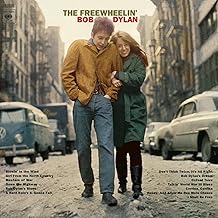
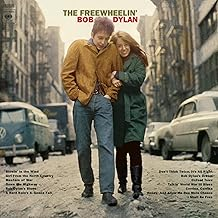
The Freewheelin' Bob Dylan 1: Blowing In The Wind
“Blowin’ in the Wind” is a song in which old biblical and folk materials are made to survive inside a modern crisis they can no longer fully master. Its power comes from the tension between inherited sacred forms and the historical novelty of the mid twentieth century: racial injustice, televised war, Cold War dread, nuclear annihilation, and the strange feeling that humanity has acquired powers its moral imagination has not caught up with.
Dylan’s song sounds old because it has to sound old. It needs the weight of scripture, ballad, spiritual, riddle, and frontier lament in order to speak about a modernity that otherwise risks becoming too abstract, bureaucratic, and technically managed to be morally heard. The dove is Noah’s dove. It comes from the story after the flood, when the ark floats over a drowned world and the dove is sent out to discover whether judgement has ended and whether the earth can be inhabited again. In Genesis, the dove’s return with the olive leaf is the sign that the waters have begun to recede. It is a tiny creature bearing cosmic news: the world has not been destroyed completely, there is still land, still covenant, still the possibility of beginning again.
Dylan’s line, “How many seas must a white dove sail / Before she sleeps in the sand?”, bends that story into modern unease. The dove no longer simply flies out from the ark and returns with proof of renewal. She must “sail” seas, as though even the bird of peace has been forced into the condition of a refugee ship, an ark, a ghost vessel, a survivor of catastrophe. The verb is wrong in a beautiful and disturbing way. The dove's not sailing through the air but sailing the seas. This dove sails because she remains adrift a flooded, post-catastrophic world. This is not a dove in flight. That makes the image much darker than a simple peace symbol. The dove after the flood is looking for land. “Before she sleeps in the sand” sounds peaceful at first, but it also sounds like exhaustion, landing, burial, the end of flight itself. Sand is shore, desert, grave, hourglass, and biblical wilderness. The image carries the echo of hope in the ark story, but drains it of easy reassurance. The dove may find land, but only after too many seas.
The world after the flood has not learned from the flood. The sign of peace has become a wanderer inside a world still organised by violence. This is where the nuclear shadow enters. The song was released in 1963, in the immediate atmosphere of Cold War terror, after the Cuban Missile Crisis of October 1962, when the possibility of nuclear war had become terrifyingly concrete. Dylan does not name nuclear weapons. He says “cannonballs”, which seems archaic, almost antique. But that is precisely the point. The song translates modern annihilation back into an older, more imaginable image of war. Cannonballs belong to battlefields, forts, civil war memory, sea warfare, and old ballads. Yet their very oldness makes them archetypal. By choosing cannonballs rather than nuclear warheads, Dylan makes modern violence continuous with older violence, while also making the old image tremble under modern pressure. “How many times must the cannonballs fly / Before they’re forever banned?” now sounds like a folk memory trying to comprehend Hiroshima, Nagasaki, Korea, Vietnam on the horizon, and the nuclear arms race. The cannonball becomes the ancestor of the missile. The old weapon carries the whole genealogy of human violence.
The word “forever” is too large for ordinary politics. It belongs to prophecy, covenant, apocalypse. To ban cannonballs “forever” is not merely to pass a treaty. It is to end a human dispensation. The line asks whether war itself can be brought under judgement, whether the cycle of violence can be abolished rather than merely paused. In a nuclear age the old dream of peace becomes newly urgent because war has become world-ending. The biblical flood once came from divine judgement. In the nuclear age, humanity can manufacture its own apocalypse. The song quietly lets that reversal haunt the old imagery. We are no longer only the people after the flood. We are also the people who might cause the next one.
The first line, “How many roads must a man walk down / Before you call him a man?”, also has biblical and American layers. The road is pilgrimage, Exodus, wandering in the wilderness, the road to freedom, the road west, the road of the hobo, the bluesman, the preacher, the fugitive, the civil rights marcher. It belongs to scripture and to weird Americana at once. In the Bible, people become themselves through journeying: Abraham leaves home, Israel crosses the wilderness, prophets walk, exiles return. In American folk culture, the road is equally charged: dust roads, railroad tracks, chain gangs, migrant workers, Depression wanderers, blues routes, outlaw trails. Dylan compresses all of this into the figure of “a man” walking roads. But the line is not simply existential. It asks, “Before you call him a man?” That “you” is the one who recognises or refuses recognition. In the civil rights context, this cuts sharply against racist infantilisation, the refusal to address Black men as men. But because the line is built out of biblical and folk-road archetypes, it becomes more than a local political complaint. It asks how long a human being must endure trial before humanity is granted by others. The old initiation structure is broken. In myth, the road teaches and transforms. Here the road does not guarantee recognition. A man may walk indefinitely and still not be called a man. The ordeal has become unjust because the judge is corrupt.
The mountain washed to the sea deepens the biblical scale. Mountains in scripture are places of revelation, covenant, law, and divine encounter: Sinai, Zion, the mountain of transfiguration. In folk and old American imagination, mountains are also ancient presences, Appalachian memory, frontier barrier, mineral wealth, isolation, judgement. To ask how many years a mountain can exist before it is “washed to the sea” is to place human injustice against geological and apocalyptic time. Mountains seem permanent, but they can be eroded. The image says two opposite things at once. Oppression can seem mountain-like, immovable, older than memory. Yet even mountains fall. The sea, which in biblical imagination often represents chaos, flood, depth, and judgement, eventually receives even the mountain. The natural world becomes a figure for historical patience and historical threat.
Then the song turns from geological time to political time: “How many years can some people exist / Before they’re allowed to be free?” The force is in “allowed”. Freedom cannot require permission. The line exposes the obscenity of a world in which one group treats another’s freedom as something to be granted, delayed, managed, or withheld. Again the old biblical material is active beneath the surface. This is Exodus language. “Let my people go” is present as a buried form. But Dylan modernises it by making bondage bureaucratic and social. “Allowed to be free” is colder than Pharaoh. It sounds like law, policy, custom, white moderation, gradualism, the paperwork of oppression.
The song’s weird Americana is also crucial. It is full of simple objects that feel as though they come from old songbooks: roads, seas, doves, sand, cannonballs, mountains, sky, ears, crying, death, wind. Nothing is technologically specific. There are no presidents, police, bombs, borders, television screens, or courtrooms. This stripping down creates a haunted folk landscape, almost a dream America, where biblical time, frontier time, slave spiritual, abolitionist hymn, and Cold War dread occupy the same field. It is modern by being archaic. It reaches the present not through topical detail but through older symbolic machinery that the present cannot escape.
The rhyme contributes to this object-making. “Man” and “sand”, “sea” and “free”, “sky” and “cry” are simple, almost nursery-like rhymes. But that simplicity is part of the song’s ancient machinery. The rhymes make the song feel communal, repeatable, already known. They make memory. “Sea/free” is especially important because it binds natural vastness to political liberation. Freedom is not argued for as a doctrine. It is sung into relation with the sea, with Exodus, with crossing, with escape, with the afterlife of slavery and migration. “Sky/cry” does something similar. To see the sky should be the simplest act of perception. To hear people cry should be the simplest act of moral hearing. Yet the rhyme makes clear that perception and compassion have become separated. The world is visible and audible, but people do not see or hear. That is why the repeated “how many” is so devastating. It resembles the old riddle song, but it also resembles a prophetic indictment. Biblical prophets often ask questions whose answers are already morally obvious.
The point is not ignorance but exposure. Dylan’s questions function like judgement disguised as innocence. They sound gentle, but they accuse the listener. How many deaths will it take? The answer is already contained in the phrase “too many people have died.” The song asks for a threshold only to reveal that the threshold has already been crossed. The refrain, “The answer, my friend, is blowin’ in the wind,” is in this deeper structure exact. The wind is biblical breath, spirit, ruach, the invisible movement of life and judgement. It is also American weather, prairie wind, dust-bowl wind, the wind through telegraph wires, the wind carrying songs, rumours, sermons, field hollers, radio signals, radioactive fallout. The wind is therefore both holy and contaminated, consoling and frightening. In the nuclear age, what blows in the wind may be the answer, but it may also be ash, dust, poison, fallout, the material trace of human self-destruction.
Dylan’s refrain holds both possibilities together. The answer is in the wind because spirit still moves. The answer is in the wind because catastrophe also moves there. This is the song’s great modernisation of biblical form. In older sacred narrative, signs come from God: the dove returns, the waters recede, the covenant is given, the prophet speaks. In Dylan’s song, the signs are everywhere, but nothing secures their meaning. The answer is not delivered as doctrine. It circulates. It is available but unstable, near but ungrasped. One must learn how to hear it. The song becomes itself a test of perception. Can the listener hear the answer in the song’s own breath? Or will the listener, like the man in the second verse, turn his head and pretend not to see?
The composition is thus an embodied hybrid object. Its material is ancient and American: Noah’s dove, Exodus freedom, prophetic questioning, the mountain and sea of scripture, the road of pilgrimage and folk wandering, the cannonball of old war song, the wind of spirit and dust. But these materials are reassembled under modern pressure: civil rights, militarism, mass death, nuclear threat, moral spectatorship, bureaucratic delay, and the fear that humanity may destroy the very earth on which the dove seeks rest. The old forms are the body of the song. The modern crisis appears through them because only these old forms have enough depth to make the crisis morally legible. So the song is historically precise and new because it knows how to become old. It allows 1963 to appear as another moment in biblical history, another wilderness, another flood aftermath, another Exodus delayed, another war before judgement, another test of whether human beings can recognise what is already before their eyes. Its simplicity is not simplicity of thought. It is simplicity of form after enormous compression. It makes a modern world out of archaic fragments, then lets those fragments sing against the catastrophe they have been asked to carry.
What emerges most strangely from the song is not merely a set of images, but a voice that should not quite be possible. The singer is at once ancient and modern, personal and anonymous, intimate and public, prophetic and uncertain. The song invents a new cultural figure by assembling older forms of authority whose original settings have disappeared. The result is not simply “the folk singer” or “the protest singer.” It is something more unstable and hybrid, a voice composed out of fragments that no longer naturally belong together, yet which the composition temporarily binds into a functioning whole. One can hear inside the voice the remains of the biblical prophet, but altered almost beyond recognition. The classical prophet speaks from a position of revelation. Isaiah, Jeremiah, Amos, Elijah, these figures do not ask whether injustice exists. They declare it. Their authority comes vertically, from covenant and divine commission. Dylan’s speaker inherits the cadence of prophetic accusation, especially the repetitive questioning and moral urgency, but the source of authority has changed completely. The singer does not thunder judgement from a mountain.
Revelation has become atmospheric rather than institutional. The answer is “blowin’ in the wind”, circulating without fixed ownership. This transforms prophecy itself. The prophet no longer possesses the truth in completed form. He becomes a receiver, a tuner of signals already moving through collective life. That alteration produces a very modern kind of prophetic figure. The old prophet stood outside society in order to condemn it. Dylan’s singer stands inside mass culture, radio culture, commercial recording culture, and yet somehow still speaks with the resonance of archaic moral speech. This is an extraordinary fusion because mass media usually dissolves prophetic authority into entertainment. Yet Dylan turns the very conditions of reproducibility, microphones, records, public performance, into the new embodiment of wandering prophecy. The voice can travel like the wind itself, detached from place, endlessly replayed, entering cars, kitchens, marches, cafés, dormitories, church halls. The prophet has become mechanically reproducible without becoming merely mechanical.
This new figure also fuses contradictory American archetypes. One hears the itinerant preacher, the Depression drifter, the dust bowl singer, the blues wanderer, the frontier witness, the union balladeer, the biblical seer, and the young urban intellectual. These are not harmoniously unified identities. Historically they belong to different Americas. The evangelical preacher often stood against bohemian culture. The folk balladeer and the biblical prophet arose within different traditions of authority. The blues singer carried irony, eroticism, survival, and wounded individuality more than covenantal judgement. Yet Dylan’s voice composes these incompatible inheritances into a new speaking figure whose coherence comes not from purity but from tension.
The strangeness lies partly in how little stable personality the speaker possesses. The “I” is almost absent. There are no confessions, no autobiographical details, no explicit doctrinal commitments. Yet the song feels intensely voiced. The speaker is present as a kind of moral orientation rather than as a psychological individual. This makes the figure oddly impersonal and portable. Anyone can sing the song, but not everyone can fully occupy the voice. The voice exceeds the empirical singer. It becomes something like a role or office temporarily embodied in performance. This is why the figure resembles older prophetic types while also differing from them fundamentally. Biblical prophets often appear less as rounded personalities than as bearers of speech acts. They are vehicles of warning, lament, or judgement. Dylan modernises this by producing a voice that is constituted by circulation itself. The singer is not authoritative because he stands above the public. He is authoritative because he absorbs dispersed historical materials and re-emits them in concentrated form. The authority comes from successful embodiment of collective memory.
The folk idiom is crucial here. Folk song traditionally presents itself as ownerless, worn smooth by repetition across generations. Dylan deliberately enters that tradition while simultaneously altering it from within. The voice therefore sounds older than the singer himself. This creates the eerie sensation that the song has been remembered rather than written. Yet that apparent timelessness conceals a highly modern artistic construction. The singer becomes a mediator between inherited communal forms and contemporary historical anxiety. The Cold War context intensifies this transformation. Nuclear modernity created a crisis for older moral languages. Traditional heroic rhetoric becomes absurd under the conditions of total destruction. One cannot easily sing triumphalist battle songs after Hiroshima. But one also cannot live entirely within bureaucratic or technocratic language, because such language neutralises moral perception. Dylan’s invention is to reactivate archaic speech forms precisely where modern political vocabulary has become numb.
The voice therefore sounds old because modernity itself has become spiritually exhausted. The archaic returns not as nostalgia, but as a surviving moral technology. At the same time, the figure is radically anti-authoritarian. Unlike the biblical prophet, the singer does not claim certainty. The refrain withholds closure. The answer exists, but drifts. This creates a prophetic mode without dogmatism. The speaker accuses without fully legislating. He points toward truth without enclosing it in system or institution. This becomes especially important in the postwar American context, where institutional authority, governments, churches, corporations, militaries, had all become suspect. Dylan’s prophetic figure emerges precisely from distrust of official speech. One might say the song constructs a figure who is ancient in structure but modern in ontology. The old prophet was anchored in divine order. Dylan’s singer is anchored only in movement, circulation, recurrence, and shared recognition. His authority depends on embodiment within song itself. If the song ceases to be sung, the prophetic figure vanishes back into fragments. The figure therefore exists only through repeated manifestation across performances, recordings, listeners, and historical moments.
This helps explain the peculiar emotional tone of the song. It is morally serious without becoming rigid. It is sorrowful without despair. It is accusatory without hatred. The speaker seems to belong simultaneously to mourning and hope. That duality comes from the fusion of biblical aftermath and American openness. The flood has happened, or may happen again, yet the road still stretches onward. The prophetic figure therefore speaks from within catastrophe while still assuming the possibility of response. Even Dylan’s singing style contributes to this strange composite ontology. The thin, nasal, almost abrasive delivery lacks the polished authority expected of official singers. It sounds weathered before its time, youthful and ancient together. The voice itself becomes a hybrid artefact, part Dust Bowl survivor, part backwoods preacher, part urban beat poet, part Midwestern teenager. It does not erase its components. One hears the seams. But the seams are precisely what create the new figure’s reality. The song therefore invents a modern prophetic embodiment suited to democratic mass culture and technological modernity. It neither restores the old prophet nor abandons prophecy altogether.
Instead it constructs a figure whose unity depends on holding incompatible inheritances together without resolution. Sacred and secular, biblical and commercial, anonymous and authored, collective and singular, archaic and contemporary, wandering and broadcast, intimate and planetary, all coexist within the same vocal form. This is why the song feels larger than its literal content. The questions matter, but the deeper achievement lies in the creation of a speaker who can still ask such questions after modernity has fragmented the older grounds of moral authority. The song becomes the temporary body of that speaker. In performance, the scattered remains of older American and biblical voices are gathered together and made to speak once more as though they belonged to a single being.
What becomes increasingly uncanny is that “Blowin’ in the Wind” does not merely gather older materials from the biblical past, folk song, spirituals and weird Americana. It also seems to contain, in latent and spectral form, the songs still to come. The song behaves less like an isolated composition than like a generative object whose hidden structure can unfold into multiple later embodiments. Once the whole album has been heard, the opening anthem changes retrospectively. One begins to hear strange anticipations inside it, echoes of songs that technically do not yet exist when it begins. The album reorganises the identity of the song backwards through time.
This gives the album a very peculiar artistic ontology. The tracks are sequential in one sense, but their deeper identity is reciprocal. Later songs alter the meaning of earlier ones, while earlier songs secretly prepare spaces into which later songs can emerge. “Blowin’ in the Wind” therefore sounds simple only on first hearing. After the album unfolds, one realises that its imagery, vocal stance, rhythms of questioning and old symbolic machinery already contain unstable possibilities that the surrounding songs will intensify, distort, harden, parody or darken. One can hear “Masters of War” already coiled inside the cannonball image. In “Blowin’ in the Wind”, war still appears through archaic and almost mythical imagery: cannonballs flying endlessly across history. Violence is universalised into recurrence. But “Masters of War” changes the emotional and metaphysical register entirely. The anonymous cycle of violence acquires agents, systems, industries and beneficiaries. The prophetic questioning of the earlier song mutates into direct accusation: “You that build all the guns”. The moral atmosphere thickens from lament into curse. Yet retrospectively this fury was already sleeping inside the earlier composition. The cannonball was never merely antique decoration. It was a compressed symbolic ancestor of the military-industrial machinery that “Masters of War” later drags into full visibility.
Something similar happens with “A Hard Rain’s A-Gonna Fall”. The wind of the earlier song seems initially open, airy, almost gentle, despite its ambiguity. But after hearing “Hard Rain”, the atmosphere of the album changes completely. Weather itself becomes apocalyptic. The question-and-answer structure survives, but now transformed into visionary overload. “Oh, where have you been, my blue-eyed son?” sounds like the folk-riddle skeleton of “Blowin’ in the Wind” swollen into nightmare prophecy. The sparse moral archetypes of the earlier song explode into hallucinated modern imagery: dead oceans, black branches dripping blood, pellets of poison flooding the waters, executioners’ faces, guns in children’s hands. Once “Hard Rain” exists within the same album-world, the wind of the earlier song can no longer sound innocent. It begins to feel charged with approaching catastrophe. The answer blowing in the wind may now include radioactive dust, fallout, poison, and the invisible atmospheric terror of the Cold War. The first song does not explicitly say this, but the later song reveals that the atmosphere was already unstable from the beginning. The wind was carrying more than spiritual possibility.
“Oxford Town” also appears retrospectively inside the opening lines about roads and recognition. “How many roads must a man walk down / Before you call him a man?” initially sounds archetypal and universal, drawing from biblical wandering, folk pilgrimage and existential journeying. But “Oxford Town” localises those roads within the violent geography of segregation and racial conflict. The abstraction of the first song acquires historical flesh. Roads become Southern roads. Recognition becomes desegregation struggle. Public morality enters specific American terrain. This retroactive transformation matters because it shows how the album builds a strange relation between universality and locality. “Blowin’ in the Wind” never abandons archetype, but later songs reveal the buried specificity already hidden within its forms. The universal was not empty abstraction. It was compressed historical potential.
Even “Talkin’ World War III Blues” exists as a bizarre comic mutation already dormant within the first song. The nuclear dread implied by “cannonballs” and endless war becomes in that later track absurdist dream narrative, deadpan humour, post-apocalyptic loneliness and paranoid comedy. This is one of the album’s strangest achievements. It refuses to separate prophecy from comedy. The same historical pressure can manifest as solemn lament or surreal joke. In fact, the comedy often intensifies the dread because the absurdity feels like the only psychologically survivable response to nuclear modernity.
This means that the prophetic figure invented in “Blowin’ in the Wind” is already internally unstable. The singer is not simply a pure moral seer. He is potentially also the joker, the talking blues rambler, the ironist, the surreal observer. The album distributes one unstable artistic being across multiple embodiments. No single song exhausts the figure. That becomes especially clear when one places “Girl from the North Country” or “Don’t Think Twice, It’s All Right” beside the public songs. At first these appear to belong to another world entirely, intimate and personal rather than historical or prophetic. Yet they too alter the opening song retrospectively. The moral structure of “Blowin’ in the Wind” depends heavily upon failed recognition: people turning their heads, refusing to hear cries, delaying freedom, withholding acknowledgment. The love songs internalise these structures into personal relation. Emotional distance, evasion, wandering, departure and failed reciprocity become private versions of the same broader metaphysical problem.
The result is that the album cannot be neatly divided into “political songs” and “personal songs.” Instead it presents different manifestations of one underlying artistic object. Public injustice, romantic loss, nuclear fear, racial violence, comic paranoia, wandering loneliness and prophetic warning all become distinct embodiments of the same unstable modern consciousness. This is why the album feels simultaneously ancient and radically new. It constructs coherence not through stylistic consistency but through recurring transformation of inherited forms. The old ballad, the spiritual, the talking blues, the murder lament, the love song and the prophetic sermon all remain partially visible inside the finished compositions.
Dylan does not erase the old genres. He allows them to coexist inside new hybrid forms. “Blowin’ in the Wind” is therefore the album’s central generative knot because it already contains this principle of unstable embodiment in miniature. The road can unfold into blues wandering, civil rights geography or personal exile. The wind can become spirit, weather, fallout, song circulation or historical anxiety. The question form can become prophetic accusation, comic rambling or visionary revelation. The old biblical and folk machinery does not dictate one future. It creates a field of possible manifestations. That is why the song acquires such strange temporal depth once the album has been absorbed as a whole. The listener begins to hear future songs as though they had been faintly present all along, not literally encoded, but structurally latent. The album becomes less like a sequence of separate tracks and more like a single object manifesting itself through different voices, moods and generic disguises.
This is also why Dylan’s artistic persona on the album feels so difficult to stabilise. He is never simply the protest singer. The album continually exceeds that category from within. The prophetic voice fractures into comedy, tenderness, bitterness, absurdity and surreal vision. Yet these are not disconnected masks. They are linked through recurring symbolic material and inherited forms that migrate across songs in altered states. The achievement lies in how subtly this is done. The songs remain singable, memorable, apparently simple. Yet beneath that simplicity lies an extraordinarily delicate compositional architecture in which old American and biblical forms are continuously recombined into new embodiments.
“Blowin’ in the Wind” appears at first to stand serenely above the rest of the album as its moral centre. But gradually one realises it is stranger than that. It is the album’s first manifestation of a larger hybrid artistic being whose later embodiments are already faintly moving inside its blowing wind, its roads, its skies and its unanswered questions.