Twin Peaks: The Return: Notes On The Fireman and Mr C
Twin Peaks: The Return: Notes On The Fireman and Mr C
Mr C functions as the clearest embodiment of what agency looks like once grounding has collapsed but instrumental power remains intact. If Dougie shows how a subject can persist without understanding, and the FBI shows how understanding can persist without efficacy, Mr C shows how efficacy can persist without responsibility, coherence, or even integrity. He is the season’s most ruthless figure because he is perfectly adapted to the world episode eight reveals. In the original series, the doppelgänger emerges as a horror precisely because identity is still assumed to be unitary and morally accountable. When Cooper’s double appears in the final moments of season two, it is terrifying because it violates a background assumption that a person’s actions, intentions, and selfhood belong together. The doppelgänger is a corruption of that unity. Mr C in season three is something else. He is not a corruption of unity. He is the product of its dissolution. By the time The Return begins, the world no longer enforces the conditions under which unity would be required. What distinguishes Mr C immediately is his clarity of function. He knows what he wants in the narrowest possible sense, survival, control, leverage, movement. He does not seek explanation, meaning, or even pleasure. He seeks alignment of circumstances with outcome. His interactions are stripped of excess. He speaks to extract, to threaten, to command. He listens only to identify leverage points. This is a mode of being optimised for a world where reasons no longer ground action. Crucially, Mr C is not omniscient. He makes mistakes. He encounters resistance. His plans require constant adjustment. What makes him effective is not knowledge in the traditional sense, but an implicit grasp of the new operating conditions of reality. He does not assume that truth will matter. He does not assume that people will act out of principle. He assumes that systems respond to pressure, that people respond to fear, and that bodies can be coerced. And the world consistently confirms these assumptions. This is why Mr C’s interactions with institutions are so revealing. He moves through police departments, criminal networks, prisons, and medical facilities without friction. These institutions no longer require legitimacy or moral justification to function. They require compliance. Mr C provides it, whether through intimidation, bribery, or sheer force. The institutions recognise him as effective. This is the quiet indictment at the heart of his storyline. He does not overthrow order. He exploits its hollowness. Mr C’s body is one of the most important elements of his portrayal. From early in the season, his physical integrity is compromised. He vomits. He bleeds. His face deteriorates. Something is wrong with him at a biological level. Yet this deterioration does not diminish his power. If anything, it intensifies his urgency. The separation between bodily integrity and agency is one of the clearest signs that the old metaphysical alignments no longer hold. In a grounded world, bodily breakdown would impair capacity. Here, it barely registers. This bodily decay is entropy. Mr C is a form of agency running without grounding, and such agency consumes its bearer. But the consumption is slow, uneven, and does not prevent domination in the meantime. This is one of the most unsettling claims of the season. The cost of ungrounded power is real, but it is deferred. In the short and medium term, it works frighteningly well. Mr C’s relationship to violence further clarifies his role. Violence, for him, is procedural. He kills when killing removes an obstacle. He threatens when threatening secures compliance. There is no excess. This is why his violence feels colder than BOB’s in the original series. BOB was chaotic, sadistic, driven by appetite. Mr C is administrative. He is what violence looks like when it has been stripped of myth and folded into logistics. Seen in this light, episode eight’s reframing of BOB as an emitted by- product rather than an intentional demon becomes crucial. Mr C is downstream of that emission. He is what happens when the residue of metaphysical rupture is stabilised into a workable form of agency. BOB is excess. Mr C is consolidation. The season suggests that the real danger is not the eruption of chaos, but its successful institutionalisation. This is also why Mr C stands in such sharp contrast to Cooper and Dougie. Cooper represents an older mode of agency, one that assumes that understanding, empathy, and responsibility can align. Dougie represents the collapse of that alignment into vacancy. Mr C represents a third path, the abandonment of alignment altogether in favour of pure effectiveness. The season presents it as an adaptation. Mr C’s adaptability is most visible in how he treats knowledge. He does not care whether what he is told is true. He cares whether it can be used. Information is valuable insofar as it enables prediction or control. This is why interrogation scenes with Mr C are so chilling. He seeks compliance. Truth is incidental. The distinction between truth and falsehood has been flattened into a distinction between useful and useless. This flattening mirrors the broader epistemic condition of season three. Systems reward outcomes, not reasons. Mr C simply accepts this condition and acts accordingly. In this sense, he is not a transgressor. He is exemplary. He shows what it looks like to take the world at face value once face value no longer guarantees depth. Even Mr C’s relationship to the supernatural reflects this instrumental stance. He does not revere Lodge entities. He negotiates with them. He threatens them when possible. He seeks coordinates, not communion. The metaphysical has become another terrain to be navigated rather than a source of awe or terror. This is a radical shift from earlier seasons, where the Lodge demanded reverence and fear. In season three, even the supernatural is subject to leverage, as long as one understands its pressure points. Yet the series never lets us forget that this adaptation is parasitic. Mr C cannot create. He can only manipulate. He cannot ground meaning. He can only exploit its absence. His power depends on a world that still contains people who care about truth, responsibility, and connection, even as those values lose structural support. He feeds on institutions that continue to function out of inertia. He is powerful precisely because he does not need to believe in what those institutions once stood for. This is why his eventual containment does not read as moral victory. When Mr C is finally undone, it is not because justice prevails or truth triumphs. It is because his form of agency exhausts itself. The world can only sustain ungrounded domination for so long before entropy catches up. But the season is careful not to suggest that this exhaustion restores the old order. It merely removes one particularly efficient expression of the new one. Mr C’s deepest significance, then, lies in what he reveals about the world rather than what he does within it. He shows that once grounding collapses, the most dangerous figures are not those who rage against meaning, but those who quietly stop needing it. He is terrifying because he is rational in a world where rationality has been stripped of its ethical and epistemic constraints. In this sense, Mr C is one of Lynch’s most devastating creations. He is not a monster lurking beneath the surface. He is the surface, operating smoothly after the foundations have burned away.
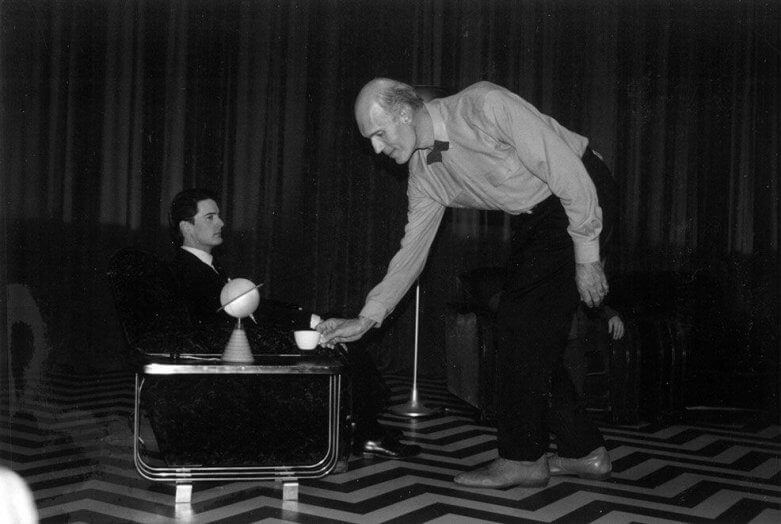
If Mr C embodies what agency looks like after grounding has collapsed, the Giant and the strange woman, the eggs, and the contraption show what it looks like when something like grounding still exists, but only in a residual, custodial, almost exhausted form. They are not counterparts to Mr C in any simple moral or metaphysical opposition. They do not restore order, explain events, or reassert intelligibility. Instead, they operate at a level beneath action and explanation, where the conditions for appearance, identity, and consequence are being quietly managed, not governed. The Giant’s most striking feature across the series, and especially in season three, is his refusal to act in ways that would count as intervention in an ordinary sense. He appears. He observes. He offers fragments. He does not correct, punish, or save. This is not benevolence restrained by principle, nor impotence disguised as mystery. It is something colder and more structural. The Giant is not operating within the same space of reasons as the other characters. He is not trying to make sense of events. He is trying to keep the world minimally coherent. In the original series, the Giant could still be read as a guide, a benevolent intelligence nudging Cooper toward insight. His clues, while cryptic, functioned as information. They could be integrated into investigation. They made sense within an expanded epistemic framework where dreams and visions still counted as evidence. By season three, that framework no longer holds. The Giant’s communications no longer function as clues. They function as constraints. They mark limits rather than paths. This shift becomes explicit in episode eight. The Giant’s response to the atomic explosion is calibration. He watches the rupture of differentiation itself, the moment where pattern overwhelms essence, and he produces something in response. The golden orb containing Laura Palmer is released as a counterweight. The logic here is structural. Something has been introduced into the world that will generate ungrounded violence. Something else must be introduced that can still carry suffering, identity, and consequence together in a way that might stabilise meaning locally. This is why Laura’s role changes so radically in season three. She is no longer just the girl who died, the secret to be uncovered, the victim whose truth will restore order. She becomes a kind of ontological anchor, a site where pain, selfhood, and responsibility might still coincide. The Giant does not guarantee that this will succeed. He does not oversee outcomes. He only ensures that the possibility exists. The strange woman Naido, deepens this picture. She is not a character in the ordinary sense. She does not have a backstory that explains her presence, nor does she function as an agent with goals. She is damaged, constrained, partially incapacitated. Her eyes are covered. Her speech is impossible. Yet she is not inert. She moves. She gestures. She insists. What makes Naido so unsettling is that she embodies obligation without articulation. Cooper knows he must help her, but he does not know why or how in any ordinary sense. There is no reason he can cite, no principle he can invoke. The obligation is immediate and pre reflective. This matters because it shows a form of normativity that persists even after epistemic grounding has collapsed. One can still feel compelled to care, even when one cannot say what care would consist in. Naido’s inability to speak is not that her truth is being silenced. It is that the conditions under which speech would function have failed. Language no longer reliably connects experience to meaning. Naido’s gestures bypass language because language has become unreliable. Her presence shows that some forms of responsibility precede explanation. One can be answerable without understanding. The eggs and the contraption extend this logic to the level of ontology itself. The contraption in the Giant’s domain, with its levers, screens, and receptacles, looks like a machine, but it is not a machine in the modern sense. It does not optimise, produce, or control. It curates. It sorts. It channels. The eggs that appear are not embryos in a biological sense, nor symbols to be decoded. They are possibilities, raw units of emergence that have not yet been integrated into a world where identity and consequence line up. This is why the eggs are so disturbing. They are not evil. They are not good. They are ungrounded. They represent the proliferation of potential without essence. In a grounded world, not everything that could exist does exist. Constraints limit emergence. The atomic rupture removes some of those constraints. The eggs are what spills out. The Giant’s contraption does not eliminate this spill. It does not restore the old order. It manages distribution. It redirects some possibilities, blocks others, delays emergence where possible. This is damage control. The Giant is not sovereign. He is custodial. He works within a world whose fundamental alignment has already been compromised. This is why the contraption feels so bureaucratic, so procedural. It is mystical in the sense of operating at a level below deliberation. The Giant does not decide in the way agents decide. He adjusts. He compensates. He maintains thresholds. His work resembles regulation after collapse, not creation before order. The eggs’ later appearance in the 1950s sequence underscores this. The frog moth that crawls into the girl’s mouth is an insertion of ungrounded potential into ordinary life. The girl does not consent. She does not resist. She sleeps. The horror is that the world can absorb such an insertion without immediate disruption. Damage installs itself quietly. This quiet installation is the key to understanding the Giant’s limited efficacy. He cannot prevent emergence. He can only hope to counterbalance it elsewhere. He introduces Laura not to defeat the frog moth, but to ensure that somewhere, suffering will still be owned by a person who can bear it, rather than diffused across a system where no one is responsible. Seen this way, the Giant and the strange woman are not figures of hope in a redemptive sense. They are figures of minimal viability. They represent the lowest level at which a world can still count as a world rather than a mere flux of pattern. They preserve the possibility of responsibility without guaranteeing justice, the possibility of care without guaranteeing success, the possibility of meaning without guaranteeing explanation. This is why the Giant never comforts. He never reassures. He never promises resolution. His presence is calm, but not kind in any sentimental sense. He does not intervene to save Cooper from suffering or to prevent violence. He intervenes only to prevent total collapse. In Lynch’s broader body of work, these figures echo his recurring interest in maintenance rather than mastery. In Twin Peaks, as in Inland Empire, there are forces that do not oppose evil so much as keep reality from dissolving completely. They are caretakers of a broken system. Their labour is invisible, procedural, and thankless. The eggs, the contraption, the strange woman, and the Giant together form a picture of metaphysics after catastrophe. Not a world ordered by law or narrative justice, but a world held together by fragile compensations, local anchors, and exhausted custodianship. They show that even after grounding collapses, not everything becomes chaos. Something remains. But what remains is thinner, colder, and far less consoling than the structures that came before.