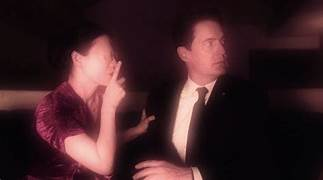
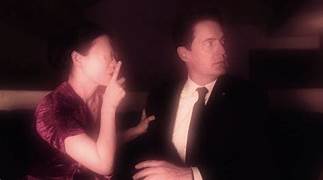
Naido in season three is the same being as the woman Cooper encounters in the Lodges in the original series, the figure often referred to as Ronette’s double, the eyeless woman, or simply the mute woman. However, season three deliberately reframes what that identity amounts to. The continuity is not psychological or biographical. It is ontological and functional. In series one and two, the woman appears in the Red Room and related Lodge spaces as a silent, wounded presence. She does not speak. She moves with difficulty. Her eyes are often obscured or damaged. At the time, viewers naturally tried to interpret her symbolically, as a victim, as a soul trapped by evil, as a fragment of Laura or Ronette, as a cipher for trauma. Those readings assume that the Lodge is a symbolic theatre populated by representations of human experiences. Season three quietly but decisively shifts that assumption. When Naido appears in The Return, especially in the purple sea and later in the glass box space, she is treated as a being with a role. Her muteness and blindness are constraints. She cannot see or speak because the conditions under which seeing and speaking would function have been damaged. Her impairments are structural, not metaphorical. This reframing retroactively changes how we should understand her earlier appearances. In the original series, Cooper still inhabits a world where dreams, symbols, and visions can be interpreted as information. The Lodge entities function like figures in a mythic language that Cooper is learning to read. The woman’s silence there feels enigmatic, as though meaning is hidden and waiting to be decoded. Season three tells us her silence was already a sign that meaning could not be transmitted in the usual way. We just did not yet have the conceptual equipment to see that. She is no longer merely present. She requires care. Cooper must help her move, protect her, respond to her gestures. The obligation she generates does not come from understanding who she is or what she represents. It comes from encountering her vulnerability directly. The series shifts her from the register of interpretation to the register of responsibility. Her blindness, in particular, matters. In Twin Peaks, sight is usually tied to knowledge, dreams, visions, surveillance, clues. To be blind in this universe is not just to lack perception. It is to exist outside the economy of revelation. Naido cannot see, and therefore cannot participate in the system where insight produces action. Yet she still matters. She still obligates. This is an ethical claim. Responsibility does not depend on epistemic clarity. When Naido later transforms, revealing herself as Diane, this does not undo her earlier identity. It completes its function. Diane, like Naido, is a figure whose subjectivity has been fractured by violence and displacement. Her split is the result of being forced into a world where agency and meaning no longer align. Naido is Diane stripped of voice and sight as a consequence of surviving in an ungrounded reality. Seen this way, Naido is continuous with the woman from the first two series, but she is also more than simply a symbol within Cooper’s dream logic. She was always a being damaged by the same rupture episode eight later makes explicit. We just lacked the frame to see it. Naido is the same woman, but sameness itself must be rethought. Identity here is not a stable essence carried across time. It is a role that persists across radically altered conditions. Naido is not the same person in the sense that Cooper is meant to return as the same Cooper. She is the same obligation appearing under worsening constraints.
Diane for years was the unseen recipient of Cooper’s dictaphone messages, the imagined stabilising presence to whom he explains, confesses, reflects. She is the guarantee that someone is listening, that language is landing somewhere, that the world still supports the act of telling. When Diane finally appears in season three she turns out not to be the ground of communication, but one of its casualties. In the original series, Diane functions as a structural support rather than a character. Cooper’s habit of speaking to her is part of what makes him intelligible as an agent. He reflects. He records. He narrates his experiences in a way that presupposes continuity of self and audience. Diane, though absent, represents the background assumption that meaning can be transmitted, stored, and later retrieved. She is part of the epistemic furniture of the show, as essential as the tape recorder, the case file, or the coffee. She does not need to appear because her function is to make appearance itself make sense. That function was always fragile. When in the last series she finally enters the frame, she does so as a damaged, defensive, deeply alienated subject. She is irritable, guarded, hostile to the men around her, especially to Gordon Cole. Her language is sharp, profane, brittle. This is the exposure of what it means to be the one who listens, absorbs, and records in a world where violence and domination have become ambient. Diane’s history, gradually and painfully revealed, makes clear that her fracture is not merely personal. She has been violated by Mr C, by the version of Cooper that operates without grounding or responsibility. Diane has not been harmed by an external monster. She is harmed by the same figure who once anchored her as listener and confidant. The voice that once narrated the world to her becomes the force that destroys her capacity to inhabit it safely. This inversion retroactively destabilises the entire original series. Cooper’s recordings to Diane, once heard as charming, reflective, ethically grounded, now acquire a shadow. They were never neutral acts of communication. They were asymmetrical. Cooper spoke. Diane listened. He processed the world aloud. She absorbed. The series does not accuse Cooper of malice in this earlier phase, but it does suggest that the distribution of agency in their relationship was never as balanced as it seemed. Season three brings this imbalance into the open. Diane’s anger is the assertion of damaged agency. She refuses to be the quiet container for other people’s meaning. Her hostility toward Gordon is especially revealing. Gordon treats her with affection and familiarity, but his manner is invasive, careless, too loud, too entitled. Diane’s rejection of this is a refusal to be reduced again to a surface onto which others project authority, nostalgia, or desire. Her speech patterns reflect this refusal. She swears. She interrupts. She withholds. She speaks as little as necessary and often in ways that close down conversation rather than extend it. This is defensive competence. Diane knows exactly what language does in this world. She knows it can be used to dominate, to erase, to overwrite. Her guardedness is a rational response to an environment where speaking has become dangerous. The revelation that the Diane we have been seeing is a tulpa, an artificial double, deepens rather than resolves this tension. A tulpa is not a trick or a puzzle. It is the ontological expression of Diane’s fracture. The real Diane has been displaced, exiled into a state where she cannot appear as herself. What remains is a functional substitute, capable of operating within systems, attending meetings, exchanging information, but not capable of trust, intimacy, or grounding. The tulpa is not a fake in the ordinary sense. It is a working entity in a world that no longer requires authenticity in order to function. The tulpa-Diane does her job. She participates. She provides information. But she does so without the subjective integrity that would make those actions fully hers. She is the perfect analogue to Mr C in this respect, an agent who functions without being whole, though unlike Mr C she is a victim of this condition rather than its beneficiary. When the tulpa-Diane is exposed and destroyed it is violent. It is traumatic. It does not restore the real Diane to wholeness. It merely removes a compromised proxy. What follows, when the real Diane re emerges, is rawness. She is shaken, fragile, uncertain. Her agency is tentative. Her reunion with Cooper is devastating. It is an encounter between two people whose shared past no longer provides a stable basis for recognition. Cooper apologises. Diane listens. But apology does not heal structural damage. The trust that once allowed Diane to function as listener has been destroyed, and no amount of explanation can rebuild it. Their sexual encounter later is especially telling. It is awkward, tense, dissociated. It isn't intimacy. It's an attempt to locate reality through physical contact, to confirm existence in a world where identity has become unstable. Diane’s expression afterward is disorientation. Something has happened, but it has not grounded her. The act fails to restore alignment between body, self, and meaning. Diane’s final transformation, her apparent disappearance or reconfiguration in the final episodes, reinforces this. She does not become a guide, a redeemer, or a restored subject. She slips out of the narrative as quietly as she entered it. This is fidelity to what her story has shown all along. Some damage cannot be narratively redeemed. Some subjects cannot be reintegrated into a world that harmed them without first changing that world’s conditions. And those conditions do not change. Seen across the whole series, Diane is the counterpoint to Cooper. He is the figure who tries, again and again, to restore coherence, to make things right by understanding them correctly. Diane is the figure who shows what it costs to live inside that attempt when understanding fails to protect, when meaning becomes another vector of violence. She also stands as one of Lynch’s most incisive engagements with gender and power, precisely because the series refuses to turn her into a moral lesson. Diane is not sanctified. She is not idealised. She is angry, difficult, wounded, opaque. She does not offer wisdom. She demands distance. In a series obsessed with listening, recording, dreaming, and seeing, Diane represents the right not to be accessible. Diane is not the answer to the question “Who is the dreamer?” She is the reminder that being cast as the listener to someone else’s dream can be a form of erasure. Her presence forces the series to confront the ethical cost of its own epistemic habits.