Christopher H. Owen, Heaven Can Indeed Fall: The Life of Willmoore Kendall
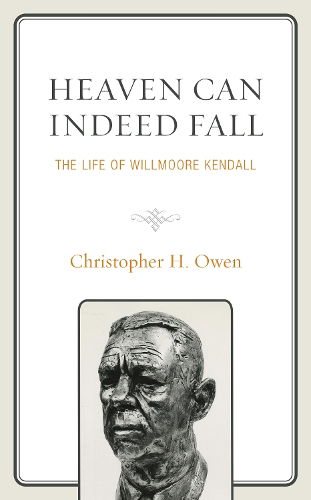
Christopher H. Owen, Heaven Can Indeed Fall: The Life of Willmoore Kendall (Rowman & Littlefield, 2021)
It is regularly said that “populism” is a vague, perhaps even useless, term because there are both right- and left-wing populists. Perhaps the idea is that there can only be one political continuum, and as Trotsky and Trump certainly don’t belong in the same spot on this line, it can’t be helpful to claim that they are both populists. In his biography of Willmoore Kendall, Christopher Owen nevertheless takes the position that his subject’s famous move from youthful democratic socialist to WWII isolationist, National Review co-founder, and intractable supporter of Joe McCarthy is explicable by the fact that Kendall was motivated throughout his short but explosive lifetime by his consistent advocacy for populism–at least if that term is taken to require an insistence on majority rule.
Owen does not suppose that this metamorphosis was simple, however. He takes Kendall to have been so brilliant a theoretician that the difficulties that readers of his work are bound to encounter when attempting to understand what it was that changed him from radical socialist to hardline rightwinger sometime around 1947 likely stem from a forgivable inability to fathom his depth. There’s a grain of truth there, certainly, but also what seems to me a somewhat larger hunk of confusion and hero-worship. And I will contend below that Owen’s misconceptions actually manage to undermine his high praise for Kendall’s political theory.
Let me begin by acknowledging that if this book were not the tale of a “thinker” it would be a very admirable biography. Naturally, to get the best sense of “what it is like” to be some particular person, only an autobiography is likely to do the trick. But by copious use of letters, interviews, and the other standard tools of the biographer, Owen has provided his readers with an excellent idea of the principal events of Kendall’s life. The problem is that when one’s subject is a thinker rather than, say, a boxer or dancer, there will likely also be a good deal of space devoted to the theories espoused by that individual. It is in this area that there is much left to be desired by Owen’s engaging book.
But first, let us have a glance at what Kendall “went through.” His event-packed life included his child-prodigy years in Oklahoma and his close but often difficult relationship with his father, a blind and ambitious radical intellectual who worked as a pastor in various backwater parishes. It’s not even entirely clear that he was a theist. In any event, one of his children, Kendall Jr., was so much smarter than his peers that he was pushed to matriculate at Northwestern while he was still wearing short pants, an embarrassment that may have been partly responsible for Willmoore Jr.’s readiness to engage in hostilities with nearly everyone once he grew up big and strong.
That early experience in Evanston didn’t go particularly well. And later, at Oxford, where he spent a couple of terms as a Rhodes Scholar, it seems he didn’t particularly impress his tutor, the historicist R.G. Collingwood (who Owen oddly calls one of the most important 20th Century philosophers), but Kendall nevertheless slowly moved from romance languages to political philosophy. He eventually received a doctorate at the University of Illinois where he wrote a well-received and quickly published dissertation on John Locke.
Kendall got teaching jobs at several universities before the onset of WWII, at which time this doctrinaire isolationist moved into international government intelligence and propaganda work, principally in Latin America. He married along the way, but the couple’s jobs often kept them apart, and Kendall apparently strayed on several occasions (there’s not much here about those events). In any case his marriage is said to have ended in an amicable divorce. Kendall claims the two never fought, but based on his relationships with almost everybody else this is a bit hard to believe.#
To avoid the Oklahoma draft board, while he was still working for a couple of ancestors to the CIA, Kendall enlisted, and was made a Captain whose duties seem to have remained largely in the Our Man in Havana mode (though for Kendall it was mostly Columbia). Shortly after the war, he was honorably discharged and picked up a very tasty faculty appointment at Yale, where the students are said to have loved him, but his colleagues clearly did not. As luck would have it, one of his students was the young William F. Buckley, an aristocratic and conservative hero-in-training who brought Kendall on board when he started The National Review.
During the Korean war Kendall left Yale to go back to intelligence work, and might have stayed with that for the excitement and greater financial remuneration if his colleagues in government hadn’t turned out just as hard to get along with as the Yale faculty and staff did.
Kendall’s busiest years at National Review were from 1955 to 1958, at the end of which time he left to take a visiting position at Stanford. Those who think the idea of calling people who disagree “lunatics” was original to Trump may be interested to learn that such usage is actually just as derivative as other Trumpianisms. This can be seen from The National Review’s first editorial, where readers are told that “the sanity of liberals is suspect ‘because the political reality of which they speak is a dream world that nowhere exists.’” According to Owen it was Kendall who spearheaded “the campaign to make ‘liberal’ a dirty word,” something that right wing media outlets have now echoed since the Reagan era. Kendall liked to claim that liberals were regularly receiving directives from a “central committee.”🗡 He took his ideological foes to be pseudo-intellectual elitists “sure of a supper and easy chair.” And, in spite of their “cocksure” attitudes, Kendall claimed liberals weren’t true believers: in reality they were always ready to suppress alternative views–especially by those who cared to point out the legitimate dangers of communist propaganda. Although Kendall was no friend of libertarianism (and a frequent adversary of Rothbard’s), he was quick to attribute inefficiencies all over the world to excessive government and to policies more friendly to communists than to parish priests. Contrary to SCOTUS, he took the view that dissidents didn’t need to be demonstrably or imminently dangerous to be silenced or exiled, just violative of community values–a matter on which he took himself to be an infallible judge. So his arguments weren’t just plentiful, they were often vicious.
Not long after his return to Yale, partly because of his support for Joe McCarthy and loyalty oaths generally, and partly because he was gradually ignoring his professorial duties, the Connecticut Ivy sought to rid itself of Kendall. Eventually, they bought him out of his tenure. Owen takes his subject’s side by providing the names of several Yale students who say Kendall’s classes were partly why they stayed in the field.
Kendall’s life continued on in the way one supposes leading right wing figures still dream about today. Temporary posts at places like Georgetown followed by a permanent department created for him at the University of Dallas, public dust-ups with liberal foes and private ones with fellow red-hunters, drunken falls from chairs, a revelation that James Madison was absolutely right rather than the Antichrist after all, sabbaticals in Spain funded by an organization attacking Franco from the right, lawsuits, debt problems, a religious conversion, trips to rehab, experimentation with novel alcoholism cures, ghostwriting for a Dominican dictator, and, of course, nearly constant crises. In the same manner in which J.D. Vance now talks about Alex Jones, Kendall began to insist that those pushing absurd conspiratorial views were fine so long as they also took a moment to bash liberals along the way.‡ At the same time, even positions only slightly to the left of Kendall’s own were considered sufficient for national exile. Clearly, his personality type has become much less novel in today’s U.S. where rightwing Kendallian-style contentiousness seems prevalent among roughly 30 percent of the U.S. population as well as a half dozen popular cable channels and radio stations. Charlie Kirk and Tucker Carlson can be counted as obvious descendants. One difference Owen’s coverage does beautifully highlight, though, is that Kendall could really turn a folksy phrase. “Prove me wrong.” is weak tea in comparison.
In addition to setting forth the key events, Owen showers Kendall with praise throughout his book. He notes that Clinton Rossiter called him America’s Socrates and that Leo Strauss hailed him as “the only man who vindicates the honor of our profession.” But there is almost no mention anywhere in the book of critical views of Kendall’s scholarship that he didn’t bring himself, objections reflecting Kendall’s own frequent shifts–toward, e.g., Strauss, Voegelin, or Madison or away from Locke. We hear nothing, e.g., of the chapters that J.W. Gough or Garry Wills–leading Locke and Federalist scholars respectively–devoted to Kendall’s alleged misinterpretations and faulty inferences.⸸ Wherever either Kendall or any supporter of his credited him for making an important or novel point, Owen takes their word for it, and each change in a Kendallian view is taken by Owen to reflect a deepening perspective.
The dissertation on Locke provides good examples. The young Kendall takes the tension in Locke’s 2nd Treatise between individual rights and majority rule to have been almost entirely unnoticed by anyone previously. Kendall takes from this that no prior scholar had ever read the book very carefully. That is the main focus of his thesis. It is quickly published as a book, and Owen seems to take this as proof of its author’s brilliance. But Owen must have failed to find such comments as C.N. Howard’s (Journal of Modern History, 1961): Kendall's…work suggests undue concern for novelty ... .His own case is not proved, and leaves us still with the problem of reconciling divergent implications in Locke, previously noted by at least some scholars. Moreover it seems that the traditional view of Locke as a moderate, concerned with the triumph of common sense, and deliberately avoiding, if not always successfully reconciling, extremes, is more tenable than Kendall's own interpretation, and not incompatible with the evidence he adduces….He seems quite unjustified in arguing that, because [other commentators] have not been driven to his views, they have not really read Locke.” Further, George Sabine’s classic 1937 History of Political Theory, to which Kendall refers in his Locke book had already written that “Locke’s theory was a double-headed monster” (with one head being an individual’s inalienable right to property and the other being the absolute sovereignty of the legislature); and he called this an “unresolved dualism” for Locke.*
If the biographer does have any criticism to make, it is that Kendall didn’t publish more. The big book on Dahl never came to fruition; there was never any magisterial overview. If only he’d been able to stay off the devil’s sauce….
This is not the place for a detailed discussion of Kendall’s evolving democratic theory.$ I will, however, briefly try to point out where I think Owen’s summaries tend to fall short–and not necessarily in ways that benefit his subject. Kendall was always what we might call “a friend of the little guy” (Think of the folksy group under fascist sway depicted in Capra’s Meet John Doe.) At first, it seemed to him that the way to benefit this group was to give them unbridled political power via a majoritarianism untethered from talk of “natural rights.” That view, though deemed “populist,” has long been acceptable to a significant segment of theorists on both left and right. But as early as the late thirties, Kendall began to pump into his conception a requirement for homogeneity among every group that he believed to be amenable to democracy. Each member has to agree on “the basics.” Another way of putting this is that democratic jurisdictions had to be solely composed of what Carl Schmitt called “friends.” Though there is no mention of Schmitt in Owen’s book or, as far as I know in Kendall’s writings, plentiful support for the “no enemies” requirement is discovered in Aristotle and Rousseau. And, following those thinkers, he first decides that legitimate democracy is applicable only to small groups. One needn’t be uncharitable to suggest that a one-time segregation supporter (see p. 181) may have thought it would seem less onerous to talk about those in geographic proximity being more likely having similar outlooks than to openly mention similarity of skin pigmentation or ethnic background as prerequisites for voting together. But even if it were true that the folk living in a particular village are bound to have the same “basic views” (which it surely is not), democracy will have been hollowed out by this requirement: the most important questions can never be voted on if one can’t get into a group without already agreeing with everyone else on them.
Eventually, his idealization of local governments and Congressional districts, seems to lead to recognition that his version of democracy isn’t just size-dependent, but is a type of “decisionism” in which the friend/enemy distinction plays a determinative role however big or small the jurisdiction. This Schmittian perspective, according to which ultimate decisions can never result from a formal electoral event but are instead necessary for any such events to occur, took an increasingly large part in Kendall’s output. It may even have been connected with his eventual blessing of Madisonian limitations on voting and even to have influenced his turn toward Catholicism. If Kendall didn’t know Schmitt’s works, both Leo Strauss and Eric Voegelin were very familiar with it, and Kendall became increasingly enamored with those two in the 1960s.
As indicated above, Owen’s adoration–perhaps counterintuitively–manages to sell his subject short in certain ways. First, although Owen would clearly have loved to see more of it, there isn’t really a shortage of Kendall publications: there was a quite substantial output. And it shouldn’t be denied that some of it, like his paper with George Carey on vote intensity, made a substantial contribution. And much of what Kendall said in the textbook he wrote with Austin Ranney on the American party system (something we hear little about in Owen’s book) has turned out to be accurate. The APSA “responsible parties” dogma has certainly produced extreme polarization, just as the two men predicted.
Furthermore, though it is not, as Owen suggests, because of any lifelong devotion to majoritarianism, it is true that Kendall never precisely “flip-flopped” on much. Rather, Kendall’s evolution from youthful Trotskyite to McCarthy-supporting cold warrior really ought to have been expected. It should also be noted that if Kendall wasn’t particularly good on civil rights, it’s hard these days to deny the correctness of his warnings about excessive Presidential and Judicial powers. On another, even more fundamental front, the view that popular sovereignty and equality must be understood as values rather than something one might discover empirically, is put beautifully in Kendall’s early “Scientific Elite” paper. This is something that numerous democratic theorists who continue to insist that democracy levels must be measured by economic indicators have still failed to grasp.
**************************
# Kendall had two subsequent marriages. One lasted four years, the other took place only a year before his death in 1967–after he succeeded in getting his first two unions annulled. It may be worth noting in connection with his claim that he never fought with his first wife, that his second breakup was said to have been connected to his throwing a knife at his spouse. Shortly thereafter, Kendall found God and converted to Catholicism, which accounted for his desire for annulments.
🗡Of course that description wasn’t even true of Dostoeyevsky’s Pyotr Stepanovich in The Demons.
‡ To be fair, the Kendall/Buckley crew were never entirely comfortable with the John Birch Society (especially its anti-Semitism) and said so. But if current “conservative leaders” object to QAnon-level nonsense, many won’t admit it out loud.
⸸ Tellingly, Owen does find space to devote a number of pages to arguing that Harry Jaffa’s criticism of the Kendall/Carey book on symbolism is badly confused, and is willing to mention that Charles Hyneman, one of the key sources throughout the book, recognized that “Willmoore’s raging compulsion to expose error and force recognition of sound principles” could be problematic.
* In fact, in his Lectures on the Principles of Political Obligation, T.H. Green had argued that Locke’s discussion of individual rights was problematic back in the 19th Century.
$ I attempt something on that front with a couple of blog entries here.
About the Author
Walter Horn is a philosopher of politics and epistemology.
His 3:16 interview is here.
Other Hornbook of Democracy Book Reviews
His blog is here